


Israel Advances in South Lebanon Toward Heights Overlooking Nabatieh, Galilee

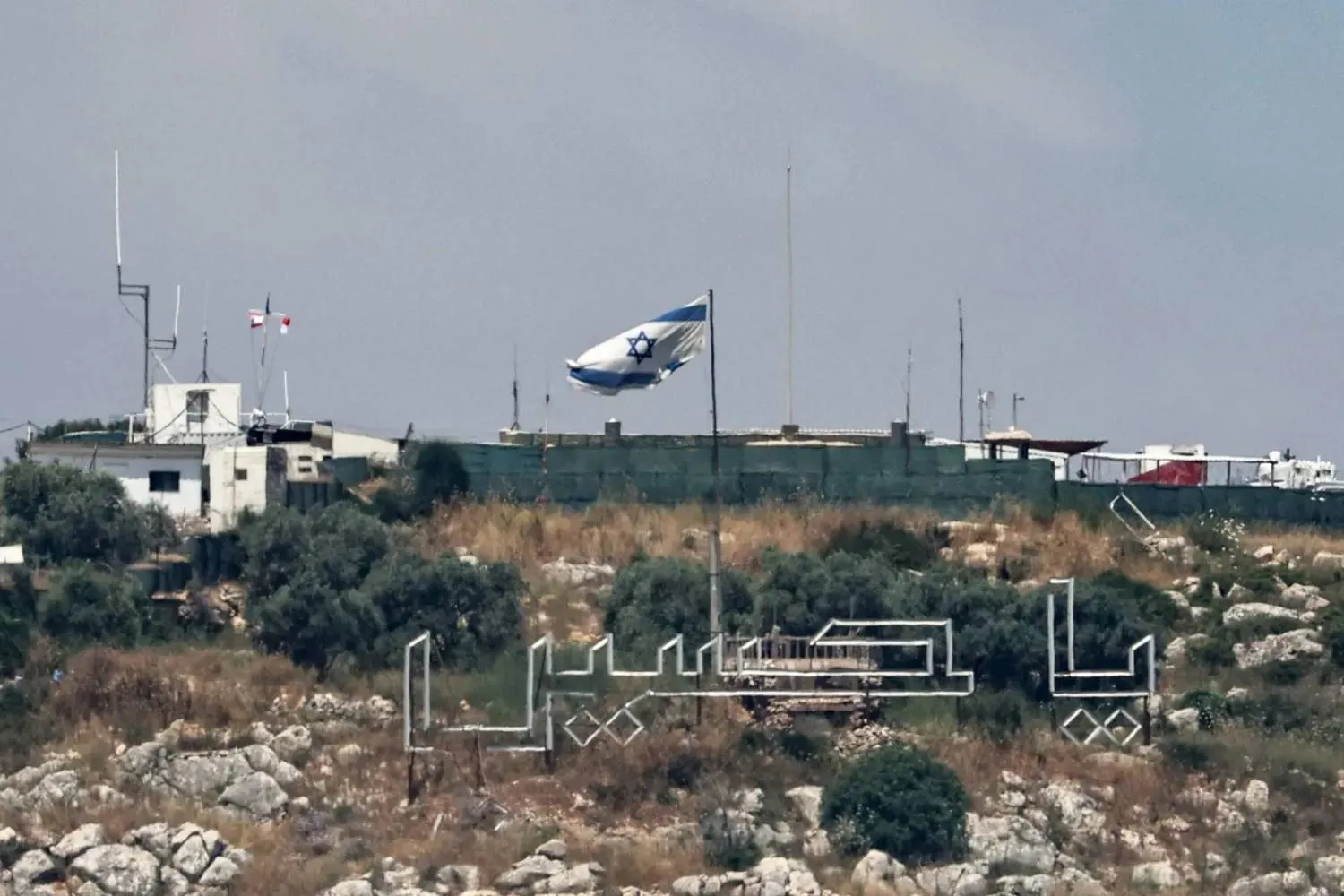
An Israeli army flag flies over the ruins of destroyed buildings in Kfar Kila, southern Lebanon (EPA)
TT

Israel Advances in South Lebanon Toward Heights Overlooking Nabatieh, Galilee

An Israeli army flag flies over the ruins of destroyed buildings in Kfar Kila, southern Lebanon (EPA)

The Israeli army pushed forward again on Thursday around the southern Lebanese city of Nabatieh, seeking to reach the strategic Ali al-Taher heights, an area it has pounded with dozens of strikes over the past two years.

Lebanese security assessments suggest the aim is to reach tunnels and facilities belonging to Hezbollah.

The move followed a similar strategic advance two weeks earlier, when Israeli forces reached the strategic Beaufort Castle east of Nabatieh before expanding around it.

Their next objective is Ali al-Taher hill, one of the last strategic heights overlooking Nabatieh from the west. The hill also overlooks Lebanese towns occupied by Israel and, in some places, has a line of sight toward settlements and towns in Galilee in northern Israel’s eastern sector.

New advance

Israeli military vehicles and bulldozers were seen at the Zafata site in Kfar Tebnit, east of Nabatieh, on the main road linking Marjayoun to Nabatieh.

Reports said Israeli forces had seized eastern and central neighborhoods of Kfar Tebnit amid widespread destruction. Local media said tanks advanced from Kfar Tebnit into Nabatieh al-Fawqa, southeast of Nabatieh city.

Security sources in southern Lebanon said the push toward Nabatieh al-Fawqa aimed to widen Israel’s “fire safety zone” and prevent Hezbollah fighters from launching drones and guided missiles at Israeli armor.

The sources told Asharq Al-Awsat the expansion was an attempt to push fighters away from the Beaufort Castle area and its surroundings, giving armored vehicles and other military vehicles room to advance toward the heights without being targeted.

The sources said reaching Zafata, a former artillery position used by Israeli forces before their withdrawal from southern Lebanon in 2000, meant the objective was to seize the Ali al-Taher heights, no more than two kilometers from the point reached.

They said taking the hill was a strategic goal for Israeli forces, given their repeated shelling of it in recent months with bunker-buster and concussion bombs, strengthening the belief that Israel seeks to enter underground facilities thought to belong to Hezbollah.

The Israeli army paved the way for the advance overnight Wednesday into Thursday with heavy airstrikes on wooded areas in Jarmaq and Kfar Rumman and on hills overlooking the area, aiming to prevent armor from being hit by guided missiles or drones.

Artillery fire also intensified across the surrounding area, a tactic usually used during attempts to push into new territory.

Israeli artillery targeted the outskirts of Qatrani in the Jezzine area near Shbeil School. Warplanes carried out four strikes on the same location.

Artillery also hit Ali al-Taher woods on the outskirts of Nabatieh al-Fawqa, the area around Al-Najdeh Al-Shaabiya Hospital in Nabatieh and the Kfar Rumman roundabout, all close to the incursion points.

Western sector

The incursion coincided with other movements that appeared to test Hezbollah’s defenses in the Mansouri area of the western sector. Two military vehicles were spotted in Mansouri after advancing from Tayr Harfa and Shama, but they quickly turned back.

Hezbollah said in two separate statements that it had targeted gatherings of Israeli vehicles and soldiers with rockets at the Rajman area near Tayr Harfa in southern Lebanon.

Local media said Israeli forces tried to advance from the Tayr Harfa-Jebbayn triangle toward the valley, in preparation for entering Majdal Zoun. The move coincided with more than 15 airstrikes on Majdal Zoun and Wadi Hassan, as well as heavy artillery fire.

Heavy clashes broke out overnight Wednesday into Thursday with Hezbollah fighters, who used rocket-propelled grenades and a loitering drone. The fighting forced Israeli forces to retreat and withdraw from the axis along which they had advanced.

Israeli artillery resumed shelling Wadi Hassan and its surroundings on Thursday morning with heavy 155 mm rounds, as warplanes and drones flew intensively over the area.

Continued shelling

In parallel, an Israeli airstrike on a residential building near Hiram Hospital in Tyre killed one person and wounded 17 others, including 10 nurses and hospital employees. Flying glass from shattered windows and doors caused the injuries.

The strike also damaged ceilings in some patient and emergency rooms and window panes, and destroyed cars belonging to doctors and employees in the hospital courtyard.

The Health Ministry’s Public Health Emergency Operations Center said Israeli strikes on Tayr Debba in the Tyre district killed nine people, including a woman, and wounded 10 others.

Operations inside Lebanon

The Israeli army said on Thursday that forces from the 91st Brigade had killed 35 Hezbollah militants over the past week as they moved near Israeli forces in southern Lebanon. It said the forces destroyed a rocket launcher hidden among trees and killed another militant in the area over the past day.

The army also said troops had seized quantities of weapons and ammunition, including rockets and RPG rounds, at various sites during ongoing military operations.

In the morning, the Israeli army said the Home Front Command had issued a precautionary directive after detecting launches from Lebanon toward northern Israel, urging people to enter protected areas when warnings are activated.


Aoun: Lebanon Wants Israel Security Deal, Hezbollah Disarmament Without Confrontation

Lebanese President Joseph Aoun speaks during an interview with AFP at the Presidential Palace in Baabda on September 15, 2026. (Photo by JOSEPH EID / AFP)
TT

Aoun: Lebanon Wants Israel Security Deal, Hezbollah Disarmament Without Confrontation

Lebanese President Joseph Aoun speaks during an interview with AFP at the Presidential Palace in Baabda on September 15, 2026. (Photo by JOSEPH EID / AFP)

Lebanese President Joseph Aoun told AFP in an exclusive interview he wants to reach a security agreement with Israel once it withdraws from the south, and is determined to disarm Hezbollah without resorting to confrontation.

Speaking ahead of his departure to France on Wednesday, Aoun said Lebanon wanted a new force, European or otherwise, to prevent a security vacuum after UN peacekeepers leave south Lebanon when their mandate expires at the end of the year.

He called on the United States, European Union and Arab countries to support Lebanon's military as it deploys across the south.

In Paris, Aoun will attend a meeting hosted by President Emmanuel Macron and attended by King Abdullah II of Jordan to build international support for Lebanese troops as they deploy across the country.

"What matters is that there is no vacuum," Aoun told AFP on Tuesday. He added that any new force for Lebanon's south, part of which is occupied by Israel, would be "temporary until the (Lebanese) army can deploy."

"Whatever the nature of this force, that poses no problem for me: European, non-European, American, another United Nations force, Asian, or even a mix of European, Arab and Asian forces," Aoun said.

"The best and most optimal option remains extending UNIFIL's mandate," he added.

Under US pressure, the UN Security Council voted last year to end the force's mandate on December 31, 2026.

The mission, currently involving around 8,500 peacekeepers from nearly 50 countries, has been deployed in south Lebanon since 1978.

Aoun also said he wants a security agreement with Israel "primarily to end the state of hostility and the deployment of the army on the border. This could be a prelude to a later peace agreement, but we cannot jump directly to a peace agreement."

"We have no choice but negotiations, because the alternative is war, which would be very costly for us," Aoun added.

"Our Arab and European partners, as well as the United States and our friends, must share with us the responsibility of supporting the army and strengthening the Lebanese state," he said.

Aoun reiterated Lebanon was determined to disarm Hezbollah, saying the decision was "neither negotiable nor open to discussion."

However, he said, "the objective is not a confrontation... We are determined to resolve this issue peacefully.

"This is not about building a state at the cost of a bloody conflict... or a new civil war."

Aoun said he had told Iran that after Hezbollah's disarmament, relations "must be based on mutual respect and non-interference in the internal affairs of the Lebanese people.

"We have no problem with having a relationship with Iran, but we do have a problem with interference in our internal affairs."


Yemeni Government Forces Regroup to Shift the Momentum

Othman Mujalli, a member of Yemen’s Presidential Leadership Council, inspects forces in Hajjah. (government media)
TT

Yemeni Government Forces Regroup to Shift the Momentum

Othman Mujalli, a member of Yemen’s Presidential Leadership Council, inspects forces in Hajjah. (government media)

Yemen’s army and allied forces have raised their state of alert on the Taiz and Hajjah fronts as they move to reorganize their military positions to shift the momentum, while the Houthis increase pressure on Taiz after seizing the western coast as far as Bab al-Mandab.

In northwestern Hajjah province, Presidential Leadership Council member Othman Mujalli inspected Fifth Military Region forces and affiliated fronts, reviewing their readiness, training and morale.

Mujalli said the armed forces would continue confronting the Houthis and working to restore state institutions, stressing the need to maintain morale and prepare for the battle to liberate the country.

He also praised the Fifth Military Region’s ability to develop equipment for ammunition production and the maintenance of weapons and vehicles, as well as bolster its drone unit and advanced surveillance system.

The visit included naval forces, the coast guard and several islands off Midi district. Mujalli reviewed efforts to evacuate civilians and personnel from Zubair Island after they were stranded because of recent developments along the western coast. He also inspected naval readiness to secure the islands and territorial waters and strengthen the military and security presence along the coast.

The visit comes as government forces seek to hold their positions in the northwest while reassessing their military deployment following rapid developments on the western coast.

Pressure on Taiz

In southwestern Taiz, the Yemeni army announced Tuesday that it had struck a Houthi ballistic missile launch platform at Taiz airport, east of the city. The Taiz Military Axis said warplanes targeted the platform as military vigilance increases around the city amid growing pressure from the west.

The Yemeni Armed Forces had earlier announced strikes on Houthi equipment, personnel and positions seized by the group in Dhubab in Taiz province and Al-Khawkhah in Hodeidah province, according to military spokesman Col. Majid al-Nazili.

The strikes coincided with an inspection tour by Taiz Military Axis Chief of Staff Maj. Gen. Abdulaziz al-Majidi of several fronts surrounding the city.

In southern Taiz, Tur al-Bahah Axis commander and 4th Mountain Infantry Brigade commander Maj. Gen. Abu Bakr al-Gbouli inspected front lines stretching from Bani Omar to Jardad and the outskirts of Al-Wazi’iyah district.

Al-Gbouli said his forces were at a high level of combat readiness and capable of responding to developments on the ground, stressing vigilance, operational discipline and constant preparedness for Houthi movements.

Regrouping

The moves follow a major shift after the Houthis seized large parts of the western coast, including Mokha, Al-Khawkhah and Hays, before reaching Bab al-Mandab and several Red Sea islands. The developments have increased pressure on Taiz, which could become a target for Houthi attempts to expand their control and tighten their grip on the city and surrounding countryside.

Observers say government military activity in Taiz and Hajjah reflects an effort to contain the repercussions of losing the coast and prevent the Houthis from turning their recent gains into a permanent reality on the ground, while reorganizing forces and raising readiness in the most sensitive sectors.

Mujalli also urged tribes to protect their sons from Houthi recruitment and being drawn into fighting. He praised Saudi support for Yemeni forces and humanitarian and development projects and inspected efforts by the Masam mine-clearance project to remove mines planted by the Houthis in government-held areas.

The developments indicate that government forces are seeking to move beyond responding to the recent setback and build a more cohesive military posture, particularly in Taiz, where inland fronts intersect with the coast and Red Sea routes, making the province central to any attempt to shift the momentum.


Survivors: Sudan Gold Mine Collapse Kills at Least 60

A group of armed defectors from the Rapid Support Forces (RSF) arrive in a vehicle as they are believed to be surrendering to the Sudanese military, in the west of Omdurman on August 19, 2026. (Photo by Ebrahim Hamid / AFP)
TT

Survivors: Sudan Gold Mine Collapse Kills at Least 60

A group of armed defectors from the Rapid Support Forces (RSF) arrive in a vehicle as they are believed to be surrendering to the Sudanese military, in the west of Omdurman on August 19, 2026. (Photo by Ebrahim Hamid / AFP)

A gold mine collapsed in southern Sudan, killing at least 60 small-scale miners, two survivors told AFP on Wednesday, while many more are missing and feared dead under the rubble.

Shafts began collapsing in the Al-Zaraa mine near the town of El-Nahud in West Kordofan on Tuesday, and by the following morning 60 bodies had been retrieved.

"We don't know how many more are still inside," one of the survivors, Khair al-Sayyed Jabara, told AFP after an all-night rescue operation with fellow miners, using the same rudimentary tools they use to mine.

"Everyone's working very hard to retrieve the bodies or any survivors, but it's difficult. We need heavy machinery to clear the rock and soil."

Since war erupted in April 2023 between Sudan's army and the Rapid Support Forces, the war efforts of both sides have been largely funded by the gold industry, in addition to foreign backers.

The conflict has devastated Sudan's already fragile economy and left much of the country out of work, pushing many into a dangerous gold rush.

Artisanal and small-scale mining, which takes place in unofficial zones or decommissioned mines, accounts for the majority of gold extracted.

Al-Amin Suleiman, another miner who was working at the rim of Al-Zaraa on Tuesday, told AFP that "the shafts here are all close together, if one collapses, it brings down all the ones next to it".

"This is what happened here. So far, 60 bodies have been pulled out but there are people still trapped underground since yesterday. I don't think they are alive."

Sudan is suffering the world's largest hunger and displacement crises, with nearly 20 million people facing crisis levels of hunger.
