Thousands Mourn al-Alwani as Lebanese Probe Awaited

Relatives receive former MP Ahmed al-Alwani's coffin upon its arrival at Baghdad airport on Saturday. (X)
TT

Thousands Mourn al-Alwani as Lebanese Probe Awaited

Relatives receive former MP Ahmed al-Alwani's coffin upon its arrival at Baghdad airport on Saturday. (X)

Thousands of Iraqis on Saturday escorted the body of former MP Ahmed al-Alwani from Baghdad Airport to Ramadi in Anbar Governorate, where tribespeople and residents from across the province awaited his arrival amid scenes of grief and anger.

Meanwhile, the circumstances surrounding his killing in Beirut remain under investigation, even as Lebanese authorities have made progress in identifying two suspects.

A private jet carrying al-Alwani's body from the Lebanese capital landed at Baghdad Airport in the morning, with large crowds of mourners gathering at the airport.

Local media reported that Iraqi politician Khamis al-Khanjar, head of the Sovereignty Alliance, covered the cost of transporting the body aboard the private aircraft.

The funeral procession traveled toward Ramadi, located 110 kilometers from Baghdad, under heavy security and accompanied by military vehicles.
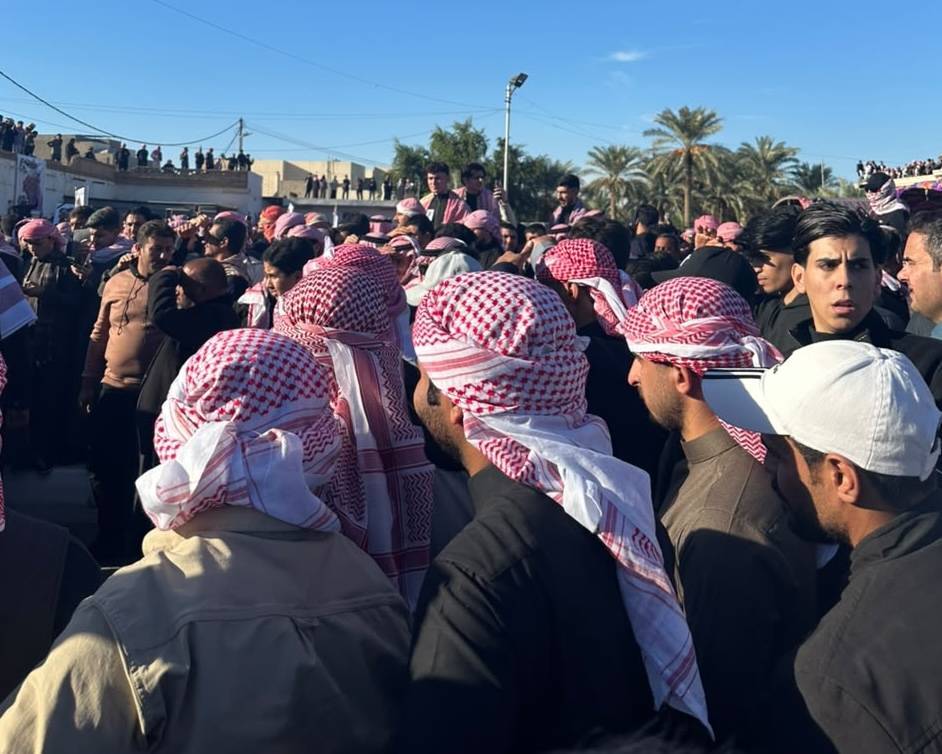
Mourners are seen at al-Alwani's funeral on Saturday. (Asharq Al-Awsat)

The Security Media Cell had urged the public to await the investigation's findings and refrain from reading broader motives into the case before it concludes, noting the ongoing coordination between the Iraqi Embassy in Beirut, Lebanese judicial and security authorities, and the Iraqi National Intelligence Service.

Al-Alwani's killing has sparked uproar across Iraq, particularly in his home province of Anbar. Discussion of the case has been accompanied by political debates and sectarian commentary on social media, amid demands to identify those responsible for his death.

Kamel al-Dulaimi, former head of the Iraqi Presidential Diwan, told Asharq Al-Awsat that the circumstances and motives behind the crime still require clear and transparent disclosure to the public, underscoring the Iraqi state's responsibility to uncover the truth.
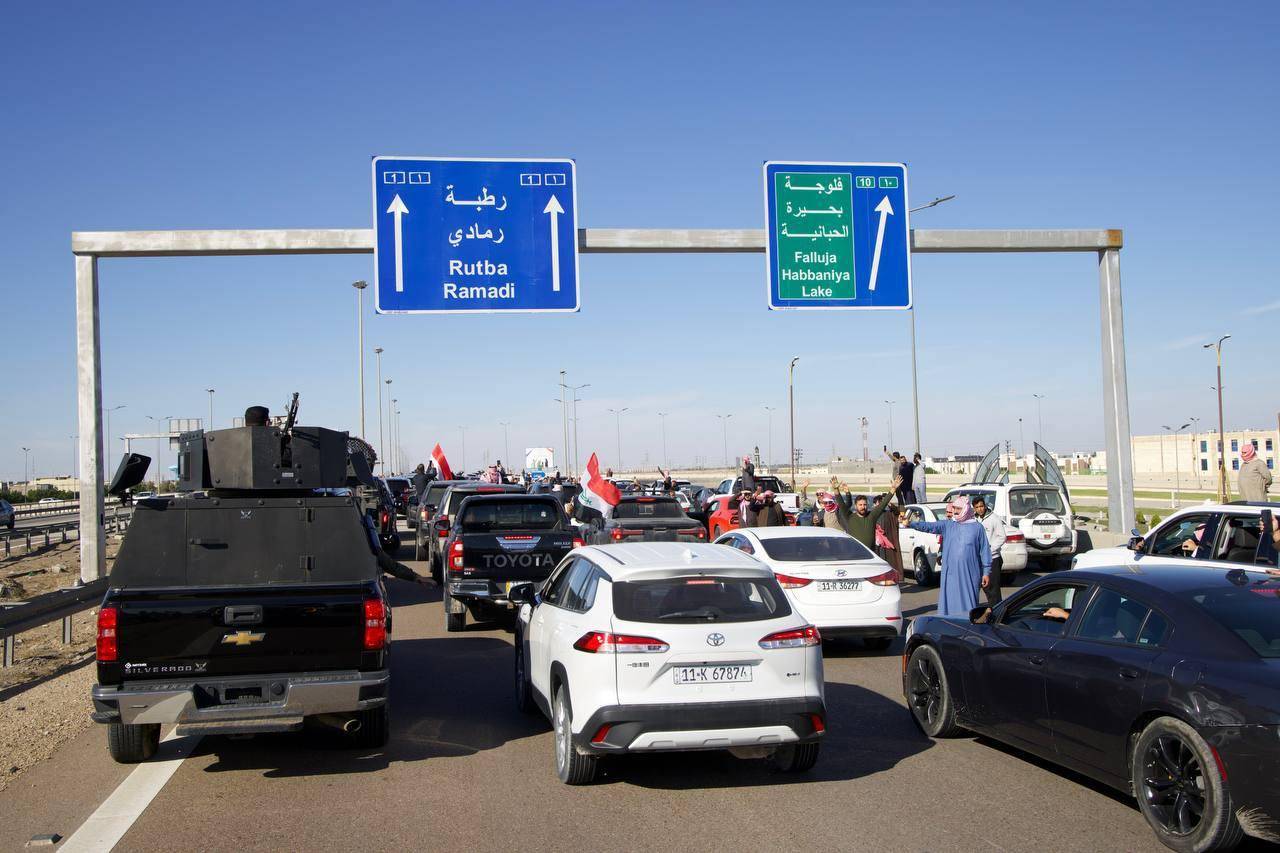
The funeral procession traveled toward Ramadi, located 110 kilometers from Baghdad, under heavy security and accompanied by military vehicles. (Asharq Al-Awsat)

He added that the case requires security and judicial cooperation among Iraq, Lebanon, and Syria to track down the perpetrators and those behind them, particularly if the investigation calls for cross-border coordination.

He warned that the sectarian rhetoric surrounding the incident reflects a persistent tendency to view national issues through a narrow lens, emphasizing that the matter concerns the sanctity of Iraqi blood and must not be reduced to the affiliation of an individual or a governorate.

Legal researcher Saif al-Saadi, who hails from Anbar, said al-Alwani was not merely a former lawmaker, but a prominent tribal, social, and political figure in the province, adding that the funeral reflects the depth of grief and anger across Anbar's cities.

Al-Alwani, who rose to prominence during the late 2013 Anbar protests, was arrested in December of that year and sentenced to death in 2014 after being convicted of killing two soldiers during clashes accompanying his arrest.

He was released in April 2025 after spending more than 11 years in prison, following the withdrawal of a complaint by one of the victims' families and his inclusion under the General Amnesty Law.


Thousands Mourn al-Alwani as Lebanese Probe Awaited

Relatives receive former MP Ahmed al-Alwani's coffin upon its arrival at Baghdad airport on Saturday. (X)
TT

Thousands Mourn al-Alwani as Lebanese Probe Awaited

Relatives receive former MP Ahmed al-Alwani's coffin upon its arrival at Baghdad airport on Saturday. (X)

Thousands of Iraqis on Saturday escorted the body of former MP Ahmed al-Alwani from Baghdad Airport to Ramadi in Anbar Governorate, where tribespeople and residents from across the province awaited his arrival amid scenes of grief and anger.

Meanwhile, the circumstances surrounding his killing in Beirut remain under investigation, even as Lebanese authorities have made progress in identifying two suspects.

A private jet carrying al-Alwani's body from the Lebanese capital landed at Baghdad Airport in the morning, with large crowds of mourners gathering at the airport.

Local media reported that Iraqi politician Khamis al-Khanjar, head of the Sovereignty Alliance, covered the cost of transporting the body aboard the private aircraft.

The funeral procession traveled toward Ramadi, located 110 kilometers from Baghdad, under heavy security and accompanied by military vehicles.

Mourners are seen at al-Alwani's funeral on Saturday. (Asharq Al-Awsat)

The Security Media Cell had urged the public to await the investigation's findings and refrain from reading broader motives into the case before it concludes, noting the ongoing coordination between the Iraqi Embassy in Beirut, Lebanese judicial and security authorities, and the Iraqi National Intelligence Service.

Al-Alwani's killing has sparked uproar across Iraq, particularly in his home province of Anbar. Discussion of the case has been accompanied by political debates and sectarian commentary on social media, amid demands to identify those responsible for his death.

Kamel al-Dulaimi, former head of the Iraqi Presidential Diwan, told Asharq Al-Awsat that the circumstances and motives behind the crime still require clear and transparent disclosure to the public, underscoring the Iraqi state's responsibility to uncover the truth.

The funeral procession traveled toward Ramadi, located 110 kilometers from Baghdad, under heavy security and accompanied by military vehicles. (Asharq Al-Awsat)

He added that the case requires security and judicial cooperation among Iraq, Lebanon, and Syria to track down the perpetrators and those behind them, particularly if the investigation calls for cross-border coordination.

He warned that the sectarian rhetoric surrounding the incident reflects a persistent tendency to view national issues through a narrow lens, emphasizing that the matter concerns the sanctity of Iraqi blood and must not be reduced to the affiliation of an individual or a governorate.

Legal researcher Saif al-Saadi, who hails from Anbar, said al-Alwani was not merely a former lawmaker, but a prominent tribal, social, and political figure in the province, adding that the funeral reflects the depth of grief and anger across Anbar's cities.

Al-Alwani, who rose to prominence during the late 2013 Anbar protests, was arrested in December of that year and sentenced to death in 2014 after being convicted of killing two soldiers during clashes accompanying his arrest.

He was released in April 2025 after spending more than 11 years in prison, following the withdrawal of a complaint by one of the victims' families and his inclusion under the General Amnesty Law.


Over 11,000 Migrants Arrive in Yemen Despite Conflict

The total number of African migrants arriving in Yemen since the beginning of this year has risen to 145,776. (Government media)
TT

Over 11,000 Migrants Arrive in Yemen Despite Conflict

The total number of African migrants arriving in Yemen since the beginning of this year has risen to 145,776. (Government media)

More than 11,000 migrants from the Horn of Africa arrived in Yemen last October despite escalating fighting between government forces and the Houthis along the country's coasts facing their transit routes. Ethiopians accounted for the vast majority of arrivals, according to the latest data from the International Organization for Migration (IOM).

The organization recorded a slight decrease in the number of arrivals compared to the previous month amid security tensions along the western coast and disruptions to boat traffic in maritime corridors, particularly in the Bab al-Mandeb area.

In its monthly flow monitoring report, the IOM stated that it tracked the arrival of 11,677 African migrants last month, marking a 1.2 percent decline compared to September, which saw 11,841 arrivals.

The organization attributed this decrease primarily to escalating fighting that disrupted boat movements and limited the ability of field teams to safely gather information and monitor migration flows.

According to data from the organization's Displacement Tracking Matrix (DTM), Djibouti topped the points of departure, accounting for 60.6 percent of the total recorded flows, followed by Somalia at 36 percent, while 3.4 percent arrived from Oman.

The Abyan Governorate received 94 percent of the migrants departing from Djibouti, compared to 6 percent who arrived in the Taiz Governorate.

Demographically, the migrants comprised 70 percent men, 14 percent women, and 16 percent children.

Despite the slight decline in October, the total number of African migrants arriving in Yemen since the beginning of this year has risen to 145,776, most of them Ethiopians, even as military escalation along Yemen's Red Sea coast threatens one of the key maritime transit routes from Djibouti.

Yemen serves as a major transit point for tens of thousands of migrants fleeing conflict, poverty, and drought in the Horn of Africa, who take the perilous "Eastern Migration Route" across the Red Sea and the Gulf of Aden in hopes of reaching Gulf countries in search of job opportunities.

Migrants stranded in Yemen face dire humanitarian conditions amid ongoing armed conflict and deteriorating basic services, in addition to the risks of exploitation, detention, and difficulties moving across frontlines, according to repeated UN and human rights reports.


Western Warnings about Muslim Brotherhood Bolster Egypt’s Crackdown on Group

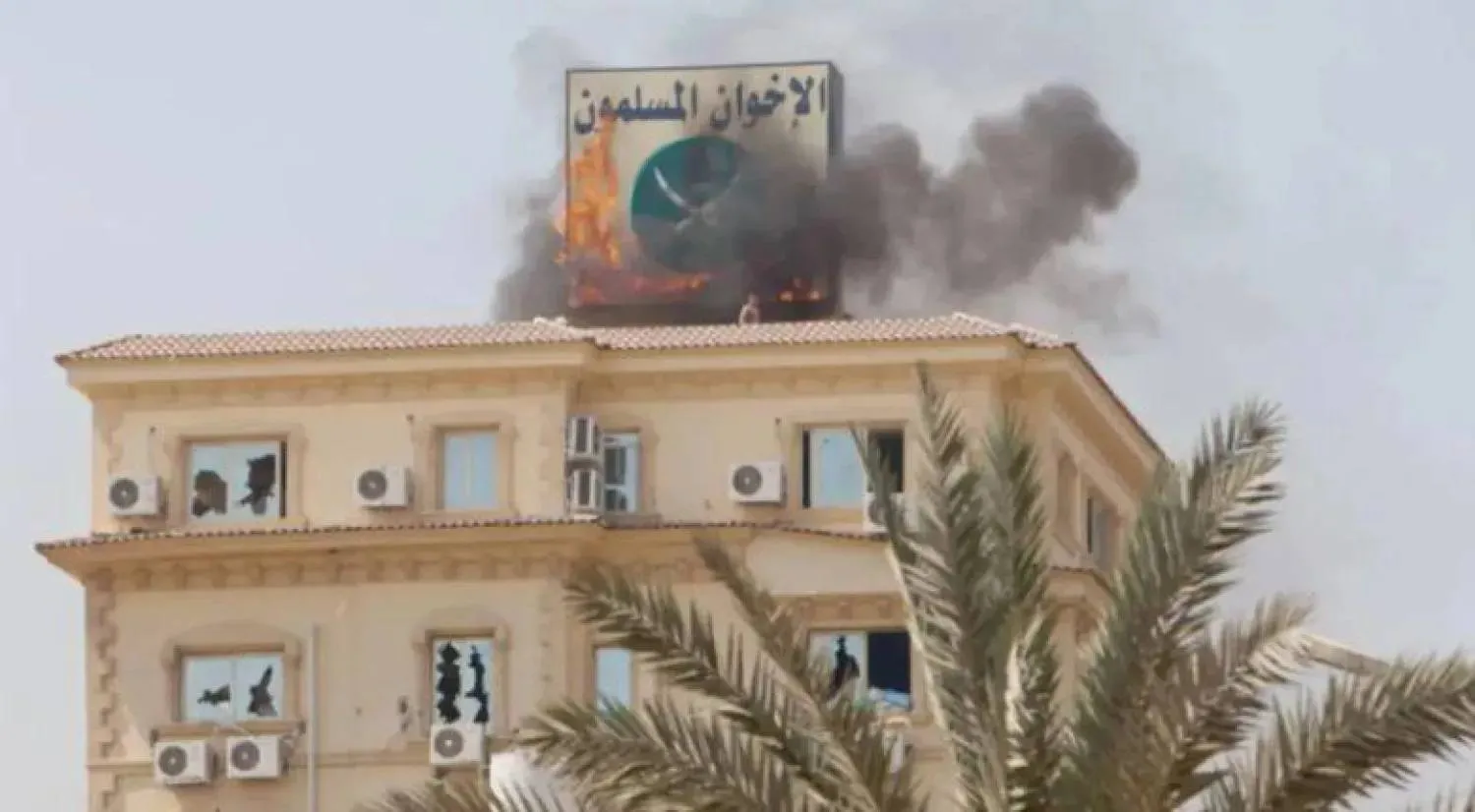
The Muslim Brotherhood’s headquarters after being set ablaze in Cairo in the summer of 2013. (Getty Images)
TT

Western Warnings about Muslim Brotherhood Bolster Egypt’s Crackdown on Group

The Muslim Brotherhood’s headquarters after being set ablaze in Cairo in the summer of 2013. (Getty Images)

US President Donald Trump’s warnings about the Muslim Brotherhood could strengthen Egypt’s efforts to restrict the group’s activities at home and abroad, researchers told Asharq Al-Awsat, following a series of Egyptian and Western measures targeting its networks.

Speaking to Salem News Channel on Thursday, Trump said the Brotherhood posed risks extending to the United States and Europe. Asked whether it or communists were more dangerous, he described both as major threats but suggested the Brotherhood currently posed the greater danger.

Mounir Adib, a researcher specializing in extremist movements and international terrorism, said Trump’s remarks reflected growing Western awareness of transnational networks.

Their significance lay in their timing, as Washington increasingly moved beyond warnings toward legal and financial measures against specific Brotherhood branches, he added.

Adib said the shift reinforced Egypt’s longstanding position that the organization uses institutions and affiliated entities to advance its political objectives.

Hesham al-Naggar, a researcher specializing in jihadist groups, described Trump’s comments as recognition of Egypt’s approach since 2013, although he considered Western measures insufficient.

He said Cairo’s initial efforts to dismantle the Brotherhood domestically and pursue its overseas networks encountered Western resistance, partly because of earlier expectations surrounding political Islam.

Attitudes have since shifted, including among some left-wing intellectuals, he noted.

On November 24, 2025, Trump signed an executive order directing the State and Treasury departments to consider terrorist designations for Brotherhood branches in Egypt, Jordan and Lebanon.

In January, Washington designated the Egyptian and Jordanian branches as Specially Designated Global Terrorists, while the Lebanese branch was also designated a Foreign Terrorist Organization.

The Sudanese Brotherhood received terrorist designations in March.

In May, the Trump administration outlined a counterterrorism strategy focusing on the Brotherhood as what it described as an ideological source of modern jihadist terrorism.

Argentina also designated the Egyptian, Jordanian and Lebanese branches earlier this year, while the European Parliament approved an October 8 resolution calling for a common EU strategy against Brotherhood networks.

Adib said these developments strengthened Cairo’s case for targeting financing channels and overseas operations, but stressed that international cooperation should rely on intelligence, evidence and legal procedures rather than political labels alone.

Al-Naggar said even limited Western measures would reinforce Egypt’s efforts.

Trump’s remarks followed Egypt’s decision to place the Brotherhood permanently on its terrorism list under a final court ruling published in the Official Gazette on Monday, after years of temporary designations.

Several Brotherhood leaders, including Supreme Guide Mohamed Badie, remain imprisoned in cases involving violence, terrorism and murder.

The following day, a Cairo criminal court issued a first-instance ruling placing 35 entities and 36 individuals based in Europe on Egypt’s terrorism lists for five years.

Adib said the next phase could bring closer US-European cooperation in intelligence sharing, monitoring financial flows and reviewing organizations linked to prohibited activities.

Al-Naggar called for a broader international response, including stronger security and intelligence cooperation, arguing that the issue extended beyond the Arab region to global security and stability.