


Israel Resumes Gaza Attacks, Targets Palestinian Factions

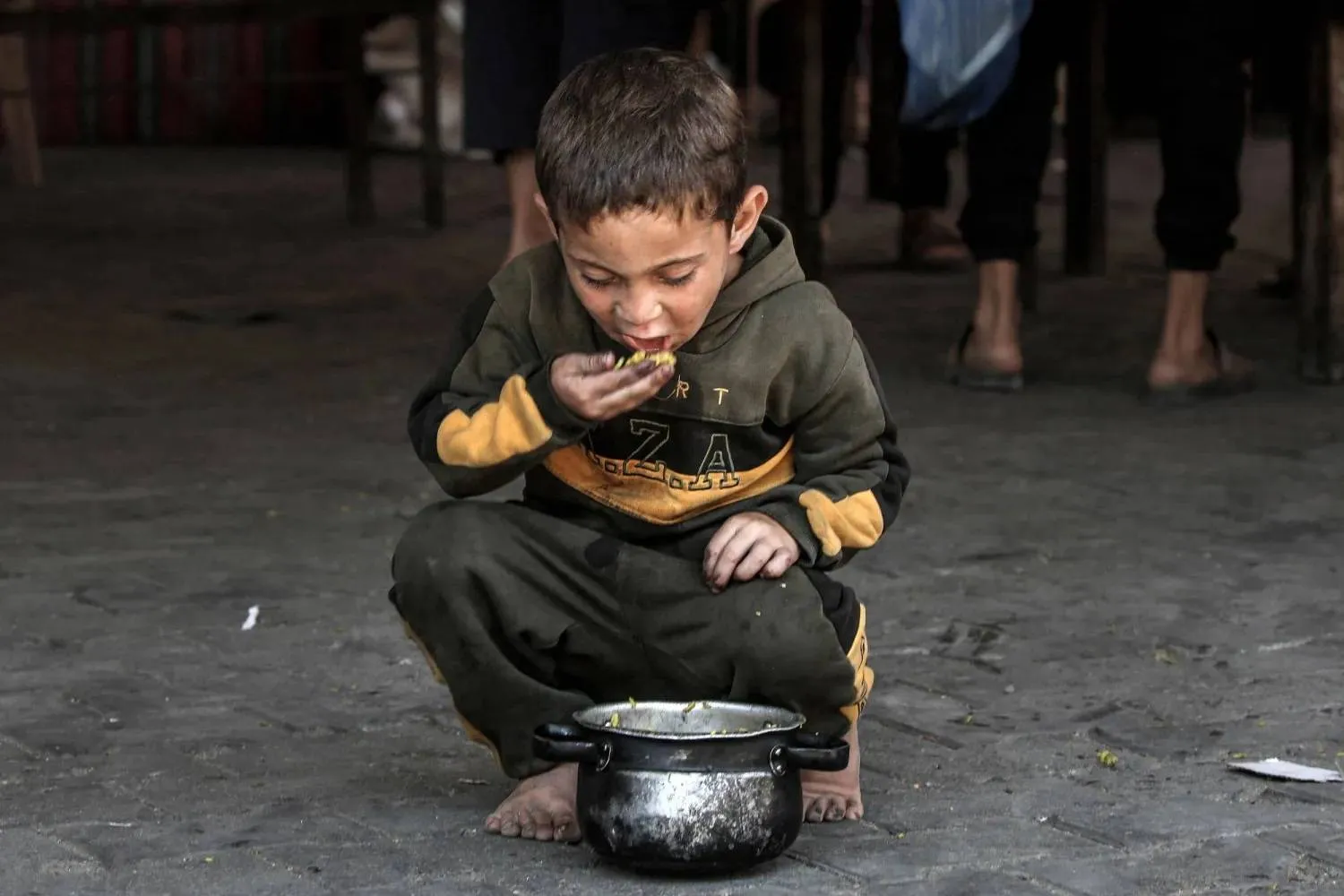
A Palestinian child eats from a bowl after receiving food from a charity kitchen at Nuseirat refugee camp in central Gaza on Friday. (AFP)
TT

Israel Resumes Gaza Attacks, Targets Palestinian Factions

A Palestinian child eats from a bowl after receiving food from a charity kitchen at Nuseirat refugee camp in central Gaza on Friday. (AFP)

Israeli forces resumed attacks in the Gaza Strip after a two-day pause requested by mediators and the United States to allow progress in ceasefire talks hosted by Cairo in recent days, where the parties agreed on wording related to the issue of weapons.

Palestinian factions had asked mediators to stop violations and assassinations in Gaza as a condition for advancing the talks, sources told Asharq Al-Awsat at the time.

Mediators then contacted US President Donald Trump’s administration and the Board of Peace to press Israel, before an agreement was reached on halting attacks for several days.

Assassinations and destroyed residential blocks

The airstrikes stopped from dawn Tuesday until Thursday afternoon, then resumed with attacks targeting operatives from Palestinian factions and fresh strikes on residential blocks. Israel used the same approach in the previous round of talks, when it halted airstrikes for two days before resuming them.

The first strike on Thursday targeted member of the al-Nasser Salah al-Deen Brigades, the armed wing of the Popular Resistance Committees, one of the factions that joined the Cairo talks. He was wounded after being hit on the roof of his family home north of Nuseirat camp in central Gaza.

About two hours later, another strike targeted a member of the Qassam Brigades, Hamas’s armed wing, in the Sabra neighborhood south of Gaza City as he stood on the roof of his family home. He was killed immediately.

Asharq Al-Awsat learned he was one of the most prominent members in Qassam’s engineering unit.

Roughly three hours later, an Israeli drone struck two young men west of Nuseirat camp in central Gaza, killing one of them. He was a prominent field operative in the Al-Quds Brigades, the armed wing of Islamic Jihad, based in the Jabalia camp.

At night, Israeli warplanes struck two small rooms and farmland near Al-Aqsa Martyrs Hospital in Deir al-Balah in central Gaza, destroying the site.

They later destroyed two homes and damaged a residential block in Maghazi camp in central Gaza. Later, they destroyed several homes and shops and damaged others after bombing another nearby residential block in the same camp.

The bombing displaced dozens of families who lost their only shelter. Israel has stepped up attacks on intact residential blocks, or those only slightly damaged during the war, especially in the central area, one of the least damaged parts of Gaza and an area where Israeli forces have not carried out major operations.

On Friday, four Palestinians were wounded in shooting incidents and artillery shelling near the yellow line. A young man survived after a drone struck the vehicle he was riding in deep in Deir al-Balah in central Gaza. No injuries were reported.

Israeli forces also expanded the yellow line in the Tuffah neighborhood east of Gaza City, specifically along Salah al-Din Street, in the fourth such operation in about a month and a half.

Hazem Qassem, a Hamas spokesperson, said in a press statement that moving the yellow line, along with the bombardment and displacement that accompanied it, was a flagrant violation of the ceasefire agreement.

He said it reflected Israeli Prime Minister Benjamin Netanyahu’s threats to increase Israel’s control over Gaza, amid the silence of the Board of Peace and the inability of mediating and guarantor states to stop the violations. He said the aim was to blow up the negotiating track and the recent positive atmosphere.

Negative response

The escalation came despite mediators’ success in reaching wording with Hamas and seven other Palestinian factions, in the absence of Fatah, on the clauses of a road map presented by Nickolay Mladenov, the high representative for Gaza at the Board of Peace.

The most sensitive clause concerned weapons, stating that they would be confined and stored rather than handed over, and that this would be done through a Palestinian body, the National Committee for the Administration of Gaza.

In return, the committee would enter Gaza and assume its duties, Israel would withdraw, and the humanitarian protocol from the first phase would be implemented.

Hamas and the Palestinian factions had been waiting for Israel’s response to what had been agreed. By Thursday evening, they had received neither a positive nor a negative reply.

A source from Hamas told Asharq Al-Awsat that the renewed escalation amounted to a clear response from Netanyahu’s government rejecting the wording, adding that the movement would wait for the official response from mediators.

Asharq Al-Awsat learned that parties outside the mediating states, as well as parties within the Board of Peace and the Gaza administration committee, support the wording reached on Gaza’s weapons and see it as an opportunity to build on.



Lebanon Says US Delegation will Oversee Israeli Withdrawal from 'Pilot Zones'

Members of United Nations Peacekeeping Force in Lebanon (UNIFIL) drive through the southern Lebanese area of Al-Mansouri on July 2, 2026.  (Photo by Kawnat HAJU / AFP)
Members of United Nations Peacekeeping Force in Lebanon (UNIFIL) drive through the southern Lebanese area of Al-Mansouri on July 2, 2026. (Photo by Kawnat HAJU / AFP)
TT

Lebanon Says US Delegation will Oversee Israeli Withdrawal from 'Pilot Zones'

Members of United Nations Peacekeeping Force in Lebanon (UNIFIL) drive through the southern Lebanese area of Al-Mansouri on July 2, 2026.  (Photo by Kawnat HAJU / AFP)
Members of United Nations Peacekeeping Force in Lebanon (UNIFIL) drive through the southern Lebanese area of Al-Mansouri on July 2, 2026. (Photo by Kawnat HAJU / AFP)

A US delegation was expected to arrive in Lebanon soon to oversee the implementation of Israel's withdrawal from "pilot zones" in the south, the Lebanese presidency reported on Thursday, citing the American ambassador.

Lebanon is demanding that Israel withdraw from these zones before taking part in a new round of negotiations scheduled for July 15 and 16 in Rome, a diplomatic source familiar with the talks told AFP on Wednesday.

The two countries reached a framework agreement on June 26 that calls for Hezbollah's disarmament and a gradual Israeli withdrawal from occupied Lebanese territory while Lebanon's army deploys into "pilot zones".

The US ambassador to Lebanon, Michel Issa, told President Joseph Aoun that "an American military delegation will arrive in Beirut in the coming days to... determine the mechanism for implementation on the ground," according to the Lebanese presidency.

The agreement -- rejected by Hezbollah -- does not set a timetable for Israel's withdrawal, and Israeli officials have also vowed that their forces will remain in a "security zone" 10 kilometres (six miles) deep as long as Hezbollah remains armed.

"It is essential to avoid any vacuum when Israeli forces withdraw from the designated area," Issa added, according to a statement from the presidency.

Lebanese President Joseph Aoun, for his part, once again called on the United States to "exert pressure on Israel to halt military operations and comply with the provisions of the framework".

Aoun is expected to visit Washington later this month at the invitation of his American counterpart Donald Trump.


Lebanon's President to Asharq Al-Awsat: We Chose Negotiation to Limit the Occupation and the Suffering of Southerners

Lebanese President Joseph Aoun (AP)
TT

Lebanon's President to Asharq Al-Awsat: We Chose Negotiation to Limit the Occupation and the Suffering of Southerners

Lebanese President Joseph Aoun (AP)

With increasing military tension between the US and Iran in and around the Strait of Hormuz, Lebanese President General Joseph Aoun is trying to hold onto hope of emerging from the catastrophe that has afflicted his country.

Using the word "catastrophe" is not an exaggeration. The Israeli occupation in southern Lebanon has expanded, bringing with it destruction, exacerbating the suffering of displaced persons, and intensifying division over responsibility for the war and ways out of it.

Facing the Israeli military occupation of the South, Lebanon has no choice but to rely on American assistance, which it hopes will materialize further after the scheduled meeting at the White House on July 21 between the US and Lebanese presidents.

Aoun's Priorities for the Meeting with Trump

At Baabda Palace, Asharq Al-Awsat asked Aoun what Lebanon seeks from the White House meeting.

He replied: "First, we want Lebanon to remain on the American agenda ... There is no need to reiterate the importance of having a good relationship with the US and benefiting from President Donald Trump's expressed desire to help us; his role is vital, and we are counting on it."

"We face an extremely difficult and complex situation. We know well that the US is the only party capable of exerting pressure on the Israeli government to prevent it from targeting the southern suburbs (of Beirut), infrastructure, or expanding occupied areas in southern Lebanon. No other party can fulfill this role."

"We want the US administration to help us restore our entire land. We will not relinquish a single inch or a single citizen. The issue of our sovereignty is not subject to concession or interpretation. It is at the forefront of the national principles that we are keen to adhere to. We want the land to be returned and to be under the sole authority of the Lebanese army, meaning under the authority of legitimate Lebanese institutions," Aoun added.

He stressed that Lebanon is asking for its natural right to extend the authority of its legitimate institutions over all Lebanese territories. "We cannot leave southern Lebanon captive to regional developments, with its people paying heavy prices in lives and property."

"Lebanon's fate cannot be separated from the fate of its south, neither in security, nor in economy, nor in stability," Aoun added.

Relatives of missing victims weep, as they gather at the site of destroyed buildings that were hit in an Israeli airstrike in Qannarit village, southern Lebanon, Saturday, June 20, 2026. (AP Photo/Mohammed Zaatari)

"We want President Trump to support our legitimate demands for the restoration of our entire land, and he is expected to succeed in persuading Israel to withdraw from Lebanon. I want to inform him of the reality in southern Lebanon and the dangers of maintaining the current situation or returning to escalation," Aoun told Asharq-Awsat.

He also hoped for American support for the Lebanese army, which is tasked with difficult missions, and for the reconstruction of what the war has destroyed and assistance to stimulate the Lebanese economy after the significant losses it has suffered.

Calculations of Direct Negotiation with Israel

Regarding the division over the method of direct negotiations with Israel, Aoun said: "We were not in a situation that allowed for ideal choices. The war threatened to expand, along with Israel threatening to occupy more territory. The scenes of displacement were harsh, as were the scenes of destruction."

"There was a risk of widespread destruction to Beirut and its infrastructure. We were effectively faced with a single option, especially given the significant imbalance of power. We had no choice but to seek assistance from the US. Direct negotiations were the only available option for us to make a serious attempt to shorten the period of occupation of our land, alleviate the suffering of the displaced, open the door for their return to their villages, and strive to rebuild what was destroyed."

President Joseph Aoun meeting with the Lebanese negotiating delegation before heading to Washington (Lebanese Presidency)


Aoun pointed out that "the state is responsible for the fate of every inch and every citizen. There is no distinction between one inch and another, or one citizen and another. We made difficult decisions based on our national responsibilities. We cannot continue to pay prices for any other party."

"Lebanon's decisions must be made within its legitimate institutions. Lebanon must defend its interests, sovereignty, and stability, which is why we said we would not accept anyone else negotiating on our behalf or in our name, nor becoming a bargaining chip in others' calculations," he stated.

Regarding the uproar caused by Trump's suggestion of a meeting between him and Israeli Prime Minister Benjamin Netanyahu at the White House, Aoun stated that "the idea of this meeting is fundamentally ruled out, but social media and others sometimes indulge in baseless scenarios."

Attempts to Overthrow the Government

Regarding the possibility of opponents of the framework agreement between Lebanon and Israel resorting to overthrowing the government, he said: "Changing the government is guided by constitutional frameworks. However, using the street to overthrow the cabinet is rejected. Furthermore, institutions play their role, always within the limits of available capabilities."

He stressed that "the government's performance is excellent, and the ministers are productive."


Hezbollah supporters block the old airport road in the southern suburbs of Beirut, with burning tires to protest against the trilateral agreement that was signed between the US, Israel and Lebanon on June 27, 2026. (Photo by Ibrahim AMRO / AFP)


Regarding his ties with Hezbollah, Aoun said: "We did not choose to sever ties with anyone. Our offices are open to everyone without exception."

"There is an objection to a choice made by the state to shorten the period of occupation and the suffering of the people. Whoever has another option to achieve this goal should present it, and we will discuss it. The option of continued war is not an option," he told Asharq Al-Awsat.

On the inclusion of a ceasefire in Lebanon in the first clause of the American-Iranian Memorandum of Understanding and its impact on the framework agreement, he said: "We welcome any assistance that aligns with Lebanon's interests. America is the only one capable of exerting pressure on Israel or persuading it. And Iran is the only one capable of influencing Hezbollah and its decisions. Of course, while affirming that Lebanon is the one negotiating on all matters related to it."

Regarding Lebanese Parliament Speaker Nabih Berri's opposition to the framework agreement with Israel, Aoun said: "Speaker Berri is a statesman, and we share what are considered red lines, which are not compromising civil peace, the reputation and role of the army, and not resorting to street protests."

He also noted that his relationship with Prime Minister Nawaf Salam is excellent.

Relationship Between Aoun and the Army Commander

Asked about the army's cohesion given Lebanon's circumstances and about rumors of renewed tensions between him and Army Commander General Rodolphe Haykal, the Lebanese president replied that "the army is cohesive and has not faltered. It is already implementing government decisions, naturally within the available capabilities."

"The army and all security institutions are doing everything they can. My relationship with General Haykal is excellent. There is no truth to the claims circulated by some media outlets."


President Joseph Aoun meeting with Army Commander General Rodolphe Haykal (Lebanese Presidency)


Aoun also expressed his satisfaction with Arab support for Lebanon. He said: "Saudi Arabia, as always, has not hesitated to provide any assistance we request to support our efforts in restoring our rights and sovereignty."

"I would like to thank the Saudi leadership, especially Crown Prince Mohammed bin Salman, for the decision to resume Lebanese exports. I also want to thank the Qatari government for assisting Lebanon, and the same applies to the United Arab Emirates, which allowed its citizens to visit Lebanon."

When asked if he was concerned about his safety, Aoun replied with a smile: "God is the guardian. No one dies before their time comes."


US to Remove Syria from Terror Blacklist

US President Donald Trump meets Syrian President Ahmed al-Sharaa (L) on the sidelines of the NATO Summit at Bestepe Presidential Compound in Ankara, on July 8, 2026. (AFP)
TT

US to Remove Syria from Terror Blacklist

US President Donald Trump meets Syrian President Ahmed al-Sharaa (L) on the sidelines of the NATO Summit at Bestepe Presidential Compound in Ankara, on July 8, 2026. (AFP)

The United States said Wednesday it will delist Syria as a state sponsor of terrorism, a decades-old designation that severely impeded investment, in a new vote of confidence in President Ahmed al-Sharaa.

Secretary of State Marco Rubio formally informed Congress of the long-expected move, which will be effective in 45 days unless lawmakers take the unlikely step of blocking it.

The step came as President Donald Trump met on the sidelines of a NATO summit in Türkiye with Sharaa, who led a 2024 opposition offensive that toppled the Assad family, which ruled with an iron fist for a half century.

"This is yet another historic step by President Trump to give the Syrian people a chance at greatness," Rubio said in a statement.

"Lifting sanctions on Syria will unlock international trade and investment, give Syria a chance to rebuild, and open up a new chapter for the Syrian people," he said.

Trump's embrace of Sharaa comes despite misgivings from Israel, which has repeatedly launched airstrikes in Syria.

Trump had earlier publicly pressed for Syria to make peace with Israel but went ahead with the delisting decision despite a lack of tangible progress.

Rubio said in his statement that "a stable, unified Syria at peace with itself and its neighbors benefits not only the region, but the entire world."

A year ago, Trump started lifting most sanctions on Syria after Saudi Arabia and Türkiye both encouraged him to meet Sharaa.

Meeting with Sharaa, Trump said: "He's doing an unbelievable job in unifying Syria. What a job he's doing."

"Syria was a mess with what happened with the previous government," Trump said.

The United States listed Syria as a state sponsor of terrorism in 1979.

The designation creates legal risks to working in Syria for businesses, especially American ones or those with transactions in the world's largest economy.