


Iraq Says Saddam Son-in-Law Plotted to Kill Security Chief

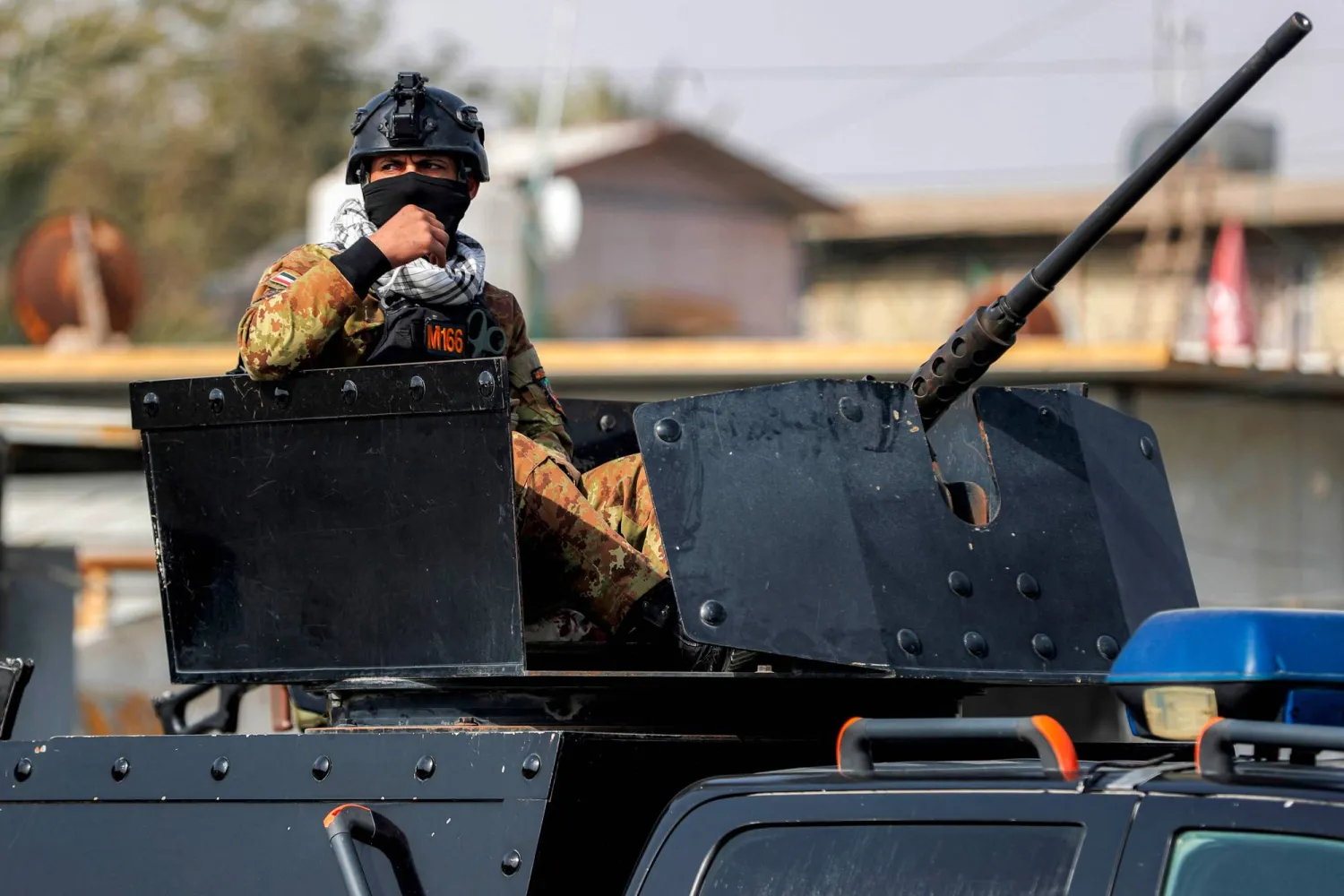
A member of the Iraqi security forces mans a turret while on guard. (Photo by AHMAD AL-RUBAYE / AFP)
TT

Iraq Says Saddam Son-in-Law Plotted to Kill Security Chief

A member of the Iraqi security forces mans a turret while on guard. (Photo by AHMAD AL-RUBAYE / AFP)

Iraq’s National Security Service said it had thwarted a plot by an “opposition cell” linked to Jamal Mustafa, the son-in-law of late president Saddam Hussein, to assassinate its chief.

But one member of the three-man cell questioned whether it could target a heavily protected senior security official.

The service said in a statement late Friday that its units in Baghdad, under the direct supervision of its head, Abdul Karim al-Basri, had “managed to foil a dangerous criminal plot” by a cell linked to the so-called Iraqi National Gathering for Liberation and Change, which it described as one of the banned Baath Party’s fronts, after intelligence work that included surveillance, tracking and infiltration.

Jamal Mustafa founded the National Gathering, which seeks to change the political system, a few years ago after he was released from custody and left Iraq for a regional country.

US forces arrested Mustafa on April 20, 2003, just 11 days after the fall of Saddam Hussein’s government. He remained in detention until mid-2021, before Iraqi authorities decided to release him in June that year because of insufficient evidence over the charges against him.

The National Security Service statement said “investigations and interrogations revealed that the cell members had moved beyond the stage of incitement and threats to the stage of assignment, target selection and weapons preparation ahead of carrying out assassination operations targeting National Security Service chief Abdul Karim al-Basri, the service’s official spokesman, the Baghdad security director and a number of officers.”

It said that “through a preemptive effort and based on judicial approvals, the service’s units were able to uncover the plot, track its members, arrest those involved and seize evidence and materials linked to the case before it reached the execution stage.”

Image taken from a video distributed by Iraqi security forces showing a light weapon allegedly used to assassinate the head of the National Security Service

The statement concluded by saying that “the report presented will include part of the suspects’ confessions, the mechanism of assignment and the planning stages that preceded the foiling of the plot.”

Audio and video recordings released by the service showed calls between the alleged plotters, in which one person speaks about an attempt to assassinate the service chief, while another, who was tasked with carrying it out, denies owning even a single firearm.

In another exchange between the two men, one of them questions whether “only a few people” could carry out a major operation of this kind against “the huge security convoys used by the service commander, Abu Ali al-Basri, and the other targeted officers.”

But in one video clip, one of the men is seen threatening the service’s leaders and declaring his absolute loyalty to Jamal Mustafa.

Image taken from a video distributed by Iraqi security forces showing the arrest of a cell member who claimed the cell was linked to the Baath Party.

Drug gang brought down

Alongside the arrest of the “Baathist cell,” the National Security Service announced that two of the most dangerous drug traffickers in the southern province of Maysan had been killed in a special security operation that involved an armed clash with a security force.

The service said in a statement on Saturday that “the operation came as part of continuing efforts to pursue organized crime gangs and drug traffickers. It was carried out in the al-Uzair area of Maysan province and resulted in the killing of two of the most prominent wanted men in this file.”

The statement said one of the men killed was considered the main crystal meth trafficker in Iraq. Known as Abu Fatim, he was wanted by the judiciary under Article 27 of the Anti-Narcotics Law and was classified as one of the country’s most prominent drug distributors.



2 Drones from Lebanon Strike Israel as Smotrich, Ben Gvir Hold Onto ‘Dahiyeh Doctrine’

Lebanese security officers gather at the site where an Israeli airstrike hit a building in Dahiyeh, Beirut's southern suburb, Lebanon, Sunday, June 7, 2026. (AP Photo/Hassan Ammar)
TT

2 Drones from Lebanon Strike Israel as Smotrich, Ben Gvir Hold Onto ‘Dahiyeh Doctrine’

Lebanese security officers gather at the site where an Israeli airstrike hit a building in Dahiyeh, Beirut's southern suburb, Lebanon, Sunday, June 7, 2026. (AP Photo/Hassan Ammar)

The Israeli military said two drones, suspected to have been launched by Hezbollah from Lebanon, struck northern Israel on Sunday but caused no casualties.

"Two impacts of suspicious aerial targets in Israeli territory were identified near the Israel-Lebanon border. No injuries were reported," AFP quoted the military as saying.

In the wake of the strikes, two far-right Israeli ministers called for retaliatory strikes on Beirut's southern suburbs, a Hezbollah stronghold known as Dahiyeh.

"The shooting at northern communities is a test of the Dahiyeh Doctrine that the prime minister declared. I call on him to implement it decisively and firmly, and to bring down buildings in Dahiyeh," Finance Minister Bezalel Smotrich said on X.

"For every drone -- a missile; for every violation -- fire; for every UAV -- Dahiyeh must tremble," wrote National Security Minister Itamar Ben Gvir on X.

Israeli officials including Prime Minister Benjamin Netanyahu have previously warned that Israel would strike Dahiyeh should Hezbollah target northern Israeli communities, a position they say has the backing of Washington.


UN: Houthis Engagement in Regional War Alongside Iran Threatens to Deepen Yemen’s Humanitarian Crisis

Lack of funding threatens more lives in Yemen (UN)
TT

UN: Houthis Engagement in Regional War Alongside Iran Threatens to Deepen Yemen’s Humanitarian Crisis

Lack of funding threatens more lives in Yemen (UN)

A UN report warned that the Houthis' continued engagement in the regional war alongside Iran coupled with a sharp reduction in humanitarian funding, threaten to deepen Yemen’s humanitarian crisis when already 450 health facilities, including 76 hospitals, have closed in the last year.

“The Houthis’ engagement in the regional war may trigger displacement, civilian casualties, and damage to vital infrastructure, including ports and storage facilities, deepening humanitarian needs nationwide,” according to a Public Health Situation Analysis (PHSA) issued by the World Health Organization this week.

WHO called on the international community to take urgent action to close the worsening funding gap, warning that continued cuts in humanitarian assistance would lead to more loss of livelihoods, and increase exposure to hunger, disease, displacement and protection risk.

The UN agency noted that escalating conflict in the Middle East has spillover risks for Yemen.

In March 2026, it said Houthis began to engage in the regional war by launching military attacks against Israel.

“Renewed hostilities are already drawing forces into regional fighting,” it said, warning that strikes on Houthi-held areas may trigger displacement, civilian casualties, and damage to vital infrastructure, including ports and storage facilities, deepening humanitarian needs.

Decline in Funding

Surging needs, significant funding cuts, and shrinking access are forcing partners to scale back life-saving support, according to WHO.

The agency said in its report that Yemen enters 2026 at a critical tipping point, with 22.3 million people in need of humanitarian assistance and protection.

Nearly 5 million people are experiencing IPC Phase 3 or above (Crisis or worse) conditions between March and May 2026, with 1.4 million people experiencing IPC Phase 4 (Emergency).

Also, Yemen faces widespread outbreaks of vaccine -preventable diseases, including circulating vaccine -derived poliovirus type 2 (cVDPV2), acute watery diarrhea (AWD)/cholera, measles, diphtheria, dengue fever and malaria, exacerbated by low vaccination rates, misinformation.

The UN agency warned that without urgent action, lives will be lost, communities will destabilize, and essential systems will edge closer to collapse.

Hospitals Closing

WHO revealed that against a backdrop of increasing needs, the humanitarian response in 2025 operated under severe and unprecedented funding shortages, with the Yemen 2025 HNRP funded at only 29%, forcing clusters to scale down or suspend critical life saving services across sectors.

As of May 2026, it said reduced funding has resulted in a reduction of nutrition services by up to 63%. Over 450 health facilities, including 76 hospitals, have closed in the last year.

In a related development, WHO said Yemen has been engulfed in violent conflict.

It said that by 2019, the country had reversed human development by 21 years, and if the conflict continues until 2030, the developmental setback could extend to nearly four decades, more than one-and-a-half generation.

Forgotten Crisis

UNFPA Representative Francesco Galtieri said this week that Yemen has become a forgotten crisis, despite witnessing one of the largest humanitarian crises in the world.

He said around 650,000 pregnant women need support in a country with the highest maternal mortality rate in the Arab region.

Galtieri noted that three women die every day due to pregnancy complications or during childbirth. Around two-thirds of these deaths could be prevented if they had access to a midwife or doctor.

He also said funding cuts are putting the programs under severe strain. Galtieri told UN News that around 40% of UNFPA’s humanitarian funding was cut last year, forcing the agency to suspend or halt support for roughly one third of its services.


Syria: Former Assad Intelligence Deputy Arrested

Qais Hassan al-Abd al-Rajab (SANA) 
TT

Syria: Former Assad Intelligence Deputy Arrested

Qais Hassan al-Abd al-Rajab (SANA) 

Syria’s Counterterrorism Directorate has arrested Major General Qais Hassan al-Abd al-Rajab, the former deputy director of the General Intelligence Directorate (State Security) under the government of Bashar al-Assad, state news agency SANA reported.

According to a statement posted Friday by the Interior Ministry on Telegram, al-Abd al-Rajab is considered “one of the most prominent officials involved in committing serious violations” against residents of the Hajar al-Aswad district, the cities of Daraya and Moadamiyat al-Sham, and a number of towns and villages in Daraa province.

The ministry said the arrest followed “continuous security monitoring” of his movements and efforts to evade detection and legal prosecution.

Interior Minister Anas Khattab said the Counterterrorism Directorate, working in coordination with provincial internal security authorities, would continue pursuing suspects and bringing them before the courts.

The effort involves search, surveillance and investigative operations aimed at gathering information, he said, “in fulfillment of a promise we made to our patient people that there will be no leniency toward those whose hands are stained with blood.”

SANA said the arrest forms part of broader efforts by the Interior Ministry and other authorities to pursue and hold accountable those implicated in crimes and violations against Syrians, in line with the principles of ending impunity, advancing transitional justice and protecting the rights of victims’ families.

In a related development, 18 Syrian organizations and associations representing victims of abuses said in a position paper issued Thursday that the collapse of the Assad regime presents “a historic opportunity” to dismantle the legacy of torture and grave violations and to lay the foundations for justice and accountability.

The statement marked the third anniversary of the Dutch-Canadian case against Syria before the International Court of Justice (ICJ).

The organizations, including the Sednaya Prison Detainees Association, the Syrian Center for Justice and Accountability, and Huquqyat, praised the governments of the Netherlands and Canada for bringing the case before the court.

They said the lawsuit filed in 2023, along with the provisional measures ordered by the ICJ, represented “an important milestone” in efforts to secure justice for Syrian victims.

The groups also welcomed a June 2025 declaration by the Syrian government committing to address the legacy of torture and abuses, saying the current period offers a genuine opportunity to launch meaningful reforms. These include closing secret detention facilities, dismantling structures linked to torture and strengthening cooperation with international judicial and human rights mechanisms.

The organizations called for a comprehensive approach based on holding all perpetrators accountable without exception, arguing that such a process is essential to safeguarding victims’ rights and restoring confidence in justice institutions.

They concluded that the ICJ proceedings remain a key pillar in building a new Syria based on the rule of law, preventing future abuses and protecting human dignity.