

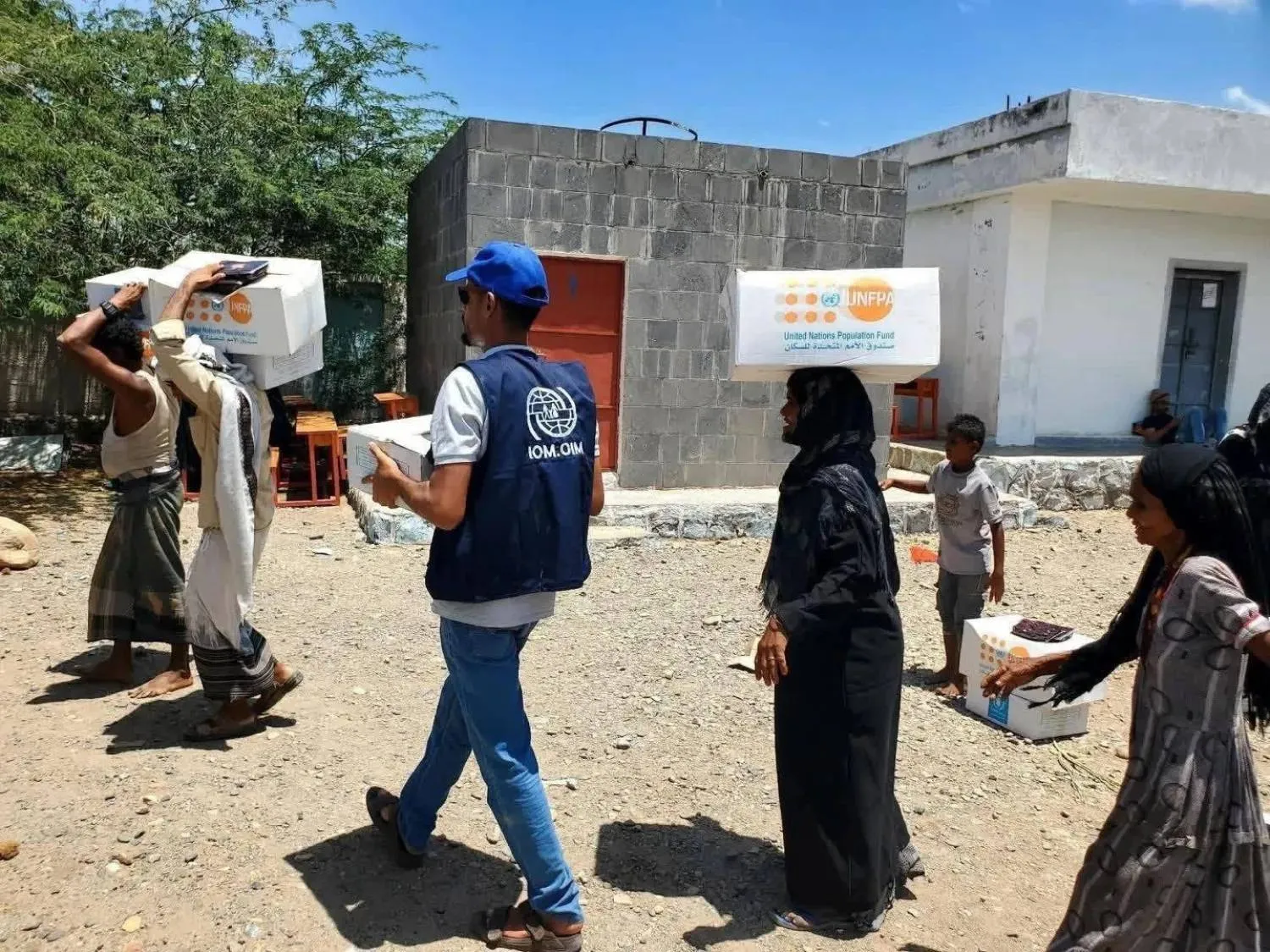

UN: Houthis Engagement in Regional War Alongside Iran Threatens to Deepen Yemen’s Humanitarian Crisis

Lack of funding threatens more lives in Yemen (UN)
TT

UN: Houthis Engagement in Regional War Alongside Iran Threatens to Deepen Yemen’s Humanitarian Crisis

Lack of funding threatens more lives in Yemen (UN)

A UN report warned that the Houthis' continued engagement in the regional war alongside Iran coupled with a sharp reduction in humanitarian funding, threaten to deepen Yemen’s humanitarian crisis when already 450 health facilities, including 76 hospitals, have closed in the last year.

“The Houthis’ engagement in the regional war may trigger displacement, civilian casualties, and damage to vital infrastructure, including ports and storage facilities, deepening humanitarian needs nationwide,” according to a Public Health Situation Analysis (PHSA) issued by the World Health Organization this week.

WHO called on the international community to take urgent action to close the worsening funding gap, warning that continued cuts in humanitarian assistance would lead to more loss of livelihoods, and increase exposure to hunger, disease, displacement and protection risk.

The UN agency noted that escalating conflict in the Middle East has spillover risks for Yemen.

In March 2026, it said Houthis began to engage in the regional war by launching military attacks against Israel.

“Renewed hostilities are already drawing forces into regional fighting,” it said, warning that strikes on Houthi-held areas may trigger displacement, civilian casualties, and damage to vital infrastructure, including ports and storage facilities, deepening humanitarian needs.

Decline in Funding

Surging needs, significant funding cuts, and shrinking access are forcing partners to scale back life-saving support, according to WHO.

The agency said in its report that Yemen enters 2026 at a critical tipping point, with 22.3 million people in need of humanitarian assistance and protection.

Nearly 5 million people are experiencing IPC Phase 3 or above (Crisis or worse) conditions between March and May 2026, with 1.4 million people experiencing IPC Phase 4 (Emergency).

Also, Yemen faces widespread outbreaks of vaccine -preventable diseases, including circulating vaccine -derived poliovirus type 2 (cVDPV2), acute watery diarrhea (AWD)/cholera, measles, diphtheria, dengue fever and malaria, exacerbated by low vaccination rates, misinformation.

The UN agency warned that without urgent action, lives will be lost, communities will destabilize, and essential systems will edge closer to collapse.

Hospitals Closing

WHO revealed that against a backdrop of increasing needs, the humanitarian response in 2025 operated under severe and unprecedented funding shortages, with the Yemen 2025 HNRP funded at only 29%, forcing clusters to scale down or suspend critical life saving services across sectors.

As of May 2026, it said reduced funding has resulted in a reduction of nutrition services by up to 63%. Over 450 health facilities, including 76 hospitals, have closed in the last year.

In a related development, WHO said Yemen has been engulfed in violent conflict.

It said that by 2019, the country had reversed human development by 21 years, and if the conflict continues until 2030, the developmental setback could extend to nearly four decades, more than one-and-a-half generation.

Forgotten Crisis

UNFPA Representative Francesco Galtieri said this week that Yemen has become a forgotten crisis, despite witnessing one of the largest humanitarian crises in the world.

He said around 650,000 pregnant women need support in a country with the highest maternal mortality rate in the Arab region.

Galtieri noted that three women die every day due to pregnancy complications or during childbirth. Around two-thirds of these deaths could be prevented if they had access to a midwife or doctor.

He also said funding cuts are putting the programs under severe strain. Galtieri told UN News that around 40% of UNFPA’s humanitarian funding was cut last year, forcing the agency to suspend or halt support for roughly one third of its services.



Arab League Chief: Israel’s Rejection of Peace Plan Shows Disregard for International Will

Arab League Secretary-General Nabil Fahmy attends a joint press conference on the day of the Arab Ministerial Committee meeting to discuss the situation in Jerusalem, in Amman, Jordan, August 5, 2026. (Reuters)
TT

Arab League Chief: Israel’s Rejection of Peace Plan Shows Disregard for International Will

Arab League Secretary-General Nabil Fahmy attends a joint press conference on the day of the Arab Ministerial Committee meeting to discuss the situation in Jerusalem, in Amman, Jordan, August 5, 2026. (Reuters)

Arab League Secretary-General Nabil Fahmy said statements by the Israeli prime minister rejecting the15-point roadmap to complete implementation of the comprehensive peace plan in Gaza reveal an explicit disregard for international will and the foundations of the peace process.

Fahmy said the Israeli prime minister's insistence that no Palestinian state be established in the Gaza Strip or the West Bank directly undermines prospects for a peaceful settlement and the establishment of a just and comprehensive peace, the Saudi Press Agency said on Monday.

In a statement, Fahmy stressed that continued Israeli violations of the ceasefire, including attacks targeting civilians and medical facilities in the Gaza Strip, constitute a blatant breach of existing obligations and relevant UN resolutions. He welcomed the clear position expressed by the foreign ministers of eight Arab and Islamic countries in their August 6 statement regarding these violations.

He renewed his call for the full and serious implementation of the comprehensive peace plan and for completing the process established by the Sharm El-Sheikh Peace Summit in October 2025.

Fahmy warned that continued Israeli attempts to impose new realities on the ground in the Gaza Strip and occupied West Bank seek to entrench the occupation and expand control over Palestinian territories. He said such attempts undermine the possibility of establishing a Palestinian state and blatantly contradict international law and relevant international legitimacy resolutions.

The secretary-general called on US President Donald Trump and the international community to assume their responsibilities in ensuring the full implementation of the comprehensive peace plan in accordance with UN Security Council Resolution 2803 of 2025. He also called for pressure on the Israeli government to end its violations and fulfill its obligations in a manner that preserves prospects for a just and lasting settlement.


Two Soldiers Killed in Houthi Drone Attack on Yemen’s Marib

The remains of a military projectile are embedded in the ground in the Port of Mokha the day after an attack by the Houthis on the city of Mokha, held by Yemen's legitimate Aden-based government on August 10, 2026. (AFP)
TT

Two Soldiers Killed in Houthi Drone Attack on Yemen’s Marib

The remains of a military projectile are embedded in the ground in the Port of Mokha the day after an attack by the Houthis on the city of Mokha, held by Yemen's legitimate Aden-based government on August 10, 2026. (AFP)

The Iran-backed Houthi group launched on Monday a drone attack on the Harib district in Yemen’s Marib governorate.

Two government soldiers were killed and seven others wounded in the attack, said field military sources. This was the second attack on Harib in days.

The Houthis continued their attacks on government forces, days after their escalation targeting al-Mokha city and its port on Yemen’s west coast, as well as Marib, Hadramawt, and Dhale.

Meanwhile, authorities in the southern and eastern governorates urged vigilance in anticipation of any attack.

Member of the Presidential Leadership Council Sultan Ali al-Aradah stressed the need for vigilance in the al-Mahra governorate and more coordination between military units and security agencies to confront threats.

He met with Chief of the General Staff of the Yemeni Armed Forces Lieutenant General Sagheer Aziz and other military officials, underlining the need to continue the crackdown on Houthi smuggling operations and thwarting their destabilizing activities.

He said al-Mahra was the gateway to eastern Yemen, calling for maintaining its stability, bolstering the presence of state institutions and protecting national interests.

In Hadramawt, PLC member and province governor Salem al-Khanbashi inspected the al-Riyan International Airport, Mukalla port and the al-Dhabba Oil Terminal to check the measures taken to ensure their security.

He chaired a meeting in Mukalla to tackle the level of readiness and emergency plans to confront any possible danger and protect lives.


Israel Declares Closed Military Zone in West Bank’s Taybeh

The site of a new Israeli settlement near the Palestinian Christian village of Taybeh, in the Israeli-occupied West Bank, August 10, 2026. (Reuters)
TT

Israel Declares Closed Military Zone in West Bank’s Taybeh

The site of a new Israeli settlement near the Palestinian Christian village of Taybeh, in the Israeli-occupied West Bank, August 10, 2026. (Reuters)

Israel's military said Monday it had declared a Christian-majority town in the occupied West Bank a closed military zone to keep out Israeli settlers and other non-residents.

The new tactic is designed to keep Israelis out of Taybeh, which is surrounded by settlements to its east and west and has been subject to arson, vandalism and settlers coming onto private and village property.

The order does not apply to Palestinian residents or journalists, who the army said would be allowed unless soldiers determine their presence poses a threat. The army said its troops would detain suspects and disperse gatherings to keep the peace.

The designation comes after months of the army and police struggling to maintain order throughout the territory, where at least 87 Palestinians have been killed by Israeli settlers or soldiers in 2026, according to the Ramallah-based Palestinian Health Ministry.

Parts of Taybeh lie in what's called “Area B,” where Israel maintains security control, but residents have complained that the army and police are slow to respond to attacks by extremist settlers.