


The Economy in the Occupied West Bank Is Being Dismantled by Israel, Report Says

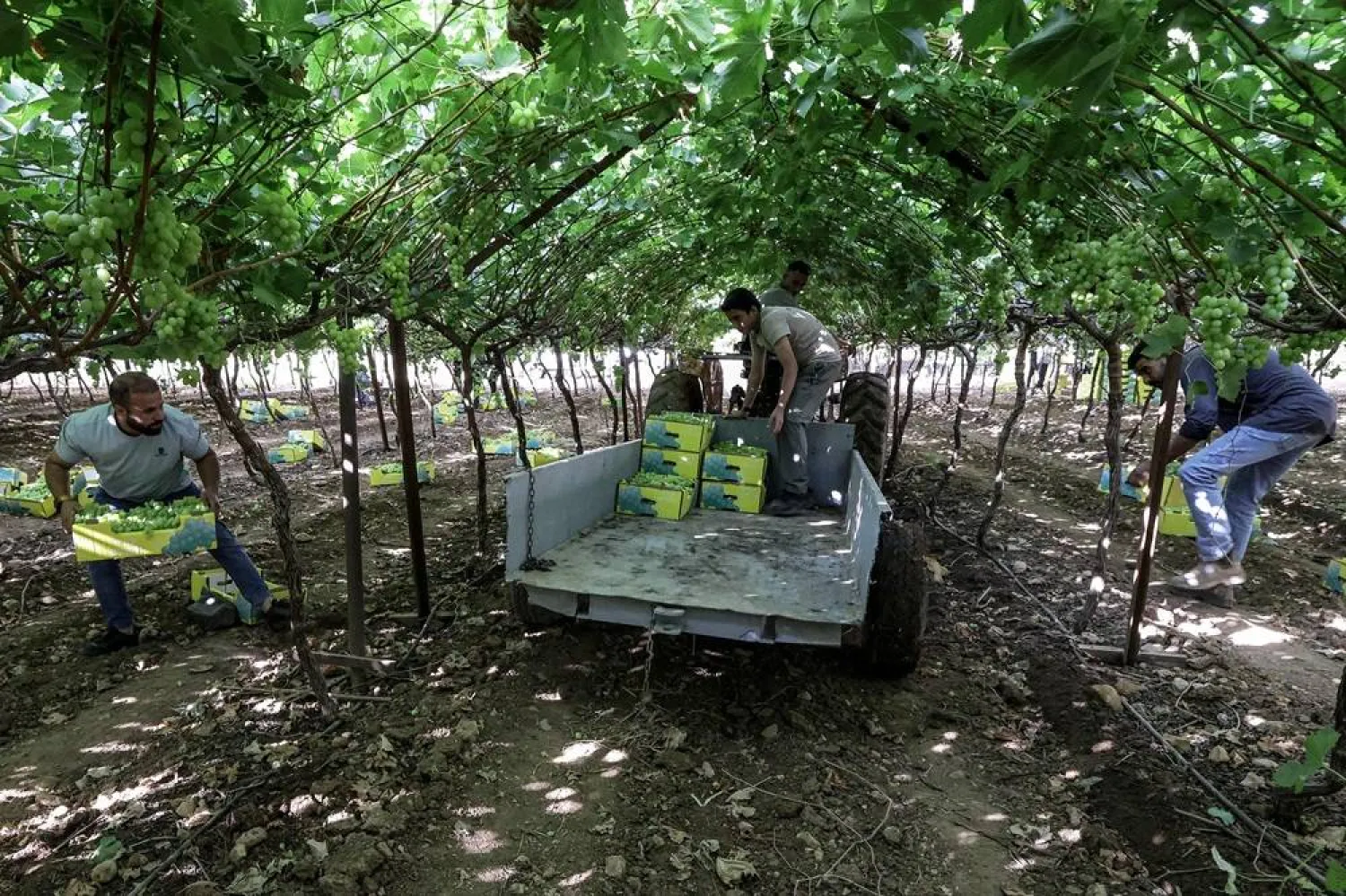
 Palestinian farm workers harvest grape vines at the Samer Hamdan vineyards in the village of Beit Hasan on the outskirts of the Jordan Valley, east of Nablus in the Israeli-occupied West Bank, on June 13, 2026. (AFP)
Palestinian farm workers harvest grape vines at the Samer Hamdan vineyards in the village of Beit Hasan on the outskirts of the Jordan Valley, east of Nablus in the Israeli-occupied West Bank, on June 13, 2026. (AFP)
TT

The Economy in the Occupied West Bank Is Being Dismantled by Israel, Report Says

 Palestinian farm workers harvest grape vines at the Samer Hamdan vineyards in the village of Beit Hasan on the outskirts of the Jordan Valley, east of Nablus in the Israeli-occupied West Bank, on June 13, 2026. (AFP)
Palestinian farm workers harvest grape vines at the Samer Hamdan vineyards in the village of Beit Hasan on the outskirts of the Jordan Valley, east of Nablus in the Israeli-occupied West Bank, on June 13, 2026. (AFP)

The economy in the West Bank is teetering toward collapse as Israel maintains a web of restrictions that limit opportunities for Palestinians living under long-term military occupation, according to a new report from a leading conflict tracker.

The International Crisis Group says that Israeli measures restricting movement, withholding revenue and taking land are not only crippling the Palestinian economy but also fueling deep instability.

“The economic conditions necessary for any Palestinian future other than permanent subjugation are being dismantled,” it says.

The report, based on interviews with Palestinian business leaders, mayors and government officials, details the financial crisis afflicting companies, households and the internationally backed Palestinian Authority, which administers cities and towns in the West Bank.

It says Israeli policies suggest a concerted effort to “advance Israel’s own declared goal of extending its control and preventing a Palestinian state from emerging.”

Throughout decades of military occupation, the Palestinian economy has been hobbled by checkpoints and military gates that curtail movement of people and goods.

Households and businesses have relied heavily on jobs and imports tied to Israel, and faced restrictions on land and trade.

The roughly 3.4 million Palestinians living in the West Bank today face roughly 30% unemployment and have seen their economy contract substantially since the start of the Israel-Hamas war.

After Hamas’ Oct. 7, 2023, attack, Israel revoked work permits for most of the nearly 200,000 Palestinians who had worked there previously. Officials cited security but in effect, it deprived the Palestinian economy of nearly $400 million a month, or almost one-fourth of its overall economic output.

Many businesses today are struggling to pay workers, contractors and suppliers, with private companies seeing an estimated 50% decline in business since before the war, “reflecting tightened movement controls, disrupted supply chains and heightened uncertainty,” the report says.

“Palestinian society survives, but in a state of grinding immiseration. Absent remedies, the result will likely be a loss of hope and a growing risk of instability and greater violence,” it says.

As the occupied West Bank's largest employer and service provider, the Palestinian Authority is at the heart of the crisis. Government agencies have borrowed heavily to stay afloat as public sector workers go unpaid and infrastructure like roads and water lines crumble. The inability to fund public services is keeping patients out of hospitals and kids out of school.

Most of the PA's money comes from taxes collected on goods entering the West Bank through Israeli ports, because Palestinians do not control their own borders. But under hard-line ministers in Israeli Prime Minister Benjamin Netanyahu’s government, Israel has withheld billions of dollars in owed tax revenue and unilaterally imposed deductions on the funds. No transfers have been made since May 2025.

Joost Hiltermann, International Crisis Group’s special adviser for the Middle East and North Africa, said the world’s focus on more than two years of war in Gaza had drawn attention away from the West Bank, but that changes taking place now could have arguably wider consequences for Palestinians’ future aspirations.

Hiltermann, who wrote the report, said Israeli officials, who exert considerable control over many of the policies in question, did not agree to be interviewed. But he noted disagreements within Netanyahu’s government, with settler leaders and security officials often clashing on how to manage the Palestinian economy.

“The security establishment doesn’t want the Palestinian Authority or economy to collapse because they would have to assume the burden of governing the territory in full after essentially destroying it,” he said.



UKMTO: Container Vessel Fired upon and Boarding Attempted by Skiff off Yemen Coast

Patrol boats affiliated with the Yemeni coast guard off the port of Mokha in the southern Red Sea (Saba News Agency)
TT

UKMTO: Container Vessel Fired upon and Boarding Attempted by Skiff off Yemen Coast

Patrol boats affiliated with the Yemeni coast guard off the port of Mokha in the southern Red Sea (Saba News Agency)

The United Kingdom Maritime Trade Operations received a report on Monday ‌that ‌a container ‌vessel was ⁠approached and fired upon ⁠by a small skiff 14 ⁠nautical miles south ‌off the ‌coast of ‌Yemen, ‌with an attempted boarding.

Authorities are investigating, ‌and vessels are advised ⁠to transit ⁠with caution and report any suspicious activity to UKMTO, it said.


Lebanon’s Aoun Hopes US-Iran Deal Will Put ‘Definitive End’ to Israel-Hezbollah War

 A man walks amidst rubble in the aftermath of Israeli strikes in Nabatieh, Lebanon, June 15, 2026. (Reuters)
A man walks amidst rubble in the aftermath of Israeli strikes in Nabatieh, Lebanon, June 15, 2026. (Reuters)
TT

Lebanon’s Aoun Hopes US-Iran Deal Will Put ‘Definitive End’ to Israel-Hezbollah War

 A man walks amidst rubble in the aftermath of Israeli strikes in Nabatieh, Lebanon, June 15, 2026. (Reuters)
A man walks amidst rubble in the aftermath of Israeli strikes in Nabatieh, Lebanon, June 15, 2026. (Reuters)

Lebanese President Joseph Aoun on Monday expressed hope that a deal between Washington and Tehran to end the Middle East war would put a "definitive end" to the conflict between Israel and Hezbollah.

In a statement issued by his office, Aoun praised the memorandum's affirmation that "Lebanon's security and safety are an integral part of any effort to consolidate stability in the region".

The Lebanese people "look forward to these understandings transforming into practical steps that put a definitive end to the cycle of violence and establish a phase of stability, security, recovery and reconstruction," the statement added.

Israel’s defense minister said Monday that Israel won’t withdraw from land occupied in Lebanon as the interim deal between Iran and the United States is pending.

Katz said Israel plans to stay “indefinitely” in lands it holds in Lebanon, as well as Syria and the Gaza Strip.

Iran has tied the interim deal over the war to halting Israel’s attacks on Hezbollah in Lebanon.

Meanwhile, two Israeli far-right ministers denounced the deal.

"We must not settle for anything less than the dismantling of Hezbollah. We must not withdraw from a single inch of territory that our soldiers have captured and cleared of terrorist infrastructure," National Security Minister Itamar Ben-Gvir said on his Telegram channel said.

Finance Minister Bezalel Smotrich also echoed the sentiment, calling the deal "bad for Israel".

He also called for a stronger campaign in Lebanon.

"We will be judged in Lebanon. This is our war, our soldiers, and the immediate security of our northern residents," he said.


Lebanon ‘Not Informed’ of Terms of Iran-US Deal, Says Official

A photograph taken from the southern area of Marjeyoun shows smoke rising from fires reportedly ignited at a site targeted by Israeli artillery shelling in the southern village of Kfar Tibnit on June 15, 2026. (AFP)
TT

Lebanon ‘Not Informed’ of Terms of Iran-US Deal, Says Official

A photograph taken from the southern area of Marjeyoun shows smoke rising from fires reportedly ignited at a site targeted by Israeli artillery shelling in the southern village of Kfar Tibnit on June 15, 2026. (AFP)

Lebanon has not been informed of details of an agreement between the United States and Iran to end the Middle East war on all fronts including in Lebanon, an official source told AFP on Monday.

Lebanon's state-run National News Agency (NNA) reported intermittent artillery shelling in the country's south on Monday but no airstrikes -- a lower level of violence compared to previous days.

Hezbollah has not commented on the agreement, but the Iran-backed group has not claimed any fresh attacks on Monday on Israeli targets.

"Lebanon was not informed of the terms of the agreement or the time of the ceasefire," the source said on condition of anonymity.

Few details have been made public about the agreement announced overnight.

Lebanese parliament Speaker Nabih Berri, a Hezbollah ally who acts as an intermediary between the group and the US, praised the deal, thanking the United States and Tehran for their "insistence on including... an essential and binding clause on halting the Israeli aggression on all of Lebanon".

Israel and Hezbollah have been at war since March 2 when the Iran-backed group fired rockets at Israel to avenge the killing of Iran's supreme leader in US-Israeli strikes days earlier.

Israel responded with a campaign of airstrikes and a ground invasion. Previous ceasefire announcements have failed to stop the fighting.

Pakistan's Prime Minister Shebhaz Sharif, whose country has been mediating between Tehran and Washington, said that "both sides have declared the immediate and permanent termination of military operations on all fronts, including in Lebanon".

Iran's Deputy Foreign Minister Kazem Gharibabadi said that "a permanent and immediate end to the war has been declared on all fronts, including Lebanon".

AFP correspondents on Monday reported a cautious return of some residents to their homes in areas of south Lebanon not occupied by Israel's army.
