Israel Approves Settler Building Plans in Palestinian West Bank City

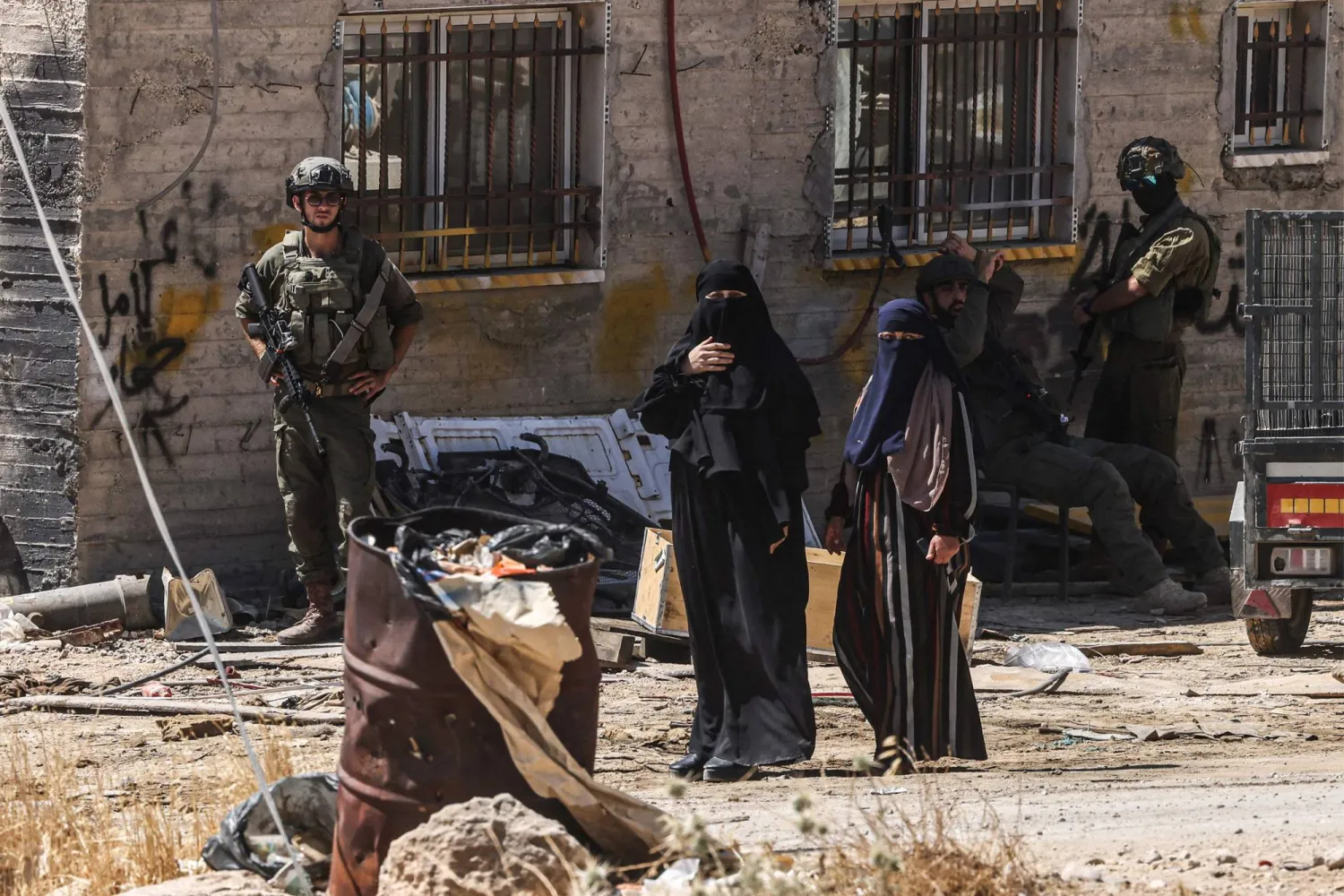
 Israeli soldiers stand by as Palestinian women look on as Israeli bulldozers demolish a Palestinian home, which the Israeli authorities say was built without permission, in Ar-Rifaiyya village, south of the Israeli-occupied Palestinian West Bank city of Hebron on June 17, 2026. (AFP)
Israeli soldiers stand by as Palestinian women look on as Israeli bulldozers demolish a Palestinian home, which the Israeli authorities say was built without permission, in Ar-Rifaiyya village, south of the Israeli-occupied Palestinian West Bank city of Hebron on June 17, 2026. (AFP)
TT

Israel Approves Settler Building Plans in Palestinian West Bank City

 Israeli soldiers stand by as Palestinian women look on as Israeli bulldozers demolish a Palestinian home, which the Israeli authorities say was built without permission, in Ar-Rifaiyya village, south of the Israeli-occupied Palestinian West Bank city of Hebron on June 17, 2026. (AFP)
Israeli soldiers stand by as Palestinian women look on as Israeli bulldozers demolish a Palestinian home, which the Israeli authorities say was built without permission, in Ar-Rifaiyya village, south of the Israeli-occupied Palestinian West Bank city of Hebron on June 17, 2026. (AFP)

Israel on Wednesday approved the expansion of a Jewish school for settlers living in the center of the Palestinian city of Hebron in the occupied West Bank, in a construction push that Palestinians say violates a decades-old agreement.

Israel's finance minister announced the plans a day after saying he had scrapped a deal that gave the Palestinian municipality control over certain planning and construction around Hebron's historic core, home to ‌a flashpoint holy ‌shrine.

The enclave around the Cave ‌of ⁠the Patriarchs - revered ⁠by Muslims, Jews and Christians - is home to more than 1,000 Jewish settlers who live among tens of thousands of Palestinians under complete Israeli security control.

Under the 1997 Hebron Agreement, Israeli troops remain deployed in the area, but construction has generally required approval from the Palestinian ⁠municipality, including around the shrine.

The religious heritage of ‌the city has made ‌it a focal point for Israeli settlers, who are determined ‌to expand the Jewish presence.

Bezalal Smotrich, Israel's far-right finance ‌minister, said construction of a 1,000 square meter building for a Jewish school in Hebron's historic core had been approved.

"We are continuing to build the Land of Israel in ‌practice and to implement practical sovereignty in the settlements," Smotrich, who has said he wants ⁠to bury ⁠the idea of Palestinian statehood, said in a statement.

Issa Amro, a Palestinian activist who lives in Hebron, said he feared Israel's dismantling of parts of the Hebron Agreement would leave Palestinian residents of the city without basic services.

He said that move was aimed at making life miserable for Palestinians and forcing them to leave.

"It means ethnic cleansing of Palestinian families from their homes, and more displacement," he said, describing Israel's actions as stealing Palestinian dreams to have a state "and to live without violence, without fear, with peace".


Military Sources: Sudanese Army Recaptures Strategic Town in Blue Nile

Members of the army-allied Sudan Shield Forces in Ed Damazin, Blue Nile region (Sudan Shield Forces' Facebook page)
TT

Military Sources: Sudanese Army Recaptures Strategic Town in Blue Nile

Members of the army-allied Sudan Shield Forces in Ed Damazin, Blue Nile region (Sudan Shield Forces' Facebook page)

Sudanese military sources said the army recaptured the strategic town of Maqanza in the Blue Nile region on Friday, about 22 kilometers from the regional capital, Ed Damazin, after the Rapid Support Forces (RSF) announced taking control of it last week.

The fighting has triggered waves of displacement, with residents fleeing after the RSF and its allies entered Maqanza on November 21.

Pro-army platforms quoted military sources as saying the army had recaptured Maqanza in Bau locality, without providing details of the operation.

The platforms circulated a video showing soldiers celebrating what they described as the recapture of the town, with a sign bearing the name of its health center visible behind them. The army has not issued an official statement confirming the recapture.

The RSF announced on November 21 that it had seized Maqanza, approximately 22 kilometers south of Ed Damazin.

The army did not comment on the announcement at the time, while pro-army platforms denied that the RSF had taken the town. On Friday, those same platforms quoted military sources as saying the army had regained control.

Meanwhile, fighters wearing RSF uniforms released a video Thursday showing them celebrating inside a house they said was in Maqanza.

Waves of Displacement

The Emergency Lawyers group estimated Friday that between 1,620 and 1,890 people had been displaced from Maqanza.

It said women, children and the elderly were among those most urgently in need of assistance and warned of further displacement as military operations continued.

The group called on the RSF and its allies to protect civilians and refrain from intimidating residents or endangering their lives and property.

Military operations in Blue Nile have caused widespread displacement.

The International Organization for Migration (IOM) estimated that 119,782 people were displaced between January 11 and October 15, 2026.

Ed Damazin received 45,815 displaced people, while El Roseires received 36,950. The remainder sought refuge in Bau, Wad al-Mahi, Geissan, Kurmuk and Al-Tadamon.

The Blue Nile Civil Society Initiative said on November 22 that more than 51,000 people had been newly displaced within the region, while over 15,000 others had left Ed Damazin and El Roseires for other Sudanese states.

Military Reinforcements in Ed Damazin

The RSF made significant territorial gains in Blue Nile during October and November, capturing several towns and localities, including Kurmuk, Geissan, Bau and Wad al-Mahi, and advancing toward Ed Damazin.

The group also intensified drone attacks on the regional capital, with reports indicating that dozens of civilians had been killed or wounded.

In response, the Sudanese army reinforced its positions across the region, including at the headquarters of the Fourth Infantry Division in Ed Damazin.

Sudanese military sources said more than 15,000 army personnel had arrived in the city.

Abu Aqla Keikel, commander of the army-allied Sudan Shield Forces, was also seen in Ed Damazin alongside members of his force. Keikel previously defected from the RSF and joined the army.

Maqanza is known for artisanal gold mining. The Sudanese Mineral Resources Company had previously identified the town as one of the locations where it planned to establish gold markets, according to local reports at the time.

The Sudan People's Liberation Movement, led by Malik Agar, had also used Maqanza as its main headquarters during its war against government forces.

The family of the current governor of the Blue Nile region comes from the town.

Relative Calm in Kordofan

On the Kordofan fronts, the pace of ground operations has slowed following a rapid army advance that saw it recapture large areas of North Kordofan state and several towns in West Kordofan, most notably Al-Khuway, one of the state's largest towns.

Army forces have also advanced toward En Nahud, one of West Kordofan's most important commercial and agricultural centers.

The region has not witnessed major ground clashes for several days, although military clearing operations have continued, with both sides still using various types of drones.

On Thursday, the army said its air defenses had shot down a hostile FH-95 drone west of Kadugli, the capital of South Kordofan state.


Israel Attempts to Assassinate Hamas Leader's Last Surviving Son as Gaza Attacks Escalate

FILED - 26 November 2026, Palestinian Territories, Deir Al-Balah: Palestinians inspect a destroyed residential apartment following an Israeli airstrike in Deir al-Balah.  Photo: Ahmed Ibrahim/APA Images via ZUMA Press Wire/dpa
FILED - 26 November 2026, Palestinian Territories, Deir Al-Balah: Palestinians inspect a destroyed residential apartment following an Israeli airstrike in Deir al-Balah. Photo: Ahmed Ibrahim/APA Images via ZUMA Press Wire/dpa
TT

Israel Attempts to Assassinate Hamas Leader's Last Surviving Son as Gaza Attacks Escalate

FILED - 26 November 2026, Palestinian Territories, Deir Al-Balah: Palestinians inspect a destroyed residential apartment following an Israeli airstrike in Deir al-Balah.  Photo: Ahmed Ibrahim/APA Images via ZUMA Press Wire/dpa
FILED - 26 November 2026, Palestinian Territories, Deir Al-Balah: Palestinians inspect a destroyed residential apartment following an Israeli airstrike in Deir al-Balah. Photo: Ahmed Ibrahim/APA Images via ZUMA Press Wire/dpa

Hamas confirmed Friday that Izzeldeen al-Hayya, the last surviving son of the group's political bureau chief, Khalil al-Hayya, had escaped an Israeli airstrike targeting an apartment where he was staying with family members in the Rimal neighborhood of Gaza City.

The confirmation came as fresh diplomatic efforts over the Gaza ceasefire are expected in the coming days, aimed at advancing provisions of the roadmap stemming from US President Donald Trump's plan for the second phase of efforts to end the war, amid continuing Israeli military escalation.

A Hamas source and another source from a separate Palestinian faction told Asharq Al-Awsat that representatives of several factions would meet in Cairo in the coming days to discuss developments in Gaza, focusing on Israeli violations of the ceasefire.

The sources said the meetings would examine options for dealing with the increasingly complex situation in the enclave and Israel's continuing military campaign, despite what they described as the Palestinian factions' compliance with the agreed terms.

The Hamas source said the factions remained committed to all provisions of the agreements reached and had conveyed that commitment to mediators and other concerned parties, provided Israel fulfilled its corresponding obligations.

The source accused Israel of failing to implement required steps, including allowing the National Committee for the Administration of Gaza to enter the territory, permitting the deployment of an international stabilization force and withdrawing its troops from Gaza ahead of subsequent measures, including bringing weapons under exclusive control.

Hamas political bureau chief Khalil al-Hayya said in remarks to the press several days earlier that continued killings and a blockade could not be accepted under a ceasefire agreement.

He described the silence of the Board of Peace and the agreement's guarantors over what he called Israeli crimes as unacceptable.

Al-Hayya said Hamas was holding discussions with other Palestinian factions to determine how to respond to Israeli ceasefire violations and the daily killing of Palestinians.

The Hamas source told Asharq Al-Awsat that contacts had been made and messages exchanged with Palestinian factions and mediating countries to discuss developments.

The source added that a meeting between Hamas leaders and Turkish intelligence chief Ibrahim Kalin addressed Israeli violations and ways to compel Israel to stop them.

According to the source, mediators had conveyed messages in recent days indicating that new diplomatic activity was expected to advance more significant measures as Israel's internal political crisis neared its end.

Yedioth Ahronoth reported Thursday evening that an official with the Board of Peace had expressed satisfaction with recent discussions with Israeli Prime Minister Benjamin Netanyahu, who reaffirmed Israel's commitment to Trump's plan.

The official said the board expects Israel to translate those commitments into concrete action in the coming days.

An Israeli official told the newspaper that Israel remained committed to the 20-point plan and expected significant progress in the coming days under Trump's Gaza initiative, including the disarmament of Hamas.

US envoy Jared Kushner spoke with Netanyahu on Tuesday, urging him to implement Israel's obligations under Trump's plan.

Kushner called for facilitating the entry of tents and humanitarian aid into Gaza ahead of winter, as well as advancing the procedures needed to allow an international stabilization force into the territory.

A Board of Peace official described the talks as productive, saying progress toward understandings remained possible and efforts were underway to move the process forward. The official added that the real test would come through concrete steps in the days ahead.

Israeli Military Escalation

The diplomatic developments come amid continued Israeli military escalation in Gaza.

A young man was killed in an airstrike in Jabalia refugee camp in northern Gaza, while six Palestinians were wounded in a strike targeting a residential apartment in the Rimal neighborhood of central Gaza City.

The apartment belonged to the husband of Khalil al-Hayya's daughter, a government official in the Hamas-run Finance Ministry. He and members of his family were wounded.

It later emerged that the intended target was Izzeldeen al-Hayya, the Hamas leader's last surviving son, whom Israeli Defense Minister Israel Katz had threatened to assassinate on Thursday.

In a statement, Hamas said the Israeli attack had targeted al-Hayya's son and the family of his other son, Azzam, who was killed several months earlier in Gaza, leaving several family members wounded.

The movement described the strike as a continuation of what it called the Israeli government's unprecedented campaign against Palestinians and a direct implementation of Katz's threats against the Hamas leader.

Hamas held Israel fully responsible for the attack and accused it of exploiting the ceasefire to continue killing Palestinians.

Field sources told Asharq Al-Awsat that two explosive-laden drones struck the apartment and detonated inside, wounding those present. No fatalities were reported.

The absence of fatalities confirmed that al-Hayya's son had survived, although he may have been among those wounded.

At least seven other Palestinians were injured by gunfire from Israeli military vehicles and drones in Khan Younis and Beit Lahia.

Shortly before midnight Thursday, Israeli warplanes destroyed four multistory residential buildings containing commercial shops, along with two houses, west of the Yellow Line in the western part of the Shujaiya neighborhood, east of Gaza City.

The Israeli military said the strikes destroyed Hamas weapons storage facilities intended for use in attacks.

On Thursday, approximately 10 Palestinians were killed in a series of Israeli airstrikes across the Gaza Strip, including Hamas members.

Among those killed was Khaled Abu Nada, a member of Hamas's political bureau, who was targeted by an Israeli drone inside a residential apartment in Deir al-Balah, central Gaza.

The Israeli military announced Friday that it had killed eight Hamas and Islamic Jihad members in a series of strikes across Gaza in recent days.

It said some of those targeted had participated in the October 7, 2023, attack, while others had been involved in holding Israeli hostages and transferring them during prisoner exchange operations.


South Lebanon’s Christians Caught Between Israeli Occupation and Accusations of Treason

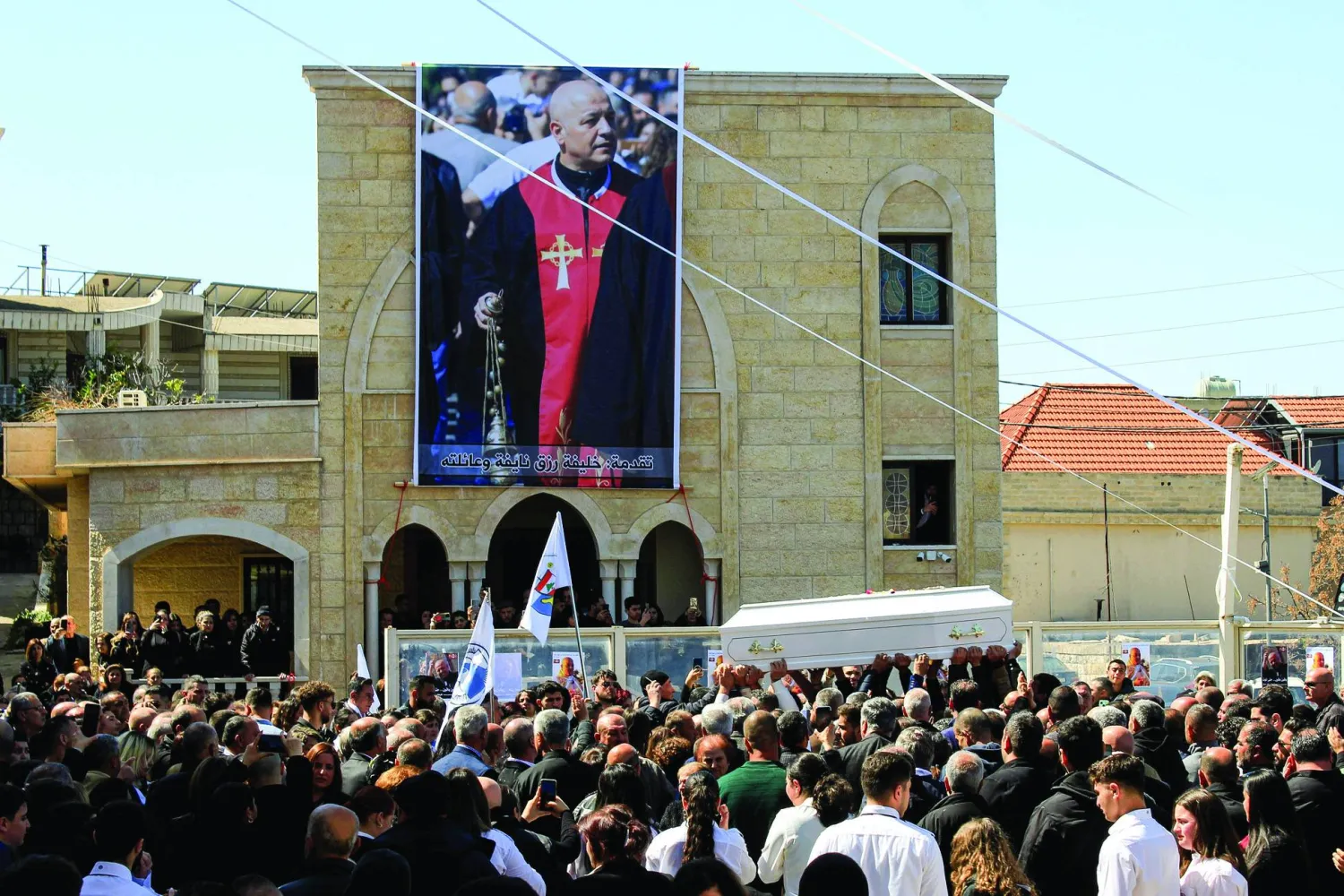
11 March 2026, Lebanon, Qlayaat: Christians from the southern Lebanese village of Qlayaa gather around the coffin of Maronite Catholic priest Father Pierre al-Rahi, killed by Israeli artillery fire on March 9.  Photo: Stringer/dpa
11 March 2026, Lebanon, Qlayaat: Christians from the southern Lebanese village of Qlayaa gather around the coffin of Maronite Catholic priest Father Pierre al-Rahi, killed by Israeli artillery fire on March 9. Photo: Stringer/dpa
TT

South Lebanon’s Christians Caught Between Israeli Occupation and Accusations of Treason

11 March 2026, Lebanon, Qlayaat: Christians from the southern Lebanese village of Qlayaa gather around the coffin of Maronite Catholic priest Father Pierre al-Rahi, killed by Israeli artillery fire on March 9.  Photo: Stringer/dpa
11 March 2026, Lebanon, Qlayaat: Christians from the southern Lebanese village of Qlayaa gather around the coffin of Maronite Catholic priest Father Pierre al-Rahi, killed by Israeli artillery fire on March 9. Photo: Stringer/dpa

Residents of Christian border villages in southern Lebanon are no longer struggling solely to remain on their land amid Israeli attacks and pressure. They now face another form of pressure from within Lebanon, as Hezbollah supporters accuse them of collaboration and treason.

The accusations intensified after Israeli military spokesperson Ella Waweya published a video on Lebanese Independence Day showing her speaking to students inside a classroom at a school in the occupied border village of Debel.

The footage fueled accusations from Hezbollah supporters and its predominantly Shiite support base, whose residents have been forced to leave villages across southern Lebanon over the past three years as a result of wars launched by Israel in response to Hezbollah's decision to open a front in support of Gaza and, subsequently, Iran.

Residents of Christian border villages, however, have insisted on remaining in their hometowns. Israeli forces have made their continued presence conditional on keeping the villages free of armed fighters and displaced people, ostensibly to spare residents displacement and their villages destruction.

Fifty-five border towns and villages, including Christian communities, now fall within the so-called Yellow Line established by Israel to create a buffer zone.

The line, which extends up to 10 kilometers into Lebanese territory, resembles the border strip Israel established following its 1978 invasion of southern Lebanon, an operation it said was intended to protect northern Israel from attacks by the Palestine Liberation Organization (PLO).

That strip extended approximately 20 kilometers into Lebanon and later evolved as Israel expanded its occupation in 1982. Israeli forces effectively maintained control over the area until their withdrawal in 2000.

Residents of villages within that strip were compelled to cooperate and coordinate with Israel to secure the basic necessities of life and remain in their homes. The period also saw the emergence of the South Lebanon Army, a militia directly linked to Israel.

Hezbollah supporters now accuse residents of Christian areas of seeking to revive that experience.

Lebanese President Joseph Aoun, however, took a firm position in April, declaring: "During my term, I will not allow any citizen who has remained steadfast in their village or town to be accused of collaboration or treason simply because they chose to continue living in their hometown."

'We Are Paying the Price for Holding On to Our Land'

F.M., a 50-year-old woman from the southern town of Qlayaa, rejects the idea that she and other residents who remained in their villages despite the Israeli occupation should have to prove their patriotism.

"They are no more patriotic than we are. We have suffered enough in this region without anyone ever doing us justice," she said.

"Since the days of the Palestinian presence in Lebanon, we, especially Christians, have paid the price for insisting on remaining on our land. Accusations of treason have followed us ever since."

Speaking to Asharq Al-Awsat, she urged those making accusations of collaboration to "look for collaborators in the right places."

"We did not invite the Israelis onto our land. It was those who chose to support outsiders, from Gaza to Iran, who helped bring them here," she said.

"We are no longer willing to keep defending ourselves against these accusations. They should leave people alone. Those who live in glass houses should not throw stones."

Growing Hostility Among Lebanese Communities

Residents of Ain Ebel, Rmeish, Debel, Qlayaa, Burj al-Muluk and other predominantly Christian border villages find themselves caught between Israeli occupation, with its restrictions, security risks and dangerous journeys to obtain basic necessities, and daily accusations of collaboration from Hezbollah supporters.

Political activist and Lebanese University psychology professor Dr. Mona Fayyad believes accusing Christians who have remained in their villages of treason reflects either ignorance or hatred.

"What are people living under occupation supposed to do?" she asked.

Speaking to Asharq Al-Awsat, Fayyad said Lebanese society is experiencing deep divisions as a result of the country's circumstances, uncertainty about its future and mounting pressures, all of which are fueling hostility between communities.

"Israeli pressure on the Shiite community because of its support for Hezbollah forced all residents of Shiite areas in the south to leave," she said.

"But Israel is also making it difficult for Christians to remain in their villages by imposing a blockade and forcing them to travel along unsafe routes."

She warned that prolonged isolation could leave residents with few alternatives.

"Ultimately, anyone cut off from the rest of Lebanon will, one way or another, be forced to deal with the Israelis," she said.

"We must also not forget that some parties, both inside and outside the country, are pushing various projects, although it remains unclear whether they will succeed."

Fayyad held the Lebanese state responsible for the situation, arguing that it has failed to take the measures needed to prevent further deterioration.

"The longer the Israeli occupation continues, the wider the divide between Lebanese communities will become, and the more hatred will grow among them," she warned.

United Christian Position

Despite their political differences, Lebanon's Christian parties are currently united in supporting the determination of residents in besieged border villages to remain on their land and categorically reject accusations of treason against them.

In a statement issued following its regular meeting on Wednesday, chaired by MP Samy Gemayel, the Kataeb Party's political bureau condemned what it described as "the campaign of accusations of treason waged by Hezbollah against the steadfast residents of border villages, particularly Debel, Ain Ebel and Rmeish."

The party held the Lebanese state responsible for protecting residents, supporting them and ensuring they have the means to remain in their hometowns.

It stressed that the residents' determination to stay on their land constitutes "a living guarantee of the Lebanese identity of this territory, particularly amid the destruction and displacement caused by the war into which Hezbollah dragged Lebanon through its support-front adventures."