

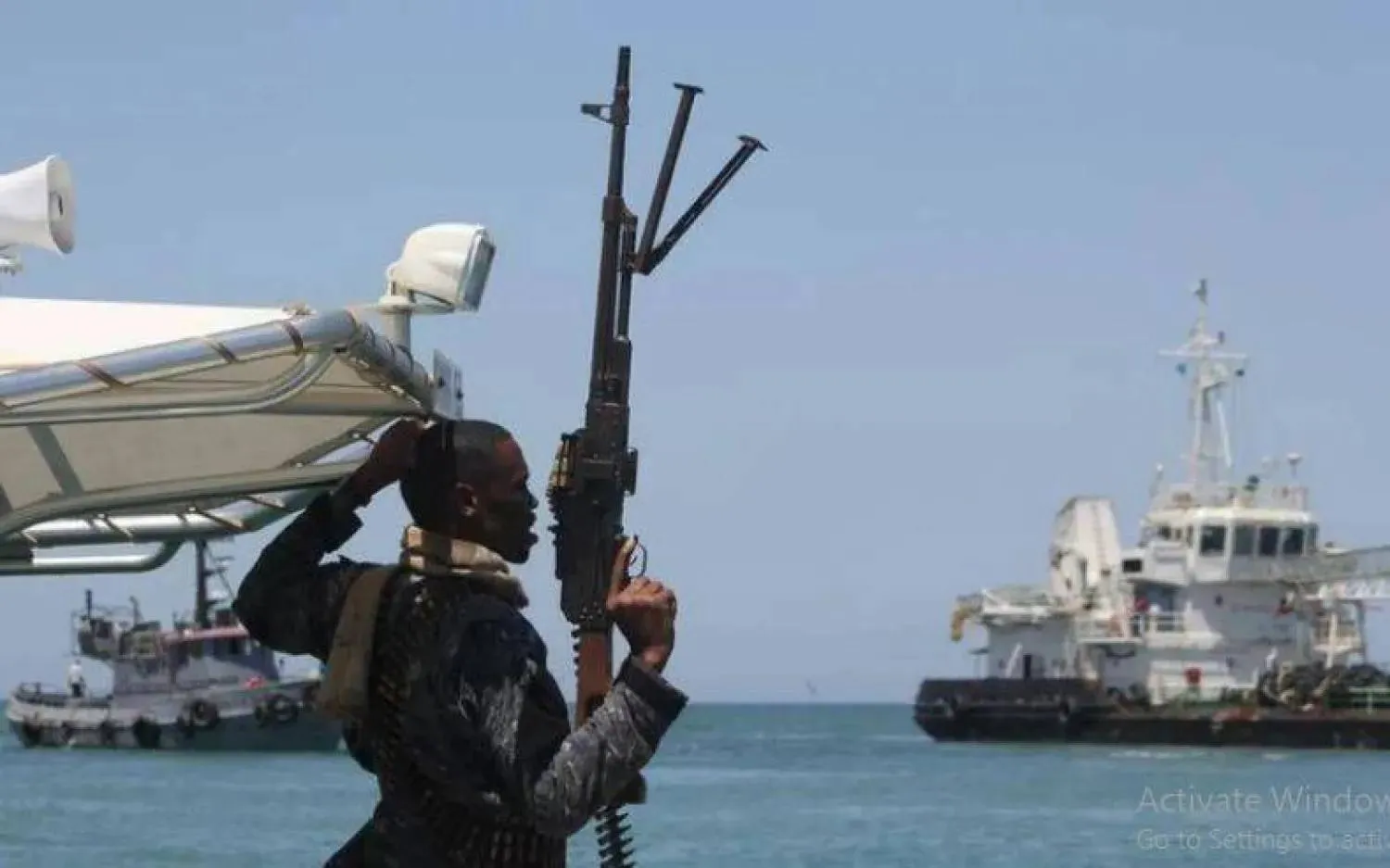

Egyptian Sailors’ Hostage Crisis in Somalia Deepens

An armed pirate takes part in the hijacking of a vessel off Somalia’s coast (File photo: Reuters) 
TT

Egyptian Sailors’ Hostage Crisis in Somalia Deepens

An armed pirate takes part in the hijacking of a vessel off Somalia’s coast (File photo: Reuters) 

The crisis involving Egyptian sailors held aboard the oil tanker M/T Eureka has taken a more complicated turn after Somali pirates who seized the vessel off Yemen’s coast last month reportedly raised their ransom demand from $2 million to $3 million in exchange for the crew’s release.

More than 45 days have passed without any clear indication of a breakthrough since the tanker was hijacked on May 2 near Yemen’s Shabwa governorate. The vessel was then sailed through the Gulf of Aden to the Somali coast. The crew comprises 12 sailors, including eight Egyptians and four Indians.

According to a statement issued Wednesday by the sailors’ families, negotiations had previously made progress, resulting in an agreement between the shipowner and cargo owner on one side and the pirates on the other to pay a ransom for the hostages’ release. However, delays in transferring the agreed sum prompted the captors to threaten to scrap the deal and increase their demands.

Negotiations Hit Obstacles

Captain El-Sayed El-Shazly, head of Egypt’s Maritime Officers Syndicate, said efforts to secure the sailors’ release had recently encountered setbacks. He indicated that the pirates raised their demand to $3 million after an earlier agreement with the vessel’s owner on a $2 million payment.

Speaking to Asharq Al-Awsat, El-Shazly said Egypt’s Foreign Ministry and Maritime Safety Authority had undertaken contacts and diplomatic efforts at various levels to support negotiations. He categorically ruled out military intervention, warning that any rescue operation would entail serious risks to the hostages’ lives and safety.

With release talks stalled, relatives fear the crisis could become even more difficult to resolve. In their statement, the families warned that continued delays would “further complicate the situation and squander the strenuous efforts” undertaken by the authorities, urging the swift implementation of proposed solutions.

The families said the sailors have endured “45 days of pain, anxiety and anticipation” under difficult humanitarian conditions, including shortages of drinking water and adequate food. They have also launched a social media solidarity campaign under several hashtags, most notably “Save the Sailors.”

Amira Abu Saada, the wife of detained sailor Mohamed Radi El-Mahsab, described the ordeal as increasingly difficult as uncertainty surrounding the hostages’ fate drags on.

“Intermittent phone calls were our only source of reassurance,” she told Asharq Al-Awsat, noting that such contacts have become increasingly rare. The last call she received from her husband came on the second day of Eid al-Adha, more than three weeks ago.

Safety Questions Resurface

Since the hijacking in early May, Egypt’s Foreign Ministry has said it has been closely following the case through coordination with the Egyptian embassy in Mogadishu and contacts with Somali authorities aimed at ensuring the sailors’ safety and securing their release as quickly as possible.

The continued complications surrounding the case have revived debate over safety procedures and regulations governing Egyptian sailors working aboard foreign vessels.

“The incident underscores the need for a serious discussion about regulating the employment of Egyptian sailors abroad,” El-Shazly said. He called for stricter standards governing service on foreign ships, particularly vessels facing questions over safety compliance and operating conditions.

For years, piracy off the Horn of Africa posed a major threat to international shipping. Attacks peaked in 2008 and continued for years, disrupting one of the world’s most important maritime trade corridors. After declining significantly in recent years, piracy incidents have resurfaced since late 2023 amid growing regional security tensions and rising risks to global shipping routes.


Syria Arrests Cell Leader over Security Force Deaths

Members of the Internal Security Forces in Syria (SANA)
TT

Syria Arrests Cell Leader over Security Force Deaths

Members of the Internal Security Forces in Syria (SANA)

Syrian authorities said on Saturday they arrested a leader of a cell involved in the deaths of three security force personnel during an anti-extremists operation in the south.

"The internal security forces of Daraa province have arrested Walid al-Fallah, one of the main leaders of the cell involved" in the deaths of the personnel in the town of Al-Sanamein in Daraa province, state news agency SANA reported.

The security force members were killed as they were attempting to arrest a member of the ISIS group, a local government official had told AFP.

The group has been territorially defeated in Syria but maintains sleeper cells.

Interior ministry spokesman Noureddine al-Baba said the anti-extremists operation, which saw five people arrested, "succeeded in dismantling criminal cells and others linked to ISIS that were coordinating with each other".

ISIS used to control vast areas of Syria and neighboring Iraq before being defeated in the two countries in 2019 and 2017, respectively.

However, in Syria it continues to periodically claim attacks against government forces, particularly in the vast desert region, as well as in the north and northeast.

It had also been established in the past in Daraa province, where its leader Abu Hassan al-Hashimi al-Qurashi was killed in October 2022 in clashes with local gunmen.

Last year, the new Syrian authorities, who overthrew president Bashar al-Assad in 2024, joined the US-led international coalition against ISIS.


EU Urges US to Reconsider Visa Denial to Palestinian Delegation for UN Meeting

President of the State of Palestine Mahmoud Abbas speaks via video conference during the General Debate of the 80th session of the United Nations General Assembly at United Nations headquarters in New York, New York, USA, 25 September 2025.  EPA/SARAH YENESEL
President of the State of Palestine Mahmoud Abbas speaks via video conference during the General Debate of the 80th session of the United Nations General Assembly at United Nations headquarters in New York, New York, USA, 25 September 2025. EPA/SARAH YENESEL
TT

EU Urges US to Reconsider Visa Denial to Palestinian Delegation for UN Meeting

President of the State of Palestine Mahmoud Abbas speaks via video conference during the General Debate of the 80th session of the United Nations General Assembly at United Nations headquarters in New York, New York, USA, 25 September 2025.  EPA/SARAH YENESEL
President of the State of Palestine Mahmoud Abbas speaks via video conference during the General Debate of the 80th session of the United Nations General Assembly at United Nations headquarters in New York, New York, USA, 25 September 2025. EPA/SARAH YENESEL

The European Union said on Saturday it regretted Washington's decision to deny visas for the second year running to Palestinian officials seeking to attend the UN General Assembly, urging a rethink, AFP said.

The US State Department said this week it was refusing to grant visas to Palestinian leader Mahmoud Abbas and other members of his delegation ahead of next week's meeting in New York.

"We regret the decision to extend the denial of entry visas for members of the Palestinian delegation for a second year in a row," said Anouar El Anouni, a spokesman for the EU's diplomatic service.

"In light of its existing headquarters agreements with the UN and its obligations as host state, we urge the United States for this decision to be reconsidered."

The administration of US President Donald Trump denied visas for the Palestinian delegation also last year, forcing Abbas, a regular at the UN General Assembly, to address the body of global leadership by video.

The General Assembly voted 152-3 on Thursday for Abbas to be able to appear virtually once again this year.

As it stands, only members of the Palestinian mission to the UN will be able to attend the meeting, which begins Tuesday.

On Friday, UN Secretary-General Antonio Guterres also expressed regret at Washington's decision, adding he was concerned about its impact "on the ability of the State of Palestine to participate fully in the work of the United Nations".

The United States and Israel have objected to the Palestinian Authority's historical payments to families of imprisoned or slain Palestinians, including those who carried out attacks against Israelis.

The PA recently reformed this system, allocating welfare payments to families on a needs basis rather than political affiliation or prisoner status.

The State Department said Washington also opposed Palestinian "actions to internationalize the Israeli-Palestinian conflict including through the International Criminal Court (ICC) and International Court of Justice (ICJ), seeking to bypass negotiations through seeking unilateral recognition".

They accused them of "continuing to pay stipends to terrorists and to glorify acts of terrorism and terrorists in public pronouncements and school textbooks".

The United States is at odds with the 142 UN member states that recognized a Palestinian state at the United Nations last year.

The decision to deny Abbas a US entry visa comes as violence by Israeli settlers against Palestinians has escalated in recent months in the West Bank.


Mokha after Houthi Takeover: Looting, Poverty, Fear and Displacement

Houthi militia members returning from Mokha to Sanaa escort a convoy believed to be carrying looted goods and detainees (AP) 
TT

Mokha after Houthi Takeover: Looting, Poverty, Fear and Displacement

Houthi militia members returning from Mokha to Sanaa escort a convoy believed to be carrying looted goods and detainees (AP) 

Since the Houthis seized the western Yemeni coastal city of Mokha a week ago, widespread looting has targeted homes, private property, government facilities and humanitarian organizations, while deteriorating basic services and soaring prices have added to pressure on residents, thousands of whom have fled fearing Houthi reprisals.

Local sources reported that Houthis raided dozens of homes and apartments, in Al-Hali neighborhood, seizing furniture, appliances and other belongings and transporting them out of Mokha by truck. Government offices were also subjected to looting directed by senior leaders, with their contents taken to unknown locations.

According to the sources, the Houthi militia entered the city’s airport and initially tried to remove some items before masked gunmen, believed to belong to Houthi intelligence services, arrived, prevented the removal of the looted property and took control of the entire civilian facility, barring other armed men from the site and its surroundings.

Another group of masked men in civilian clothes appeared, based on their look, bags and actions, to be an engineering team tasked with dismantling equipment and packing it into special boxes and bags.

The masked men left several hours later in three small vehicles with tinted windows. When the earlier group returned, the sources recounted, the airport had been stripped of equipment, files and records.

They also described the looting of records, files and computers from Mokha’s local authority headquarters, along with contents from the city’s branch of the Central Bank of Yemen. It was not known where the items were taken.

Houthi leaders also targeted homes belonging to officers in the National Resistance forces, while raids extended to the homes of civilian employees. Residents recounted that Houthi members justified some of the looting by claiming the properties belonged to people linked to forces led by Presidential Leadership Council member Tareq Saleh.

Aid and Services Hit

Relief and charity workers reported that the Houthi militia seized the offices of humanitarian organizations and charities and transported their contents outside the city under the supervision of unidentified individuals believed to belong to Houthi security and intelligence agencies.

The UN Office for the Coordination of Humanitarian Affairs condemned the seizure of a humanitarian compound housing UN agencies and international organizations in Mokha, reporting that Houthi members confiscated eight vehicles belonging to the city’s UN humanitarian center after storming it.

Multiple rights sources estimated that raids on humanitarian organizations and charities affected around 18,000 families that had been receiving food assistance from the United Nations and local organizations, as poor households face worsening living conditions.

Houthi military operations, looting and seizures also halted support for 30 health facilities across six coastal districts: Mokha, Dhubab, Al-Wazi’iyah and Mawza in Taiz, and Hays and Al-Khawkhah in Hodeidah, affecting medicines, medical supplies and staff salaries.

Loss of Security

More than 1,500 humanitarian workers have been left without jobs or sources of income after several organizations suspended or halted operations, amid disrupted services and rising prices.

Mokha residents complained that electricity had been almost completely cut off since the Houthi takeover. The price of a household gas cylinder rose from about $3.50, or 5,400 Yemeni rials, to $11.60, or 18,000 rials, based on the exchange rate in government-held areas of 1,550 rials to the dollar.

The Houthis have begun imposing the exchange rate used in areas under their control, 535 rials to the dollar, while banning banknotes issued by the Central Bank in Aden and replacing them with old, worn banknotes or newly introduced alternative coins approved by the group. Many residents of Mokha and Yemen’s western coast rely on fishing and daily manual work.

Marsadak, the Media Freedoms Observatory affiliated with the Studies and Economic Media Center, announced that 117 journalists, media workers and employees of media organizations were displaced in September. It noted that most had left their homes fearing arrest or abduction, while others reported raids on journalists’ homes and the looting of their contents.

The developments have left Mokha residents facing a crisis extending beyond the loss of property, with displacement and fears of arrest compounded by deteriorating services and the disruption of some humanitarian assistance as the city grapples with the consequences of its sudden transition to Houthi control.
