
Israel PM Says Troops to Stay in South Lebanon ‘as Long as Necessary’

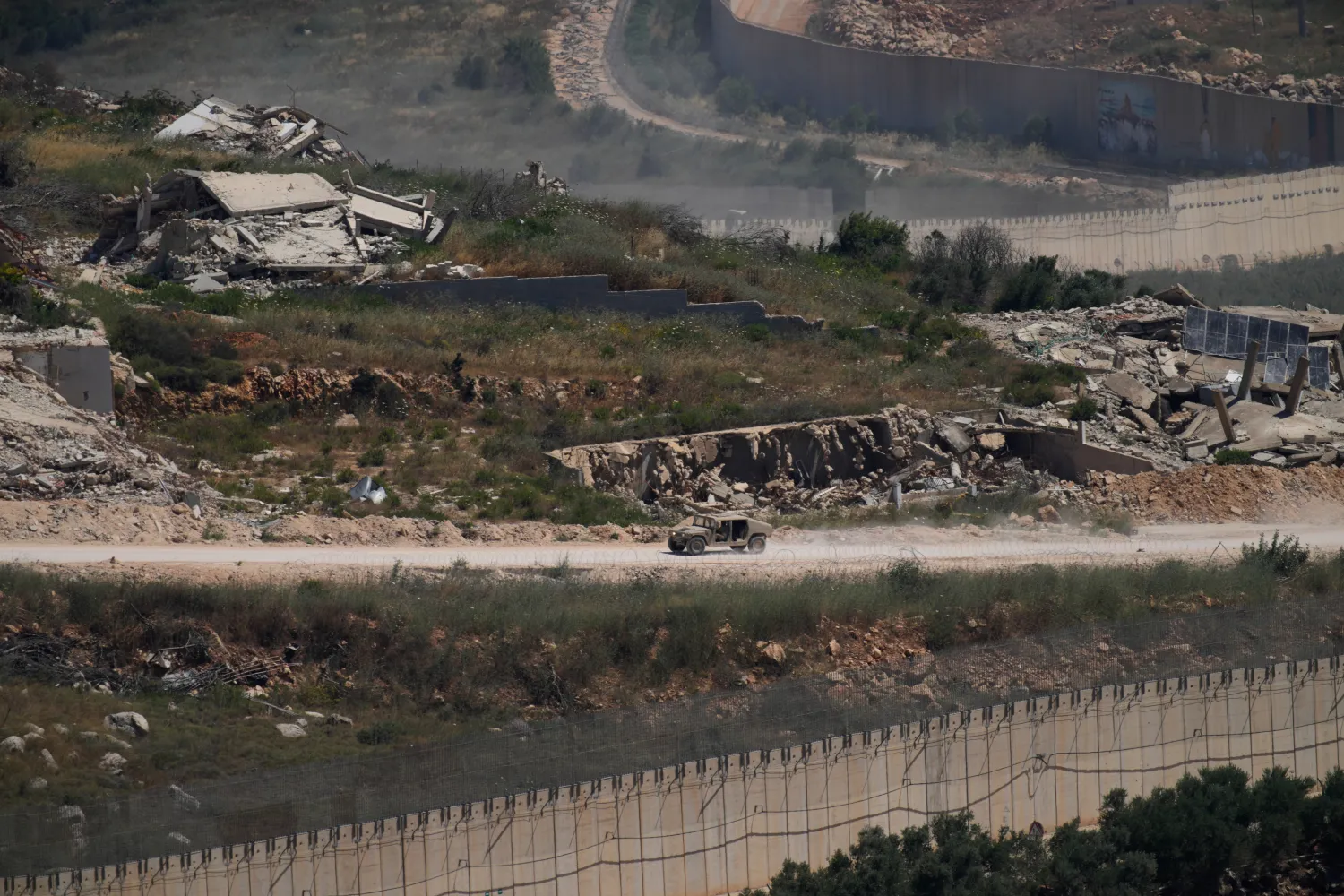
 An Israeli military vehicle moves past destroyed buildings in southern Lebanon as seen from northern Israel, Sunday, June 21, 2026. (AP)
An Israeli military vehicle moves past destroyed buildings in southern Lebanon as seen from northern Israel, Sunday, June 21, 2026. (AP)
TT

Israel PM Says Troops to Stay in South Lebanon ‘as Long as Necessary’

 An Israeli military vehicle moves past destroyed buildings in southern Lebanon as seen from northern Israel, Sunday, June 21, 2026. (AP)
An Israeli military vehicle moves past destroyed buildings in southern Lebanon as seen from northern Israel, Sunday, June 21, 2026. (AP)

Israeli Prime Minister Benjamin Netanyahu said on Sunday that Israeli forces would remain in occupied regions of southern Lebanon "as long as necessary", while also vowing to prevent Iran from acquiring nuclear weapons. 

"We will remain in the security zone in southern Lebanon for as long as necessary to protect the cherished residents of the north and all the citizens of Israel... Nothing will alter that commitment," Netanyahu said. 

"And with regard to Iran: whatever political developments may unfold, I will not allow Iran to acquire nuclear weapons. As long as I serve as prime minister of Israel, that will not happen." 

Israel's military chief said on Sunday that Hezbollah had suffered a severe blow fighting Israeli forces and was now in a "very difficult position", as he met with troops in southern Lebanon. 

He spoke as the United States and Iran held talks in Switzerland after signing a preliminary agreement to end the broader Middle East war, with the conflict in Lebanon threatening to derail the deal. 

"Hezbollah has suffered a severe and significant blow, and we are committed to remaining prepared to continue operating and prevent its rebuilding," Lieutenant General Eyal Zamir said, according to a military statement. 

"Hezbollah is in a very difficult position," he added. 

Hezbollah had pulled Lebanon into the Middle East war in early March when the Iran-backed Lebanese group fired rockets at Israel in retaliation for the killing of Iran's supreme leader in US-Israeli strikes. 

Despite a new ceasefire announcement on Friday as part of the memorandum of understanding signed by Tehran and Washington, Israel and Hezbollah had continued to clash. 

However, there were no reports of fresh strikes in Lebanon since Saturday evening. 

Zamir vowed to defend the communities of northern Israel from Hezbollah rockets. 

"This is the purpose guiding all our efforts... The ceasefire that has been declared is fragile, and we must maintain a high level of readiness for the renewal of combat operations," Zamir said. 

- Qassem - 

Hezbollah chief Naim Qassem on Sunday rejected any Israeli security zone in Lebanon. 

Israeli troops "remaining on Lebanese land is impossible. There are no security zones for Israel... we have a national army which deploys, and it is responsible for preserving sovereignty, and it is who we cooperate with," Qassem said in a televised address. 

"Israel is an aggressor and must leave. America bears full responsibility," he said, adding that "Israel will not remain in Lebanon, even if it increases its crimes, and we will defend ourselves." 

Qassem's address came as Washington and Tehran held talks in Switzerland after this week signing a preliminary agreement to end the broader Middle East war, which includes a halt to the hostilities in Lebanon. 

Ongoing Israeli strikes in recent days have threatened to derail the deal, but fighting in Lebanon has paused since Saturday evening, after Iran again closed the strategic Strait of Hormuz in response to Israel's attacks on Lebanon. 

"Any ceasefire under the banner of a comprehensive cessation of hostilities -- we have already committed to this if it happens, but we will not accept any violation. We will confront any violation... we will deal with it as we see fit," Qassem said. 

He urged Lebanese authorities to "take advantage of the path of the memorandum of understanding." 

"Look at the great Iran, closing the Strait of Hormuz for the sake of Lebanon. This is a weapon in your hands," he said, addressing the Lebanese authorities, adding, "Take up this weapon and use it." 

Under US pressure, Lebanon in April began direct talks with Israel in Washington aimed at ending the hostilities and separating the Israel-Hezbollah conflict.

Hezbollah has firmly rejected the direct talks, a fifth round of which is due to begin next week. 

Earlier on Sunday, Defense Minister Israel Katz said Israeli forces had standing orders to act against any threat inside Lebanon and insisted they would remain in the so-called security zone established within occupied Lebanese territory. 

"There has never been, and there is currently no restriction on Israeli soldiers in Lebanon from acting to eliminate threats... As Prime Minister Benjamin Netanyahu and I have made clear: Israel will not withdraw from the security zone in Lebanon," Israel Katz said in a statement, referring to an area extending roughly 10 kilometers (six miles) into Lebanese territory that Israel is occupying. 

Israeli forces and Hezbollah fighters engaged in fierce clashes this week, with Lebanese officials reporting dozens of people killed and the Israeli military reporting five of its own soldiers dead. 


Yemen Calls for Intensifying Regional Coordination over Maritime Navigation

 People walk past tents in al-Firdaws camp in Aden province, amid clashes between Iran-aligned Houthi fighters and Yemeni government forces, in Aden, Yemen, September 17, 2026. (Reuters)
People walk past tents in al-Firdaws camp in Aden province, amid clashes between Iran-aligned Houthi fighters and Yemeni government forces, in Aden, Yemen, September 17, 2026. (Reuters)
TT

Yemen Calls for Intensifying Regional Coordination over Maritime Navigation

 People walk past tents in al-Firdaws camp in Aden province, amid clashes between Iran-aligned Houthi fighters and Yemeni government forces, in Aden, Yemen, September 17, 2026. (Reuters)
People walk past tents in al-Firdaws camp in Aden province, amid clashes between Iran-aligned Houthi fighters and Yemeni government forces, in Aden, Yemen, September 17, 2026. (Reuters)

The Yemeni delegation participating in the multinational maritime coalition, headed by Rear Admiral Abdul Khaliq Monser, called for unifying international efforts and intensifying regional coordination to confront threats targeting the security of maritime navigation.

Monser stressed the importance of providing operational and technical support to restore the readiness of the Yemeni naval forces, enabling them to perform their duties in protecting territorial waters and international shipping lanes.

He said that the continuous threats launched by the Houthi militia in the Red Sea, the Bab al-Mandeb Strait, and the Gulf of Aden have directly impacted the security and safety of international navigation and affected trade movement and global supply chains.

The Yemeni armed forces said they thwarted an infiltration attempt carried out by the Houthi militia in the Al-Fulaiha sector, south of Marib Governorate.

The armed forces said 12 Houthi militants were killed in the clashes and other injured, while the remaining infiltrating elements fled.

Meanwhile, Yemeni government forces continue to confront Houthi attempts to seize control of the highlands located east of Bab al-Mandeb and west of Taiz. The Kahboub and al-Waziyah fronts witnessed fierce battles over the past 24 hours, while airstrikes targeted Houthi gatherings and vehicles.

The Houthi group is seeking to secure its positions of control in the Bab al-Mandeb Strait, Mayyun Island, and the west coast.

Two sources from the group told AFP that experts from the Iranian Revolutionary Guard Corps (IRGC) visited the Bab al-Mandeb region to tackle the installation of radars nearby and oversee tunnel excavation works in the mountainous hills overlooking it.


Report: Iranian Revolutionary Guards Experts Visit Bab al-Mandeb to Install Radars

A commercial vessel is anchored off Yemen's coast at Bab al-Mandeb, in the straits connecting the Red Sea with the Gulf of Aden and the Indian Ocean on September 12, 2026. (AFP)
TT

Report: Iranian Revolutionary Guards Experts Visit Bab al-Mandeb to Install Radars

A commercial vessel is anchored off Yemen's coast at Bab al-Mandeb, in the straits connecting the Red Sea with the Gulf of Aden and the Indian Ocean on September 12, 2026. (AFP)

Experts from the Iranian Revolutionary Guard Corps (IRGC) visited the Bab al-Mandeb region to tackle the installation of radars nearby and oversee tunnel excavation works in the mountainous hills overlooking it, two Houthi military sources told AFP on Saturday.

The sources stated that the Iranian experts working with the Houthis visited the Bab al-Mandeb region, the port and airport of Yemen’s Mokha, and the Jabal Al-Nar camp east of Mokha.

They added that the experts oversaw tunnel excavation works in the mountainous hills overlooking Mokha and Bab al-Mandeb, and discussed the process of installing radars near Mokha and inside Zuqar Island in the southern Red Sea.

The sources said that the experts came from Hodeidah, which held by the Houthis, and carried out separate visits between Thursday and Friday.

Meanwhile, Yemeni government sources told AFP on Saturday that battles had intensified between the Iran-backed Houthis and government forces around the Kahboub mountain region overlooking the Bab al-Mandeb area.

The conflict in Yemen has been experiencing a sharp escalation since July, against the backdrop of the war in the Middle East between Iran and the United States.


Syria Arrests Cell Leader over Security Force Deaths

Members of the Internal Security Forces in Syria (SANA)
TT

Syria Arrests Cell Leader over Security Force Deaths

Members of the Internal Security Forces in Syria (SANA)

Syrian authorities said on Saturday they arrested a leader of a cell involved in the deaths of three security force personnel during an anti-extremists operation in the south.

"The internal security forces of Daraa province have arrested Walid al-Fallah, one of the main leaders of the cell involved" in the deaths of the personnel in the town of Al-Sanamein in Daraa province, state news agency SANA reported.

The security force members were killed as they were attempting to arrest a member of the ISIS group, a local government official had told AFP.

The group has been territorially defeated in Syria but maintains sleeper cells.

Interior ministry spokesman Noureddine al-Baba said the anti-extremists operation, which saw five people arrested, "succeeded in dismantling criminal cells and others linked to ISIS that were coordinating with each other".

ISIS used to control vast areas of Syria and neighboring Iraq before being defeated in the two countries in 2019 and 2017, respectively.

However, in Syria it continues to periodically claim attacks against government forces, particularly in the vast desert region, as well as in the north and northeast.

It had also been established in the past in Daraa province, where its leader Abu Hassan al-Hashimi al-Qurashi was killed in October 2022 in clashes with local gunmen.

Last year, the new Syrian authorities, who overthrew president Bashar al-Assad in 2024, joined the US-led international coalition against ISIS.