
Israel PM Says Troops to Stay in South Lebanon ‘as Long as Necessary’

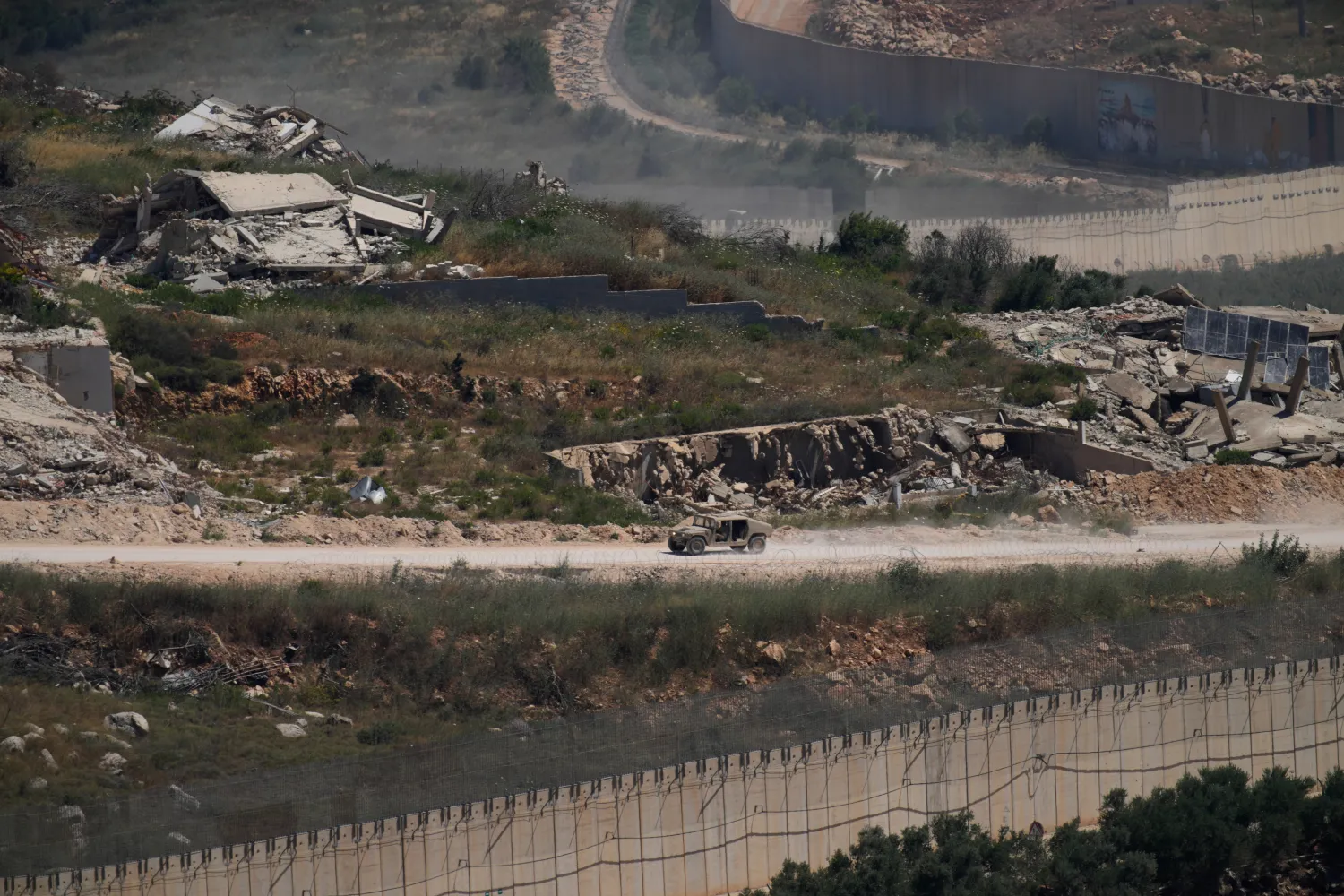
 An Israeli military vehicle moves past destroyed buildings in southern Lebanon as seen from northern Israel, Sunday, June 21, 2026. (AP)
An Israeli military vehicle moves past destroyed buildings in southern Lebanon as seen from northern Israel, Sunday, June 21, 2026. (AP)
TT

Israel PM Says Troops to Stay in South Lebanon ‘as Long as Necessary’

 An Israeli military vehicle moves past destroyed buildings in southern Lebanon as seen from northern Israel, Sunday, June 21, 2026. (AP)
An Israeli military vehicle moves past destroyed buildings in southern Lebanon as seen from northern Israel, Sunday, June 21, 2026. (AP)

Israeli Prime Minister Benjamin Netanyahu said on Sunday that Israeli forces would remain in occupied regions of southern Lebanon "as long as necessary", while also vowing to prevent Iran from acquiring nuclear weapons. 

"We will remain in the security zone in southern Lebanon for as long as necessary to protect the cherished residents of the north and all the citizens of Israel... Nothing will alter that commitment," Netanyahu said. 

"And with regard to Iran: whatever political developments may unfold, I will not allow Iran to acquire nuclear weapons. As long as I serve as prime minister of Israel, that will not happen." 

Israel's military chief said on Sunday that Hezbollah had suffered a severe blow fighting Israeli forces and was now in a "very difficult position", as he met with troops in southern Lebanon. 

He spoke as the United States and Iran held talks in Switzerland after signing a preliminary agreement to end the broader Middle East war, with the conflict in Lebanon threatening to derail the deal. 

"Hezbollah has suffered a severe and significant blow, and we are committed to remaining prepared to continue operating and prevent its rebuilding," Lieutenant General Eyal Zamir said, according to a military statement. 

"Hezbollah is in a very difficult position," he added. 

Hezbollah had pulled Lebanon into the Middle East war in early March when the Iran-backed Lebanese group fired rockets at Israel in retaliation for the killing of Iran's supreme leader in US-Israeli strikes. 

Despite a new ceasefire announcement on Friday as part of the memorandum of understanding signed by Tehran and Washington, Israel and Hezbollah had continued to clash. 

However, there were no reports of fresh strikes in Lebanon since Saturday evening. 

Zamir vowed to defend the communities of northern Israel from Hezbollah rockets. 

"This is the purpose guiding all our efforts... The ceasefire that has been declared is fragile, and we must maintain a high level of readiness for the renewal of combat operations," Zamir said. 

- Qassem - 

Hezbollah chief Naim Qassem on Sunday rejected any Israeli security zone in Lebanon. 

Israeli troops "remaining on Lebanese land is impossible. There are no security zones for Israel... we have a national army which deploys, and it is responsible for preserving sovereignty, and it is who we cooperate with," Qassem said in a televised address. 

"Israel is an aggressor and must leave. America bears full responsibility," he said, adding that "Israel will not remain in Lebanon, even if it increases its crimes, and we will defend ourselves." 

Qassem's address came as Washington and Tehran held talks in Switzerland after this week signing a preliminary agreement to end the broader Middle East war, which includes a halt to the hostilities in Lebanon. 

Ongoing Israeli strikes in recent days have threatened to derail the deal, but fighting in Lebanon has paused since Saturday evening, after Iran again closed the strategic Strait of Hormuz in response to Israel's attacks on Lebanon. 

"Any ceasefire under the banner of a comprehensive cessation of hostilities -- we have already committed to this if it happens, but we will not accept any violation. We will confront any violation... we will deal with it as we see fit," Qassem said. 

He urged Lebanese authorities to "take advantage of the path of the memorandum of understanding." 

"Look at the great Iran, closing the Strait of Hormuz for the sake of Lebanon. This is a weapon in your hands," he said, addressing the Lebanese authorities, adding, "Take up this weapon and use it." 

Under US pressure, Lebanon in April began direct talks with Israel in Washington aimed at ending the hostilities and separating the Israel-Hezbollah conflict.

Hezbollah has firmly rejected the direct talks, a fifth round of which is due to begin next week. 

Earlier on Sunday, Defense Minister Israel Katz said Israeli forces had standing orders to act against any threat inside Lebanon and insisted they would remain in the so-called security zone established within occupied Lebanese territory. 

"There has never been, and there is currently no restriction on Israeli soldiers in Lebanon from acting to eliminate threats... As Prime Minister Benjamin Netanyahu and I have made clear: Israel will not withdraw from the security zone in Lebanon," Israel Katz said in a statement, referring to an area extending roughly 10 kilometers (six miles) into Lebanese territory that Israel is occupying. 

Israeli forces and Hezbollah fighters engaged in fierce clashes this week, with Lebanese officials reporting dozens of people killed and the Israeli military reporting five of its own soldiers dead. 


UN: Yemen Situation Rapidly Evolving as Restrictions Hamper Access to Western Coast

The United Nations said the latest events had displaced more than 100,000 people since the start of the month (AP)
TT

UN: Yemen Situation Rapidly Evolving as Restrictions Hamper Access to Western Coast

The United Nations said the latest events had displaced more than 100,000 people since the start of the month (AP)

More than 100,000 people have been displaced in Yemen since the beginning of September, most of them heading to the provinces of Taiz and Lahj, the United Nations said.

The pace of displacement has risen sharply since Sept. 3, Laurent Bukera, the UN resident and humanitarian coordinator for Yemen, told Asharq Al-Awsat.

Bukera said the United Nations was prepared to respond to further waves of displacement and an expected increase in humanitarian needs in Yemen as fighting continues along the western coast. More than 60,000 displaced people had received assistance through the Rapid Response Mechanism as of Sept. 15.

The movement of humanitarian workers has been affected in several areas along the western coast, he said, warning that insecurity, movement restrictions and communications outages continue to hamper access to some locations.

Bukera stressed the urgent need to ensure safe and sustained humanitarian access, provide safe passage for those fleeing the fighting, and secure the resources needed for a rapid response as needs continue to grow.

Displacement surges

The latest figures from the International Organization for Migration show that more than 100,000 people have been displaced since the start of September, Bukera said.

The situation remains fluid, with the number of internally displaced people expected to rise.

The United Nations and its humanitarian partners are supporting the most vulnerable people across Yemen, particularly those displaced, wherever security, access and available resources allow.

UNICEF said the fighting displaced more than 57,000 children in just two weeks and cut children off from essential services. It warned that the escalation was deepening a crisis in which 12.2 million children need humanitarian assistance.

Urgent needs, dwindling supplies

The most urgent needs include emergency shelter, household essentials, food, safe water, sanitation, emergency health care, protection and cash assistance, Bukera said.

Many of those displaced were already living in highly vulnerable conditions. Some have been forced to flee more than once.

Humanitarian response capacity is under severe pressure as supplies run low and funding remains scarce, Bukera said. Insecurity and movement restrictions are making it harder to reach people quickly.

Major gaps remain in shelter, water and sanitation, food security, health, nutrition, protection and cash assistance.

The Rapid Response Mechanism is working under a planning scenario designed to address any sharp increase in needs, Bukera said.

Aid workers and warehouses at risk

Asked about the change of control in Mokha, Bukera said the immediate priority was the safety and well-being of civilians, particularly those forced to flee or cut off from essential services and humanitarian aid by the recent fighting.

UN agencies are assessing needs and adapting their response to keep aid flowing, he said.

The safety of humanitarian workers and the security of offices, warehouses and other humanitarian assets remain a “matter of grave concern.”

Humanitarian workers, facilities and assets must be respected and protected at all times, Bukera said. Aid must also be allowed to move safely and without obstruction so life-saving relief can reach those in need.

Taiz and Lahj take in most of the displaced

Humanitarian partners are delivering immediate aid in affected areas and communities receiving displaced people, including Taiz and Lahj, which have taken in the largest numbers.

Registration is continuing as displacement and humanitarian needs rise.

More than 60,000 internally displaced people had received aid through the Rapid Response Mechanism by Sept. 15, in addition to other support for displaced families, Bukera said.

Access remains difficult in some locations because of insecurity, movement restrictions and communications outages.

The UN Office for the Coordination of Humanitarian Affairs remains in contact with the relevant authorities to facilitate aid deliveries and secure safe passage for civilians.

UN prepares for wider crisis

The United Nations is responding to the current crisis while preparing for further waves of displacement and mounting humanitarian needs, Bukera said.

Humanitarian partners are developing planning scenarios covering rapid-response assistance, multipurpose cash aid and multisector support, including food supplies, to meet the needs of large numbers of people.

Bukera called for civilians and civilian infrastructure, including displacement sites, roads, schools and hospitals to be protected at all times.

He renewed calls for safe passage for those fleeing the fighting and for the resources needed to keep pace with the escalating humanitarian needs.


Arab Interior Ministers Council Condemns Houthi UAV Launch Toward Makkah

Arab Interior Ministers Council Condemns Houthi UAV Launch Toward Makkah
TT

Arab Interior Ministers Council Condemns Houthi UAV Launch Toward Makkah

Arab Interior Ministers Council Condemns Houthi UAV Launch Toward Makkah

The General Secretariat of the Arab Interior Ministers Council strongly condemned reports that the terrorist Houthi militia launched a UAV toward Makkah on Wednesday.

The Royal Saudi Air Defense Forces successfully intercepted and destroyed the UAV before it entered Makkah's prohibited airspace, SPA reported.

In a statement, the General Secretariat said: “While expressing its firm condemnation and absolute denunciation of this cowardly terrorist attack, which constitutes a blatant violation of the rules of international law, a flagrant breach of the sanctity of the Grand Mosque and the holy sites, and a provocation to the feelings of all Muslims, the General Secretariat affirms its full solidarity and complete support for the Kingdom of Saudi Arabia in the measures it takes to protect its territory and holy sites, preserve its security and stability, and safeguard the safety of its citizens and residents.”


Raid on ISIS Site in Daraa Countryside Leaves 3 Syrian Security Personnel Dead

Syrian security forces personnel (AFP - File Photo)
TT

Raid on ISIS Site in Daraa Countryside Leaves 3 Syrian Security Personnel Dead

Syrian security forces personnel (AFP - File Photo)

Internal Security Forces raided a site in the town of Al-Sanamayn in the Daraa countryside on Thursday where an armed group affiliated with ISIS was holed up, after tightening the siege around the group and giving its members a deadline to surrender, which they did not heed.

The Internal Security Forces said through their official channels that the security operation in Al-Sanamayn was ongoing, confirming that the outlawed armed group was affiliated with ISIS.

The forces said they had tightened the siege around the group and given its members a deadline to surrender, but they did not respond, prompting the raid on the site where they were holed up.

Earlier on Thursday, three members of the Internal Security Forces were killed and others were wounded in a clash with an armed group in the town of Al-Sanamayn in Daraa Governorate, southern Syria, while carrying out a security raid targeting a wanted individual, according to a statement issued by the Internal Security Forces.

Member of an ISIS cell being arrested in Daraya, Damascus countryside (File Photo - SANA)

A government source said that an "outlawed armed group led by the wanted individual" had "targeted the patrol and engaged its members in a firefight while they were carrying out the mission."

It added that security forces had deployed throughout the town to pursue members of the group and announced a "temporary curfew" there.

A local government source told Agence France-Presse that the wanted individual who clashed with the security forces belonged to the group.

The group carries out attacks from time to time, particularly against Syrian security forces, after urging its members to fight the new authorities following the ouster of former President Bashar Al-Assad in December 2024.

The Syrian government officially joined the international coalition against the extremist group late last year. The group's presence in Syria was concentrated in the north and northeast and in the Badia region, but it also maintains cells in the south.

The group announced in 2022 that its leader, Abu Al-Hassan Al-Hashimi Al-Qurashi, had been killed in fighting whose date it did not specify. It later emerged that the fighting had taken place in Daraa Governorate.