


Israel Strikes South Lebanon despite Framework Agreement to End Hostilities

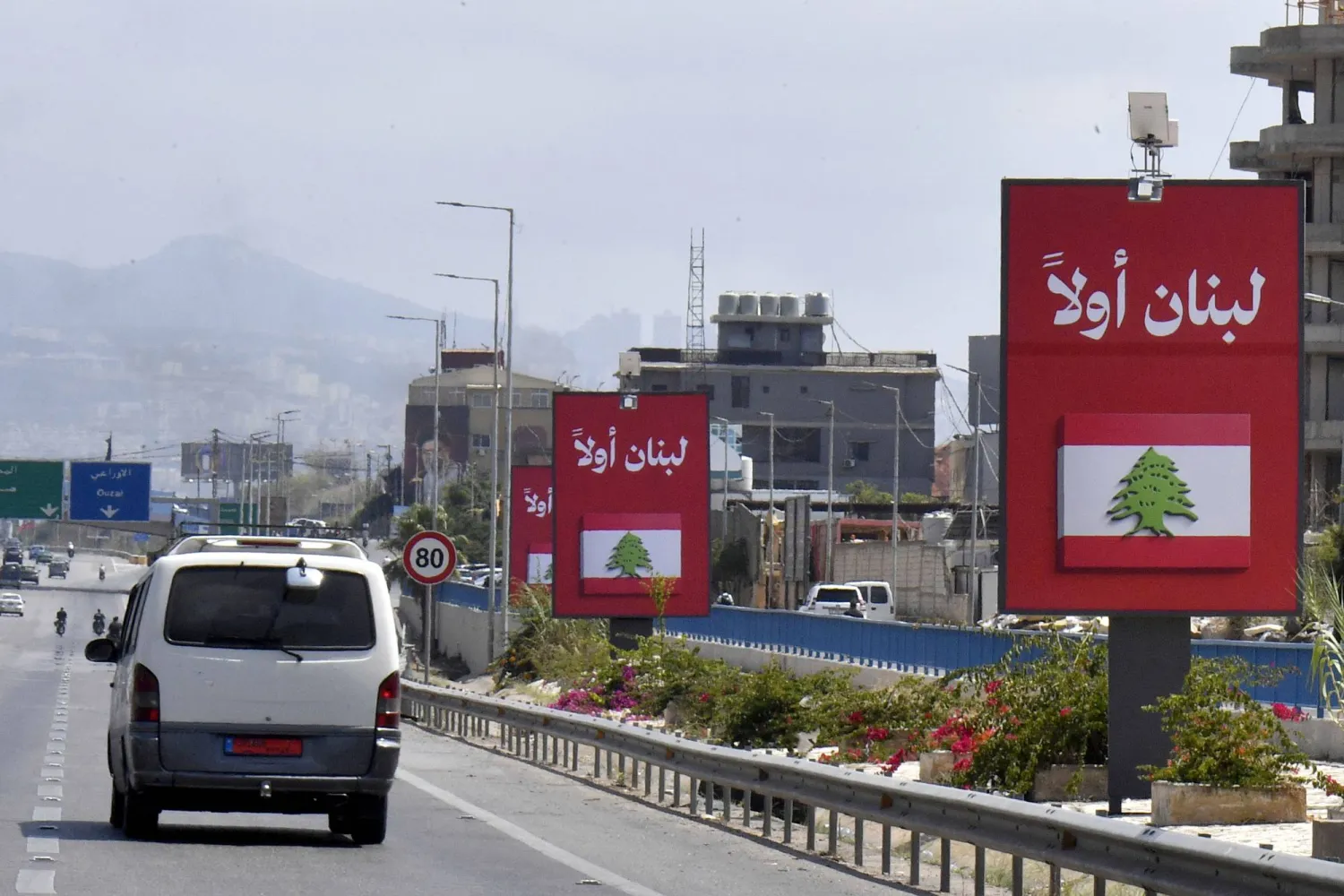
Billboards reading 'Lebanon First' are displayed alongside the airport highway in Beirut, Lebanon, 27 June 2026, amid a ceasefire between Israel and Lebanon.  EPA/WAEL HAMZEH
Billboards reading 'Lebanon First' are displayed alongside the airport highway in Beirut, Lebanon, 27 June 2026, amid a ceasefire between Israel and Lebanon. EPA/WAEL HAMZEH
TT

Israel Strikes South Lebanon despite Framework Agreement to End Hostilities

Billboards reading 'Lebanon First' are displayed alongside the airport highway in Beirut, Lebanon, 27 June 2026, amid a ceasefire between Israel and Lebanon.  EPA/WAEL HAMZEH
Billboards reading 'Lebanon First' are displayed alongside the airport highway in Beirut, Lebanon, 27 June 2026, amid a ceasefire between Israel and Lebanon. EPA/WAEL HAMZEH

Israel renewed its strikes on Lebanon on Sunday, Lebanese state media reported, two days after an agreement was signed by the two countries, which a Hezbollah lawmaker warned would lead to "internal conflict".

The strikes come a day after one person was killed in an Israeli strike on the south, according to Lebanon's health ministry, with the Israeli military saying it targeted Hezbollah members near its self-proclaimed "security zone", which reaches 10 kilometres (6 miles) into Lebanon.

Lebanon's state-run National News Agency (NNA) reported several strikes on Sunday.

The Israeli army said a soldier "fell in combat" in southern Lebanon.

In a later statement, Israeli military chief Eyal Zamir approved plans for "continued operations in the security zone, in accordance with the ceasefire agreement".

Lebanese President Joseph Aoun told his US counterpart Donald Trump on Saturday that his country "would assume its responsibilities" in implementing the framework agreement, which was signed in Washington on Friday after five rounds of talks.

The deal aims to pave the way for peace between Israel and Lebanon, who have officially been at war for decades, though Israel's many conflicts across its northern border have largely been with non-state actors.

The agreement makes any Israeli withdrawal from occupied Lebanese land conditional on Beirut disarming Hezbollah, which is backed by Iran.

Israeli Prime Minister Benjamin Netanyahu called the deal "historic" for his country.

- 'Internal conflict' -

Hezbollah strongly opposed the talks with Israel from the start and rejects the agreement, with leader Naim Qassem saying on Saturday that the group would treat the deal as "null and void" and describing it as "a surrender of sovereignty".

His supporters took to the streets on Friday evening to protest the framework.

An AFP correspondent saw signs on Sunday morning that read "Lebanon first" being burned along Beirut's airport road, which borders the city's southern suburbs, a Hezbollah stronghold, after previous billboards saying "thank you Iran" were removed.

Hezbollah lawmaker Hassan Fadlallah said on Sunday that "the agreement of humiliation and disgrace signed by the authorities will never see the light of day".

He added that what "the authorities have done amounts to sedition aimed at pushing the country into chaos and shifting the conflict from one with the enemy to an internal conflict".

Hezbollah repeatedly asked Lebanese authorities to link themselves to Iran's negotiations to end its war with the US, while Tehran has insisted any ceasefire for the Middle East war should include Lebanon.

In a phone conversation with his Lebanese counterpart Nabih Berri, Iranian parliament speaker and head of Tehran's negotiating delegation Mohammad Bagher Ghalibaf said that "our goal is to end the war in Lebanon, return the refugees to their homes and remove the occupation and the withdrawal of the Zionist regime from the Lebanese territory, and we are seriously pursuing this issue".

According to the text of the deal shared by the US State Department, Lebanon and Israel expressed their intent to "conclusively end the conflict, address its underlying causes and... formally conclude any state of war between them".

Under the agreement, Lebanon's military will "restore effective sovereign authority over all Lebanese territory, pending the verified disarmament of non-state armed groups".

Israel's Defense Minister Israel Katz, however, has insisted troops will stay in Lebanon so long as Hezbollah remains armed.



Lebanon Central Bank Says New Audit to Scrutinize Transactions for Graft

A view shows Lebanon's Central Bank building in Beirut, Lebanon August 25, 2023. (Reuters)
TT

Lebanon Central Bank Says New Audit to Scrutinize Transactions for Graft

A view shows Lebanon's Central Bank building in Beirut, Lebanon August 25, 2023. (Reuters)

Lebanon's central bank said Wednesday that an outside firm had begun a forensic audit into past transactions linked to its foreign assets, scrutinizing them for evidence of graft in the wake of the country's economic collapse.

The move is part of measures the institution has taken to improve oversight, steps that have also resulted in the arrest of the body's former governor, Riad Salameh.

A forensic audit has also been a key demand of the international community and the International Monetary Fund as Lebanon seeks bailout funds after the economic crash, which began in 2019.

The central bank said Wednesday that on August 17, the New York-based Alvarez & Marsal began the forensic audit of "selected transactions", covering the period from October 2019 to the end of 2023.

The audit includes "transactions related to the central bank's foreign assets, including subsidy programs for essential goods and materials" as well as other transfers, it said.

In May, the central bank had said that the audit aimed to verify that payments and transfers "were executed pursuant to proper authorizations and approvals", and that funds "were used for their intended purposes, without any violation, misuse, or misappropriation".

In 2020, Alvarez & Marsal had launched an audit of the central bank but later halted work after the body failed to hand over necessary data.

The firm resumed that audit the following year, and its preliminary report in 2023 painted a damning picture of the institution under long-serving former governor Salameh.

Salameh, who headed the bank from 1993 to July 2023, is widely viewed as a key culprit in the country's dramatic economic crash and is accused of having amassed a fortune during his time in the job.

He has faced numerous accusations including embezzlement and tax evasion in probes in Lebanon and abroad but has consistently denied any wrongdoing, insisting he is being made a "scapegoat" for the economic collapse.

He was arrested in September 2024 and charged with offenses including the alleged embezzlement of $44 million from the central bank, but was released a year later after posting record bail of more than $14 million.

He was placed in custody again in July over accusations including embezzlement and illegal enrichment after a complaint lodged by the new central bank authorities.


Israel Ready to Remove Gaza Population if US Gives Approval, Says Minister

An Israeli military vehicle maneuvers in Gaza, as seen from the Israeli side of the border, September 1, 2026. (Reuters)
TT

Israel Ready to Remove Gaza Population if US Gives Approval, Says Minister

An Israeli military vehicle maneuvers in Gaza, as seen from the Israeli side of the border, September 1, 2026. (Reuters)

Israel has plans ready to remove Palestinians from the Gaza Strip but is waiting for the United States to figure out where to take them, the defense minister said Wednesday.

"There is no real solution for Gaza in the end without this migration," Defense Minister Israel Katz told a conference hosted by Israeli news site Ynet and newspaper Yedioth Ahronoth.

The Israeli government "is organized and prepared to get them out -- by sea, by air, by every way possible", he said.

The US embassy referred requests for comment to the State Department in Washington.

US President Donald Trump, at the start of his second term, stunned much of the world by calling for all two million Palestinians to leave the Gaza Strip.

Trump spoke of developing the Mediterranean territory, devastated by Israeli bombardment since the October 7, 2023 attack by Hamas, into a luxury resort destination.

Trump walked back the idea following strong pushback including from Egypt, the only country other than Israel to border Gaza.

The proposal was also condemned by Palestinians themselves, for whom any effort to force them off their land would recall the "Nakba", or catastrophe -- their mass displacement during Israel's creation in 1948.

Announcing a Gaza war ceasefire in October, Trump laid out 20 points for the territory that included no forced displacement.

Katz, known for his outspoken remarks, said that Trump had only "frozen" the idea as he looks for countries to take in Palestinians.

"The plan hasn't been cancelled; it is being discussed all the time, even now, and I think there is no other solution for everyone's good," he said.

"But for it to happen, we need the US. When will we get their approval? Whenever it becomes clear that Hamas is not meeting its obligations" under the ceasefire, he said.

Katz, without citing his source, said 80 percent of people in Gaza wanted to leave but that Hamas was preventing them.

Forced displacement of civilians in occupied territory is considered a war crime under the Geneva Conventions.

The International Criminal Court has issued arrest warrants for Prime Minister Benjamin Netanyahu and Katz's predecessor Yoav Gallant over alleged war crimes, which both Israel and the United States deny.

Israeli attacks have already internally displaced the vast majority of Gaza's people following the unprecedented Hamas attack, which killed 1,221 people, according to official Israeli figures.

Israel's offensive has since claimed 73,470 lives in Gaza, with more than 1,330 since the ceasefire, according to the Gaza health ministry, which operates under Hamas.


Netanyahu Says ‘We Are Not Retreating’ During Gaza Visit

Prime Minister Benjamin Netanyahu in Gaza on Wednesday. (Netanyahu on X)
TT

Netanyahu Says ‘We Are Not Retreating’ During Gaza Visit

Prime Minister Benjamin Netanyahu in Gaza on Wednesday. (Netanyahu on X)

Prime Minister Benjamin Netanyahu on Wednesday visited Israeli forces in the Gaza Strip, where he vowed not to pull back troops despite a recent push by mediators to advance a US-backed ceasefire plan calling for their withdrawal.

It was the first time Netanyahu has visited the war-shattered territory since the ceasefire between Israel and Hamas came into effect in October 2025.

"We control the area. We are not retreating. We are staying on this line," Netanyahu said near the so-called Yellow Line, which demarcates the areas under Hamas and Israeli military control.

"We control 60 percent of the Strip, and we are not stopping, because we are eliminating the terrorists who threaten us, day in and day out."

Israel has kept striking the Gaza Strip and its forces have made further inroads despite the US-brokered ceasefire, insisting it must eliminate threats from Hamas, which led the unprecedented October 7, 2023 attack against Israel.

International appeals to move to the next stages of the US-led peace plan have not stopped Israel targeting Palestinians it says are militants.

Netanyahu, facing tight elections in October, last month rejected a proposal for advancing to the next stage of the plan after Hamas said it had agreed to hand over its weapons.

The Israeli premier has vowed no military pullout until the Palestinian movement is "genuinely" disarmed.

On Tuesday, Israel said its forces and a Palestinian anti-Hamas militia captured the head of Hamas's internal security apparatus during a ground operation in Gaza City that Palestinian health officials said killed four people.

Hamas's Interior Ministry identified the man as Muein al-Arabid, and said he was an "officer in the internal security service", but did not mention whether he was its chief.

"We are doing everything to reach our goal -- disarming Hamas and demilitarizing Gaza. Gaza will no longer pose a threat to Israel," Netanyahu said Wednesday, adding that "there is still work left to complete -- and we will complete it".

Israel's defense minister on Wednesday said the country had plans to remove Palestinians from the Gaza Strip but was waiting for the United States to figure out where to take them.

"There is no real solution for Gaza in the end without this migration," Defense Minister Israel Katz told a conference hosted by Israeli news site Ynet and newspaper Yedioth Ahronoth.

The Israeli government "is organized and prepared to get them out -- by sea, by air, by every way possible", he said.

Similar suggestions in the past that Gazans could be displaced from the territory entirely have drawn international outrage, as well as condemnation from Palestinians themselves.

Announcing the Gaza war ceasefire in October, Trump laid out 20 points for the territory that included no forced displacement.

Forced displacement of civilians in occupied territory is considered a war crime under the Geneva Conventions.

Israeli operations in Gaza have killed at least 1,334 people since the ceasefire came into effect, according to the Palestinian territory's health ministry, which also operates under Hamas authority and whose figures are considered reliable by the United Nations.

The Israeli army has reported five deaths in its ranks over the same period, as well as the death of one civilian contractor.