



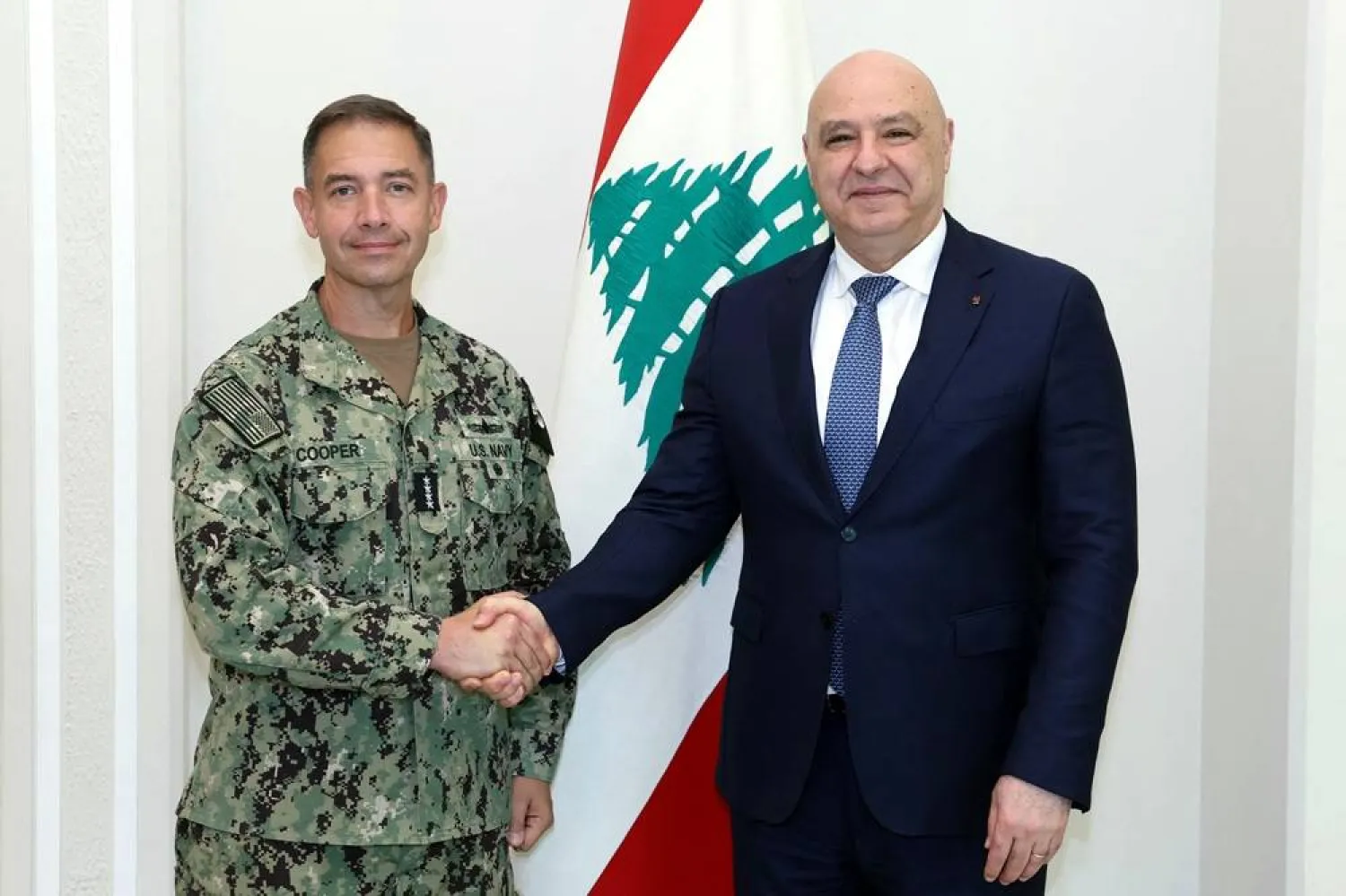

Lebanese President Joseph Aoun told the US Central Command chief on Monday that he was committed to extending the state's control through its military up to the border with Israel, where Iran-backed group Hezbollah maintains a strong presence.
He reaffirmed to Admiral Brad Cooper "the Lebanese state's determination to extend its authority, through its armed forces, to the southern border", the presidency said in a statement, adding that the pair discussed preparations for implementing a framework agreement between Lebanon, Israel and the US.
Earlier, Lebanese army commander Rodolphe Haykal met with Cooper to discuss the implementation of the agreement that was signed last week with the aim to halt hostilities between Israel and Hezbollah.
Haykal received Cooper, with the discussions addressing "the latest developments in Lebanon and the region", a Lebanese army statement said.
They also discussed "the importance of successfully implementing the security annex of the framework agreement", as well as ways of strengthening future cooperation, the statement added.
On Friday, Lebanon and Israel, under US sponsorship, signed a "trilateral framework" agreement seeking to end hostilities, after the Iran-backed Hezbollah drew Lebanon into the Middle East war in March with rocket fire at Israel, triggering Israeli airstrikes and a ground invasion.
The deal commits Lebanon to restoring sovereignty over its territory through the "verified disarmament of non-state armed groups and dismantlement of associated infrastructure", enabling a progressive Israeli withdrawal, according to the text released by the State Department.
"The components of this process will be detailed in a Security Annex, developed with the full support of the United States," the text said, without immediately publishing the annex.
US Secretary of State Marco Rubio said on Friday that Washington would reimburse Lebanon's army for $30 million as it seeks to "improve the capability and capacity" of the Lebanese military.
Washington has long been a key supporter of Lebanon's army.
Hezbollah chief Naim Qassem has called the agreement "null and void" and instead called for the implementation of a US-Iran memorandum of understanding to halt the regional war that included Lebanon.
The Israel-Lebanon talks in Washington have sought to separate Lebanon from the Iran deal.
However, Friday's agreement came after a lull in fighting that followed the US-Iran memorandum, which Tehran insisted should include Lebanon.
Hezbollah on Monday said it reserved the right to self-defense after several Israeli attacks on southern Lebanon the day before, accusing Israel of a "blatant violation of the ceasefire".
Israeli troops are operating in a self-declared occupied "security zone" stretching around 10 kilometers (six miles) deep inside Lebanese territory along the border.
Lebanese authorities say Israeli attacks since the war began on March 2 have killed more than 4,200 people.


