
Implementation of Deal on Pilot Zones in Southern Lebanon Runs into Israeli, Hezbollah Resistance

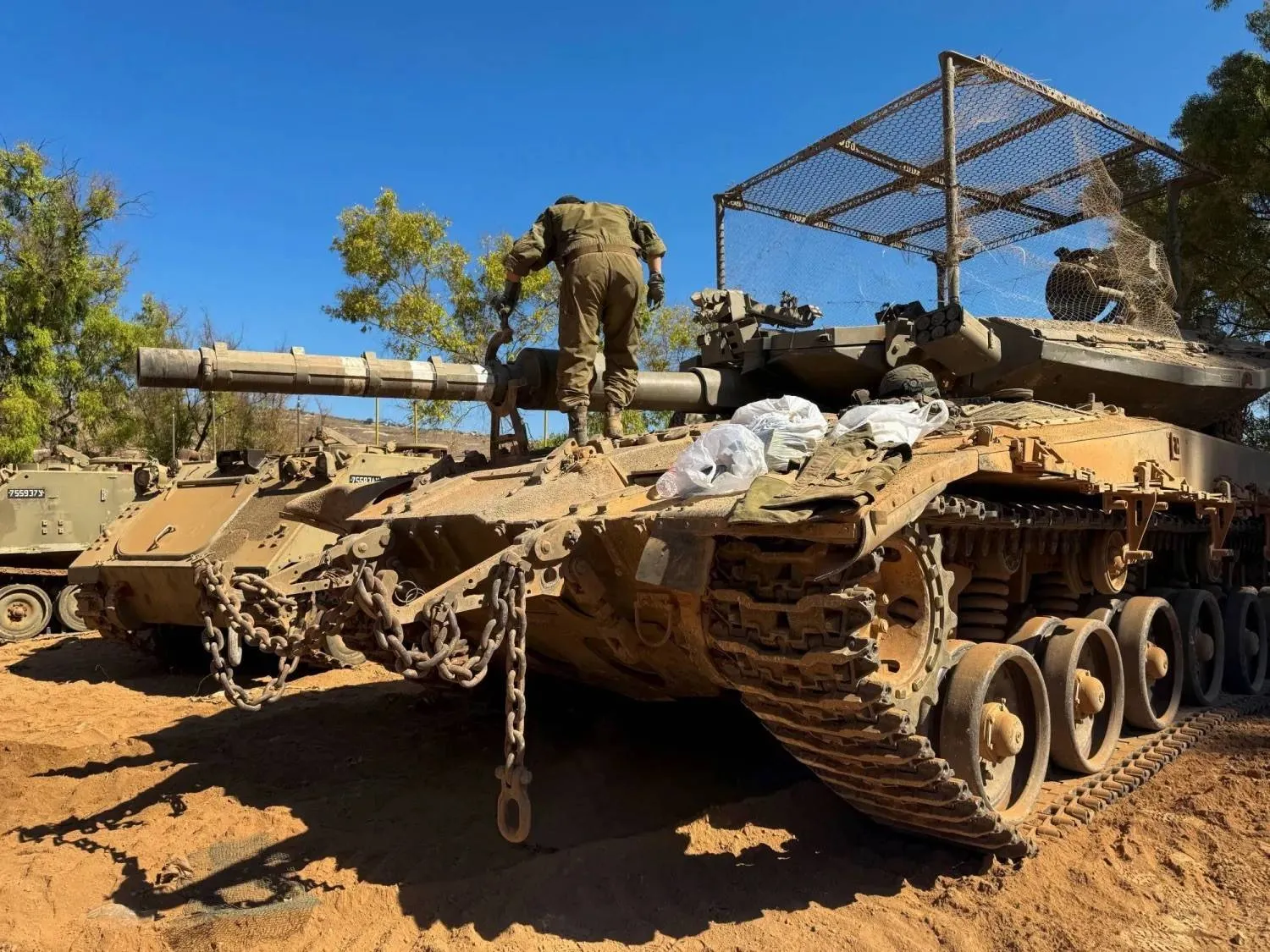
An Israeli soldier works on a tank on the Israeli side of the Israel-Lebanon border (Reuters)
TT

Implementation of Deal on Pilot Zones in Southern Lebanon Runs into Israeli, Hezbollah Resistance

An Israeli soldier works on a tank on the Israeli side of the Israel-Lebanon border (Reuters)

Lebanon is awaiting the launch of the first phase of Israel’s withdrawal from two pilot areas in the south, although no date has yet been set. The move remains uncertain amid Israeli military violations and threats, while Hezbollah continues to denounce the US-brokered framework agreement as “nonexistent” and refuses to cooperate in its implementation.

Speaking Sunday from Beaufort Castle overlooking southern Lebanon, Israeli Chief of Staff Lt. Gen. Eyal Zamir issued fresh warnings.

He described the Beaufort area as “packed with terrorist infrastructure,” saying Hezbollah, “with Iranian funding and direction,” had spent decades building underground tunnels and military networks there to threaten Israeli communities in the north.

Zamir stressed that the Lebanese army “must fulfill its commitments under the historic agreement” by clearing the area of Hezbollah operatives.

He added that the Israeli military would continue acting “decisively” against threats from Lebanese territory and was prepared to launch a rapid offensive if the ceasefire were violated.

He also claimed Hezbollah had been significantly weakened by Israeli military operations and was now relying on Iran for support.

Israeli Pressure, Hezbollah Rejection

Against this backdrop, Lebanese officials say implementation of the pilot-zone provision is being hindered by resistance from both Israel and Hezbollah.

Ministerial sources told Asharq Al-Awsat that contacts are underway to establish a US-chaired trilateral committee comprising the United States, Lebanon, and Israel to oversee the deployment of the Lebanese army in two pilot zones covering the towns of Froun and Ghandouriyeh in Bint Jbeil district, and Zawtar al-Gharbiyeh in Nabatieh district.

The committee would supervise the pilot phase, with Washington expected to pressure Israel to proceed. However, the sources said Hezbollah’s refusal to cooperate further complicates implementation.

US Mediation

The sources said Washington is holding talks with both Iran and Israel in an effort to devise a mechanism for a simultaneous Israeli withdrawal and Hezbollah redeployment. Israel insists that its withdrawal be linked to Hezbollah’s evacuation of the areas, while Hezbollah maintains that no such steps will be taken before Israel pulls out.

They added that contacts had slowed in recent days because of Iran’s near-total absence from diplomatic exchanges, as Tehran has been preoccupied with funeral ceremonies following the death of Supreme Leader Ali Khamenei.

Despite the lull, Israel’s public broadcaster Kan reported Sunday that preparations for the next withdrawal phase were advancing under direct US coordination.

The plan calls for a joint mechanism to oversee the ceasefire and transfer security responsibility to the Lebanese army.

The pilot phase is part of the US-brokered framework agreement, which envisions two experimental security zones under the exclusive control of the Lebanese army, alongside reconstruction efforts and the return of displaced residents, under the supervision of a US-led trilateral military coordination group.

Continuing Violations

Israeli forces continued military operations in southern Lebanon. Artillery shelled the towns of Braachit and Deir Siryan, while an Israeli drone dropped two stun grenades over Hadatha in Bint Jbeil district.

An Israeli helicopter also carried out aerial sweeps over Majdal Zoun, while fighter jets flew over Beirut’s southern suburbs, Sidon, and surrounding areas. Israeli forces also continued demolishing homes and neighborhoods in several southern villages, most recently in Talloussah in Marjayoun district.

Meanwhile, the Lebanese army said its engineering units had dismantled four unexploded Israeli munitions in Meifadoun, Braachit, Kfardounine, and Shaqra, moving them to secure locations while urging residents to report suspicious objects.

Politically, Hezbollah escalated its criticism of the framework agreement. Hezbollah MP Hassan Fadlallah argued that the deal “has no provision that serves Lebanon,” claiming it seeks to achieve through diplomacy what Israel failed to impose by force: entrenching the occupation, creating a buffer zone, shielding Israel from international legal accountability, and ultimately eliminating the “resistance.”

Fadlallah also asserted that the agreement lacks constitutional, legal, and national legitimacy, declaring that Hezbollah would not allow its implementation.

He insisted that southern Lebanon’s villages “are not a testing ground” and that the group would continue to uphold what it described as its right to defend Lebanon.


Al-Alimi: Bab Al-Mandab Should Not Become Another Strait of Hormuz

Yemeni Presidential Leadership Council Chairman Rashad Al-Alimi (Saba)
TT

Al-Alimi: Bab Al-Mandab Should Not Become Another Strait of Hormuz

Yemeni Presidential Leadership Council Chairman Rashad Al-Alimi (Saba)

Head of Yemen’s Presidential Leadership Council (PLC) Dr. Rashad Al-Alimi has stressed that Bab Al-Mandab must not be allowed to become another Strait of Hormuz, nor should Yemen be turned into a platform for geopolitical blackmail on behalf of Tehran.

Alimi met on Thursday with Head of the European Union Delegation Patrick Simonnet and Ambassador of the Netherlands Janet Sebben. They discussed areas of bilateral cooperation, as well as the latest local and regional developments.

He affirmed the state would continue to fulfill the aspirations of the Yemeni people. “It would continue to assume its responsibility to protect its citizens, restore its institutions, extend its authority throughout the national territory, and safeguard its coastline, ports, and territorial waters,” Alimi said.

Al-Alimi stressed that Yemen, as it defends Bab Al-Mandab, its coastline, and territorial waters and makes sacrifices to protect them, is defending not only its own security and sovereignty, but also contributing to international security and protecting global interests.

He said Yemen is helping to secure one of the world’s most important maritime routes for trade, energy supplies, and life-saving food commodities.

He stressed that this shared responsibility requires a more effective international partnership to support the Yemeni state and strengthen its ability to protect this strategic maritime route.

The President pointed to the clear link between this escalation and Iran’s broader strategy of shifting the cost of international pressure on Iran onto others. This is done by targeting neighboring countries, threatening energy facilities, and disrupting the Red Sea and supply chains, thereby turning Iran’s crisis with the international community into a crisis for the region and the global economy.

He stressed that Bab Al-Mandab must not be allowed to become another Strait of Hormuz, nor should Yemen be turned into a platform for geopolitical blackmail on behalf of the Iranian regime.

Al-Alimi affirmed that the government did not initiate this round of the war. Rather, the militias chose to resume the escalation by operating unauthorized flights and attacking civilians, displacement camps, the Port of Mocha, and civilian facilities in an attempt to impose new military realities on the ground.

“Therefore, we do not want international discourse to return to the same traditional equation of calling on both sides to exercise restraint, as if responsibility were equally shared,” he said. “The party that initiated the escalation must be identified, and those who launch attacks must hold responsibility for the escalation and its consequences at all levels,” he added.

Al-Alimi called for urgent European action, in coordination with the United Nations and donors, to provide shelter, food, healthcare, and other essential services to displaced persons, and to support local authorities. He warned against leaving thousands of Yemenis facing a new wave of displacement while the international community confines itself to statements of concern.

He also renewed his call to move from managing the threat to addressing its source. This requires the effective implementation of relevant UN Security Council resolutions and tighter measures to prevent the smuggling of weapons, technology, and dual-use components to the militias.

Al-Alimi urged EU member states to maintain their economic, humanitarian, and development support for the government and to encourage donors to support the reform and recovery program. He said this would strengthen state institutions’ capacity to provide services and meet their obligations.

He said a capable state is the real guarantee for peace. He stressed that peace based on state weakness, while militias retain their weapons and decision-making power over war, would amount to nothing more than a truce until the next round of fighting.


Mansouri Destruction Tests Limits of Southern Lebanon’s ‘Yellow Line’

Smoke rises from the site of an Israeli strike on the southern Lebanese village of Mansouri on Sept. 9, 2026 (AFP)
TT

Mansouri Destruction Tests Limits of Southern Lebanon’s ‘Yellow Line’

Smoke rises from the site of an Israeli strike on the southern Lebanese village of Mansouri on Sept. 9, 2026 (AFP)

Israel has stepped up demolitions, explosions and bulldozing in the coastal town of Mansouri, south of Tyre, making it one of the hardest-hit areas in southern Lebanon in recent days.

The intensity of the destruction has raised questions over why Israel is focusing on the town — and whether it is targeting specific military installations or pursuing a broader aim:

reshaping the terrain to control Mansouri by fire without fully occupying it.

A documented tally of Israeli attacks over the past seven days shows a sharp surge in explosions inside the town. More than 75 were recorded between Sept. 3 and midday Thursday, alongside airstrikes and repeated artillery shelling.

The campaign peaked on Wednesday, with dozens of explosions in a single day. Another 12 were recorded on Thursday morning. The figures are a minimum estimate, with further explosions reported but not precisely counted.

According to available information, Israeli forces have recently adopted a method of demolishing homes and residential neighborhoods remotely. Drones drop barrels packed with powerful explosives onto rooftops before detonating them.

A similar tactic was recorded in Bani Hayyan, where a drone dropped explosives onto homes before they were blown up.

Mansouri is strategically important because it lies along the coastal route and close to several positions occupied by Israeli forces. The mounting destruction suggests Israel’s actions go beyond daily military operations, raising questions about the military reality it is seeking to impose in the town and its surroundings.

Reshaping the terrain

Retired Brig. Gen. Hassan Jouni links Israel’s focus on Mansouri to the area’s geography. But he says the presence of Hezbollah infrastructure alone does not explain the scale of the destruction.

“This is linked to Mansouri’s geography and its geographical extent,” Jouni told Asharq Al-Awsat. “The area forms a corridor that Hezbollah historically used extensively in its operations.

My assessment is that infrastructure exists there.”

“The terrain, dense woodland and a long corridor stretching from north of Tyre to the border made the area particularly useful to Hezbollah,” he said.

“It is likely to contain extensive and varied infrastructure, especially given its proximity to the border. During the fighting, reports spoke of drones and rockets being launched from this area.”

But Jouni stressed that this “does not mean every explosion carried out by Israel is targeting such infrastructure.”

“Israel is reshaping the geography and altering the terrain to create a military landscape better suited to its army,” he said.

“The natural geography is being changed to make surveillance, observation and monitoring easier for the Israeli army. What we are seeing is more an effort to reshape the geography than simply to target infrastructure in Mansouri.”

Jouni said the same logic applied to the destruction of buildings.

“Some homes stand at commanding, elevated locations that overlook the surrounding area,” he said.

“They are being destroyed because of the importance of their position — not necessarily because they contain infrastructure or ammunition, or because they belong to Hezbollah or its members. Some are destroyed solely because of where they stand.”

Jouni described Mansouri as a “pivotal target” for Israel because it “lies between Israeli army positions in the western sector and the city of Tyre.”

A shifting operational zone

Jouni said the “yellow line” should not be understood as a fixed boundary on the ground.

“The yellow line being discussed cannot be drawn as a line on the ground,” he said. “It is a series of operational zones extending in the west from the vicinity of Mansouri and Majdal Zoun, moving north toward Haddatha and then east to the vicinity of Ali al-Taher.”

“There is no yellow line like the one in Gaza, marked by signs or concrete blocks,” he added.

“Here, we are talking about a fluid, dynamic operational zone. It has been called the yellow line, but in practice, it is not fixed.”

Jouni said the limits of the Israeli army’s presence in southern Lebanon were defined not by a fixed line, but by shifting operations.

In Israeli calculations, he said, Mansouri is “a vital central target separating the city of Tyre from Israeli army positions along the southern border or in the buffer zones.”

“Israel views Mansouri strategically,” he said. “It is treating the town as a barrier village — and seeking to remove that barrier.”

Control by fire

Retired Brig. Gen. Saeed Qazah said Israel appeared to be trying to strip Mansouri of cover and control it from surrounding positions, rather than occupy it and station troops inside.

“Mansouri appears to contain many Hezbollah installations and infrastructure sites,” Qazah told Asharq Al-Awsat. “I do not know whether Hezbollah members are still able to infiltrate or move through them, but that may be one reason the Israelis are targeting the town so heavily.”

“They appear to be trying to destroy Mansouri — its infrastructure and its buildings — to leave it exposed without having to occupy it physically,” he said.

“They can control it by fire from Majdal Zoun, Bayyada and Shamaa. Once the buildings are destroyed and the area is exposed, they can detect any movement inside and respond.”

Qazah said the scale of destruction did not necessarily mean Israel was preparing to occupy the town.

“Mansouri lies on the edge of what has been declared the yellow line,” he said. “It is close to Majdal Zoun, Bayyada and Shamaa, while Majdal Zoun stands on higher ground overlooking it.”

“The Israelis enter, plant explosives and destroy infrastructure and homes to turn the area into exposed, scorched ground.”

Qazah said Israel appeared to want Mansouri cleared and exposed, allowing it to monitor the town from surrounding hills and positions.

“They would then be able to use firepower against any armed movement inside without having to station forces in the heart of the town, as long as they can control it by fire,” he said.

Qazah said Majdal Zoun lies southeast of Mansouri, while Bayyada and Shamaa lie to the south, alongside the Buyout al-Sayyad area. Their terrain and elevation, he said, allow Israel to monitor the town and its surroundings.

“Mansouri is tied to this coastal route,” Qazah said.

“It appears to contain many installations that are being entered and destroyed, while homes are also being demolished to leave the area devastated and completely exposed, allowing any potential movement inside it to be detected.

“This is particularly important because any movement from Mansouri could head toward Majdal Zoun or areas where Israeli forces are deployed.”


Algeria Severs Diplomatic Ties with the UAE

Algerian President Abdelmadjid Tebboune (Photo: The Presidency)
TT

Algeria Severs Diplomatic Ties with the UAE

Algerian President Abdelmadjid Tebboune (Photo: The Presidency)

Algeria announced Thursday that it's severing diplomatic ties with the United Arab Emirates, in a Foreign Ministry statement reported by state media.

“Having exhausted all the ways for preserving the bilateral relations, the Algerian government has decided, today, to sever diplomatic relations with the United Arab Emirates,” the statement said, according to the official APS news agency.

The ministry statement was also read out on public television.