Israel Kills 4, Including School Principal, in South Lebanon, Health Ministry Says

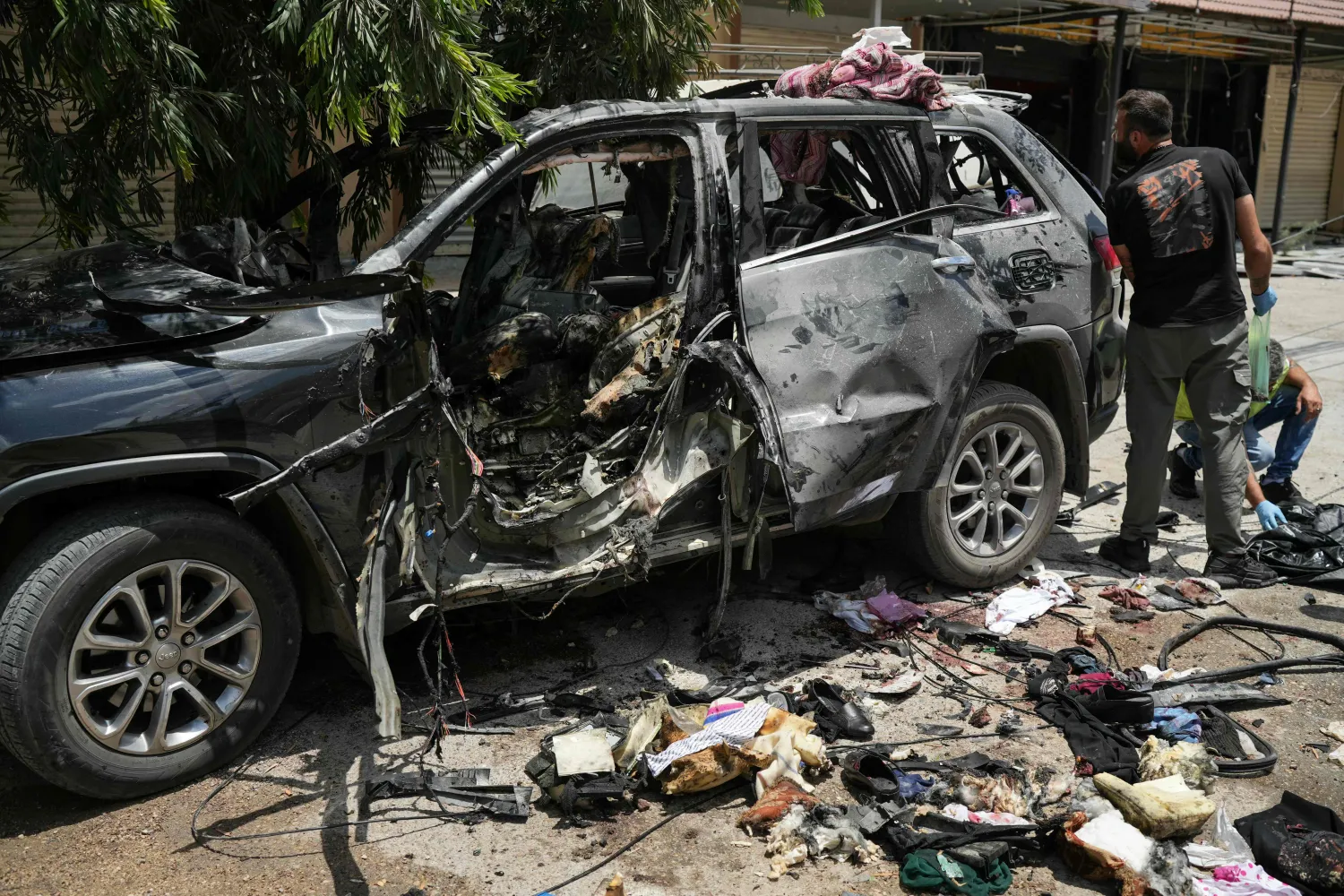
First responders inspect the wreckage of a car targeted by an Israeli strike in Nabatieh on July 6, 2026. (AFP)
TT

Israel Kills 4, Including School Principal, in South Lebanon, Health Ministry Says

First responders inspect the wreckage of a car targeted by an Israeli strike in Nabatieh on July 6, 2026. (AFP)

Four people, including a school principal, were killed in an Israeli strike on a vehicle in southern Lebanon on Monday, Lebanon's health ministry said, in one of the deadliest attacks in weeks.  

The attack tests a ceasefire announced last month that has sharply reduced violence in southern Lebanon, the main arena for conflict between Iran-aligned Hezbollah and Israel, but not eliminated it entirely.  

The Israeli military said it had struck a vehicle carrying four people it said were approaching what it calls a "security zone" in southern Lebanon and posing a threat to its forces.  

The health ministry identified the victims as school principal Esperanza ‌Ghandour, her mother, ‌a female domestic worker and a male foreign laborer.  

Ghandour had been ‌checking ⁠on repairs at ⁠her war-damaged home in Nabatieh and was on her way back when the vehicle was struck, a local source and Lebanon's state news agency said.  

At Najdeh Hospital in Nabatieh, a health official told Reuters by phone that staff heard the strike before the victims arrived.  

"We heard the explosion and saw the smoke rising," the official said.  

The strike took place in an area that local residents had considered safe from attack, he added.  

He said attacks by Israeli drones have continued since the ceasefire ⁠but not as regularly as before. 

ATTACK SHATTERS SENSE OF SECURITY 

Israel has ‌occupied what it describes as a security zone extending about ‌10 km (6 miles) into southern Lebanon along the border, saying it is needed to protect northern Israeli communities ‌from attacks by Hezbollah.  

Israeli forces remain deployed in parts of the zone despite the ceasefire, ‌while Lebanon says the Israeli presence violates its sovereignty.  

For residents of Nabatieh and surrounding towns, the attack shattered what little sense of security had returned under the ceasefire.  

Ali Safa, 32, said his family had been back and forth, forced to flee the south several times since a truce was announced in late June.  

"It brought the ‌fear back all over again," Safa said of Monday's strike.  

"Some of the few businesses that had reopened closed again because of the daily ⁠strikes, and some families ⁠left. There's always this small hope that at least you're back in your own home, but every day you wonder whether you'll have to leave again."  

Lebanon has borne the deadliest spillover of the US-Israeli war with Iran since Hezbollah opened a front in support of Tehran on March 2, triggering an Israeli offensive and ground incursion into southern Lebanon.  

The ceasefire was negotiated by the United States and Qatar with help from Iran. Tehran has insisted on a Lebanon ceasefire in its talks over ending the wider regional conflict, while Israel has scaled back attacks in Lebanon at Washington's behest.  

Israeli attacks have killed more than 4,300 people in Lebanon, according to the health ministry, which does not distinguish between civilians and combatants. On the Israeli side, at least 36 people, including 32 soldiers and four civilians, have been killed in the fighting, according to Israeli authorities. 


Lebanon’s EDL Begins Cutting Power to Ministries, Municipalities and Public Institutions over Unpaid Dues

The offices of Electricite du Liban in Beirut on August 17, 2024. (EPA)
TT

Lebanon’s EDL Begins Cutting Power to Ministries, Municipalities and Public Institutions over Unpaid Dues

The offices of Electricite du Liban in Beirut on August 17, 2024. (EPA)

Lebanon’s public power utility, "Electricite du Liban" (EDL), began on Monday implementing measures to disconnect electricity supply to public administrations, public institutions, and municipalities that have failed to settle their financial dues.

This unprecedented move, in terms of its sweeping scope, targets ministries, official bodies, water authorities, and municipalities. It comes amid a severe financial crisis confronting the state utility due to the accumulation of public sector debts.

An initial list obtained by Asharq Al-Awsat revealed the names of institutions and administrations covered by the measures. They include the Council for Development and Reconstruction, Ministry of Public Works and Transport, Directorate General of Urban Planning, Directorate General of Education at the Ministry of Education and Higher Education, the Land Registry Directorates, and the Directorate General of Customs, in addition to subscriptions belonging to the Ministry of Telecommunications across various regions.

An informed source confirmed to Asharq Al-Awsat that "the decision to cut electricity to public institutions and administrations that fail to settle their dues does not aim to punish them or disrupt their work, but rather to enforce respect for the law and establish permanent financial regularity in paying electricity bills, thereby ensuring that EDL secures its rights and the continuity of its operations."

The source explained that "the primary objective is not the power disconnection itself, but rather to push public institutions to assume their financial responsibilities and settle their accumulated obligations on a regular basis, instead of continuing to pile up debts and resorting to temporary fixes whenever the crisis intensifies."

Rafik Hariri International Airport in Beirut successfully avoided a power disconnection after the Civil Aviation Authority reached an understanding with EDL. The agreement stipulates the payment of a portion of the accumulated dues and the rescheduling of the remaining amounts, alongside a commitment to settle incoming bills on a regular basis.

The accumulated dues owed by the Directorate General of Civil Aviation reached around $22.8 million, according to figures circulated regarding public sector debts.

These measures come in light of EDL’s need to collect regular revenues to finance fuel purchases and operate power plants. Its dues from public administrations and institutions reached around a quarter of a billion dollars.

The problem of arrears dates back to years of irregular electricity bill payments and has worsened with the tariff increase and the lack of sufficient credit availability among some administrations. This presents a dual challenge related to settling past debts and ensuring the payment of new consumption.


Lebanese, Syrian Talks in Damascus Tackle Border Security, Refugees

Syrian Foreign Minister Asaad Al-Shaibani and Lebanon's Deputy Prime Minister Tarek Mitri meet in Damascus. (Syrian Foreign Ministry)
TT

Lebanese, Syrian Talks in Damascus Tackle Border Security, Refugees

Syrian Foreign Minister Asaad Al-Shaibani and Lebanon's Deputy Prime Minister Tarek Mitri meet in Damascus. (Syrian Foreign Ministry)

Syrian Foreign Minister Asaad Al-Shaibani received on Monday a high-level Lebanese delegation led by Deputy Prime Minister Tarek Mitri in the Syrian capital, Damascus, for talks on outstanding issues between the neighboring countries.

Informed sources in Damascus told Asharq Al-Awsat that the Syrian side focused heavily on border control and joint security cooperation and coordination, while the Lebanese side focused primarily on the file of Syrian refugees in Lebanon.

A Syrian Foreign Ministry statement said: "The meeting discussed ways to strengthen bilateral relations between the two brotherly nations and develop joint coordination across various fields, primarily security cooperation and border control. This is in addition to expanding the horizons of partnership in the sectors of education, higher education, social affairs, and labor, as well as following up on the work of joint technical committees to serve mutual interests."

The Lebanese delegation's visit to Damascus comes within the context of strengthening bilateral relations, serving as a continuation of previous talks and a follow-up on the work of the joint committees established between the two sides to address shared files.

This follows an agreement reached by both countries last July to establish a joint higher committee to serve as an institutional framework for coordinating the work of the relevant ministries, developing economic, investment, and trade cooperation, and reinforcing security understandings.

According to informed sources in Damascus, the management of the Syrian–Lebanese border, traffic at border crossings, and security coordination to combat smuggling and infiltration topped the agenda of the talks.

The file of Syrian refugees and the status of residents in Lebanon, particularly those who entered covertly, was brought forward. The discussions sought to address the refugee issue from multiple dimensions, including social, security, and legal aspects. The situation of Syrian students in Lebanese schools was also raised.


Yemen Urges Int’l Pressure to Dry Sources of Houthi Funding, Weapons

Houthi supporters holding weapons during a protest in Sanaa, Yemen. (EPA file)
TT

Yemen Urges Int’l Pressure to Dry Sources of Houthi Funding, Weapons

Houthi supporters holding weapons during a protest in Sanaa, Yemen. (EPA file)

The Yemeni government is seeking to elevate its coordination with the United Kingdom beyond political and diplomatic support, pushing for more impactful measures to confront the terrorist Houthi militia.

These proposed actions include designating the group as a terrorist organization, choking off its financial and armament supply lines, and tightening restrictions on the dual-use technologies and components used to develop its military capabilities. This diplomatic push coincides with anticipated international efforts to mobilize economic and humanitarian assistance for Yemen.

These issues were at the forefront of a meeting between Chairman of the Presidential Leadership Council Dr. Rashad Al-Alim and British Minister of State for the Middle East Stephen Doughty. The two officials reviewed the latest developments in Yemen and examined the threats posed by the Houthis to regional security and international shipping lanes, alongside the ongoing preparations to convene an international support conference for Yemen at the end of this month.

Al-Alimi underscored that the safeguarding of international maritime navigation cannot be achieved without neutralizing the core sources of the Houthi threat.

He called for bolstering the capacities of the Yemeni state to defend its sovereign territory and territorial waters, stressing that political and legal declarations must be paired with concrete, practical measures targeting the financing, weaponization, and smuggling networks that sustain the group’s military apparatus.

He urged the UK to play a more effective role in mobilizing international support to designate the Houthis as a terrorist organization and ban the group in line with British law.

Continuing to address its threats without deterrent measures leaves the group's sources of strength outside the scope of targeting, he added.

Al-Alimi briefed the British minister on the scale of the Houthi escalation, pointing to the targeting of the civilian airports in Aden and Riyan, as well as the relentless attacks on the city of Taiz.

He highlighted the attacks endured by Taiz's residential neighborhoods, civilian facilities, markets, schools, and homes, in addition to the assaults on civilian targets in Saudi Arabia and the ongoing threats posed to waterways and international shipping lanes.

He linked regional security directly to the restoration of Yemeni state institutions' ability to extend their authority, maintaining that supporting the government in this direction represents the sole sustainable guarantee for protecting maritime corridors and regional stability.

Al-Alimi praised the British positions supporting Yemen, particularly London's role as the penholder on the Yemeni file in the UN Security Council.

He also lauded the Saudi support provided through the King Salman Humanitarian Aid and Relief Center and the Saudi Development and Reconstruction Program for Yemen, including the response to humanitarian needs in Taiz and other governorates.