


Israel Tells Washington It Is Ready to Join War Against Iran Immediately

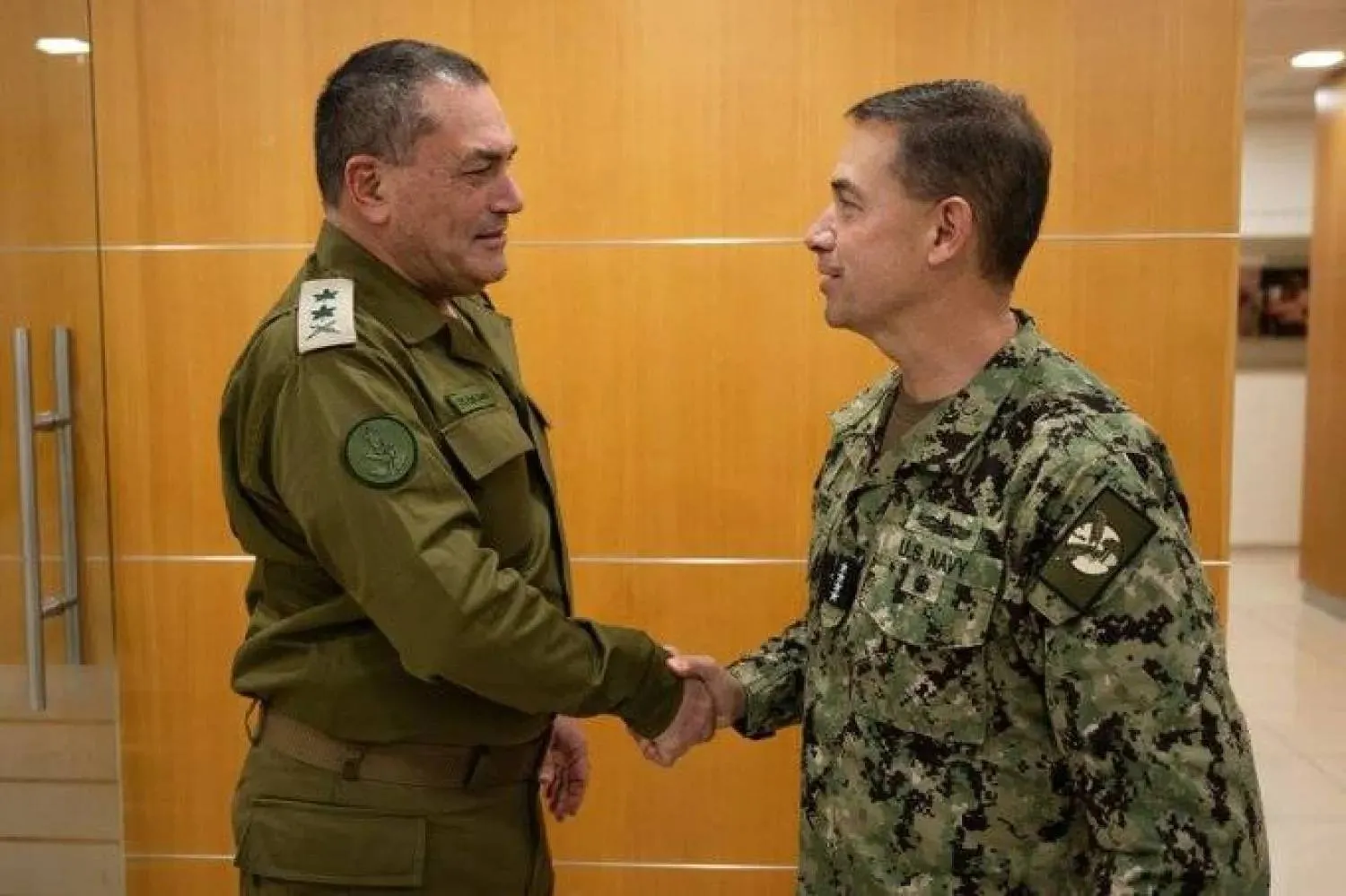
US Central Command commander Admiral Brad Cooper visits Israel on Sunday at the invitation of Israeli military Chief of Staff Eyal Zamir to strengthen military coordination and the defense partnership between the two sides. (Israeli military/X)
TT

Israel Tells Washington It Is Ready to Join War Against Iran Immediately

US Central Command commander Admiral Brad Cooper visits Israel on Sunday at the invitation of Israeli military Chief of Staff Eyal Zamir to strengthen military coordination and the defense partnership between the two sides. (Israeli military/X)

A military spokesperson in Tel Aviv said on Wednesday that the Israeli army was on high alert and ready to join the war alongside the US military against Iran as soon as it received orders from the government.

The Walla news site said the preparations had been in place since the first day of the ceasefire because Israel did not trust Iranian promises and viewed them as mere maneuvers.

“The Iranian leadership, intoxicated by an imagined victory, is not making the responsible calculations required of any government before going to war. It is acting arrogantly, as though it won the war, and is trying to blackmail the United States,” if added, noting that Israel had expected US President Donald Trump’s patience with Tehran to run out.

Walla also said the Israeli army had remained in close contact with US Central Command, or CENTCOM, to discuss what it described as the high likelihood of a resumption of the war, review the experience of the two previous wars in June 2025 and February 2026, and draw lessons from them to improve performance and prepare a new target bank for a third war that Israel sees as inevitable.

The most recent coordination meeting between the two commands was held at the end of last week in preparation for a scenario in which the confrontations resume.

Iranian actions had topped the agenda of a visit that US Defense Secretary Pete Hegseth had been scheduled to make on Wednesday before canceling it at the last minute, causing significant embarrassment in Tel Aviv. A senior political source close to Netanyahu said Hegseth had been due to meet Prime Minister Benjamin Netanyahu and his counterpart, Defense Minister Israel Katz.

According to the sources, one of the aims of the visit was to calm Israeli concerns over the possible sale of advanced F-35 stealth fighter jets to Türkiye. Israel is deeply concerned by the move, and some officials have begun mobilizing pressure in Congress to block its approval.

According to a report by Israel’s Channel 12, Israeli security agencies warn that Türkiye’s possession of advanced US stealth fighter jets, namely the F-35, could harm what Tel Aviv describes as the Israeli air force’s “qualitative edge” in the Middle East and restrict its ability to operate in arenas Israel considers central, including Iran, Syria, Lebanon and the wider eastern Mediterranean.

In an interview with CNN, Netanyahu said Turkish President Recep Tayyip Erdogan was “not exactly a model ally of the United States,” adding that he “threatens to destroy my country, the only Jewish state,” according to Netanyahu. Israel is currently the only country in the Middle East operating F-35 aircraft, the most advanced fighter jet in the US arsenal.

A report by Yedioth Ahronoth on Wednesday said friction between Israel and Türkiye was no longer limited to political or rhetorical disputes and now extended to four main arenas of concern to Israel’s security establishment.

The first arena is the negotiations with Iran, where Israel views Türkiye’s role as an attempt to prevent Tehran’s defeat in a way that would lead to wider Israeli dominance in the region.

The second arena relates to the Gaza Strip. The report points to Türkiye’s support for Hamas and claims that an arm of the movement operates from inside Türkiye and manages activities against Israel from there.

The third arena is Syria, where Israel is concerned by Turkish efforts to expand its influence after the changes the country has undergone.

According to Channel 12, the Israeli air force is working to prevent the consolidation of a Turkish foothold in Syria, including through repeated strikes on the T4 base. Israel is also seeking to prevent Ankara from arming the Syrian army with drones and air defense systems.

The fourth arena, which the report says is taking shape, is the eastern Mediterranean maritime front. Israel fears an expanding Turkish presence in an area Tel Aviv views as vital to its military and economic activity and to its relations with Greece and Cyprus.

According to the report, Türkiye is already developing advanced military industries, including defense systems and ballistic missiles, and is seeking to build its own stealth fighter, called Kaan.

But the project faces major difficulties, particularly over engines, as Türkiye does not yet have the independent capacity to develop an engine suitable for this type of aircraft, prompting it to request US-made F110 engines.

But the violation of the ceasefire between the United States and Iran has pushed this issue into the background, even for Israel.

It prefers to focus on what it has in common with the Americans, not on what divides it from them.

While Iran considered Israel’s continued military operations in Lebanon a violation of the US-Iranian agreement, Israel initiated a larger escalation in Lebanon in recent hours after Trump announced the cancellation of the ceasefire.

According to political sources in Tel Aviv, the escalation was not only a way to vent frustration over the anger caused by the halt to the war, but also a means of dragging the Revolutionary Guards leadership into the war and blowing up the negotiations entirely.



Israel Targets Top Hamas Leader in Deadly Gaza Strike on Anniversary

Palestinians inspect the rubble of a residential apartment following an Israeli air strike in the west of Gaza City on 03 October 2026. (EPA)
TT

Israel Targets Top Hamas Leader in Deadly Gaza Strike on Anniversary

Palestinians inspect the rubble of a residential apartment following an Israeli air strike in the west of Gaza City on 03 October 2026. (EPA)

Israel said on Saturday that it attempted to kill Hamas's top leader in the Gaza Strip in an airstrike on an apartment that local officials said killed five people, four of them women.

The pre-dawn strike came on the anniversary according to the Jewish calendar of the October 7, 2023 attack, the deadliest-ever day for Israel which retaliated with a devastating offensive in Gaza.

The Israeli military said it aimed to kill Ali al-Amoudi, describing him as the "right-hand man" of slain Hamas chief Yahya Sinwar and saying he was involved in planning the October 7 attack.

Israel said it was reviewing whether it killed or injured him.

It said it targeted him after learning that he was inside an apartment building, saying it showed that Hamas was using civilians as human shields.

"Today, al-Amoudi is the most senior Hamas figure in the Gaza Strip and is directly involved in Hamas's terror activities and in rebuilding the organization for war. The terrorist was struck in order to remove the threat," a military statement said.

"Steps were taken to mitigate harm to civilians, including the use of precise munitions," the military said, adding it "regrets any harm caused to uninvolved individuals".

Israel killed Sinwar in Gaza in October 2024, in what many Israelis saw as a major symbolic victory, although Israel has vowed to keep destroying Hamas even since a US-brokered ceasefire was declared a year ago.

Amoudi is considered Hamas's top person in the Gaza Strip. The movement's leader Khalil al-Haya lives in Qatar and has tried to maneuver diplomatically to Hamas's advantage.

Haya agreed in July to a US plan for Hamas to give up its weapons, in what President Donald Trump hailed as a breakthrough but Israeli Prime Minister Benjamin Netanyahu dismissed as insincere.

An official at Gaza City's Al-Shifa hospital told AFP it received at dawn the bodies of five people and a number of injured following an airstrike in the Rimal neighborhood.

It said the dead were two women and their daughters, as well as a man.

Mahmoud Bassal, the spokesman for the civil defense agency which operates as a rescue force under Hamas authority, said two missiles directly hit the apartment, causing a fire and damaging the building.

Mourners gathered later on Saturday at the small Greek Orthodox church of Saint Porphyrius in Gaza City for the funeral of the two women, identified as 56-year-old Maysaa Abu Daoud and her 36-year-old daughter Mary Al-Najjar.

Ihab Ayad, a relative of the women, said that they had been "minding their own business" at home when Israel carried out the strike.

"We didn't hurl stones or fire rockets. If any child among us carries a stone, they call him a terrorist, a murderer. But they possess the most powerful arsenal and destroy everything," he said.

The Hamas-led October 7 attack killed 1,221 people, according to an AFP tally based on official Israeli figures.

The massive Israeli offensive in response has left most of Gaza in ruins and killed more than 74,200 people, according to Gaza's health ministry, which is under Hamas authority and whose figures are considered reliable by the United Nations.

Israeli forces have killed more than 1,440 people since the announcement of the ceasefire a year ago, according to Gaza's health ministry.

The Israeli military has identified five deaths in its ranks over the same period, as well as the death of one civilian contractor.


Yemen’s Armed Forces Say It Is Conducting Strikes Against Houthis in Sanaa

Yemen government soldiers ride in a pick-up truck near the Jabal Han front, west of the city of Taiz on October 3, 2026. (AFP)
TT

Yemen’s Armed Forces Say It Is Conducting Strikes Against Houthis in Sanaa

Yemen government soldiers ride in a pick-up truck near the Jabal Han front, west of the city of Taiz on October 3, 2026. (AFP)

Yemen's armed forces said early on Sunday it was conducting strikes against the Iran-aligned Houthis in the capital Sanaa and the group's stronghold Saada. 

A spokesperson for Yemen's armed forces, which ‌are aligned with ‌the legitimate government, ‌said ⁠forces were targeting "vital targets", without providing further details. 

The ‌conflict between the Iran-backed Houthis and forces aligned ‌with the government mostly ‌stopped after a 2022 truce, but fighting has broken out again in a spillover from the wider war between Iran ‌and the United States. 

Hostilities resumed this year after the ⁠Houthis ⁠escalated attacked in Yemen, making major territorial gains along the Red Sea coast. 

Earlier, government forces broke a new wave of Houthi attacks targeting the western front of the city of Taiz and forced the attackers to retreat.

This coincided with a broad escalation in air and artillery targeting operations that struck the group's positions, reinforcements, and supply lines across various fronts in the governorate.

The Iran-backed Houthi group has been exerting pressure for more than two weeks in an effort to encircle the city of Taiz from the south by seizing control of its countryside and isolating it from the liberated Yemeni regions toward Lahij and Aden.

It has also been trying to consolidate its gains in the West Coast and Bab al-Mandab regions by taking control of the highlands.

Armed Forces spokesperson Colonel Majid Al-Nuzaili said that the forces carried out 71 precise operations against Houthi gatherings, mobilizations, and reinforcements in the areas of Al-Aqrud, Samea, Al-Ahkoum, Al-Akboosh, Jabal Rasen, Jabal Jardad, Bani Omar, Bani Bakari, Al-Kaawish, and Al-Athawir.

He added that the operations resulted in the destruction of a number of hostile transport and support vehicles and the neutralization of militia elements, repelling their advance.


'National Day' Stirs Debate over Independence in Iraq

Members of the Iraqi security forces stand guard near the Victory Arch monument during preparations for Sovereignty Day celebrations, marking the withdrawal of US-led coalition forces from Iraq, in Baghdad, Iraq, October 2, 2026. (Reuters)
TT

'National Day' Stirs Debate over Independence in Iraq

Members of the Iraqi security forces stand guard near the Victory Arch monument during preparations for Sovereignty Day celebrations, marking the withdrawal of US-led coalition forces from Iraq, in Baghdad, Iraq, October 2, 2026. (Reuters)

Senior officials in Iraq celebrated the National Day on October 3, which marks the country's independence from the British mandate and its entry into the League of Nations in 1932. The day has sparked debate over conflicting occasions in the official calendar.

President Nizar Amidi said in a statement that “on this day in 1932, Iraq became an independent state and a member of the League of Nations,” noting that “Iraqis have remained committed to their homeland despite the wars, crises, challenges, and difficulties they have endured.”

Meanwhile, government spokesperson Haider Al-Aboudi stressed that “on this occasion, the government renews its pledge that the decision of Iraqis remains in their own hands, and that sovereignty is manifested in security and a dignified life.”

Judge Faiq Zidan, head of the Supreme Judicial Council, also stressed that “the judiciary will remain a guarantee for rights and a fortress for justice,” adding that “the accelerating developments at this stage and the increasing challenges facing Iraq make it capable of protecting its present and shaping its future with deeply rooted institutions and an independent judiciary.”

British King Charles III and Emperor Naruhito of Japan both sent congratulatory cables to the Iraqi government on National Day, which does not receive significant political or public attention due to legislative and political disputes.

King Charles expressed his aspiration for continued cooperation between the two countries in facing shared challenges, particularly regarding climate, environmental preservation, and working together to find effective and sustainable solutions to these challenges.

Debate over ‘National Day’

For years, cultural and political elites have been engaged in a debate over a date that could achieve consensus as the country's National Day.

The former Baath regime had designated July 17 to commemorate its 1968 coup against the rule of the late Prime Minister Abdul Karim Qasim, while leftist factions used to celebrate the fall of the monarchy on July 14, 1958.

After 2003, leaders of opposition parties to the regime of the late President Saddam Hussein attempted to designate the day of his regime's fall, April 9, as a national holiday. The suggestion was rejected by the American civil administrator, Paul Bremer, according to Nabil al-Musawi, a leader in the Iraqi National Congress led by Ahmad Chalabi.

Later, during the government of former Prime Minister Mustafa al-Kadhimi, it was agreed to designate October 3, 1932, as Iraq's National Day.

In a statement on Saturday, Kadhimi said that when his government chose October 3 as a national day to commemorate Iraq's accession to the League of Nations in 1932, he did not want it “to be just an occasion on the nation's calendar, but rather a day where Iraqis gather in love for their homeland and pride in their unifying national identity.”

Some Iraqi historians disagreed with the government, stating that October 3 should not be the National Day because, in their view, independence from the British mandate in 1932 was not complete.

Legal expert Ali al-Tamimi told Asharq Al-Awsat that October 3 is the only date that has a binding legal basis to serve as the country's National Day.

Al-Tamimi added that the legal philosophy behind this day is that it serves as international recognition of the completion of the components of the modern Iraqi state, including an independent government, fixed borders, financial resources, an independent judiciary, and international commitment, making Iraq the first Arab country to join the League of Nations.