

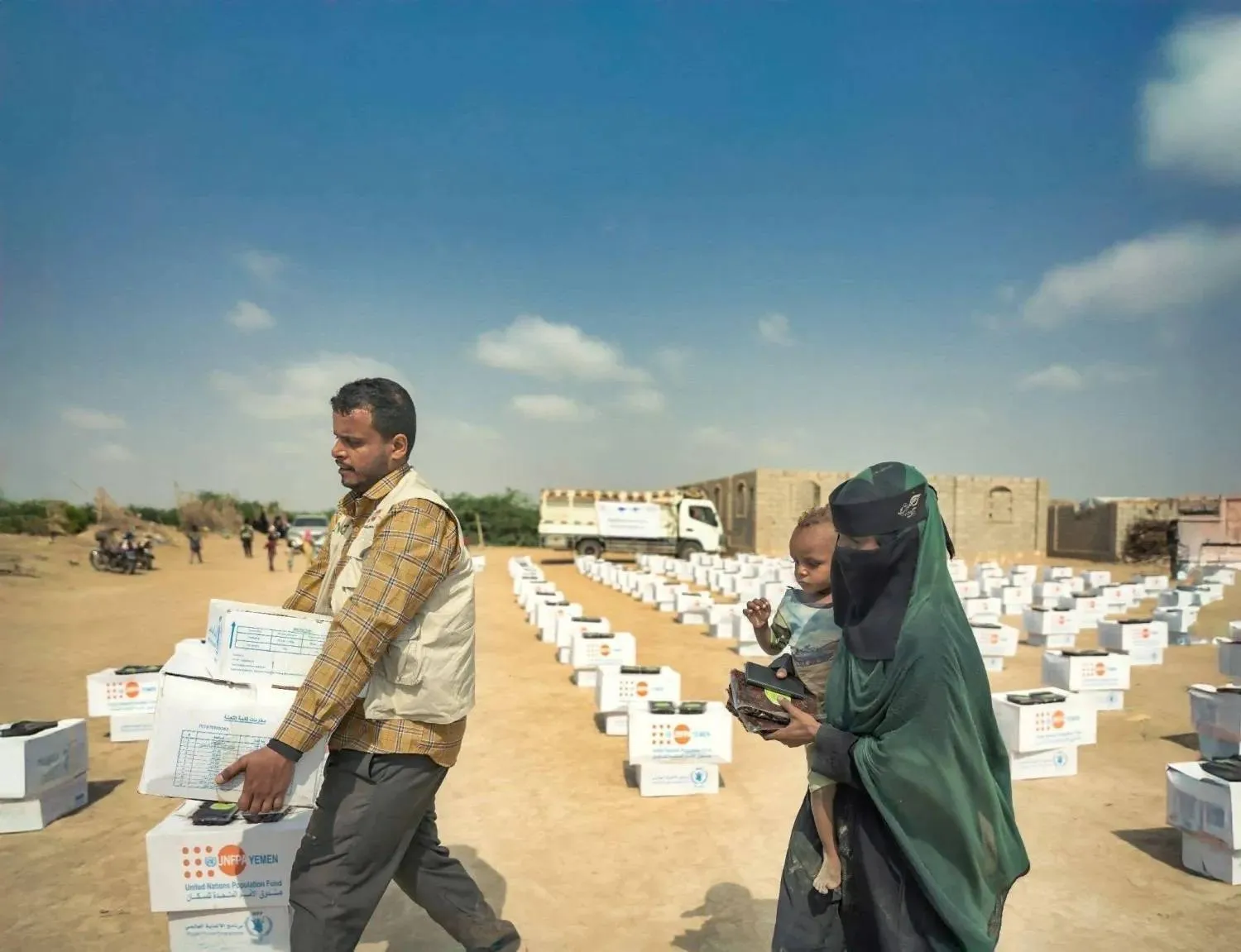

Hunger Worsens in Yemen’s Houthi-Controlled Areas, Ports Lose $1.4 Billion

According to the latest WFP-FAO Hunger Hotspots report, rates of severe food deprivation increased for the second consecutive month (UN)
TT

Hunger Worsens in Yemen’s Houthi-Controlled Areas, Ports Lose $1.4 Billion

According to the latest WFP-FAO Hunger Hotspots report, rates of severe food deprivation increased for the second consecutive month (UN)

A recent report by the World Food Programme and the Food and Agriculture Organization has said that household food consumption in Yemen continued to deteriorate for the second consecutive month, with 62 percent struggling to meet their minimum food needs in May 2026, including 36 percent facing severe food deprivation.

According to the latest WFP-FAO Hunger Hotspots report, rates of severe food deprivation increased for the second consecutive month, rising from 31 percent in April to 36 percent in May 2026, reflecting a gradually worsening trajectory.

Approximately 10 percent of households in Houthi-controlled (SBA) areas and eight percent in government (IRG) areas reported having at least one member going entire day and night without eating due to lack of food.

In Houthi areas, June data showed up to 13 percent increase in the prices of key food items in Sanaa City since February 2026, mainly reflecting global food price trends and higher shipping costs. This comes at a time when 70 percent of the population in SBA areas report reduced monthly income, highlighting a severe erosion of purchasing power.

The report said that in SBA areas, the economy continues to face severe challenges, including depleting foreign currency reserves, liquidity constraints, sanctions, the relocation of banks from Sanaa to Aden, and a slowdown in economic activity.

The degradation of Red Sea ports has further compounded revenue shortages, resulting in an estimated $ 1.4 billion in losses. Meanwhile, the Houthis have intensified taxation and seized assets, further undermining livelihoods.

Against a backdrop of economic hardship and reduced Red Sea port capacity, the closure of the Strait of Hormuz has amplified Yemen’s fuel supply challenges.

The latest Integrated Food Security Phase Classification (IPC) analysis for IRG-controlled areas projects further deterioration of food security situation toward the end of 2026, with an estimated 5.4 million people expected to face severe levels of acute food insecurity. Key drivers include the combined effects of the lean season, floods, and a curtailed humanitarian response.

The deterioration in food consumption gaps in Yemen has accelerated after humanitarian assistance was curtailed during 2024-2026, compared to 2021-2023 when large-scale food assistance was provided.

SBA areas exhibited a relatively sharper deterioration of inadequate food consumption following the loss of humanitarian operational space. The deterioration rate was 36 percent in SBA areas versus 27 percent in IRG areas, with severe food deprivation nearly doubling in SBA areas during the same periods.

The report added that while the market exchange rate in IRG areas has remained stable since August 2025, the customs dollar rate was notable increased from YER 750 to $1,550 in May 2026, raising concerns over the potential impact on imported commodity prices and household living costs.

Between January and May 2026, fuel imports via Houthi controlled ports dropped by 73 percent compared to the same period in 2025, and by 60 percent via government-controlled ports. Consequently, SBA areas are reporting increasing instances of low-quality fuel at fuel stations, adversely affecting vehicles, water pumps, power plants, and livelihoods.

Due to severe funding shortages, WFP started the implementation of its new TEFA program in IRG-controlled areas in mid-February 2026, reducing the caseload from 3.4 million in December 2025 to a prioritized 1.7 million people. As of mid-June 2026, WFP had completed two TEFA cycles, with the third cycle underway.

The post-distribution monitoring data in April–May 2026 demonstrate a significant improvement in the prevalence of severe food deprivation among TEFA beneficiaries (from 46 percent in February to an average of 25 percent in April-May 2026). Inadequate food consumption showed a similar trend, improving by 23 percentage points during the same period (from 75 to 52 percent).

Dietary diversity and quality have also improved, alongside better access to nutritious foods. The proportion of TEFA beneficiaries reporting low dietary diversity (consuming four or fewer food groups in the past week) decreased from 72 percent to 56 percent.

The consumption of protein-reach food items has improved by 18 percentage points, primarily driven by the inclusion of pulses in the TEFA ration.

The report added that to consolidate these gains and maximize impact, TEFA should be complemented by large-scale recovery interventions, including nutrition, livelihood, water, sanitation and hygiene (WASH), and multi-purpose cash programs.


Drill Boosts Military Ties between Egypt and Türkiye

 Egyptian and Turkish forces participating in the "Golden Eagle" exercise on Wednesday. (Egyptian Military Spokesperson on Facebook)
Egyptian and Turkish forces participating in the "Golden Eagle" exercise on Wednesday. (Egyptian Military Spokesperson on Facebook)
TT

Drill Boosts Military Ties between Egypt and Türkiye

 Egyptian and Turkish forces participating in the "Golden Eagle" exercise on Wednesday. (Egyptian Military Spokesperson on Facebook)
Egyptian and Turkish forces participating in the "Golden Eagle" exercise on Wednesday. (Egyptian Military Spokesperson on Facebook)

The joint Egyptian-Turkish military drill "Golden Eagle" kicked off on Wednesday with the participation of the Egyptian Airborne Forces, Egyptian Thunderbolt Forces and the Turkish Special Forces.

The drill is part of the growing military cooperation between Cairo and Ankara and is in line with the military framework agreement signed during Turkish President Recep Tayyib Erdogan’s visit to Egypt in February.

The first phase of the drill included a series of theoretical lectures on various subjects aimed at unifying operational concepts and boosting integration and interoperability among the participating forces. An exhibition of the weapons and equipment used during the exercise was also organized.

Military and strategic expert and president of the Arab Foundation for Development and Strategic Studies Samir Ragheb said the drill reflects the extent of the development of military relations between Egypt and Türkiye, which, in turn, is a reflection of their political rapprochement.

He told Asharq Al-Awsat that the two countries are increasing the number of drills between them.

Egypt also recently joined Türkiye’s program to develop the KAAN stealth fighter jet, he noted.

Last month, Egypt’s Chief of Staff Ahmed Khalifa met with his Turkish counterpart Selcuk Bayraktaroglu in Cairo, underlining the importance of coordinating efforts and supporting military cooperation with Türkiye to achieve common interests.

Egypt and Türkiye signed a military cooperation agreement during Erdogan's visit to Cairo in February. (Egyptian Presidency)

Adel Al-Omda, military adviser at the Military Academy for Postgraduate and Strategic Studies, noted that Egypt is facing “grave international challenges from all directions, which demands ongoing tactical and information cooperation.”

He told Asharq Al-Awsat that cooperation means that these challenges can be confronted, offering a reassuring message to the people.

Military cooperation with a major regional power such as Türkiye will yield positive results and counter some challenges, he remarked.

So long as there is military cooperation, political and economic agreement can be ensured, he added.

Ragheb noted that the military drill sends a positive message that relations are strong and stable.

It also sends a message that the countries are prepared to stop wars as neither of them want to be embroiled in the regional conflict. They have both played mediator roles in Gaza, Iran, Yemen and Syria.


Study Says 93% of Sudanese Want Peace

24 June 2026, Sudan, Juba: Children gather at the Renk Returnees Camp during a Caritas press trip in Renk, Upper Nile State. Photo: Martin Hanser/APA/dpa
TT

Study Says 93% of Sudanese Want Peace

24 June 2026, Sudan, Juba: Children gather at the Renk Returnees Camp during a Caritas press trip in Renk, Upper Nile State. Photo: Martin Hanser/APA/dpa

A comprehensive Sudanese study has revealed that 93.2% of Sudanese support peace negotiations, a finding that participants described as “digital evidence refuting claims used to justify the continuation of the war in the name of the Sudanese people.”

The Advocacy Group for Peace in Sudan (AGPS) said in a press statement that it presented the preliminary results of the study during a workshop attended by researchers, journalists, civil society representatives, and public policy experts.

According to the group, the study was based on 1,668 online surveys, 30 in-depth qualitative interviews, and a random sample covering all 18 Sudanese states, in addition to Sudanese communities in Chad, Egypt, South Sudan, Uganda, the Gulf states, and several other countries.

Dr. Issam Abbas, one of the study’s supervisors, explained that “the use of the Python programming language in data analysis, together with the stratified random sampling method, enhanced the reliability and scientific accuracy of the results.”

The findings showed that 74.3% support an immediate ceasefire, 88.3% of those who favor a political settlement are willing to actively support it and Central Darfur State recorded the highest level of support for peace, at 94.7%.

The study found that competition over power and wealth was viewed as the leading cause of the conflict, followed by the legacy of the former regime, marginalization, and foreign interference.

It also found that 80.9% of respondents hold both branches of the military establishment responsible for the war, 79.2% blame the former regime and 73.7% blame armed movements.

Confidence in peace agreements was low, with only 14.4% expressing high confidence, compared with 9% who said they had no confidence in such deals.

The results further showed that 90% of participants demand accountability, while 8% favor a hybrid justice system combining national and international mechanisms. The study identified key red lines for any future settlement, including the rejection of Sudan’s partition, the existence of multiple armies, and ontinued military involvement in politics.

Meanwhile, 77.9% of respondents said that social media is their primary source of information, while 93.4% believed that tribal and regional rhetoric poses a direct threat to citizenship and national cohesion.

Dr. Asmaa Elnaiem, Executive Director of the Advocacy Group for Peace in Sudan and a member of the Executive Office of the Sudan Peace Appeal, said the results presented so far represent only about 20% of the full analysis.

She noted that the study was designed to be expandable and regularly updated to reflect developments on the ground.

Sudan has been engulfed in war between the Sudanese Armed Forces (SAF) and the Rapid Support Forces (RSF) since April 2023. The conflict has killed at least 59,000 people, displaced around 13 million others, and pushed large parts of the country into famine. More than 30 million people are now in need of humanitarian assistance.


Israel Tells Washington It Is Ready to Join War Against Iran Immediately

US Central Command commander Admiral Brad Cooper visits Israel on Sunday at the invitation of Israeli military Chief of Staff Eyal Zamir to strengthen military coordination and the defense partnership between the two sides. (Israeli military/X)
TT

Israel Tells Washington It Is Ready to Join War Against Iran Immediately

US Central Command commander Admiral Brad Cooper visits Israel on Sunday at the invitation of Israeli military Chief of Staff Eyal Zamir to strengthen military coordination and the defense partnership between the two sides. (Israeli military/X)

A military spokesperson in Tel Aviv said on Wednesday that the Israeli army was on high alert and ready to join the war alongside the US military against Iran as soon as it received orders from the government.

The Walla news site said the preparations had been in place since the first day of the ceasefire because Israel did not trust Iranian promises and viewed them as mere maneuvers.

“The Iranian leadership, intoxicated by an imagined victory, is not making the responsible calculations required of any government before going to war. It is acting arrogantly, as though it won the war, and is trying to blackmail the United States,” if added, noting that Israel had expected US President Donald Trump’s patience with Tehran to run out.

Walla also said the Israeli army had remained in close contact with US Central Command, or CENTCOM, to discuss what it described as the high likelihood of a resumption of the war, review the experience of the two previous wars in June 2025 and February 2026, and draw lessons from them to improve performance and prepare a new target bank for a third war that Israel sees as inevitable.

The most recent coordination meeting between the two commands was held at the end of last week in preparation for a scenario in which the confrontations resume.

Iranian actions had topped the agenda of a visit that US Defense Secretary Pete Hegseth had been scheduled to make on Wednesday before canceling it at the last minute, causing significant embarrassment in Tel Aviv. A senior political source close to Netanyahu said Hegseth had been due to meet Prime Minister Benjamin Netanyahu and his counterpart, Defense Minister Israel Katz.

According to the sources, one of the aims of the visit was to calm Israeli concerns over the possible sale of advanced F-35 stealth fighter jets to Türkiye. Israel is deeply concerned by the move, and some officials have begun mobilizing pressure in Congress to block its approval.

According to a report by Israel’s Channel 12, Israeli security agencies warn that Türkiye’s possession of advanced US stealth fighter jets, namely the F-35, could harm what Tel Aviv describes as the Israeli air force’s “qualitative edge” in the Middle East and restrict its ability to operate in arenas Israel considers central, including Iran, Syria, Lebanon and the wider eastern Mediterranean.

In an interview with CNN, Netanyahu said Turkish President Recep Tayyip Erdogan was “not exactly a model ally of the United States,” adding that he “threatens to destroy my country, the only Jewish state,” according to Netanyahu. Israel is currently the only country in the Middle East operating F-35 aircraft, the most advanced fighter jet in the US arsenal.

A report by Yedioth Ahronoth on Wednesday said friction between Israel and Türkiye was no longer limited to political or rhetorical disputes and now extended to four main arenas of concern to Israel’s security establishment.

The first arena is the negotiations with Iran, where Israel views Türkiye’s role as an attempt to prevent Tehran’s defeat in a way that would lead to wider Israeli dominance in the region.

The second arena relates to the Gaza Strip. The report points to Türkiye’s support for Hamas and claims that an arm of the movement operates from inside Türkiye and manages activities against Israel from there.

The third arena is Syria, where Israel is concerned by Turkish efforts to expand its influence after the changes the country has undergone.

According to Channel 12, the Israeli air force is working to prevent the consolidation of a Turkish foothold in Syria, including through repeated strikes on the T4 base. Israel is also seeking to prevent Ankara from arming the Syrian army with drones and air defense systems.

The fourth arena, which the report says is taking shape, is the eastern Mediterranean maritime front. Israel fears an expanding Turkish presence in an area Tel Aviv views as vital to its military and economic activity and to its relations with Greece and Cyprus.

According to the report, Türkiye is already developing advanced military industries, including defense systems and ballistic missiles, and is seeking to build its own stealth fighter, called Kaan.

But the project faces major difficulties, particularly over engines, as Türkiye does not yet have the independent capacity to develop an engine suitable for this type of aircraft, prompting it to request US-made F110 engines.

But the violation of the ceasefire between the United States and Iran has pushed this issue into the background, even for Israel.

It prefers to focus on what it has in common with the Americans, not on what divides it from them.

While Iran considered Israel’s continued military operations in Lebanon a violation of the US-Iranian agreement, Israel initiated a larger escalation in Lebanon in recent hours after Trump announced the cancellation of the ceasefire.

According to political sources in Tel Aviv, the escalation was not only a way to vent frustration over the anger caused by the halt to the war, but also a means of dragging the Revolutionary Guards leadership into the war and blowing up the negotiations entirely.
