


Plans for Post-War Gaza Face Challenges on the Ground

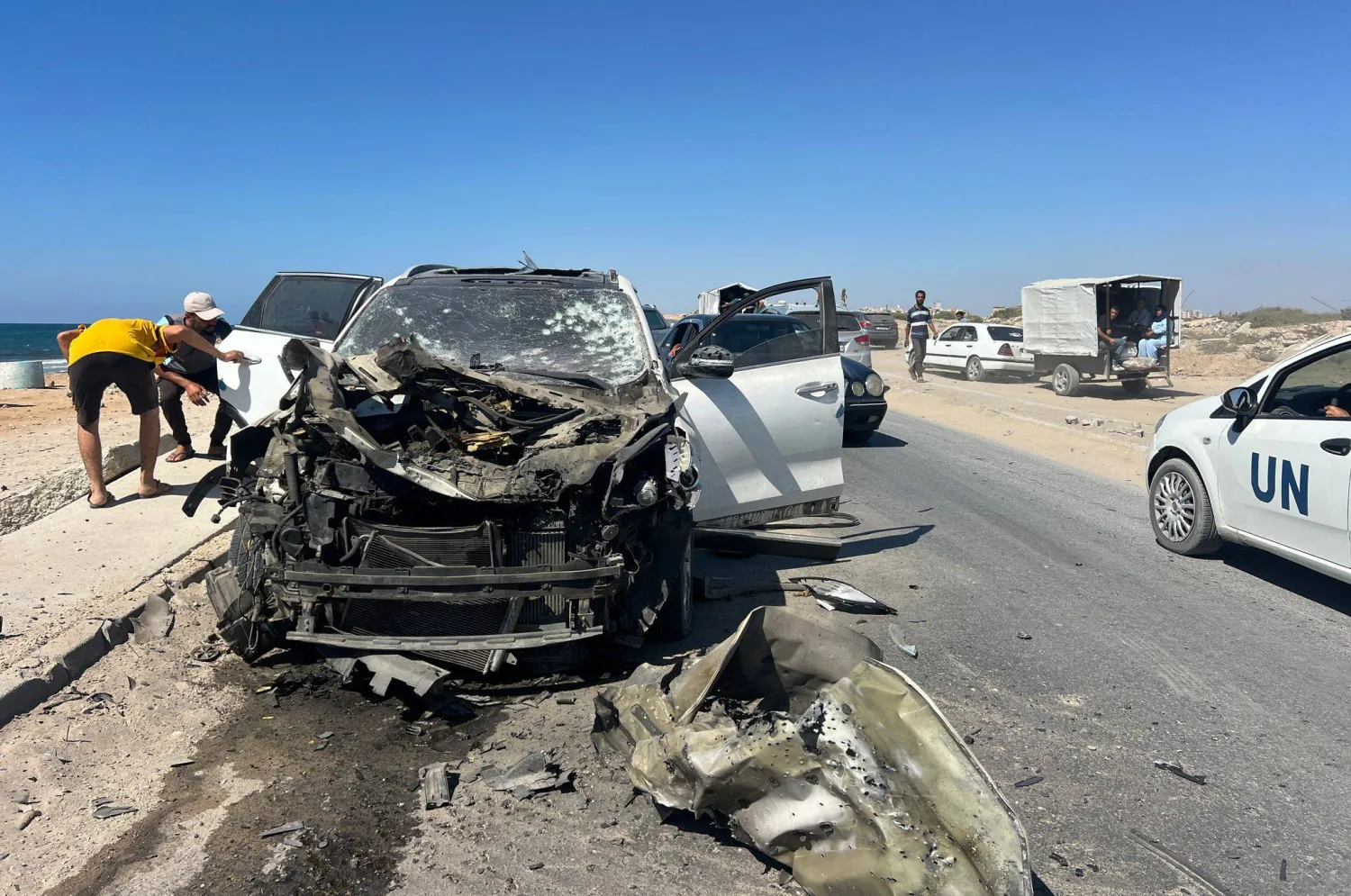
11 July 2026, Palestinian Territories, Nuseirat: A vehicle damaged in an Israeli strike is seen at the scene in the Nuseirat refugee camp in the central Gaza Strip, where a Palestinian was killed and others were wounded. (dpa)
TT

Plans for Post-War Gaza Face Challenges on the Ground

11 July 2026, Palestinian Territories, Nuseirat: A vehicle damaged in an Israeli strike is seen at the scene in the Nuseirat refugee camp in the central Gaza Strip, where a Palestinian was killed and others were wounded. (dpa)

In spite of the ongoing risk of renewed fighting in Gaza, stakeholders have spent months preparing for the post-war phase.

Plans for governance, security and humanitarian relief have begun to take shape, but remain largely theoretical in the absence of a political agreement, credible security guarantees and sustained funding.

Below are some of the key challenges facing local and international players as they seek to rebuild the devastated territory home to more than two million Palestinians.

- Security concerns -

Security remains the cornerstone of every post-war scenario under discussion.

Israel insists Hamas must disarm before any progress can be made, while the Palestinian movement refuses to surrender its weapons before Israeli troops withdraw and a Palestinian governing authority is established.

However, an official from the Board of Peace established by US President Donald Trump to help prepare for post-war Gaza told AFP that Hamas's disarmament was no longer being treated as a precondition for advancing plans on the ground.

"The entire planning is around worst case scenario," he said, referring to a planned pilot "humanitarian zone" in Rafah, in the south.

"We get nothing in the negotiation, but we move forward anyhow."

Among the proposals is an International Stabilization Force (ISF) tasked with helping maintain order in Gaza.

According to the same source, four countries -- Morocco, Kosovo, Albania and Kazakhstan -- are "really engaged" in the initiative.

A logistical base on the Israeli side of the Kerem Shalom crossing is "close to complete" and would be able to host an initial rotation of around 500 troops before any deployment into Gaza, the official said.

Preparations are also continuing for a Palestinian police force, with around 20,000 applications already received, the official added.

But several diplomats and security sources interviewed by AFP described a process that remains deadlocked.

According to one diplomatic source, training has yet to begin and Israel has rejected the current list of recruits following its vetting process, arguing in particular that a proposed force of 5,000 police officers would be too large for Gaza.

Despite a ceasefire in place since October 2025, daily violence grips the territory as Israeli strikes continue targeting what the military says are violations of the truce by fighters from Hamas and other Palestinian groups.

- Little reconstruction -

The humanitarian needs of Gaza remain overwhelming.

The United Nations estimates reconstruction will take years and require tens of billions of dollars, as construction materials and debris-clearing equipment remain in critically short supply.

Despite substantial donor pledges, much of the expected funding has yet to be disbursed, according to the Board of Peace.

"We're working with an amount that for now meets our needs," the board official said, adding that if several humanitarian zones have to be established then "we obviously need more funding".

The board is currently planning a pilot humanitarian zone in Rafah which would accommodate tens of thousands of vetted Palestinians, the official said earlier this week.

- No governing institutions -

Hamas announced recently it intends to hand over administrative responsibilities to the National Committee for the Administration of Gaza (NCAG), a body set up by the Board of Peace comprising Palestinian technocrats tasked with overseeing day-to-day governance during a transitional period.

But the NCAG has still not even managed to enter Gaza, with several Palestinian and diplomatic sources saying Israel has barred the committee from entering.

For Israel, dismantling Hamas's administrative apparatus falls short of its longstanding demand that the group disarm.

The future role of the Palestinian Authority (PA) also remains unresolved.

Based in Ramallah in the occupied West Bank -- a separate Palestinian territory from the Gaza Strip -- the PA remains the international community's officially recognized Palestinian interlocutor.

The NCAG is intended as a temporary body implementing basic services across the strip, with European officials expecting it to work in coordination with the PA.

Several observers, however, warn that the result could be an administration responsible for delivering public services but lacking authority over security forces or border crossings -- leaving it dependent on its international backers while remaining vulnerable to Hamas should the group retain all or part of its military arsenal.


Sudan’s Al-Burhan Backs Inclusive Dialogue but Pledges to Continue Fighting the RSF

Al-Burhan flanked by Yasser Al-Atta and Shams El Din Kabbashi during the Army Day celebration (Transitional Sovereignty Council Media)
TT

Sudan’s Al-Burhan Backs Inclusive Dialogue but Pledges to Continue Fighting the RSF

Al-Burhan flanked by Yasser Al-Atta and Shams El Din Kabbashi during the Army Day celebration (Transitional Sovereignty Council Media)

The Chairman of the Transitional Sovereignty Council and Commander of the Sudanese Army, Abdel Fattah al-Burhan, has approved an initiative to launch a dialogue that brings together all political and civil parties.

Despite his announcement, he pledged to continue fighting until the rebellion of the Rapid Support Forces (RSF) is defeated across the country.

Speaking on Friday on the 72nd anniversary of the Sudanese Armed Forces, al-Burhan said: "In light of this troubled political reality, a group of Sudanese citizens took the initiative to present their vision to work as an independent national mechanism to prepare for an inclusive Sudanese dialogue, with the goal of reaching a comprehensive national consensus that puts the country on the path to stability."

He added that he agreed to provide the necessary guarantees for holding the all-party talks, facilitate the participation of the different groups, and protect their safety.

Al-Burhan stressed that the state was willing to provide the necessary logistical support as well as legal, political, and security guarantees, without being the organizing entity of the dialogue.

He noted that providing these guarantees does not mean the state will dictate the participants of the dialogue, draft its agenda, control its outcomes, or provide it with political sponsorship.

Al-Burhan clarified that "the action taken by the state regarding any of the participants in the dialogue is not considered a pardon, but rather means suspending the criminal proceedings previously taken by the state against them."

He stated that these measures represent a "temporary immunity" to create appropriate conditions that ensure the participation of the parties.

The Sudanese army commander also pledged legal protection for the opinions and positions expressed by participants, saying statements made during dialogue sessions would not be used as grounds for legal prosecution.

A-Burhan said the army was ready to engage with any serious peace initiative but would not accept what he called an “incomplete peace” that returned the RSF and its supporters to power.

He stated that the army would continue the “completion of the cleansing of the country from the terrorist militia.”

The path to peace must begin with RSF forces withdrawing from cities and gathering in designated areas, followed by the return of displaced people and refugees to their homes, he added.

The Democratic Bloc welcomed al-Burhan’s announcement to hold the all-party talks.

Its spokesperson, Mohamed Zakaria, said Saturday that al-Burhan’s emphasis on the importance of inter-Sudanese dialogue and the need to create a conducive environment for its launch represents a significant step towards addressing the crisis through a national political process.

He called on all sides to engage positively with any serious effort to launch a comprehensive national dialogue, provided that the process is managed entirely by Sudanese parties and that the regional and international role is limited to facilitation and support without interfering in determining participants or imposing an agenda or outcomes.


Egypt, China Consolidate Cooperation by Holding Air Combat Maneuvers

Egyptian President Abdel Fattah El-Sisi and China’s President Xi Jinping held summit talks in the Chinese capital, Beijing, in May 2024. Photo: Egyptian Presidency
TT

Egypt, China Consolidate Cooperation by Holding Air Combat Maneuvers

Egyptian President Abdel Fattah El-Sisi and China’s President Xi Jinping held summit talks in the Chinese capital, Beijing, in May 2024. Photo: Egyptian Presidency

Egypt and China have consolidated their military cooperation by announcing new air combat drills that are set to start this month.

"The Chinese and Egyptian air forces will hold Eagles of Civilization 2026 joint training in Egypt from mid-August to early September," said Senior Colonel Chen Xi, spokesperson for China's Ministry of National Defense (MND), at a press briefing on Friday.

"The training will focus on such subjects as air combat tactics, air superiority operations, and combat search and rescue, and will include force employment drills," said the spokesperson.

"As the second iteration of its kind, the joint training will further enhance mutual trust and traditional friendship, deepen substantive cooperation between the Chinese and Egyptian militaries, and contribute to regional peace and stability," stressed the spokesperson.

The joint air force exercise between China and Egypt "Eagles of Civilization 2025" was held in April last year at an Egyptian air base. It marked the first-ever military air drill between the two nations and the first time the Chinese PLA Air Force systematically deployed multiple troop types to the African continent.

In May 2024, Egyptian President Abdel Fattah el-Sisi and Chinese President Xi Jinping met in Beijing to mark the 10th anniversary of their comprehensive strategic partnership.

The leaders declared 2024 the "Egypt-China Partnership Year,” signing bilateral agreements on the Belt and Road Initiative, technology, and industrial localization.


Yemen's Mokha Port Halts Operations after Houthi Attacks

Flames and smoke rise from the port of Mokha during a strike in Yemen, Friday, Aug. 14, 2026. (AP Photo/Abdulnasser Alseddik)
TT

Yemen's Mokha Port Halts Operations after Houthi Attacks

Flames and smoke rise from the port of Mokha during a strike in Yemen, Friday, Aug. 14, 2026. (AP Photo/Abdulnasser Alseddik)

Yemen's Mokha port has suspended commercial and maritime operations after being hit by more than 25 missiles in Houthi attacks over recent days, the port's director said on Saturday.

The attacks killed seven people and caused an estimated $16 million in losses, the director told a news conference.

The latest attacks come amid an ongoing Houthi escalation that has lasted for about two weeks, targeting military positions and vital facilities in government-controlled provinces, alongside an intensification of operations on several fronts.

Brig. Gen. Sadiq Duwaid, spokesman for the National Resistance Forces, said the group had launched dozens of ballistic missiles and drones in recent days at the city of Mokha, its port, and surrounding facilities.

Duwaid believes the group turned to targeting civilian infrastructure after suffering losses on the battlefronts, while government forces say the latest attacks are aimed at weakening economic activity and depriving residents of essential services and sources of income.

The repeated strikes made it difficult for ambulance and field teams to reach the port in the early hours, according to the National Resistance Forces' military media outlet, which said the intensity of the bombardment hindered firefighting operations and efforts to assess the damage and casualties.
