

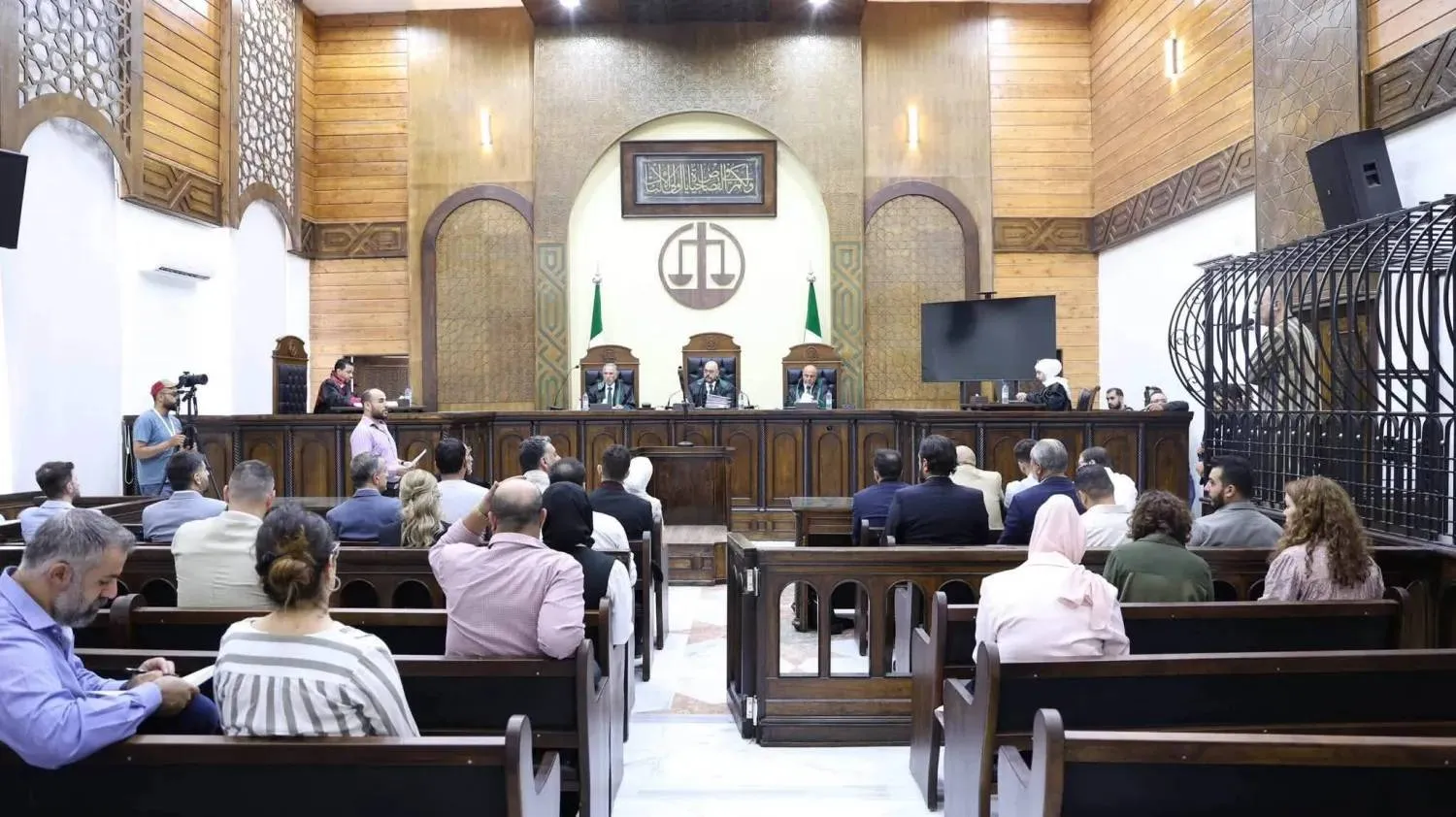

Atef Najib’s Fifth Closed-Door Hearing Held Amid Public Pressure on His Lawyer

 Former security official Atef Najib is questioned during a fifth closed-door hearing on Tuesday (Syrian Justice Ministry)
Former security official Atef Najib is questioned during a fifth closed-door hearing on Tuesday (Syrian Justice Ministry)
TT

Atef Najib’s Fifth Closed-Door Hearing Held Amid Public Pressure on His Lawyer

 Former security official Atef Najib is questioned during a fifth closed-door hearing on Tuesday (Syrian Justice Ministry)
Former security official Atef Najib is questioned during a fifth closed-door hearing on Tuesday (Syrian Justice Ministry)

Atef Najib denied all charges against him during the fifth closed-door session of his trial before Damascus’ Fourth Criminal Court, which adjourned proceedings until the 21st of this month.

Tuesday’s session was devoted to hearing witnesses for the public prosecution and civil claimants, amid reports that the defense lawyer retained by Najib had faced public pressure.

Fadel Abdulghany, chairman of the Syrian Network for Human Rights, who attended the hearing, said the court heard 14 testimonies from people who said they had been directly subjected to abuses by Najib.

As in the previous hearing, Najib denied responsibility for all charges against him.

Abdulghany said the next session would continue hearing witnesses. More than 51 claimants have joined the case, requiring the court to hear further testimony and examine documents and other evidence related to the charges.

Najib had denied the accusations during earlier sessions, saying he was not in Daraa when the Omari Mosque was stormed. He also denied that the Political Security branch he headed had detained children.

The fifth session was presided over by Judge Fakhreddin Mustafa al-Aryan, alongside judges Abdul Hamid Mohammed al-Hamoud and Hossam Hussein Abdul Rahman. Judge Omar Mahmoud al-Radi attended as the representative of the public prosecution.

Relatives of victims from Daraa province also attended, along with members of the National Commission for Transitional Justice, representatives of the United Nations Office of the High Commissioner for Human Rights, the Syrian Network for Human Rights, activists and representatives of international and official bodies following the proceedings.

Syrian Bar Association President Mohammed Ali al-Tawil told Asharq Al-Awsat that Najib’s trial was Syria’s first and most prominent transitional justice case and carried significant symbolic importance.

He said the bar association was closely following the proceedings, which he described as moving in a “good, smooth, lawful and positive manner,” despite the abuses suffered by Syrians under the former government and at Najib’s hands.

Al-Tawil said the first session was devoted to preliminary questioning, while the indictment was read during the second and Najib was allowed to respond.

The third, fourth and fifth sessions were devoted to hearing public prosecution witnesses. Around 35 testimonies have been heard, and the court will continue hearing witnesses at the next session.

Should the defense call witnesses, Najib’s lawyer will submit their names to the court, which will decide whether to hear their testimony, al-Tawil said.

He said the defense lawyer, a member of the Quneitra branch of the bar association, had come under considerable pressure for representing Najib.

The association supported the lawyer “to guarantee the defendant’s right to a defense, which is protected by law,” al-Tawil said, despite its conviction that Najib had played a prominent role in events in Syria in 2011.

He said a criminal court could not be properly constituted without a defense lawyer and that the bar association would appoint one if none were retained.

Al-Tawil said Syrian trials had undergone a significant qualitative transformation, citing the assessment of representatives of United Nations organizations monitoring Najib’s trial.

Hearing public prosecution witnesses is a key stage in criminal proceedings and one of the means of evidence used by the court in reaching its judgment. The court examines testimony alongside documents and other evidence in the case file, while guaranteeing the defense the right to question witnesses.

Ahead of the fifth session, the Justice Ministry released video clips of testimony given during previous hearings. The witnesses’ faces and identities were concealed in coordination with the witness protection program.

The testimony included details of torture and physical abuse suffered by detainees, particularly in the 2011 case involving children in Daraa, and Najib’s alleged responsibility.

Najib was a Political Security officer with the rank of brigadier general and is a maternal cousin of Bashar al-Assad. He served at several Political Security branches in Damascus and Tartous before becoming head of the branch in Daraa.

His name became associated with the detention of children accused of writing anti-government slogans on school walls at the start of the uprising in Daraa.



Syria Arrests Assad-era Officer who Fled Austria after Conviction

A man walks past heavily-damaged and destroyed buildings in the Jobar suburb northeast of Damascus on August 12, 2026. (Photo by LOUAI BESHARA / AFP)
TT

Syria Arrests Assad-era Officer who Fled Austria after Conviction

A man walks past heavily-damaged and destroyed buildings in the Jobar suburb northeast of Damascus on August 12, 2026. (Photo by LOUAI BESHARA / AFP)

Syrian security forces have arrested a former Assad-era security officer who fled Austria after being sentenced to eight years in prison for abusing detainees and returned to his hometown in southern Syria, state news agency SANA said on Tuesday night.

Lieutenant Colonel Musab Abu Rukba was arrested in the city of Nawa in Daraa province by internal security forces in coordination ⁠with the counter-terrorism ⁠department, SANA said, citing the security forces.

Abu Rukba had been convicted by a Vienna court last month of bodily harm, aggravated coercion and sexual assault against detained opponents of former President Bashar al-Assad while he headed the police’s criminal investigations department in the northern city of Raqqa more than a ⁠decade ago.

He had pleaded not guilty.

Reuters reported on Friday that Abu Rukba had left Austria while challenging his eight-year sentence on appeal and arrived in Nawa in early August, where his family held a reception to celebrate his return.

SANA said on Tuesday that Abu Rukba had entered Syria illegally after fleeing Austria and that authorities had tracked him down in Nawa. He had been referred to the relevant authorities to complete legal procedures ahead of prosecution, it said.

It was ⁠not immediately ⁠clear what charges Abu Rukba could face in Syria or whether Austria had requested his arrest or extradition.

A spokesperson for the Austrian court that convicted him told Reuters at the time that Abu Rukba had not been considered a flight risk before his trial because he had lived in Austria since 2014 and was seeking asylum there with his family.

He was not held in custody during the trial or subjected to other restrictions, and his departure from Austria did not breach Austrian laws or court orders while the appeals process remained underway, the spokesperson said.


Israel Says It Recovered Remains of Soldier Killed in Lebanon in 1982

Destruction is pictured in the village of Arnoun as seen from nearby Marjeyoun in southern Lebanon on August 11, 2026. (AFP)
TT

Israel Says It Recovered Remains of Soldier Killed in Lebanon in 1982

Destruction is pictured in the village of Arnoun as seen from nearby Marjeyoun in southern Lebanon on August 11, 2026. (AFP)

The Israeli military said on Tuesday it had repatriated the remains of Sgt First Class Yehuda Katz, a soldier killed in Lebanon 44 years ago, in a joint operation with the Mossad intelligence agency.

Katz was the last Israeli soldier declared missing in the Sultan Yacoub battle against Syrian forces in eastern Lebanon in 1982.

"His return to Israel was made possible through efforts based on accurate intelligence... that lasted more than four decades," the military said in a statement.

It is not clear where his body was found.

Israeli Prime Minister Benjamin Netanyahu commended the security forces and said that "for many years, I approved numerous clandestine operations to locate the missing soldiers of Sultan Yacoub. I promised their families that we would never stop working to bring them home."

In a separate statement, President Isaac Herzog said that "the circle that remained an open and bleeding wound from the Battle of Sultan Yacoub is finally closed," and that he had kept a photograph of Yehuda Katz hanging in his office as "a daily reminder of our sacred duty to bring our sons home and leave no one behind".

Katz's remains were brought to Israel and identified at an institute for the identification of fallen soldiers under the military rabbinate, the military said.

Three Israeli soldiers had been missing for decades after the Sultan Yacoub battle. In 2019, the military announced the repatriation of the remains of Sgt First Class Zachariah Baumel, while in May 2025 it said it had recovered the body of Sgt First Class Tzvika Feldman "in the heart of Syria".


Lebanon Mulls Removing Restrictions Against 600,000 Syrians

Lebanese soldiers are seen at the Masnaa border crossing with Syria in wake of the collapse of the Syrian regime. (AP file)
TT

Lebanon Mulls Removing Restrictions Against 600,000 Syrians

Lebanese soldiers are seen at the Masnaa border crossing with Syria in wake of the collapse of the Syrian regime. (AP file)

Lebanese authorities began reviewing security restrictions against some 600,000 Syrians in the latest move that reflects Beirut’s desire to open a new chapter in relations with Damascus based on clear security and legal foundations.

The restrictions are among the thorniest issues in Lebanon and that emerged during the wave of Syrian displacement sparked by the civil war. The restrictions led to hundreds of thousands of Syrians being barred entry to Lebanon.

Addressing the issue would pave the way for Lebanese-Syrian relations that are based on security coordination and respect for the law.

Asharq Al-Awsat learned that Lebanon’s General Directorate of the General Security has kicked off the legal procedures to lift security restrictions against over 600,000 Syrians that barred their entry to Lebanon for years.

A prominent security source revealed that General Security chief Hassan Choucair has formed a committee that will study the file of Syrians who have security warrants against them that have prevented them from entering Lebanon.

The warrants are tied to residency or entry violations.

The source told Asharq Al-Awsat that authorities are now examining the file of every Syrian who has been barred entry to Lebanon over residency violations, such as entering Lebanon illegally or violating residency rules or exceeding the duration of their stay.

The source said the committee has already completed tens of thousands of files.

The General Security will issue a statement upon completion of the procedures. It will inform the Syrian authorities of its results.

The move is not limited to building trust between Beirut and Damascus, but it also aims to crack down on people smuggling across the Lebanese-Syrian border.

The latest procedures will allow Syrians to enter Lebanon with their identification papers or through travel agencies as long as they meet the necessary requirements.

Syrians wishing to work in Lebanon must obtain work and legal residency permits from the General Security.

“Lebanon welcomes anyone who wants to reside on its territory as long as they are doing so legally,” said the source.

“Syria is a sisterly country and organizing the movement of people in and out of both countries benefits them both,” he added.