


Houthis Link Educational Support to Loyalty and Affiliation

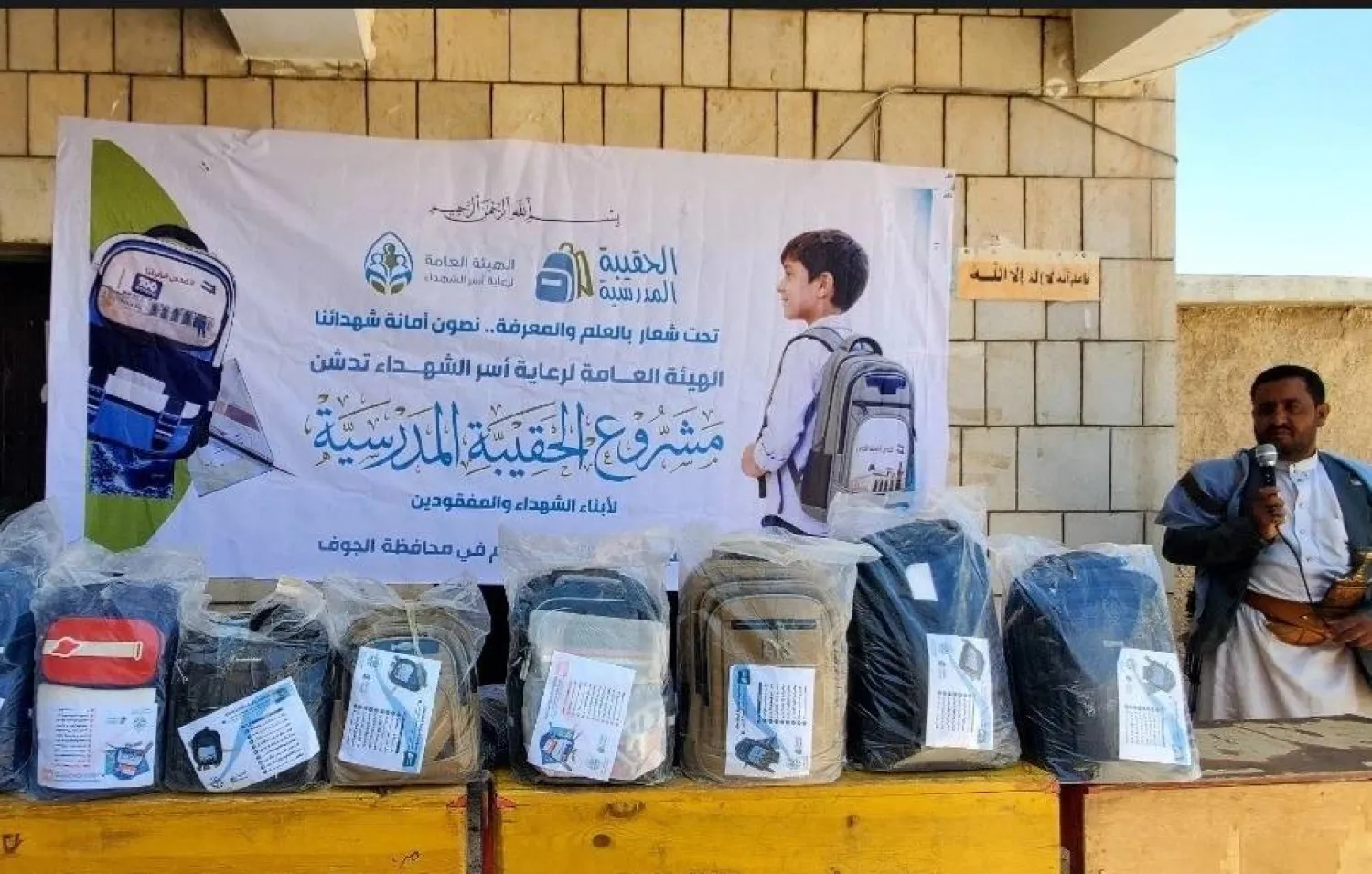
School supplies distributed to the children of Houthi fighters killed in combat, excluding other poor families, in Sanaa. (X)
TT

Houthis Link Educational Support to Loyalty and Affiliation

School supplies distributed to the children of Houthi fighters killed in combat, excluding other poor families, in Sanaa. (X)

The education system in areas under Houthi control is facing a fresh wave of criticism as the group launched the new academic year during the summer. The Houthis are accused of limiting the distribution of school supplies and cash assistance to their supporters and to the families of fighters killed or missing on the front lines, while also requiring private schools to grant tuition exemptions to the same groups.

The developments come as debate continues over the secondary school examination results announced by the Houthi authorities, with education experts questioning the unusually high pass rates and raising concerns about the impact of these policies on educational equity and the future of education in Yemen.

The controversy unfolds as millions of Yemeni families continue to face worsening economic conditions, leaving many unable to afford even the most basic educational expenses, including tuition fees, school bags, textbooks, and uniforms, amid declining purchasing power and widening poverty caused by the war and the economic crisis.

According to education sources, the Houthi-run so-called Zakat Authority oversaw the distribution of school bags and cash assistance through supervisors affiliated with the group. The sources said the mechanism prioritized the families of Houthi fighters and supporters, while excluding thousands of impoverished families unable to provide basic school supplies for their children.

The distribution process sparked widespread frustration among parents and education advocates, who argued that educational assistance should be allocated according to humanitarian need rather than political considerations or organizational affiliation.

Inequality

"Ibrahim," a parent in the Houthi-held Yemeni capital, Sanaa, told Asharq Al-Awsat that none of his three children received any educational support despite being registered on lists of families in need, while he witnessed school bags and uniforms being distributed to families linked to the group.

He said his family was living under severe financial hardship, yet their needs had been ignored. He argued that if charitable initiatives had supervised the distribution of the aid themselves, some of it would have reached his children.

Other parents in rural areas around Sanaa voiced similar complaints, saying the cost of preparing their children for the new school year had exceeded their financial means, while assistance remained limited to specific groups, deepening their sense of inequality.

Meanwhile, humanitarian sources said Houthi authorities responsible for aid operations and the Zakat Authority had recently confiscated quantities of school bags, notebooks, pens, uniforms, and cash that charitable initiatives had allocated to support poor students at the start of the academic year.

Education sources also said the Houthis had required private schools to waive tuition fees this year for the children of their supporters, as well as the families of fighters killed or captured on the front lines, without providing any compensation to the schools.

The principal of a private school on the outskirts of Sanaa, who requested anonymity, said the administration had no choice but to comply with the directives for fear of punitive measures. She noted that the exemptions did not extend to other students from the poorest families, despite their urgent need for assistance.

Education experts warned that imposing additional financial burdens on private schools without compensation threatens their financial stability and undermines their ability to continue providing educational services under the country's difficult economic conditions.
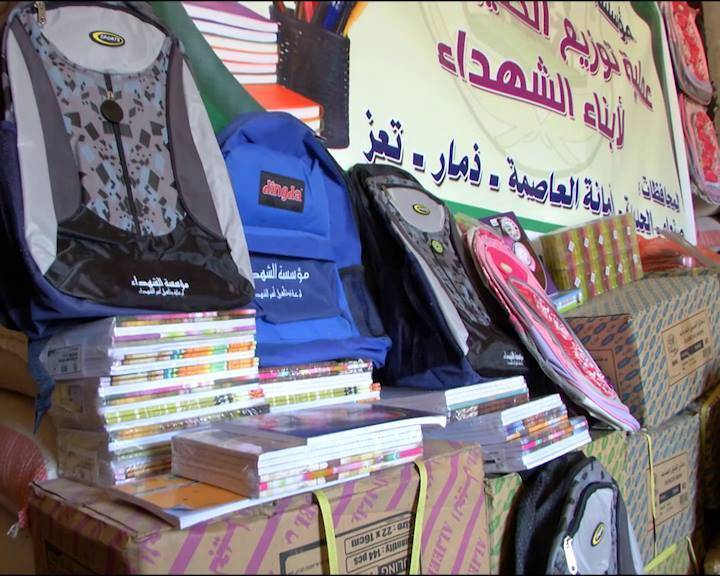
School supplies allocated by the Houthis for the children of their members. (Facebook)

Secondary School Results Raise Questions

Alongside the controversy over aid distribution, the secondary school examination results announced by the Houthi authorities have prompted widespread debate within education circles after reporting high pass rates and scores exceeding 99 percent for a number of students, despite years of decline in the education sector during the war.

The Education Ministry in the unrecognized Houthi administration announced an overall pass rate of 88.12 percent among more than 210,000 students who sat the examinations. Education specialists said the figure raises questions given the reality facing schools, which continue to suffer from teacher shortages, unpaid salaries, limited resources, and a decline in educational standards.

Education experts believe the conditions facing the education sector make it difficult to explain such a sharp increase in pass rates without releasing data detailing the grading and assessment process in a way that would strengthen confidence in the results and dispel the doubts surrounding them.

Several teachers also expressed surprise at the high scores, saying the level of academic achievement they observed throughout the school year did not correspond with the announced results, particularly in light of repeated student absences and disruptions to the education process.

Cheating Allegations

Yemeni education sources say the high pass rates recorded in Houthi-controlled areas do not reflect an improvement in educational standards. Instead, they attribute the results to widespread cases of organized cheating at some examination centers, along with the circulation of answer keys before and during the exams, which they consider a primary factor behind the higher scores.

Education activists also accused the Houthis of failing around 25,000 male secondary school students this year, claiming the move was part of a policy aimed at pressuring students and encouraging them to join the group's ranks in exchange for better chances of passing. The Houthi authorities have not commented on the allegations.

Several teachers said they had documented irregularities at some examination centers, including weak oversight and allowing certain students to receive assistance while taking the exams. They said such practices undermine the credibility of the examination process and compromise the fairness of student assessment.

In one case, a student from Sanaa said he was surprised to receive a score of 72 percent despite missing most of the school year because he had to work to help support his family. He said he attended only the final examinations, prompting him to question how the results had been calculated.

Meanwhile, a number of high-achieving students expressed dissatisfaction with the announced results, calling for greater transparency in grading procedures and the publication of detailed marks to safeguard students' rights and strengthen confidence in the secondary school certificate.



Syria Arrests Assad-era Officer who Fled Austria after Conviction

A man walks past heavily-damaged and destroyed buildings in the Jobar suburb northeast of Damascus on August 12, 2026. (Photo by LOUAI BESHARA / AFP)
TT

Syria Arrests Assad-era Officer who Fled Austria after Conviction

A man walks past heavily-damaged and destroyed buildings in the Jobar suburb northeast of Damascus on August 12, 2026. (Photo by LOUAI BESHARA / AFP)

Syrian security forces have arrested a former Assad-era security officer who fled Austria after being sentenced to eight years in prison for abusing detainees and returned to his hometown in southern Syria, state news agency SANA said on Tuesday night.

Lieutenant Colonel Musab Abu Rukba was arrested in the city of Nawa in Daraa province by internal security forces in coordination ⁠with the counter-terrorism ⁠department, SANA said, citing the security forces.

Abu Rukba had been convicted by a Vienna court last month of bodily harm, aggravated coercion and sexual assault against detained opponents of former President Bashar al-Assad while he headed the police’s criminal investigations department in the northern city of Raqqa more than a ⁠decade ago.

He had pleaded not guilty.

Reuters reported on Friday that Abu Rukba had left Austria while challenging his eight-year sentence on appeal and arrived in Nawa in early August, where his family held a reception to celebrate his return.

SANA said on Tuesday that Abu Rukba had entered Syria illegally after fleeing Austria and that authorities had tracked him down in Nawa. He had been referred to the relevant authorities to complete legal procedures ahead of prosecution, it said.

It was ⁠not immediately ⁠clear what charges Abu Rukba could face in Syria or whether Austria had requested his arrest or extradition.

A spokesperson for the Austrian court that convicted him told Reuters at the time that Abu Rukba had not been considered a flight risk before his trial because he had lived in Austria since 2014 and was seeking asylum there with his family.

He was not held in custody during the trial or subjected to other restrictions, and his departure from Austria did not breach Austrian laws or court orders while the appeals process remained underway, the spokesperson said.


Israel Says It Recovered Remains of Soldier Killed in Lebanon in 1982

Destruction is pictured in the village of Arnoun as seen from nearby Marjeyoun in southern Lebanon on August 11, 2026. (AFP)
TT

Israel Says It Recovered Remains of Soldier Killed in Lebanon in 1982

Destruction is pictured in the village of Arnoun as seen from nearby Marjeyoun in southern Lebanon on August 11, 2026. (AFP)

The Israeli military said on Tuesday it had repatriated the remains of Sgt First Class Yehuda Katz, a soldier killed in Lebanon 44 years ago, in a joint operation with the Mossad intelligence agency.

Katz was the last Israeli soldier declared missing in the Sultan Yacoub battle against Syrian forces in eastern Lebanon in 1982.

"His return to Israel was made possible through efforts based on accurate intelligence... that lasted more than four decades," the military said in a statement.

It is not clear where his body was found.

Israeli Prime Minister Benjamin Netanyahu commended the security forces and said that "for many years, I approved numerous clandestine operations to locate the missing soldiers of Sultan Yacoub. I promised their families that we would never stop working to bring them home."

In a separate statement, President Isaac Herzog said that "the circle that remained an open and bleeding wound from the Battle of Sultan Yacoub is finally closed," and that he had kept a photograph of Yehuda Katz hanging in his office as "a daily reminder of our sacred duty to bring our sons home and leave no one behind".

Katz's remains were brought to Israel and identified at an institute for the identification of fallen soldiers under the military rabbinate, the military said.

Three Israeli soldiers had been missing for decades after the Sultan Yacoub battle. In 2019, the military announced the repatriation of the remains of Sgt First Class Zachariah Baumel, while in May 2025 it said it had recovered the body of Sgt First Class Tzvika Feldman "in the heart of Syria".


Lebanon Mulls Removing Restrictions Against 600,000 Syrians

Lebanese soldiers are seen at the Masnaa border crossing with Syria in wake of the collapse of the Syrian regime. (AP file)
TT

Lebanon Mulls Removing Restrictions Against 600,000 Syrians

Lebanese soldiers are seen at the Masnaa border crossing with Syria in wake of the collapse of the Syrian regime. (AP file)

Lebanese authorities began reviewing security restrictions against some 600,000 Syrians in the latest move that reflects Beirut’s desire to open a new chapter in relations with Damascus based on clear security and legal foundations.

The restrictions are among the thorniest issues in Lebanon and that emerged during the wave of Syrian displacement sparked by the civil war. The restrictions led to hundreds of thousands of Syrians being barred entry to Lebanon.

Addressing the issue would pave the way for Lebanese-Syrian relations that are based on security coordination and respect for the law.

Asharq Al-Awsat learned that Lebanon’s General Directorate of the General Security has kicked off the legal procedures to lift security restrictions against over 600,000 Syrians that barred their entry to Lebanon for years.

A prominent security source revealed that General Security chief Hassan Choucair has formed a committee that will study the file of Syrians who have security warrants against them that have prevented them from entering Lebanon.

The warrants are tied to residency or entry violations.

The source told Asharq Al-Awsat that authorities are now examining the file of every Syrian who has been barred entry to Lebanon over residency violations, such as entering Lebanon illegally or violating residency rules or exceeding the duration of their stay.

The source said the committee has already completed tens of thousands of files.

The General Security will issue a statement upon completion of the procedures. It will inform the Syrian authorities of its results.

The move is not limited to building trust between Beirut and Damascus, but it also aims to crack down on people smuggling across the Lebanese-Syrian border.

The latest procedures will allow Syrians to enter Lebanon with their identification papers or through travel agencies as long as they meet the necessary requirements.

Syrians wishing to work in Lebanon must obtain work and legal residency permits from the General Security.

“Lebanon welcomes anyone who wants to reside on its territory as long as they are doing so legally,” said the source.

“Syria is a sisterly country and organizing the movement of people in and out of both countries benefits them both,” he added.