
Iran, Iraqi Factions Criticize Al-Zaidi’s Washington Visit

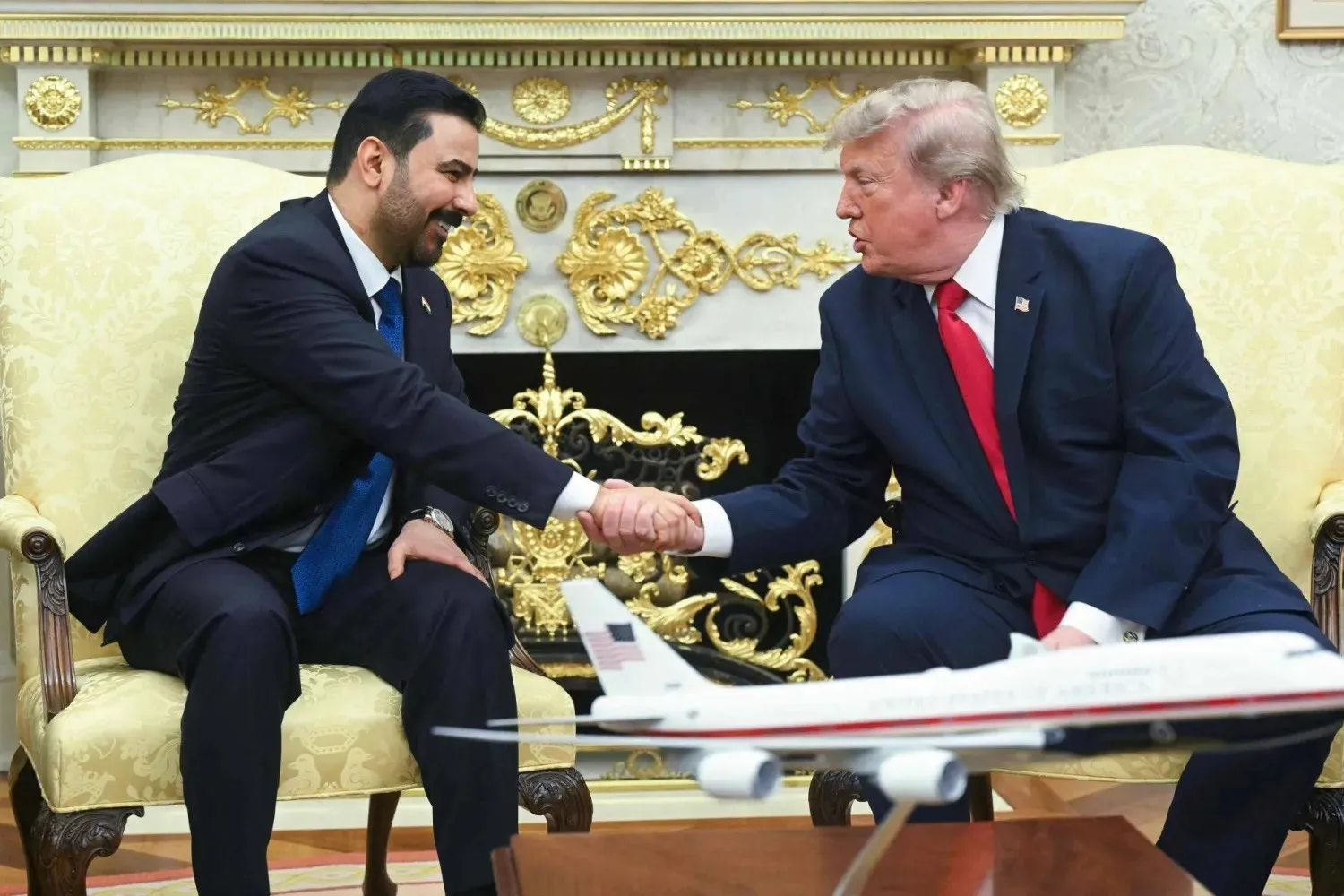
US President Donald Trump shakes hands with Iraqi Prime Minister Ali al-Zaidi at the White House on July 14, 2026. (AFP) 
TT

Iran, Iraqi Factions Criticize Al-Zaidi’s Washington Visit

US President Donald Trump shakes hands with Iraqi Prime Minister Ali al-Zaidi at the White House on July 14, 2026. (AFP) 

Iraqi Prime Minister Ali al-Zaidi received a notably warm welcome during his visit to the United States, where he met President Donald Trump and sought to translate political rapprochement into economic and investment partnerships.

Drawing on his business background, al-Zaidi told US companies they shared “a common language — the economy.” He stressed, however, that he had not come to the United States as a “contractor,” but to pursue broad-based development in Iraq, which he said had missed opportunities for growth over the past two decades despite its ties with successive US administrations.

Al-Zaidi linked Iraq’s next security and political phase to a new era of economic cooperation. He noted that the departure of the remaining US forces after September 30, under an agreement reached between the government of former Prime Minister Mohammed Shia al-Sudani and Washington, could open the door to broader economic and investment partnerships.

Before the visit, al-Zaidi said Iraq would no longer need the concept of “resistance” after the end of September, arguing that “resistance is not a profession, but a necessity” imposed by the country’s past circumstances.

His outreach drew criticism from Iran-aligned groups and their Iraqi allies, who argued that opening the door to US companies represented a political and economic shift requiring reassessment.

The criticism coincided with Iraq’s signing of about 48 memorandums of understanding and agreements with US companies, alongside energy deals that included an oil export route bypassing the Strait of Hormuz and a memorandum of understanding with Syria to transport Iraqi oil to the Syrian port of Banias.

Velayati Criticizes Al-Zaidi

The developments also drew criticism in Tehran, where Ali Akbar Velayati, an adviser to Iran’s supreme leader, described al-Zaidi as “inexperienced,” according to media reports.

Writing in the newspaper Farhikhtegan, Velayati said the Iraqi prime minister’s conduct during his meeting with Trump, shortly after the funeral of former Supreme Leader Ali Khamenei, was “a great disgrace.”

Observers say the dispute reflects intensifying competition over Iraq’s future relationship with both the United States and Iran, as Baghdad seeks to attract foreign investment while preserving its regional balance.

Analyst Iyad al-Samawi questioned whether Iraq was truly prepared to host major US companies and provide an adequate investment climate.

“Global companies do not invest on emotion or gamble with their decisions,” he underlined, stating that they look not only for oil, but also for security, stable legislation, judicial independence, efficient procedures, clear decision-making, and institutional integrity.

He added that major US companies operate under strict anti-bribery and anti-corruption laws and would not lower their standards to accommodate an unstable business environment. The success of the agreements signed in Washington, he said, “begins not with the companies, but with the Iraqi state itself.”

A former security official told Asharq Al-Awsat that the campaign against al-Zaidi was “not merely a passing political escalation,” but reflected concerns that his economic opening could create a more favorable environment for US companies.

Speaking on condition of anonymity, the official said al-Zaidi was seeking to apply his business experience to government by “blending politics with finance and business.” But major US companies, he added, would not invest in Iraq as long as political corruption and security instability persisted.

The official argued that pressure from Iran and allied Iraqi factions was intended to slow the economic opening championed by the prime minister.


Israel Defiance Minister Vows Troops to Stay in Lebanon, Syria, Gaza

A photograph taken from the southern Lebanese village of Chaqra shows the Israeli flag as it flutters on top of the nearby Crusaders Cital of Doubieh on August 11, 2026. (AFP)
TT

Israel Defiance Minister Vows Troops to Stay in Lebanon, Syria, Gaza

A photograph taken from the southern Lebanese village of Chaqra shows the Israeli flag as it flutters on top of the nearby Crusaders Cital of Doubieh on August 11, 2026. (AFP)

Israel's Defense Minister Israel Katz visited southern Lebanon on Wednesday, vowing to destroy infrastructure and keep troops in a so-called "security zone" as well as in Syria and Gaza.

The comments came almost two months after Israel and Lebanon agreed to a US-sponsored framework deal that involves the disarmament of the Iran-backed Hezbollah, a gradual withdrawal of Israeli forces from Lebanon's south and the deployment of the Lebanese army to the region, starting in test areas known as "pilot zones".

The United States plans new talks in early September in Rome between Israel and Lebanon.

Katz and Prime Minister Benjamin Netanyahu have repeatedly vowed not to withdraw from the occupied "security zone" in southern Lebanon -- a strip of territory where Israeli forces operate that reaches around 10 kilometers (six miles) into Lebanon.

"As the prime minister and I have clearly stated, we are not withdrawing from this security zone," Katz said during a visit to troops, according to a statement from his office.

The Israeli military "is here to protect the northern communities and its own forces. We will clear this area and guarantee the security of the residents of the north. We will in no way withdraw from the security zones: not in Lebanon, not in Syria, and not in Gaza," he added.

In southern Lebanon, Katz said the military was "destroying the underground infrastructure" in the area and "destroying all the houses".

Hezbollah drew Lebanon into the Middle East war in early March with rocket fire aimed at Israel to avenge the killing of Iran's supreme leader in US-Israeli strikes.

Israel responded with massive airstrikes and a ground invasion of southern Lebanon.

Israel has also carried out repeated incursions and bombings in Syria since the overthrow of longtime ruler Bashar al-Assad, saying it sought to establish a demilitarized zone in the country's south.

In Gaza, Israeli forces occupy more than 60 percent of the war-battered territory.

Last week, Netanyahu rejected a US-led plan for Gaza endorsed by Hamas, saying the Israeli military "will not carry out any withdrawal until Hamas is genuinely disarmed, and will continue to thwart threats against our forces and our citizens".


Israel Seeking to ‘Remove Palestine from World’s Agenda’, Says Erdogan

Palestinian President Mahmoud Abbas (L) shakes hands with Türkiye’s President Recep Tayyip Erdogan (R) after a press conference at the presidential palace in Ankara on August 12, 2026. (AFP)
TT

Israel Seeking to ‘Remove Palestine from World’s Agenda’, Says Erdogan

Palestinian President Mahmoud Abbas (L) shakes hands with Türkiye’s President Recep Tayyip Erdogan (R) after a press conference at the presidential palace in Ankara on August 12, 2026. (AFP)

Turkish President Recep Tayyip Erdogan on Wednesday accused the Israeli government of Benjamin Netanyahu of seeking to "remove Palestine" from the world's agenda.

"The aim of the Netanyahu government is to remove Palestine from the common agenda of humanity by profiting from chaos and new conflicts in the region," Erdogan said at a joint news conference with his Palestinian counterpart Mahmoud Abbas.

"No matter what they do, they will not succeed. The Palestinian cause will continue to grow in people's hearts as they try to destroy it," he said, vowing Türkiye would fight for the establishment of a Palestinian state.

A strong advocate of the Palestinian cause, Erdogan has repeatedly lambasted Netanyahu's government, accusing the Israeli prime minister of committing "genocide" in Gaza and of pursuing expansionist policies in the West Bank, Lebanon, Syria and beyond.

Abbas arrived in Ankara on Tuesday accompanied by his diplomatic advisor Majdi Khalidi, intelligence chief Majed Faraj and senior Palestinian official Ziad Abu Amr.

He met Erdogan on Wednesday with the pair discussing developments in the region in talks the Palestinian leader described as "important and fruitful".

Last month, Abbas, 90, said Palestinian legislative elections would take place on November 28 followed by a presidential poll early next year.

If the November election goes ahead, it would be the first such ballot in two decades.

"I hope the decision to hold legislative and presidential elections in Palestine after a long time will bring good fortune... (and) will advance the reconciliation process," Erdogan said, in a nod to the historic rivalry between Abbas' Fatah movement and Gaza's Hamas rulers.

Abbas also hailed the August 7 defense pact between Türkiye, Saudi Arabia and Pakistan, saying it was "of utmost importance" and expressing hope it would help enhance security and stability in the region.


Germany’s Ex-Envoy to Israel Slams ‘Disastrous’ West Bank Policy

Smoke rises as the Israeli army detonates explosives in the house of slain Palestinian Farouq Ramadan in Tell village, near the West Bank city of Nablus, 11 August 2026. (EPA)
TT

Germany’s Ex-Envoy to Israel Slams ‘Disastrous’ West Bank Policy

Smoke rises as the Israeli army detonates explosives in the house of slain Palestinian Farouq Ramadan in Tell village, near the West Bank city of Nablus, 11 August 2026. (EPA)

Germany's former ambassador to Israel, Steffen Seibert, levelled unusually sharp criticism at the Israeli government and what he labelled its "disastrous" settlement policy in the occupied West Bank in a media interview released Wednesday.

Israel's policy in the Palestinian territory amounts to "displacement through psychological and physical violence", he was quoted as saying by news weekly Die Zeit.

Modern Germany, at pains to atone for the horrors of the Nazi era and the Holocaust, has long been a steadfast supporter of Israel.

Seibert, the former spokesman of then chancellor Angela Merkel, qualified her stance that "Israel's security is part of Germany's reason of state", noting that this commitment applied to Israel within its internationally recognized borders.

He stressed that "if the very existence of Israel is threatened by a murderous attack by Hamas, by the no less murderous plans of Hezbollah, or by Iran, then we must stand by this state".

"But that does not apply to the settlers in the Jordan Valley," he told Zeit.

"Under international law, these are illegal settlements driven by the ideology that this land belongs solely to us -- that God gave it to us.

"The concept of 'reason of state' does not extend to that; it does not support a sense of superiority over another population."

It was equally necessary, he added, to tell the Palestinians that the right of the Israeli people to live in their own state must be respected.

"We need to make it clear what we mean when we -- rightly -- say that we stand by Israel," said Seibert.

But he added: "That does not mean our support extends to every action taken by the Israeli state -- for instance, the occupation, which is now entering its 60th year."