

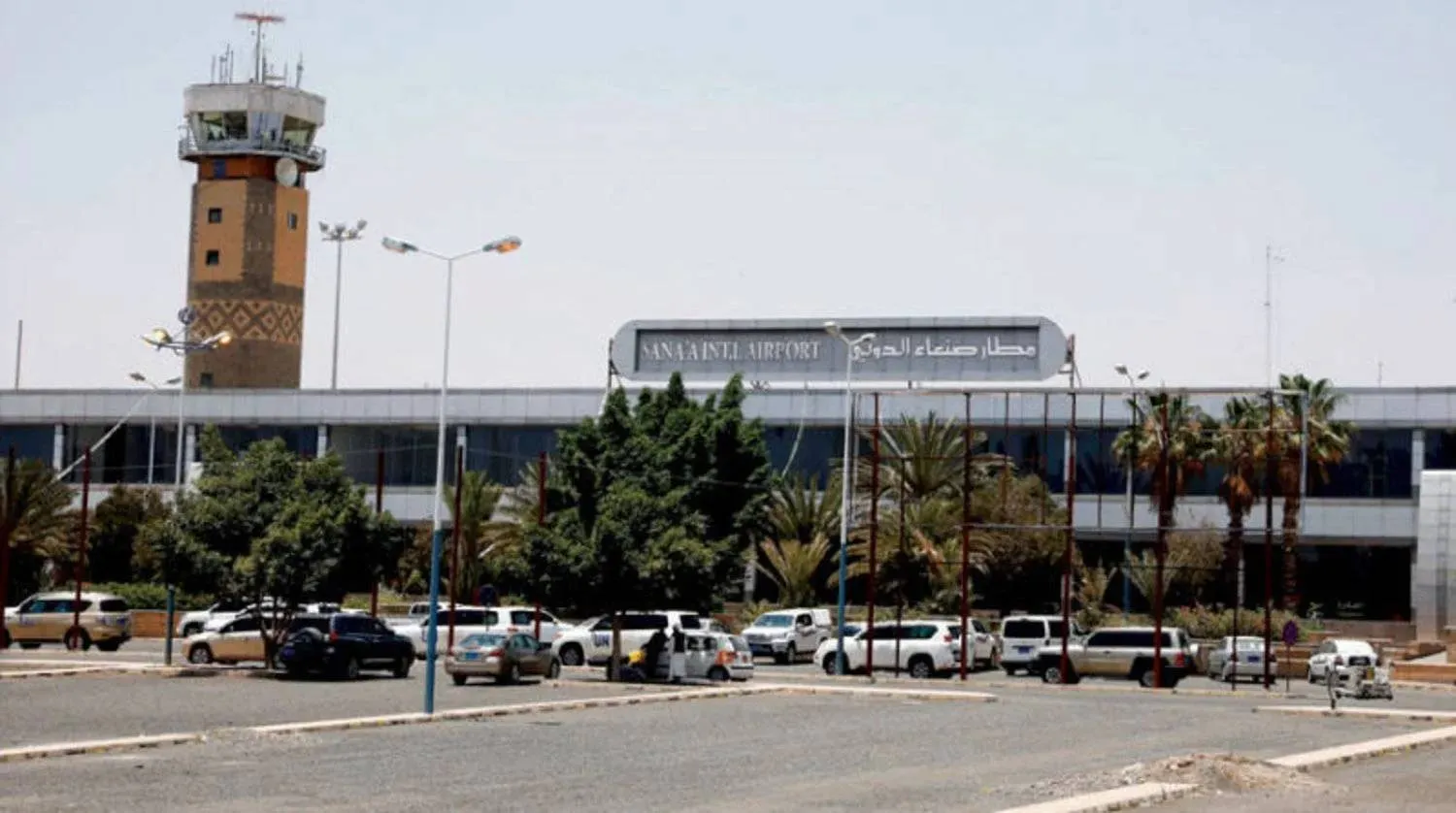

How Yemen’s Govt Exposed the Houthis’ Misleading ‘Blockade’ Narrative

A view of Sanaa International Airport in Yemen. (EPA file)
TT

How Yemen’s Govt Exposed the Houthis’ Misleading ‘Blockade’ Narrative

A view of Sanaa International Airport in Yemen. (EPA file)

A week ago, the Yemeni Armed Forces targeted the runway at Sanaa International Airport to prevent an aircraft operated by Iran’s Mahan Air from landing after departing Tehran.

The legitimate government said the flight violated Yemen’s airspace by operating outside the state’s legal framework despite repeated warnings that any unauthorized breach would be intercepted.

The incident followed what the government described as the Houthis’ continued rejection of initiatives aimed at easing civilians’ suffering and restoring civilian flights through the national carrier.

The government said it has sought to reopen Sanaa airport under legal state supervision, as at other government-run Yemeni airports, while accusing the Houthis of insisting on flights between Sanaa and Tehran operated by Mahan Air, which has faced international sanctions over allegations of providing logistical support to Iran’s Revolutionary Guard Corps (IRGC).

The government said that a recent Mahan Air flight carrying a Houthi delegation switched off its tracking signals while crossing Yemeni airspace to conceal the transport of IRGC and Hezbollah personnel, military equipment, weapons, and communications devices, in violation of relevant UN Security Council resolutions.

Yemen’s Information Minister Moammar al-Eryani told Asharq Al-Awsat last week that the government had exhausted political, diplomatic, and legal avenues and proposed practical initiatives to avoid further escalation, but the Houthis rejected them all.

Instead, they sought, together with Tehran, to turn Sanaa airport into a permanent gateway for Iranian flights operating outside state authority, he stressed.

Observers say the Houthis’ conduct reflects a broader effort to advance Tehran’s regional agenda by drawing Yemen into regional conflicts and turning the country into a military and political platform threatening international shipping and global energy supplies.

Mutlaq al-Mutairi, a professor of political communication at King Saud University, told Asharq Al-Awsat that the Houthis’ use of Yemeni territory for objectives beyond national interests has deepened the country’s isolation and undermined prospects for a political settlement, worsening the suffering of ordinary Yemenis.

Al-Mutairi said the Houthis’ rejection of government proposals to resume civilian flights through the national carrier undermines their “misleading” narrative that the airport closure is responsible for civilians’ hardships.

Instead, the group has used the airport issue as a political bargaining chip while promoting a false blockade narrative through incendiary statements and false slogans to mobilize Yemenis for conflicts that serve only Iran’s regional project, he said.

He added that the continued flow of food, medicine, and petroleum products through Yemeni ports weakens Houthi claims of a comprehensive blockade.

In his view, the crisis stems from the group’s decision to take up arms against the state, undermine its institutions with Iranian backing, exploit public suffering, damage infrastructure, and target oil exports instead of pursuing peace.

Saudi Arabia has rejected accusations by the Houthis’ military spokesman that the Kingdom was blockading Yemen and restricting maritime shipping.

In a statement Monday, the Saudi Foreign Ministry said Houthi actions had worsened humanitarian and economic conditions, particularly in areas under their control, while rejecting every initiative to resume flights from Sanaa airport, including the latest Jordanian proposal.

The ministry said that Saudi Arabia has worked with Yemen’s legitimate government to ease humanitarian suffering by supporting the state budget, funding development projects, supplying fuel for power plants, and backing UN-led peace efforts, including the roadmap accepted by the Yemeni government but never formally endorsed by the Houthis.

Maj. Gen. Turki al-Malki, spokesman for the Saudi-led Coalition to Restore Legitimacy in Yemen, likewise described the Houthi blockade narrative as “misleading.”

He said more than 300 commercial vessels entered the ports of Hodeidah, Salif, and Ras Isa during the first half of 2026 carrying food, fuel, construction materials, and other goods.

Al-Malki added that claims of closed ports and airports were part of Houthi misinformation, saying the group was responsible for the closure of Sanaa International Airport, the destruction of Yemenia Airways aircraft, and the rejection of every initiative to resume flights.



Israel Opens Criminal Probes Over Killings of Hind Rajab and Gaza Rescue Workers, Military Says

Hind Rajab. (Family handout/AFP/Getty Images)
TT

Israel Opens Criminal Probes Over Killings of Hind Rajab and Gaza Rescue Workers, Military Says

Hind Rajab. (Family handout/AFP/Getty Images)

Israel's military will open internal investigations over its troops' killings in Gaza of Palestinian girl Hind Rajab in January 2024 and 15 emergency and aid workers in March 2025, it said on Wednesday, although rights groups said such probes rarely lead to convictions.

The military said the investigation decisions followed probes by its Fact-Finding and Assessment Mechanism. It released decisions regarding five incidents involving the deaths of Palestinians. They included an examination ‌of the killings ‌of seven aid workers with the World ‌Central ⁠Kitchen charity in ⁠April 2024. On that incident, the military said there was "no reasonable suspicion of criminal misconduct that would justify the opening of a criminal investigation."

"For more than a thousand days, the Israeli army has been conducting intensive combat across numerous fronts, carrying out a wide range of military missions ⁠in an exceptionally complex operational reality," the Israeli ‌military said.

"As part of the military's ‌obligations under international law and Israeli domestic law, the army ‌examines exceptional incidents that occurred during combat," the military said.

Israeli ‌rights groups say that criminal misconduct investigations into Israeli troops over the killing of Palestinians rarely lead to convictions.

"Nearly zero indictments are served relative to the number of complaints of soldiers and ‌commanders who commit offenses. In rare cases when commanders or soldiers are convicted, they receive ridiculously ⁠lenient ⁠sentences compared with the severity of the offense," a spokesperson for the Israeli rights organization Yesh Din said.

During Israel's offensive in response to an October 7, 2023, Hamas attack, Hind Rajab was pinned down in a car for hours, begging Palestinian medics over a mobile phone to send help, while her aunt, uncle and three cousins already lay dead.

When an ambulance finally arrived, contact with the girl and the rescuers themselves was lost. Twelve days later, the bodies of the girl, her relatives and two ambulance workers were recovered from the area.


Syria Arrests Assad-era Officer who Fled Austria after Conviction

A man walks past heavily-damaged and destroyed buildings in the Jobar suburb northeast of Damascus on August 12, 2026. (Photo by LOUAI BESHARA / AFP)
TT

Syria Arrests Assad-era Officer who Fled Austria after Conviction

A man walks past heavily-damaged and destroyed buildings in the Jobar suburb northeast of Damascus on August 12, 2026. (Photo by LOUAI BESHARA / AFP)

Syrian security forces have arrested a former Assad-era security officer who fled Austria after being sentenced to eight years in prison for abusing detainees and returned to his hometown in southern Syria, state news agency SANA said on Tuesday night.

Lieutenant Colonel Musab Abu Rukba was arrested in the city of Nawa in Daraa province by internal security forces in coordination ⁠with the counter-terrorism ⁠department, SANA said, citing the security forces.

Abu Rukba had been convicted by a Vienna court last month of bodily harm, aggravated coercion and sexual assault against detained opponents of former President Bashar al-Assad while he headed the police’s criminal investigations department in the northern city of Raqqa more than a ⁠decade ago.

He had pleaded not guilty.

Reuters reported on Friday that Abu Rukba had left Austria while challenging his eight-year sentence on appeal and arrived in Nawa in early August, where his family held a reception to celebrate his return.

SANA said on Tuesday that Abu Rukba had entered Syria illegally after fleeing Austria and that authorities had tracked him down in Nawa. He had been referred to the relevant authorities to complete legal procedures ahead of prosecution, it said.

It was ⁠not immediately ⁠clear what charges Abu Rukba could face in Syria or whether Austria had requested his arrest or extradition.

A spokesperson for the Austrian court that convicted him told Reuters at the time that Abu Rukba had not been considered a flight risk before his trial because he had lived in Austria since 2014 and was seeking asylum there with his family.

He was not held in custody during the trial or subjected to other restrictions, and his departure from Austria did not breach Austrian laws or court orders while the appeals process remained underway, the spokesperson said.


Israel Says It Recovered Remains of Soldier Killed in Lebanon in 1982

Destruction is pictured in the village of Arnoun as seen from nearby Marjeyoun in southern Lebanon on August 11, 2026. (AFP)
TT

Israel Says It Recovered Remains of Soldier Killed in Lebanon in 1982

Destruction is pictured in the village of Arnoun as seen from nearby Marjeyoun in southern Lebanon on August 11, 2026. (AFP)

The Israeli military said on Tuesday it had repatriated the remains of Sgt First Class Yehuda Katz, a soldier killed in Lebanon 44 years ago, in a joint operation with the Mossad intelligence agency.

Katz was the last Israeli soldier declared missing in the Sultan Yacoub battle against Syrian forces in eastern Lebanon in 1982.

"His return to Israel was made possible through efforts based on accurate intelligence... that lasted more than four decades," the military said in a statement.

It is not clear where his body was found.

Israeli Prime Minister Benjamin Netanyahu commended the security forces and said that "for many years, I approved numerous clandestine operations to locate the missing soldiers of Sultan Yacoub. I promised their families that we would never stop working to bring them home."

In a separate statement, President Isaac Herzog said that "the circle that remained an open and bleeding wound from the Battle of Sultan Yacoub is finally closed," and that he had kept a photograph of Yehuda Katz hanging in his office as "a daily reminder of our sacred duty to bring our sons home and leave no one behind".

Katz's remains were brought to Israel and identified at an institute for the identification of fallen soldiers under the military rabbinate, the military said.

Three Israeli soldiers had been missing for decades after the Sultan Yacoub battle. In 2019, the military announced the repatriation of the remains of Sgt First Class Zachariah Baumel, while in May 2025 it said it had recovered the body of Sgt First Class Tzvika Feldman "in the heart of Syria".