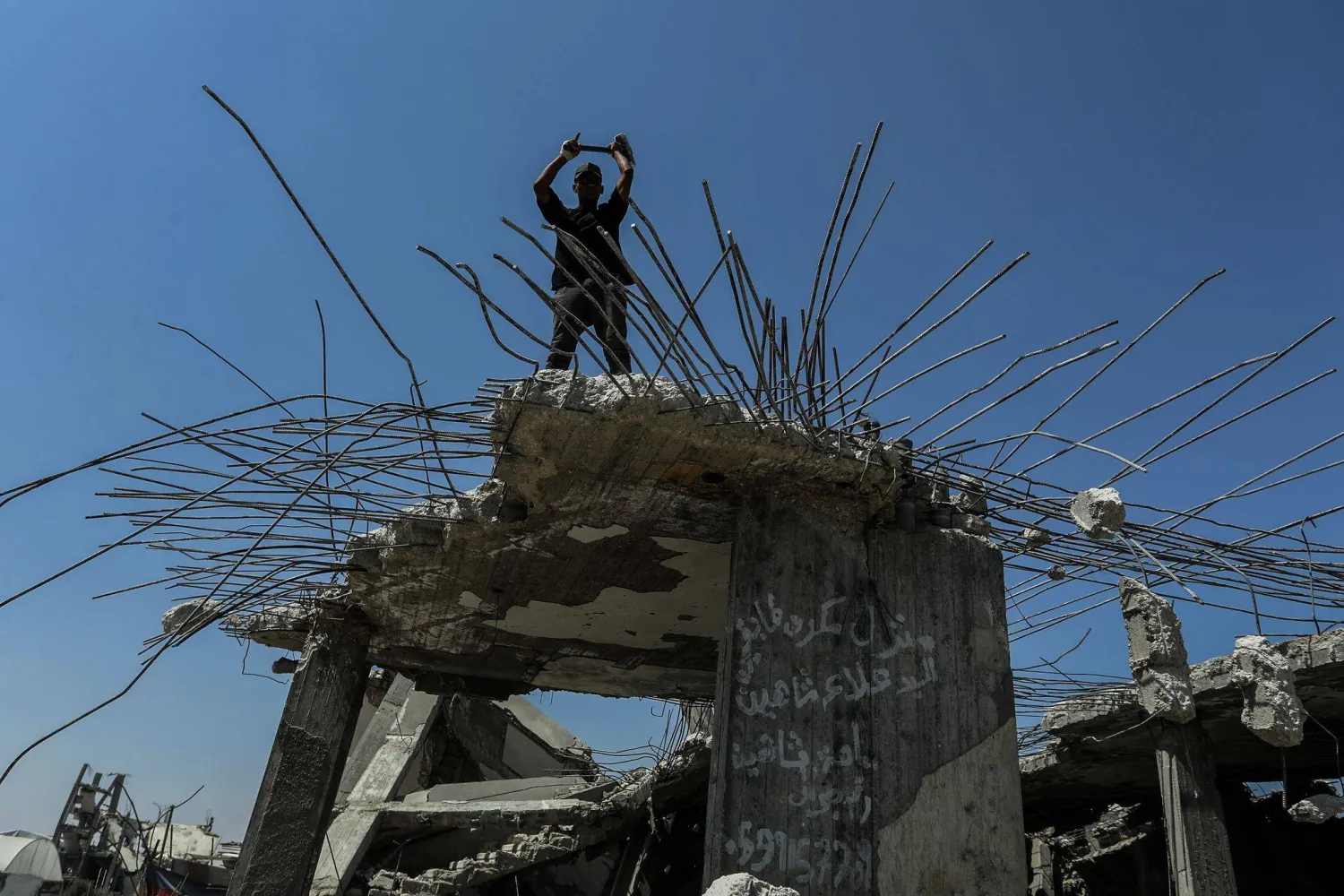
Israel Intensifies Assassinations of Hamas Police Officers in Gaza

25 July 2026, Palestinian Territories Photo: Abed Rahim Khatib/dpa
TT

Israel Intensifies Assassinations of Hamas Police Officers in Gaza

25 July 2026, Palestinian Territories Photo: Abed Rahim Khatib/dpa

The Israeli military intensified targeted killings over the weekend, with operations on Saturday and Sunday focusing primarily on security officers serving in the Hamas-run government in the Gaza Strip. Those targeted were responsible for various security portfolios, including pursuing armed gangs and individuals accused of collaborating with Israel.

Shortly before noon on Sunday, an Israeli drone fired three missiles at a vehicle in the Al-Baraka area of Deir al-Balah in central Gaza, well away from the "yellow line." The strike killed two men who were later identified as Col. Wael Al-Ladawi, 44, director of the Internal Security Service in central Gaza, and Maj. Ramez Abu Zureiq, 49.

Field sources told Asharq Al-Awsat that Al-Ladawi had recently led a security campaign, coordinated with several security agencies and Palestinian factions, to intensify efforts against armed gangs backed by Israel after they targeted members of the military wings of Palestinian factions. The sources said he was also responsible for handling the file of individuals accused of collaborating with Israel and had recently overseen the arrest of several suspects.

The attack came one day after a series of similar strikes targeting police officers and security personnel. One of those strikes killed Brig. Gen. Abdel Nasser Al-Maqadma, 54, director of police in North Gaza Governorate, as he was riding a bicycle in the Ard Al-Shanti area, north of the Sheikh Radwan neighborhood in northwestern Gaza City.

That attack, carried out on Saturday afternoon, coincided with another strike targeting the vehicle of the officer in charge of Jabalia police in northern Gaza, leaving him critically wounded. Medical teams in the territory are continuing efforts to save his life.

Meanwhile, Lt. Col. Yamen Obeid, 48, a police officer in Jabalia, died of wounds sustained in an Israeli strike on July 14 that targeted him along with a group of police officers and personnel west of the city. That attack killed one police officer and four security personnel at the time.

At least 49 police officers and security personnel have been killed since the ceasefire took effect on October 10, 2025.

Gaza's Interior Ministry accused Israel of "persistently targeting the foundations of police work" in an effort to spread chaos throughout the territory. The ministry called on the international community and the mediating countries to pressure Israel to stop targeting the police force.

Israeli strikes on Saturday killed seven Palestinians and wounded more than 20 others in a series of attacks across southern, central, and northern Gaza.

One of the strikes targeted the entrance to Al-Aqsa Martyrs Hospital in Deir al-Balah, where tents used by journalists are located nearby. Several journalists narrowly survived the attack.

The strike killed a Palestinian man who operated a small tobacco stand and wounded at least 14 people passing in front of the hospital entrance. Two other Palestinians were killed in a separate strike targeting them in the Al-Mawasi area of Khan Younis in southern Gaza.


Palestinian Authorities Say Israeli Army Kills Teen in West Bank

Mourners carry the body of Palestinian Islam Ajouri, 14, at Rafidia Hospital in Nablus in the Israeli-occupied West Bank, on August 23, 2026. (Photo by JAAFAR ASHTIYEH / AFP)
TT

Palestinian Authorities Say Israeli Army Kills Teen in West Bank

Mourners carry the body of Palestinian Islam Ajouri, 14, at Rafidia Hospital in Nablus in the Israeli-occupied West Bank, on August 23, 2026. (Photo by JAAFAR ASHTIYEH / AFP)

Israel's military killed a Palestinian teenager in the occupied West Bank on Sunday, Palestinian health authorities said, while an Israeli and a Palestinian were wounded in separate incidents.

Israeli gunfire killed Islam Ahmad Maher Ajouri, 14, in the Askar refugee camp where he lived, outside Nablus in the north of the West Bank, the Palestinian health ministry announced.

Mohammed Abu Kashk, head of the Askar camp services committee, told AFP that the teenager was killed by Israeli forces during a raid on the camp.

"There were no clashes or confrontations that would justify shooting a child and killing him," he said.

According to a source from the Palestinian Red Crescent, Ajouri was hit in the chest by live ammunition. He was pronounced dead at Nablus National Hospital.

At his funeral, his uncle Ahmed Mohamed Zamzoum told AFP that the boy went outside during the army raid. "Every time the Israeli forces enter, one or more martyrs are killed," he said.

The Israeli army told AFP it was verifying the information.

In a separate incident, the army said it apprehended a man suspected of stabbing an Israeli earlier on Sunday in Al-Auja, in the central West Bank.

Israeli rescue service Magen David Adom said the 24-year-old victim had "a penetrating wound".

The man was evacuated to a hospital in Jerusalem, and his condition was described as "moderate".

According to the initial findings of the investigation, the victim parked near a shopping center and was "attacked from behind and stabbed in the shoulder", Israeli police said in a statement.

Hani Najum, the head of the Al-Auja village council, told AFP that "the Israeli army raided the village, deployed in its streets" and imposed a curfew.

In a third incident, the army reported that a "terrorist" attempted "to steal a weapon from an IDF soldier" near the Palestinian town of Taybeh, northeast of Ramallah, and that forces opened fire at the man, saying he was "neutralized".

Palestinian sources told AFP that the man, Aws Akram Maatan, from the village of Burqa east of Ramallah, suffered an injury to his foot and was taken to a Jerusalem hospital for treatment.

The head of the Burqa village council, Sayel Kanaan, said in a statement that Maatan had been shot "without justification".

Violence has surged in the West Bank, which Israel has occupied since 1967, since the start of the war in Gaza sparked by Hamas's October 2023 attack on Israel.

Israeli soldiers or settlers have killed at least 1,100 Palestinians since then, according to an AFP tally based on data from the Palestinian health ministry.

Over the same period, at least 48 Israelis have been killed in Palestinian attacks or during Israeli military operations, according to Israeli figures.


Tunisia Says Recovered Eight Migrants' Bodies

African migrants rescued by the Tunisian coast guard in October (AFP)
TT

Tunisia Says Recovered Eight Migrants' Bodies

African migrants rescued by the Tunisian coast guard in October (AFP)

The Tunisian national guard said Sunday it recovered eight bodies from the sea after a boat carrying irregular migrants capsized off the country's southeastern coast, with six people still missing.

The boat was carrying 15 people, only one of whom was rescued after it sank some 14 nautical miles off the shore of Zarzis on Friday night, AFP reported.

"Search operations resulted in the recovery of three bodies yesterday and five bodies today, bringing the total to eight," the national guard said in a statement.

Searches for the remaining missing passengers were still ongoing, it added.

On Saturday night, residents in Ben Guerdane -- the city bordering Libya where 14 of the migrants were from -- staged protests, blocking roads and setting tires on fire.

Tunisia, whose coast is some 145 kilometres (90 miles) from the Italian island of Lampedusa, is a key departure point for migrants seeking to make the perilous journey across the Mediterranean in search of better lives in Europe.

The central Mediterranean crossing is the deadliest migration route in the world, according to the International Organization for Migration (IOM).

The IOM said earlier this month that the number of migrant deaths on the central Mediterranean route had more than doubled in the first four months of 2026 compared to the same period last year.

At least 914 migrants have died or gone missing along the route this year, according to the IOM.

In 2023, Tunisia signed a 255-million-euro ($290 million) deal with the European Union, nearly half of which was earmarked for tackling irregular migration.

The deal, strongly supported by Italy's hard-right government, aimed to bolster Tunisia's capacity to prevent boats leaving its shore.


The 'Ali al-Taher' Battle: A Test of Hezbollah’s Capabilities

A protester shouts slogans while holding a portrait of the late Hezbollah leader Hassan Nasrallah during a protest against the backdrop of Lebanon-Israel talks and the normalization of relations, in Beirut, Lebanon, Friday, Aug. 7, 2026. (AP Photo/Hussein Malla)
TT

The 'Ali al-Taher' Battle: A Test of Hezbollah’s Capabilities

A protester shouts slogans while holding a portrait of the late Hezbollah leader Hassan Nasrallah during a protest against the backdrop of Lebanon-Israel talks and the normalization of relations, in Beirut, Lebanon, Friday, Aug. 7, 2026. (AP Photo/Hussein Malla)

The battle for the “Ali al-Taher” heights is placing Hezbollah before a difficult test that goes beyond its ability to defend the hill and prevent its fall. It also tests the effectiveness of the military strategies it has recently developed after conventional strategies failed over the past two years to counter Israel’s military and technological superiority.

Can Israel, through firepower, air power and surveillance, suffocate the force deployed in the area and undermine the conditions needed for its survival? Or can the underground fortifications, tunnels, storage facilities and combat capabilities prepared by Hezbollah give it room to continue wearing down Israeli forces and prolong the confrontation?

Ability to Maneuver

Retired Brigadier General Bahaa Hallal says that, regarding Hezbollah’s military position, “the land still has strategic value for it, but its defensive value automatically declines if it shifts from a controlled area to an exposed area under surveillance.” He explains: “The party’s core strength is not simply holding the hilltop, but its ability to operate in depth and particularly in the surrounding area, while Israel seeks to turn its air and intelligence superiority into permanent ground superiority.”

Hallal told Asharq Al-Awsat that “the main challenge facing Hezbollah is maintaining its ability to maneuver. If Israel manages to establish a presence, impose a buffer zone around the hill and prevent the party from moving, the balance of power will gradually begin to shift in its favor.”

In this context, underground fortifications are among the most important tools available to the defender. They can reduce the impact of air superiority, preserve a degree of continuity and survivability, and prevent the battle from being decided simply by control of the ground surface. Hallal cautions, however, that fortifications that provide protection from bombardment can become a burden if the area around them becomes besieged or isolated.

Isolated Pockets?

According to Hallal, this raises the central question in the “Ali al-Taher” battle: “Do the underground facilities still constitute an integrated network for maneuvering and communication, or have they become isolated pockets?”

Hallal says the ability to make decisions, communicate and implement them, while maintaining communication channels under pressure, will be among the main challenges facing Hezbollah. However, Hezbollah’s model, historically based on a degree of decentralization and flexibility, may mean that targeting a local position or commander would not necessarily be enough to bring down the entire system.

Hallal says the party’s strengths include geographical knowledge, organizational depth, the ability to exploit the mountainous terrain, and the capacity to continue operating despite losing positions. By contrast, he identifies Israel’s superiority in surveillance and air power, as well as the risk of isolation, as its main weaknesses.

He says that if Israel succeeds in separating “Ali al-Taher” from Hezbollah’s broader operational theater, the force there will face a more difficult defensive situation. He also considers the destruction of villages, roads and homes to be a major strategic pressure because it strikes part of the social and geographical environment in which any local force operates.

A Network of Tunnels

Retired Brigadier General George Nader describes the “Ali al-Taher” hill as being of major tactical importance because it overlooks a wide area north of the Litani River and large parts of the area south of it. He also points to its historical significance, as it was previously under Israeli occupation.

Nader told Asharq Al-Awsat that, according to the information on which he relies, the hill is an important position for the command of the Radwan Forces. It contains underground facilities and a network of tunnels linked to ammunition, logistics, missiles, drones, fighters and operations rooms.

A Bargaining Chip in Negotiations

Nader believes that Israeli control of the hill would give Israel greater leverage and a greater ability to impose its terms in future rounds of negotiations, particularly if it manages to turn military control into an established reality on the ground.

He believes Israel’s destructive and technological capabilities make the targeting of these facilities and tunnels a possibility, warning that the presence of large quantities of ammunition and missiles in the area could mean that any large-scale destruction operation would have major repercussions.

Major Israeli Attack

Based on this, Nader expects a major Israeli attack to seize the hill, considering that the objective could have political implications for Israeli Prime Minister Benjamin Netanyahu, who seeks to use control of the site to demonstrate that he has succeeded in striking Hezbollah’s command center in the south, thereby enhancing the security of the northern settlements on the eve of Israeli electoral events.

As for Hezbollah’s options in response, Nader believes they appear limited given the difficulty of movement south of the Litani River. This, in his assessment, makes it difficult to divert Israeli forces or force them to disperse their efforts by opening other fronts of movement in the area.