
Lebanon Tightens Control of Ports, Drying Up Hezbollah Funding Sources

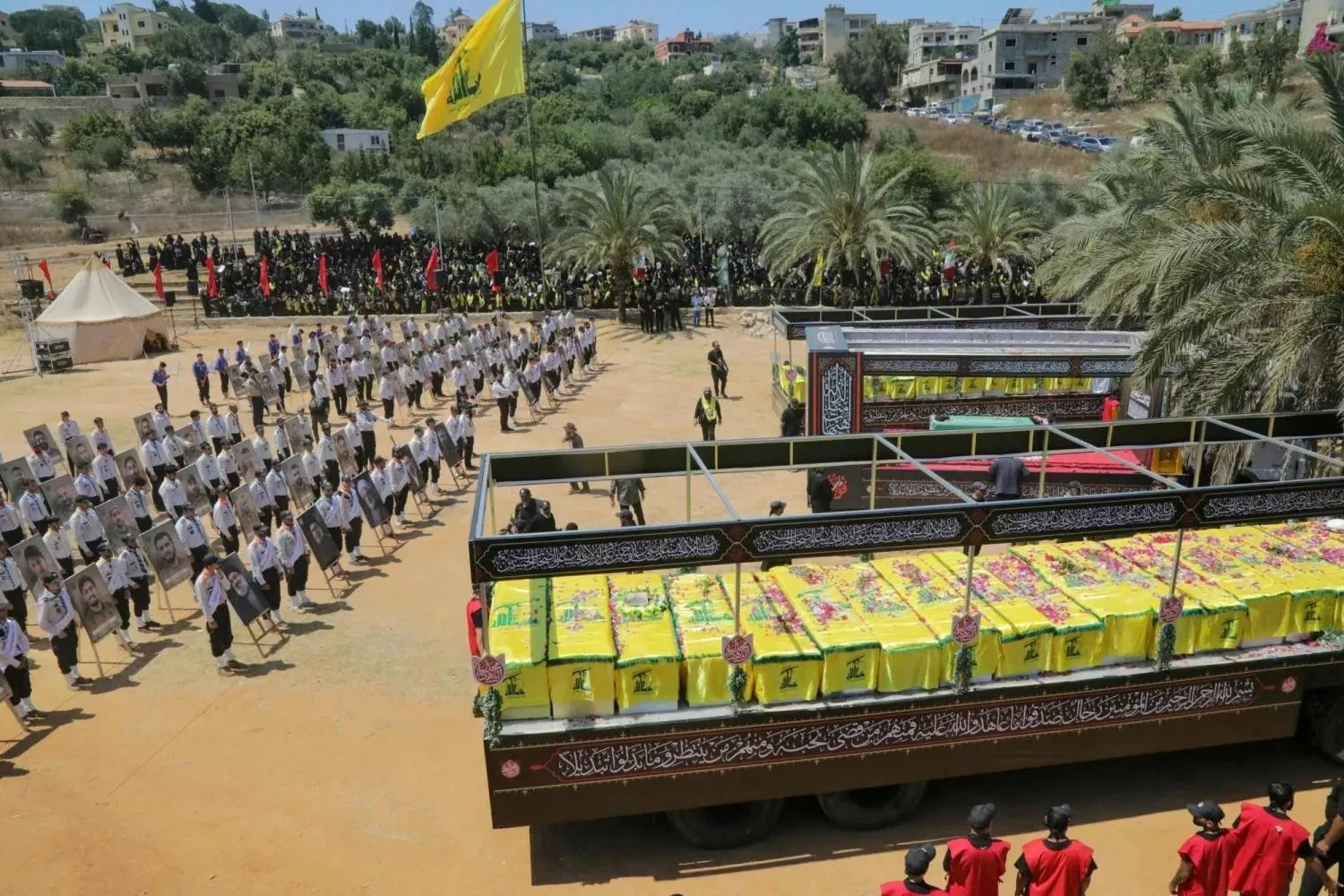
The coffins of Hezbollah members killed in clashes with the Israeli army, alongside a symbolic coffin for Iran’s former Supreme Leader, Ali Khamenei, during a mass funeral in the southern Lebanese village of Majdal Selm on July 18, 2026 (AFP). 
TT

Lebanon Tightens Control of Ports, Drying Up Hezbollah Funding Sources

The coffins of Hezbollah members killed in clashes with the Israeli army, alongside a symbolic coffin for Iran’s former Supreme Leader, Ali Khamenei, during a mass funeral in the southern Lebanese village of Majdal Selm on July 18, 2026 (AFP). 

Lebanon’s confrontation with Hezbollah is no longer confined to the issue of the group’s weapons and the implementation of international commitments in the South. It has expanded to a broader campaign to tighten state control over seaports, the airport and border crossings, curbing Hezbollah’s influence and cutting off its illicit sources of funding.

Since the election of President Joseph Aoun and the formation of Prime Minister Nawaf Salam’s government, the authorities have pursued a security and administrative strategy to reassert sovereign control over the country’s land, sea and air entry points.

According to security sources, the measures introduced in recent months have gone beyond reorganizing operations at these facilities. They have also struck at Hezbollah’s logistical infrastructure by significantly restricting smuggling routes and disrupting funding channels that operated through the Syrian border, Beirut airport and the Port of Beirut.

Hezbollah’s Influence Recedes

While anti-smuggling and border-control measures continue to be strengthened, their effects are already visible, with Hezbollah losing influence inside institutions where it once held considerable sway.

A source involved in overseeing Lebanon’s land, sea and air crossings told Asharq Al-Awsat that Hezbollah’s influence within these facilities has declined to an unprecedented level since the start of the new administration.

The source said the shift has directly affected the group’s financial and logistical capabilities, which, before the latest war, benefited from a different security and administrative environment that allowed goods and cash to move with relatively few constraints.

In recent months, the Lebanese state has also imposed a higher level of technical oversight by deploying modern scanners at the Port of Beirut, Beirut’s Rafic Hariri International Airport and the Masnaa border crossing. The equipment has curbed the smuggling of goods, prohibited materials and cash through these facilities.

The source added that the illegal crossings which for years served as the backbone of Hezbollah’s logistical network “no longer play the role they once did,” after the Syrian authorities tightened controls on their side of the border in parallel with enhanced Lebanese enforcement. As a result, illegal cross-border traffic has fallen to what the source described as almost negligible levels.

A Fundamental Shift

The source noted that conditions along the unofficial crossings with Syria have changed dramatically from previous years, when trucks linked to Hezbollah allegedly crossed regularly, taking advantage of a weak state and the marginalization of official institutions in favor of the group and smuggling networks operating within its orbit.

The changes have extended beyond the movement of goods to the group’s financing networks. An official source reported a marked decline in attempts to bring bags of cash and gold into Lebanon through the airport, as well as in the smuggling of Captagon pills and hashish, activities the source described as among the most significant illicit operations associated with cross-border trafficking.

The source also underscored the importance of the government’s decision to bar Iranian aircraft from landing at Beirut’s Rafic Hariri International Airport, saying it had tightened pressure on Hezbollah’s supply channels by closing one of the routes allegedly used to transport cash and other material support to the group.

Officials also described the fall of Bashar al-Assad’s regime as the most significant turning point—and the most severe blow—Hezbollah has faced since its founding. With Syria no longer providing what they described as a secure logistical environment, Hezbollah and Iran have lost one of their principal corridors for moving weapons and funding into Lebanon.

A security source told Asharq Al-Awsat that Hezbollah’s influence within the institutions overseeing ports and border crossings has become “almost nonexistent” following a series of security and administrative measures aimed at rebuilding oversight systems at the Port of Beirut, Rafic Hariri International Airport and the Masnaa crossing.

According to the source, the measures included the reassignment of numerous security and administrative personnel believed to have been under Hezbollah’s influence and who allegedly facilitated the passage of goods on an almost daily basis. The restructuring, the source said, closed loopholes that had long represented vulnerabilities within the agencies responsible for monitoring these facilities.

The source added that the authorities have not limited their efforts to administrative reshuffles. They have also launched investigations and legal proceedings against individuals suspected of facilitating the passage of goods, bags of cash and jewelry on Hezbollah’s behalf in recent months, as part of a broader policy aimed at dismantling the group’s networks of influence within public institutions.


Sudan’s Al-Burhan Backs Inclusive Dialogue but Pledges to Continue Fighting the RSF

Al-Burhan flanked by Yasser Al-Atta and Shams El Din Kabbashi during the Army Day celebration (Transitional Sovereignty Council Media)
TT

Sudan’s Al-Burhan Backs Inclusive Dialogue but Pledges to Continue Fighting the RSF

Al-Burhan flanked by Yasser Al-Atta and Shams El Din Kabbashi during the Army Day celebration (Transitional Sovereignty Council Media)

The Chairman of the Transitional Sovereignty Council and Commander of the Sudanese Army, Abdel Fattah al-Burhan, has approved an initiative to launch a dialogue that brings together all political and civil parties.

Despite his announcement, he pledged to continue fighting until the rebellion of the Rapid Support Forces (RSF) is defeated across the country.

Speaking on Friday on the 72nd anniversary of the Sudanese Armed Forces, al-Burhan said: "In light of this troubled political reality, a group of Sudanese citizens took the initiative to present their vision to work as an independent national mechanism to prepare for an inclusive Sudanese dialogue, with the goal of reaching a comprehensive national consensus that puts the country on the path to stability."

He added that he agreed to provide the necessary guarantees for holding the all-party talks, facilitate the participation of the different groups, and protect their safety.

Al-Burhan stressed that the state was willing to provide the necessary logistical support as well as legal, political, and security guarantees, without being the organizing entity of the dialogue.

He noted that providing these guarantees does not mean the state will dictate the participants of the dialogue, draft its agenda, control its outcomes, or provide it with political sponsorship.

Al-Burhan clarified that "the action taken by the state regarding any of the participants in the dialogue is not considered a pardon, but rather means suspending the criminal proceedings previously taken by the state against them."

He stated that these measures represent a "temporary immunity" to create appropriate conditions that ensure the participation of the parties.

The Sudanese army commander also pledged legal protection for the opinions and positions expressed by participants, saying statements made during dialogue sessions would not be used as grounds for legal prosecution.

A-Burhan said the army was ready to engage with any serious peace initiative but would not accept what he called an “incomplete peace” that returned the RSF and its supporters to power.

He stated that the army would continue the “completion of the cleansing of the country from the terrorist militia.”

The path to peace must begin with RSF forces withdrawing from cities and gathering in designated areas, followed by the return of displaced people and refugees to their homes, he added.

The Democratic Bloc welcomed al-Burhan’s announcement to hold the all-party talks.

Its spokesperson, Mohamed Zakaria, said Saturday that al-Burhan’s emphasis on the importance of inter-Sudanese dialogue and the need to create a conducive environment for its launch represents a significant step towards addressing the crisis through a national political process.

He called on all sides to engage positively with any serious effort to launch a comprehensive national dialogue, provided that the process is managed entirely by Sudanese parties and that the regional and international role is limited to facilitation and support without interfering in determining participants or imposing an agenda or outcomes.


Egypt, China Consolidate Cooperation by Holding Air Combat Maneuvers

Egyptian President Abdel Fattah El-Sisi and China’s President Xi Jinping held summit talks in the Chinese capital, Beijing, in May 2024. Photo: Egyptian Presidency
TT

Egypt, China Consolidate Cooperation by Holding Air Combat Maneuvers

Egyptian President Abdel Fattah El-Sisi and China’s President Xi Jinping held summit talks in the Chinese capital, Beijing, in May 2024. Photo: Egyptian Presidency

Egypt and China have consolidated their military cooperation by announcing new air combat drills that are set to start this month.

"The Chinese and Egyptian air forces will hold Eagles of Civilization 2026 joint training in Egypt from mid-August to early September," said Senior Colonel Chen Xi, spokesperson for China's Ministry of National Defense (MND), at a press briefing on Friday.

"The training will focus on such subjects as air combat tactics, air superiority operations, and combat search and rescue, and will include force employment drills," said the spokesperson.

"As the second iteration of its kind, the joint training will further enhance mutual trust and traditional friendship, deepen substantive cooperation between the Chinese and Egyptian militaries, and contribute to regional peace and stability," stressed the spokesperson.

The joint air force exercise between China and Egypt "Eagles of Civilization 2025" was held in April last year at an Egyptian air base. It marked the first-ever military air drill between the two nations and the first time the Chinese PLA Air Force systematically deployed multiple troop types to the African continent.

In May 2024, Egyptian President Abdel Fattah el-Sisi and Chinese President Xi Jinping met in Beijing to mark the 10th anniversary of their comprehensive strategic partnership.

The leaders declared 2024 the "Egypt-China Partnership Year,” signing bilateral agreements on the Belt and Road Initiative, technology, and industrial localization.


Yemen's Mokha Port Halts Operations after Houthi Attacks

Flames and smoke rise from the port of Mokha during a strike in Yemen, Friday, Aug. 14, 2026. (AP Photo/Abdulnasser Alseddik)
TT

Yemen's Mokha Port Halts Operations after Houthi Attacks

Flames and smoke rise from the port of Mokha during a strike in Yemen, Friday, Aug. 14, 2026. (AP Photo/Abdulnasser Alseddik)

Yemen's Mokha port has suspended commercial and maritime operations after being hit by more than 25 missiles in Houthi attacks over recent days, the port's director said on Saturday.

The attacks killed seven people and caused an estimated $16 million in losses, the director told a news conference.

The latest attacks come amid an ongoing Houthi escalation that has lasted for about two weeks, targeting military positions and vital facilities in government-controlled provinces, alongside an intensification of operations on several fronts.

Brig. Gen. Sadiq Duwaid, spokesman for the National Resistance Forces, said the group had launched dozens of ballistic missiles and drones in recent days at the city of Mokha, its port, and surrounding facilities.

Duwaid believes the group turned to targeting civilian infrastructure after suffering losses on the battlefronts, while government forces say the latest attacks are aimed at weakening economic activity and depriving residents of essential services and sources of income.

The repeated strikes made it difficult for ambulance and field teams to reach the port in the early hours, according to the National Resistance Forces' military media outlet, which said the intensity of the bombardment hindered firefighting operations and efforts to assess the damage and casualties.