


Sudan Army Drone Attack on Darfur Court Kills 35

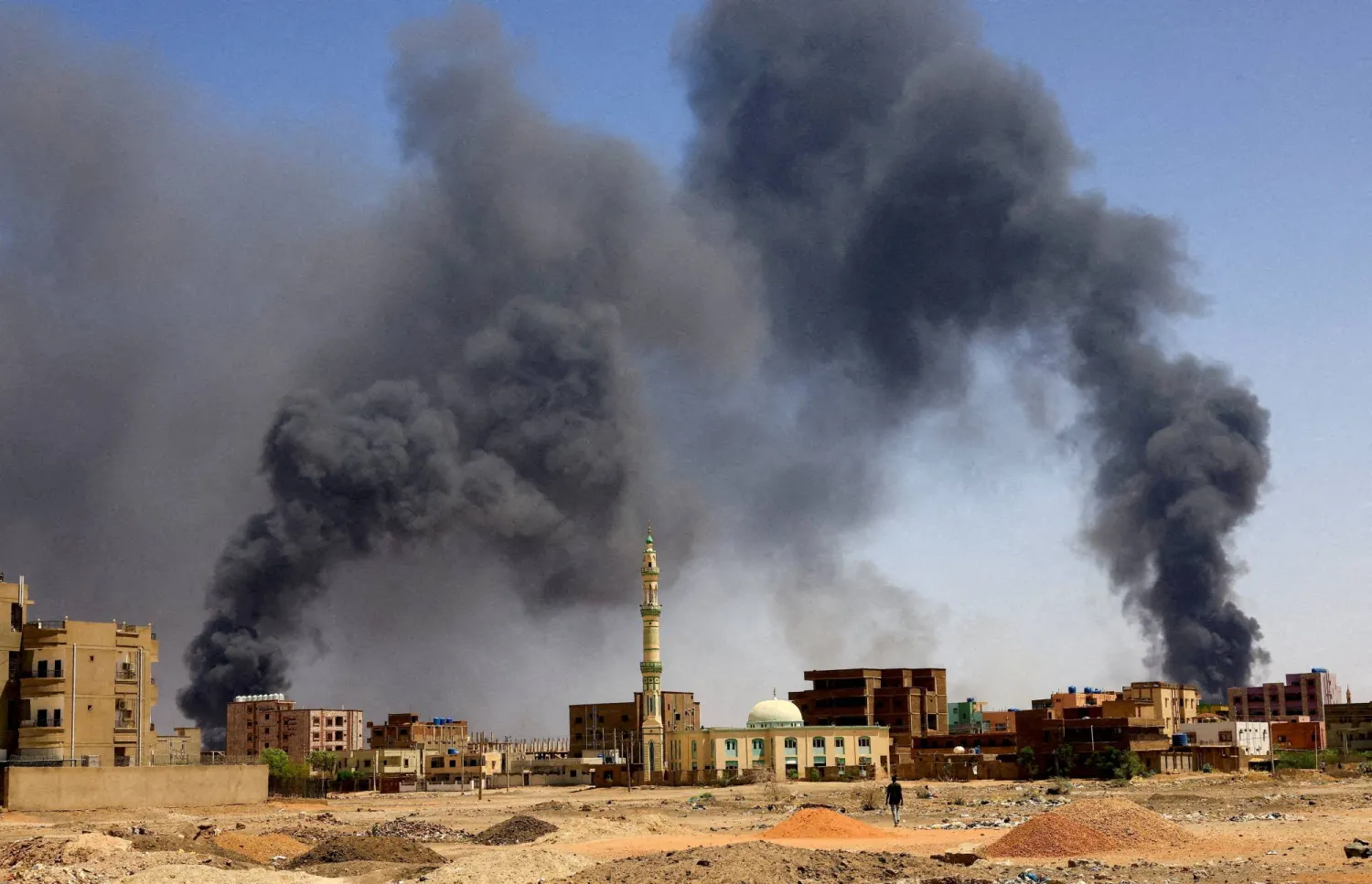
Smoke rises over buildings during clashes between the Sudanese army and the Rapid Support Forces in Khartoum (Archive - Reuters)
TT

Sudan Army Drone Attack on Darfur Court Kills 35

Smoke rises over buildings during clashes between the Sudanese army and the Rapid Support Forces in Khartoum (Archive - Reuters)

The Sudanese army on Sunday struck a traditional court in western Darfur with drones, killing 35 people and wounding others, a rights group said.

The Emergency Lawyers, which has documented abuses by both the army and its rival paramilitaries throughout the three-year conflict, said the strike hit the court in the village of Garra al-Zawaya in North Darfur state at around 1:00 pm local time (1100 GMT), as civilians had "gathered to attend hearings on local cases and disputes".

The village is under the control of the paramilitary Rapid Support Forces (RSF), which have been locked in a brutal conflict with the army since April 2023.

"The court session was being held under a tree with the participation of local community leaders," a witness from the area told AFP on condition of anonymity for safety reasons.

Among those killed were "four tribal leaders and two RSF commanders", the witness added.

There was no immediate response from the army. The RSF's self-declared government condemned the attack as "a horrific crime", saying 37 people had been killed and 50 others wounded.

- Drone warfare -

Garra al-Zawaya lies near the town of Kabkabiya in North Darfur, about 150 kilometers (93 miles) west of El-Fasher, the army's last stronghold in Darfur before it was captured by the RSF in a bloody offensive last October.

UN investigators have said violence linked to the RSF's siege and capture of El-Fasher bears "the hallmarks of genocide".

Following its takeover of the city, the RSF, which emerged from the Janjaweed militia accused of atrocities in Darfur in the early 2000s, consolidated control over much of the region.

Since El-Fasher campaign, both sides have increasingly relied on drone warfare. According to the United Nations, more than 1,000 civilians were killed in drone strikes during the first five months of this year.

Last week, after losing control of a key highway linking the capital Khartoum and the city of El-Obeid, RSF commander Mohamed Hamdan Daglo released a video message in which he told his fighters to consider themselves "unleashed" in their war against the army.

El-Obeid, the largest city in the southern Kordofan region, has come under intense drone attacks in recent weeks, prompting the UN to issue a "red alert" over the unfolding "catastrophe" there, where the RSF has sought to reimpose a blockade and is feared to be preparing a ground offensive.

The UN has repeatedly warned that RSF advances in El-Obeid and the wider Kordofan region could lead to mass atrocities.

The war between Daglo and his former ally, army chief Abdel Fattah al-Burhan, has killed tens of thousands of people, displaced millions and created what the United Nations describes as the world's largest hunger and displacement crises.

Both sides have been accused of committing war crimes, including indiscriminate attacks on civilians, but the RSF has been particularly accused of systematic sexual violence, looting and mass atrocities.



Syria, Lebanon Revive Rail Link Plans, Eye Connections to Iraq, Gulf and Türkiye

Syrian Transport Minister Yarub Badr and Lebanese Public Works and Transport Minister Fayez Rasamny speak at a press conference at the Syrian Transport Ministry. (SANA)
TT

Syria, Lebanon Revive Rail Link Plans, Eye Connections to Iraq, Gulf and Türkiye

Syrian Transport Minister Yarub Badr and Lebanese Public Works and Transport Minister Fayez Rasamny speak at a press conference at the Syrian Transport Ministry. (SANA)

Lebanese Public Works and Transport Minister Fayez Rasamny announced Tuesday that Lebanon and Syria had set the broad outlines for rail connectivity between the two countries, with a technical committee to examine a unified route linking them to Iraq, the Gulf states and Türkiye.

Speaking at a joint news conference in Damascus with Syrian Transport Minister Yarub Badr, Rasamny explained that a specialized committee would study the technical aspects of preparing the route.

Badr noted that the two sides had reached understandings paving the way for practical steps to serve their transport sectors and agreed to form a joint technical team to follow up on implementation.

He added that cooperation between Syria and Lebanon could help attract donor support and secure financing for joint projects, while efforts were underway to remove obstacles hindering progress.

Badr met Rasamny at the Transport Ministry in Damascus to discuss improving transport links between the two countries. Their talks covered several key files, foremost among them strengthening road and rail connections.

Badr reviewed the state of Syria’s land transport sector and prospects for its development under the national sustainable land transport policy, based on economic efficiency, competitiveness, social integration, safety and environmental considerations.

He outlined plans to rehabilitate and expand the main road network, advance digital transformation, regulate the sector and develop railway projects.

Badr stressed the importance of closer coordination and intensified efforts to improve transport links with Lebanon, facilitate the movement of people and goods, stimulate trade and strengthen connectivity with the wider region.

Rasamny called for accelerating work, exchanging ideas and expertise, and setting clear, time-bound objectives. He said that such steps would strengthen Syrian-Lebanese cooperation, support economic prosperity in both countries and expand commercial transport links with their regional surroundings.

Lebanese government sources had earlier told Syria TV that the official visit was devoted to discussing joint transport and infrastructure files and reviving technical cooperation between the relevant ministries and institutions in both countries.


Israel Defense Minister Vows to Keep Troops in Syria During Visit

25 June 2024, Jerusalem: Israeli Defense Minister Israel Katz is pictured in Jerusalem. (dpa)
TT

Israel Defense Minister Vows to Keep Troops in Syria During Visit

25 June 2024, Jerusalem: Israeli Defense Minister Israel Katz is pictured in Jerusalem. (dpa)

Israeli Defense Minister Israel Katz made a rare visit to troops in southern Syria on Tuesday, reiterating a pledge to keep forces in the area as long as there were "threats" to his country's security.

Damascus slammed Katz's "illegal entry" into the country, which came a week after Israel bombed the disused Abu al-Duhur base in northwestern Syria, claiming it wanted to prevent Turkish troops deploying to the facility. Ankara has denied any visit to the site.

In southern Syria, Israeli forces have been stationed in a "security zone" since the fall of longtime ruler Bashar al-Assad in December 2024.

They occupy what was previously a buffer zone patrolled by the United Nations that had separated Israeli and Syrian forces in the Israeli-occupied Golan since 1974.

"There is daily activity here to thwart threats, to eliminate remnants of the old regime, to prevent dangerous consolidation of the new regime," Katz said according to a video statement from his office.

"The message is clear to the president of Syria as well: when you wake up in the morning in your palace in Damascus, look up at Mount Hermon and see the Israeli army -- you know we are here to protect our communities and our border," he added.

"As long as there are threats, the army will remain here to guarantee our security -- this is what we have done and this is what we intend to continue doing in the future," Katz said.

Syria's foreign ministry said Katz's visit was a "flagrant violation of the country's sovereignty and territorial integrity".

It went on to urge the international community to take "the necessary measures to force the occupying authorities to halt these repeated violations".

Israel has carried out hundreds of strikes in Syria since the fall of Assad and made repeated incursions into Syrian territory.

Officials have also repeatedly vowed to keep troops in the security zone, where Israel is seeking a broader demilitarized area.

Israeli army chief Lieutenant General Eyal Zamir visited troops in the security zone last week, saying the military would not allow threats to "establish themselves" on the border.

During his visit on Tuesday, Katz addressed the strike on the Abu al-Duhur air base, saying Israel had "acted against a Turkish attempt to entrench itself in Syria, at the risk of Israel's security interests".


Kurdish-Led SDF Says It Has Dissolved After Merging with Syrian Army

 Syrian President Ahmad al-Sharaa, right, meets with the commander of the Kurdish-led Syrian Democratic Forces, Mazloum Abdi, center left, at the presidential palace in Damascus, Syria, Tuesday, Aug. 25, 2026. (AP)
Syrian President Ahmad al-Sharaa, right, meets with the commander of the Kurdish-led Syrian Democratic Forces, Mazloum Abdi, center left, at the presidential palace in Damascus, Syria, Tuesday, Aug. 25, 2026. (AP)
TT

Kurdish-Led SDF Says It Has Dissolved After Merging with Syrian Army

 Syrian President Ahmad al-Sharaa, right, meets with the commander of the Kurdish-led Syrian Democratic Forces, Mazloum Abdi, center left, at the presidential palace in Damascus, Syria, Tuesday, Aug. 25, 2026. (AP)
Syrian President Ahmad al-Sharaa, right, meets with the commander of the Kurdish-led Syrian Democratic Forces, Mazloum Abdi, center left, at the presidential palace in Damascus, Syria, Tuesday, Aug. 25, 2026. (AP)

The commander of the Kurdish-led Syrian Democratic Forces on Tuesday announced the official dissolution of the group, which once controlled a de facto autonomous zone in Syria's northeast.

Speaking during a news conference at the presidential palace in Damascus, Mazloum Abdi said the SDF has completed a merger with the Syrian army and would cease to operate as an independent force. The Kurdish-led force lost most of its territory in northeast Syria to a government offensive in January and then signed the deal to merge with the army.

The SDF was once the main partner of the United States in Syria as it battled the ISIS group. But after the ouster of former Syrian President Bashar al-Assad in December 2024, Washington formed close ties with the new government in Damascus led by interim Syrian President Ahmad al-Sharaa.

The SDF “carried a heavy responsibility during one of the most difficult periods in Syria’s history,” Abdi said.

“Today, circumstances have changed, and the country has entered a new phase, one of peace and participation in building a new Syria,” he said, announcing the “end of the SDF’s mission” and “its dissolution as an independent military force.”

Under the 50-year rule of the Assad dynasty in Syria, Kurds were marginalized, with many denied citizenship.

Shortly after the uprising against the Assad government began in 2011, the Kurds filled the vacuum created by the withdrawal of government forces from wide areas of Syria’s northeast. The SDF at one point controlled about 25% of Syria.

The Kurds were initially circumspect about the new post-Assad government and unwilling to give up their de facto autonomy. Some of the opposition groups that took part in the offensive that ousted Assad were Turkish-backed forces that had clashed with the SDF in the past.

Türkiye considered the SDF to be a terrorist organization because of its ties to the Kurdistan Workers’ Party, or PKK, a separatist group that staged a decades-long insurgency in Türkiye. A peace process is now underway.

Kurds questioned whether the new authorities would give them true representation in the new government, while al-Sharaa tried to woo them.

During ceasefire negotiations with the SDF in January, he issued a decree strengthening Kurdish rights. It made Kurdish an official language along with Arabic, and adopted Nowruz as a national holiday. It also restored the citizenship of tens of thousands of Kurds in northeastern Hasakeh province after they were stripped of it during the 1962 census.

Abdi said that al-Sharaa had promised that Kurds would have the right to education in their own language, an important issue for the country’s Kurdish population.

Questions remain, including the fate of the SDF's all-female fighting units.

But the success of the integration agreement with the SDF is a major boost to al-Sharaa's government, which has struggled to unify the country as it begins to recover from a nearly 14-year civil war. Most of the country is now under the control of the central government in Damascus.

The exception is southern Syria's Sweida province, which is now controlled by Druze factions that are hostile to Damascus after clashes last year. The Druze factions have received support from Israel, which is also occupying a strip of land in southern Syria near the border with the Israeli-annexed Golan Heights.