


Israel Resumes Lebanon Strikes as Talks Underway in Rome

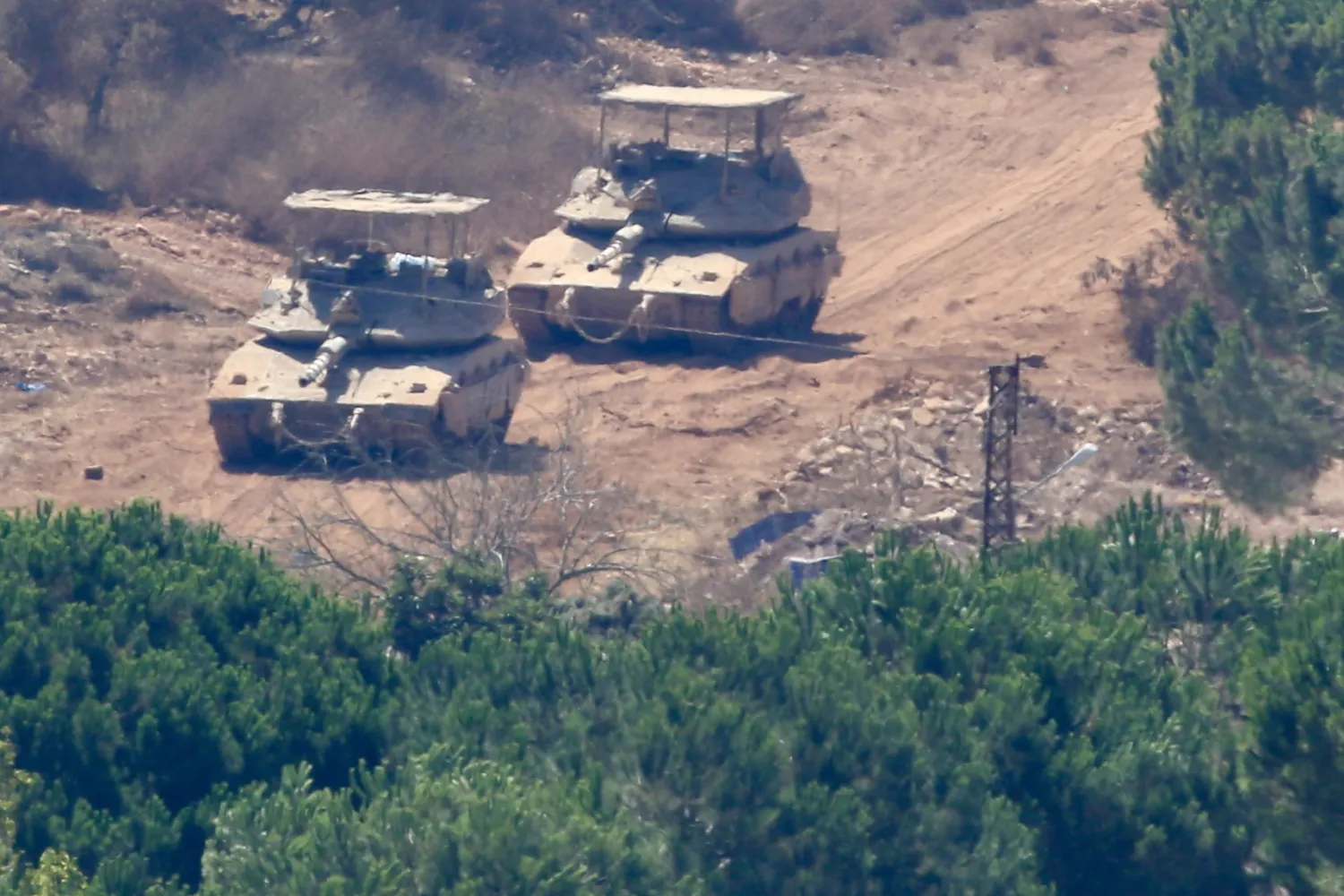
Israeli tanks in Zawtar al-Sharqiyeh as seen from Zawtar al-Gharbiyeh, southern Lebanon, 05 August 2026. (EPA)
TT

Israel Resumes Lebanon Strikes as Talks Underway in Rome

Israeli tanks in Zawtar al-Sharqiyeh as seen from Zawtar al-Gharbiyeh, southern Lebanon, 05 August 2026. (EPA)

Israel's military resumed strikes in southern Lebanon on Wednesday despite ongoing talks, blaming a ceasefire violation by the Hezbollah group as state media reported at least one person killed. 

The fresh strikes, accompanied by the first evacuation warning in weeks, came as the United States led diplomacy between Israel and Lebanon in Rome aimed at putting an end to hostilities, with Beirut seeking Israel's phased withdrawal from the south. 

"In response to a blatant violation of the ceasefire by the Hezbollah terrorist organization, the army has begun conducting precise strikes in southern Lebanon," the Israeli military said in a statement, shortly after telling residents to evacuate the town of Mansouri in the south. 

Lebanese state media said one person died and 11 were wounded in a separate strike. 

In Rome, Israel requested that the day's talks with Lebanon end three hours early, a source in the negotiations told AFP, saying the head of the Israeli delegation, US ambassador Yechiel Leiter, had blamed alleged "misleading leaks" by the Lebanese side. 

But the talks were expected to resume on Thursday for a third and final day. 

In previous US-sponsored talks in June, Israel and Lebanon agreed to a framework deal that involves the disarmament of Hezbollah, a gradual withdrawal of Israeli forces from Lebanon's south and the deployment of the Lebanese army to the region, starting in test areas known as "pilot zones". 

This week's negotiations are the seventh round since Hezbollah drew Lebanon into the Middle East war in March with rocket fire at Israel in support of its backer Iran. 

Israel responded with heavy airstrikes and a ground invasion that Lebanon says have killed more than 4,300 people. 

In its first such warning since June, the Israeli military on Wednesday told the residents of Mansouri: "In light of Hezbollah's violations of the ceasefire agreement, the Israeli forces are compelled to act against it with force." 

"For your safety, you must evacuate your homes immediately and move north," the military's Arabic-language spokeswoman, Ella Waweya, posted on X. 

The UN's humanitarian agency had said just the night before that more than 800,000 people displaced by earlier fighting in Lebanon had begun heading back home following the recent lull in violence, though more than 360,000 remained displaced. 

- 'Shame, humiliation' - 

The town of Mansouri, located around nine kilometers (six miles) south of Tyre and 10 kilometers north of Israel, and its surroundings were subjected to several Israeli strikes and artillery shelling in recent weeks despite the ceasefire between Hezbollah and Israel that took hold in June. 

The town's municipality told residents on June 22 that they could return, but asked them to avoid the part of the town that fell within Israel's so-called "security zone" in southern Lebanon. 

The "security zone" designates a strip of territory where Israeli forces continue to operate that runs around 10 kilometers deep inside southern Lebanon along its border with Israel. 

A US State Department official had told AFP that this week's discussions would "include expanding the pilot zone process, resolving all outstanding border issues, and working on a comprehensive peace and security agreement". 

As the delegations met in Rome, Italian Foreign Minister Antonio Tajani spoke with his counterpart from Iran, Hezbollah's main patron, and called on Tehran to halt the group's operations. 

Tajani, in a post shortly before the Israeli strikes, voiced hope that the talks would "yield concrete results". 

Hezbollah leader Naim Qassem said on Tuesday that the direct negotiations would bring "nothing but shame, humiliation" and successive concessions for Lebanon. 

Hezbollah has repeatedly rejected the direct talks and refuses to surrender its weapons. 

Violence in Lebanon has decreased since the Lebanon-Israel deal and the signing in June of a preliminary US-Iran agreement on the Middle East conflict. 

But Lebanon continued to report intermittent Israeli strikes and shelling, as well as detonations and demolitions in southern villages. 

Since the war between Israel and Hezbollah erupted in early March, Israel's military has lost 38 soldiers and one civilian contractor. 


Libya: Tensions Flare in Al-Qatrun After a Young Man Killed in Shooting Blamed on LNA

The Supreme Council of Sheikhs and Dignitaries of Fezzan offers condolences to the people of al-Qatrun (Council)
TT

Libya: Tensions Flare in Al-Qatrun After a Young Man Killed in Shooting Blamed on LNA

The Supreme Council of Sheikhs and Dignitaries of Fezzan offers condolences to the people of al-Qatrun (Council)

Tension gripped the southern Libyan city of al-Qatrun following the killing of 16-year-old Hussein Matar, who was shot while at a petrol station in the city.

Accounts differed over who opened fire on Matar, as residents accused the Libyan National Army’s 87th Battalion of responsibility.

Al-Qatrun witnessed skirmishes and running clashes between residents and members of the 87th Battalion on Thursday evening, during which shots were fired indiscriminately. Several members of the Tebu tribe were seen carrying weapons.

The Fezzan National Political Gathering moved quickly to hold the perpetrators fully responsible and called on the 87th Battalion to “bear the full consequences of this crime”.

The Libyan National Army has not officially commented on the incident. However, a source close to its General Command said the leadership valued the people of al-Qatrun and was working to address their living difficulties.

Rania al-Sayd, a founding member of the Fezzan Gathering, said the incident “cannot be viewed as an isolated event or an individual dispute”.

She described it as “a direct attack on the social fabric and the fragile stability we are trying to preserve in the south”, saying it was intended “to drag the region back into chaos and cycles of revenge”.

Al-Sayd told Asharq Al-Awsat that “any attack on life, property or honor is unacceptable”, calling on the security and judicial authorities to carry out their duties by apprehending the perpetrators and bringing them to justice immediately.

She said she was counting on “the role of councils of elders, dignitaries and sheikhs in al-Qatrun and across the south”.

“Your role today is not ceremonial, but a duty,” she said. “You bear the responsibility of healing divisions, preventing bloodshed and containing the strife before it escalates.”

A delegation from the Supreme Council of Sheikhs and Dignitaries of Fezzan, headed by Sheikh Ibrahim Abu Bakr Nasr, arrived in al-Qatrun on Thursday evening in an effort to contain the escalating unrest, offer condolences and assess the situation in the city.

The Fezzan Gathering called for “the formation of an urgent and transparent investigative committee, the disclosure of its findings to the public and the surrender of the perpetrators to justice without concealment or delay”.

It also called for an end to what it described as “any retaliatory measures or collective punishment against the people of al-Qatrun”, warning against burdening the region with further bloodshed and tension.

In a statement issued on Thursday evening, the gathering called on the United Nations Support Mission in Libya to “fulfil its legal and moral responsibilities to protect civilians in the south and open an independent international investigation into the incident”.

It also urged the international community to “intervene urgently to stop these acts targeting innocent people and put an end to human rights violations in southern Libya”.

Al-Sayd said Libya “cannot withstand further crises and divisions”, warning that “what is happening in al-Qatrun could be repeated in any city if we continue to treat the symptoms while ignoring the causes”.

She also warned against “being drawn into strife and hate speech, or turning the region into a weapon in the hands of those who seek to divide us”.

Al-Qatrun is controlled by the Libyan National Army. The interim Government of National Unity has no presence in the city, which is experiencing fuel shortages similar to those affecting most Libyan cities.

The Supreme Council of Sheikhs and Dignitaries of Fezzan said its delegation had offered condolences to the people of al-Qatrun “as part of its community role and efforts to reunite the people of the region and consolidate unity”.

The council said on Friday that the delegation was received by Tebu sheikhs, elders and young people in al-Qatrun.

It said they discussed the incident in the city and stressed the importance of social cohesion and containing its repercussions.

“The blood of the people of Fezzan is one, and al-Qatrun’s wound is a wound for all of Fezzan,” the council said, pledging to continue pursuing “tolerance, reconciliation, the prevention of bloodshed and the upholding of justice”.

Libya’s National Institution for Human Rights also weighed in, expressing concern over “the rising number of extrajudicial killings in many cities, regions and municipalities”.

It attributed the increase to “the security chaos affecting many cities across the country as a result of the absence of the Interior Ministry and the relevant security authorities”.

The institution called on the Interior Ministry, the al-Qatrun Security Directorate, the Criminal Investigation Agency and the attorney-general’s office within the jurisdiction of the Sebha Court of Appeal to open a comprehensive investigation into Matar’s killing.

It also urged them to intensify efforts to arrest those accused of involvement in the crime and bring them to justice.

Lieutenant General Saddam Haftar, deputy commander-in-chief of the Libyan National Army, previously met sheikhs and dignitaries in al-Qatrun during a wider tour of several southern cities to assess security conditions and residents’ living needs.


Hezbollah Seeks New Victory Narrative in Defending Beirut

Members of the Mahdi Scouts carry the coffins of a Hezbollah commander and members of his family during their funeral in Beirut’s southern suburbs (AP)
TT

Hezbollah Seeks New Victory Narrative in Defending Beirut

Members of the Mahdi Scouts carry the coffins of a Hezbollah commander and members of his family during their funeral in Beirut’s southern suburbs (AP)

As Israel continues to occupy large swathes of southern Lebanon and destroy entire villages, recent statements by Hezbollah officials have raised questions about a shift in the group’s priorities.

The “resistance,” which has long portrayed itself as a force dedicated to liberating occupied territory and confronting Israel, is now speaking more frequently of a “defensive confrontation” and of preventing Israeli forces from reaching Beirut.

That shift has come after Hezbollah’s “red lines” fell one after another. Places including Bint Jbeil, Khiam and Beaufort Castle had become central symbols of the battle.

The latest was the Ali al-Taher ridge, which Hezbollah refused to hand over to the Lebanese army before it, too, fell. The Israeli military said on Thursday evening that it had achieved “operational control” of the highland area, both above and below ground.

Hezbollah Secretary-General Naim Qassem has said several times that the group “prevented Israel from reaching Beirut and disarming us.”

His remarks came after Israel seized large areas of the south and destroyed others, while Hezbollah refrained from responding to Israeli attacks since the “framework agreement.”

Israeli officials have said their forces will remain in southern Lebanon until Hezbollah is disarmed — an equation the group rejects.

Seeking victory after defeat

Amid Hezbollah’s deepening predicament, ministerial sources say its officials are now searching for “a victory somewhere” to present to their support base, which is suffering the consequences of the “support wars.”

“The discourse Hezbollah is presenting at this stage — sometimes by talking about Beirut and at other times by declaring Ali al-Taher a red line — is directed at its supporters and social base in an attempt to convince them that what happened was not a defeat, despite the scale of the losses and destruction they suffered,” the sources told Asharq Al-Awsat.

Dr. Riad Kahwaji, a researcher and writer specializing in security and defense affairs, offered a similar assessment, saying Hezbollah changes its narrative according to the circumstances it faces and is now seeking to justify its defeat.

Everything the group said before the war about deterrence, its ability to destroy Tel Aviv and the equation of “Haifa in exchange for Beirut’s southern suburbs” proved unsuccessful, he said.

Kahwaji told Asharq Al-Awsat that Qassem had also spoken of close combat with Israeli forces and threatened that they would not dare launch a ground battle or enter the battlefield.

The results on the ground, however, included the loss of more than 50 villages and the advance of Israeli forces north of the Litani River, to the outskirts of Nabatieh and the Ali al-Taher hill.

On the defensive despite the occupation

Kahwaji said Hezbollah now needs a new narrative “to sell to its popular base.” That narrative is built around the claim that the group prevented Israel from reaching Beirut and has shifted into a defensive position after losing its ability to liberate occupied territory.

Talk of defense and preventing further Israeli advances has therefore replaced talk of liberation.

Kahwaji said Hezbollah no longer invokes most of the narratives it promoted before the war. It now hopes its support base will accept the existing reality and be persuaded by the “achievement” the group is seeking to present.

A shift reflecting the depth of the predicament

Dr. Imad Salamey, a professor of political science at Lebanese American University, offered another interpretation of the shift in Hezbollah’s rhetoric.

He said the group’s officials are attempting to recast its role and weapons as a means of defending all of Lebanon, rather than only the south or the Shiite community.

“The claim that Israel would have reached Beirut is intended to address Lebanon’s various sectarian communities and persuade them that Hezbollah’s weapons provide a national protective umbrella,” Salamey told Asharq Al-Awsat.

“According to this narrative, demands for the group’s disarmament threaten the security of all Lebanese.”

At the same time, Salamey said the rhetoric also reflects the scale of the pressure Hezbollah is facing.

“The group is trying to pressure the government into backing away from its demand that weapons be placed exclusively under state control and to reject any arrangement that would require its military withdrawal from the south or from areas such as Ali al-Taher,” he said.

“The paradox is that Hezbollah’s continued armed presence outside state authority provides Israel with the pretext it uses to justify its continuing operations and military presence, while Lebanon’s priority should be to remove those pretexts and push Israel to withdraw.”

Salamey said Hezbollah’s preemptive rejection of any arrangement requiring its withdrawal or disarmament could not be separated from the ongoing negotiations.

“In practice, Hezbollah is seeking to derail any negotiations based on the state restoring full security control over the south,” he said.

“This weakens the government’s position and restricts its ability to demand an Israeli withdrawal.”


Victims of Iraq’s Tishreen Protests Prepare to Sue Badr Organization Leader

Some Iraqis with disabilities were among the victims of the crackdown on the 2019 Tishreen protests (Reuters)
TT

Victims of Iraq’s Tishreen Protests Prepare to Sue Badr Organization Leader

Some Iraqis with disabilities were among the victims of the crackdown on the 2019 Tishreen protests (Reuters)

Reactions continued to mount in Iraq over controversial remarks by Badr Organization leader Hadi al-Amiri about the involvement of armed factions in suppressing the 2019 Tishreen protest movement, amid reports of moves to take legal action against him.

Defending the factions and what he described as their role in protecting the current political system, both by fighting ISIS and by confronting attempts to undermine its foundations, al-Amiri said the factions were responsible for quelling what he called the “Tishreen sedition,” referring to the popular protests that erupted in October 2019.

His remarks appeared to be a slip of the tongue, particularly as they came nearly seven years after the mass uprising, which claimed thousands of victims at the hands of what was then referred to as the “third party,” whose identity has never been revealed. The protesters’ sole slogan was: “We want a homeland.”

Al-Amiri is one of the leading figures in the Shiite Coordination Framework and a member of a three-man committee that also includes former Prime Minister Nouri al-Maliki and Prime Minister Mohammed Shia al-Sudani. The committee was formed to mediate between the Iraqi government, on one side, and armed factions refusing to surrender their weapons, on the other.

Al-Amiri made the controversial remarks at a public gathering several days ago, saying: “It was the resistance that courageously stood against the Tishreen sedition and preserved the state and the political system.”

His comments angered the families of protesters killed in the demonstrations, as well as those who were wounded.

Slip of the tongue

Al-Amiri’s remarks appeared intended to justify caution over demands that the factions surrender their weapons, particularly those that have said their arms are rooted in ideological commitments and tied to the ongoing confrontation between the United States and Iran.

His comments also followed a visit to Iraq last week by Iranian parliament Speaker Mohammad Bagher Ghalibaf.

But the remarks, widely described as a “slip of the tongue,” triggered a wave of criticism from victims of the Tishreen movement. Some drew a direct connection between al-Amiri’s statement that armed factions had confronted the “sedition” in 2019 and the unidentified “third party” accused of killing protesters.

The armed factions had not previously stated a position on accusations that they were the mysterious “third party.”

Al-Amiri’s comments, however, appeared to suggest that the party’s identity was now known, prompting victims’ families to begin pursuing legal action.

Al-Amiri has not personally responded to interpretations of his remarks. However, a Shi’ite politician close to the Coordination Framework told Asharq Al-Awsat that al-Amiri’s comments, as he intended them, were a defense of the factions’ position at a pivotal moment.

“The Tishreen movement was supported by regional and international parties and was indeed the most serious movement against the political class at the time, even though its slogans were patriotic,” the politician said.

“Attempts at the time to demonize the so-called third party as hostile to both sides — the government and the protesters — led to accusations against Baathists and others, including Israelis,” he added. “Those attempts were aimed at achieving one objective: protecting the political process from threats, as the ruling political class perceived them.”

The source said al-Amiri “could not have found stronger evidence of efforts to protect the political system than what the factions had done, perhaps without realizing the repercussions.”

“The factions protected the political system through one method: confronting the protesters and attempting to suppress them, which led to further casualties,” he said.

Asked why al-Amiri had not clarified his remarks to ease the fierce backlash, which is expected to move into the courts, the Shi’ite politician said: “Any justification or retraction would weaken his position and increase the accusations against the factions at a time when they are facing intense pressure to disarm.”

“He therefore appears to prefer confronting the protesters’ families, even if that produces legal consequences that may not be in his favor,” he added.

Impunity

Dozens of families of victims of the Tishreen movement have begun completing documents proving that their relatives were killed or wounded in clashes with security forces while taking part in the 2019 protests.

They plan to submit the documents as part of formal lawsuits before Iraqi courts following the Badr leader’s remarks.

The families, who have appointed lawyers to represent them in cases against al-Amiri, are undoubtedly aware that the courts may not convict him directly because his remarks were political.

Their likely objective, however, is to restore the reputations of their relatives who were killed or wounded after the authorities branded protesters at the time with harsh labels such as “agents” and “children of the embassies.”

Legal expert Ali al-Tamimi told Asharq Al-Awsat that “the killing of protesters constitutes genocide under Iraqi law and is not subject to a statute of limitations.”

“The attacks against protesters in Baghdad, Nasiriyah, Karbala and Najaf constituted acts of terrorism under Iraqi law and its definition of terrorism,” he said.

“These crimes are not subject to a statute of limitations or the passage of time under the convention barring statutory limitations for genocide crimes and can therefore be pursued at any point in the future,” Tamimi added.
