



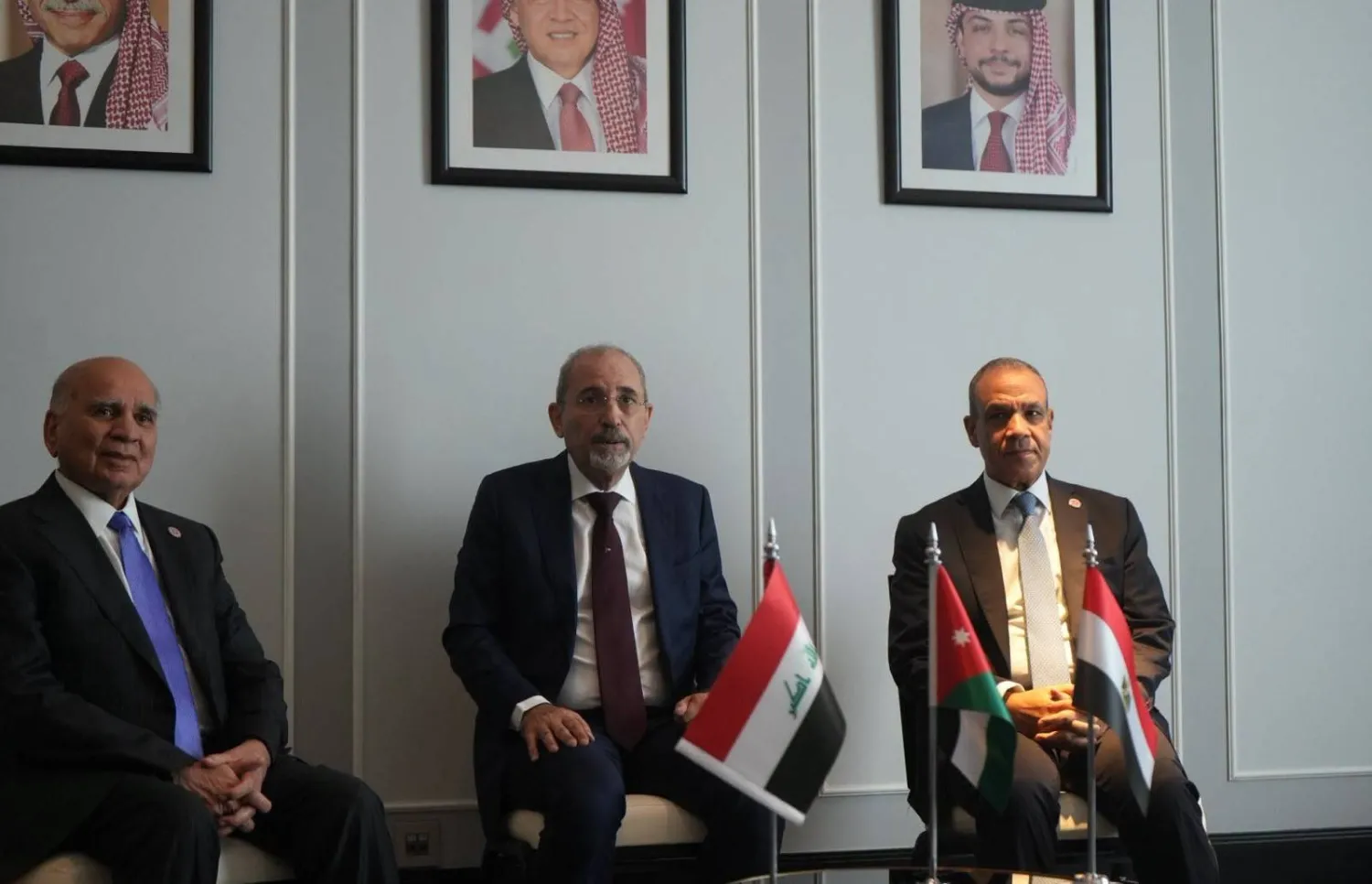

Egypt, Iraq, and Jordan reaffirmed the importance of activating their trilateral cooperation mechanism through its specialized technical committees and strengthening coordination in the economic, investment, industrial, and energy sectors as regional tensions continue to mount.
The three countries held talks Wednesday on the sidelines of the Ministerial Meeting on Jerusalem in the Jordanian capital, Amman.
The meeting brought together Egyptian Foreign Minister Badr Abdelatty, Jordanian Deputy Prime Minister and Foreign Minister Ayman Safadi, and Iraqi Deputy Prime Minister and Foreign Minister Fuad Hussein.
Egypt, Jordan, and Iraq launched their trilateral coordination and cooperation mechanism in Cairo in 2019, and the leaders of the three countries have since held several summits under its framework. Foreign ministers have also met regularly on the sidelines of various political gatherings.
During the meeting, Abdelatty stressed the importance of the trilateral cooperation mechanism as a key framework for advancing regional integration and strengthening joint Arab action. He said it offers opportunities to leverage the capabilities and resources of the three countries in ways that serve the interests of their peoples.
He also stressed the need to translate the political will of the three countries' leaders into practical projects in infrastructure, trade, industry, energy, electricity interconnection, agriculture, and transportation, while emphasizing implementation of the recommendations issued by the mechanism's technical committees to strengthen economic and development partnerships.
The ministers also discussed a number of regional issues of shared concern, foremost among them developments in the Palestinian issue. They stressed the need to intensify Arab and international efforts to support the legitimate rights of the Palestinian people, including the establishment of an independent Palestinian state along the June 4, 1967 lines with East Jerusalem as its capital.
Abdelatty reaffirmed Egypt's commitment to supporting the trilateral cooperation mechanism as a means of strengthening cooperation among Egypt, Jordan, and Iraq while promoting regional security, stability, and development.
Ashraf Harbi, a member of the Egyptian Council for Foreign Affairs, said the trilateral cooperation mechanism is not limited to regularly scheduled meetings. Instead, meetings are convened whenever political, economic, or security developments in the region require consultation, allowing the three countries to coordinate on regional and international developments and adopt appropriate positions and measures.
Harbi told Asharq Al-Awsat that the mechanism serves as a permanent framework for strategic consultation among Cairo, Baghdad, and Amman, covering political, economic, development, and social issues, in addition to promoting bilateral and trilateral cooperation in energy, transportation, investment, and infrastructure, as well as the exchange of expertise, studies, and research.
He said the mechanism has become increasingly important amid successive regional crises because it facilitates the exchange of views and information and enables the three countries to coordinate their positions on issues including the war in the Gaza Strip, maritime security in the Red Sea and the Bab al-Mandab Strait, developments related to the Strait of Hormuz, and other security or economic events that could affect regional stability.
According to a statement issued by Iraq's Foreign Ministry and carried Wednesday by the Iraqi News Agency (INA), the three ministers agreed to hold regular meetings at various levels to monitor implementation of joint projects, particularly in the economic, investment, industrial, and energy sectors.
The ministers also discussed prospects for cooperation in the energy sector, including oil projects, electricity interconnection, and ways to expand joint cooperation in support of economic integration and energy security among the three countries, the ministry said.
Harbi said recent developments in the Gaza Strip, particularly what he described as Israel's intransigence following understandings on implementing the peace plan, underscore the need for continued consultation among the three countries, as well as a shared vision and coordinated plan to address the consequences of the ongoing regional escalation and its future implications in order to preserve regional stability and protect Arab interests.
He added that the mechanism is flexible and broad in scope, extending beyond any single issue to encompass all matters affecting the interests of the three countries. Its primary objectives, he said, are to strengthen political and strategic consultation, coordinate positions on regional and international issues, and advance economic and development cooperation through joint projects while expanding collaboration across multiple sectors.


