

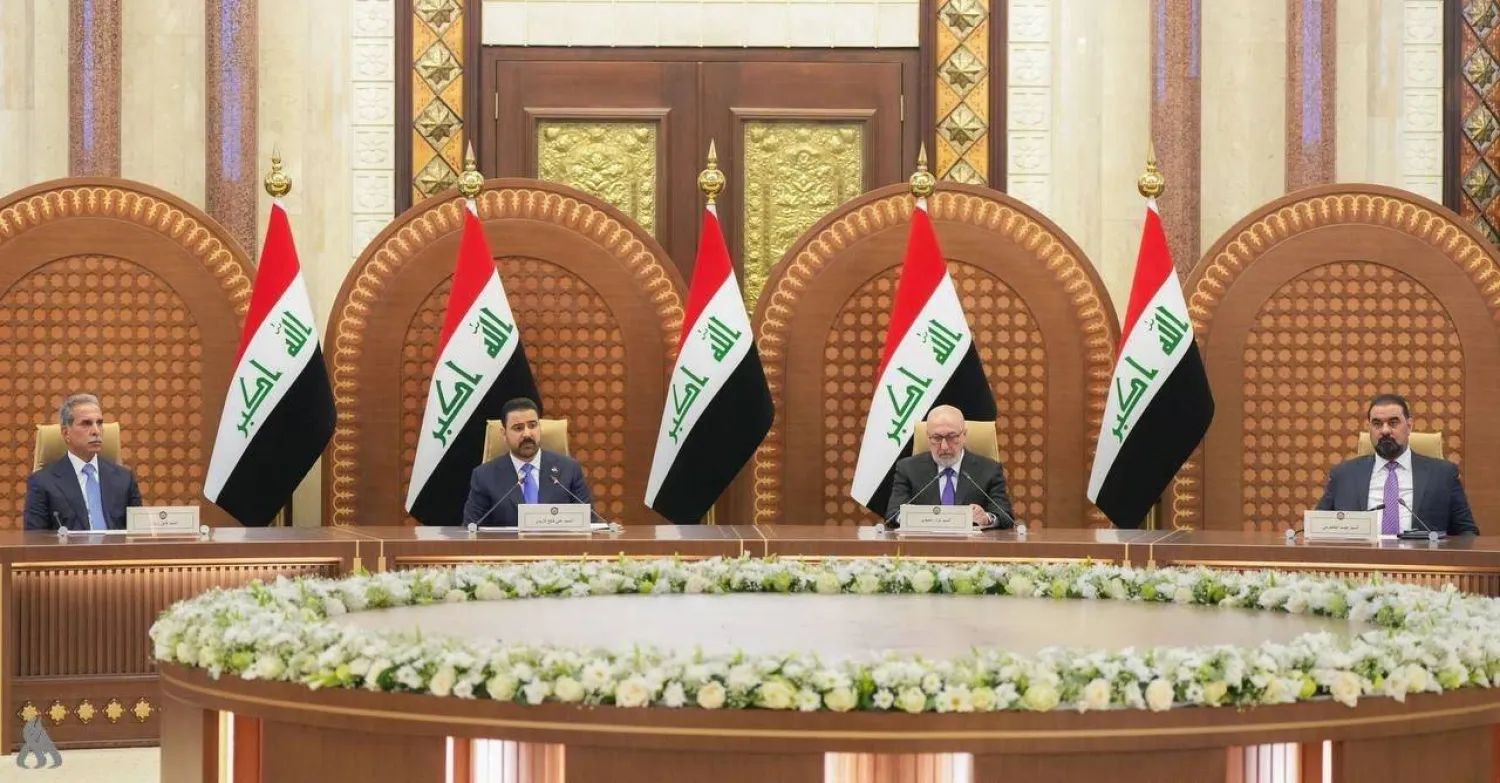

Iraq’s Ruling Coalition Warns Factions to Lay Down Weapons by Sept 30 Deadline

Prime Minister Ali al-Zaidi (second left) chairs the meeting of the State Administration Coalition on Wednesday. (INA)
TT

Iraq’s Ruling Coalition Warns Factions to Lay Down Weapons by Sept 30 Deadline

Prime Minister Ali al-Zaidi (second left) chairs the meeting of the State Administration Coalition on Wednesday. (INA)

Iraq's State Administration Coalition, which boasts Shiite, Sunni and Kurdish forces, made a firmer stance against factions that continue to carry weapons outside the authority of the state.

It stressed that any armed movement that takes place after the September 30 deadline for the factions to hand over their weapons will be dealt with according to the law, including the counter-terrorism law.

The move marked a political and security escalation in one of Iraq’s thorniest issues since the 2003 American invasion and ouster of the former regime.

Prime Minister Ali Al-Zaidi hosted on Wednesday the 37th regular meeting of the State Administration Coalition, attended by the president, president of the Kurdistan Region of Iraq, parliament speaker and president of the Supreme Judicial Council.

The meeting reviewed the overall political, security, economic and service situation in the country, as well as regional developments and their implications for Iraq, reported the country’s state news agency INA.

In a statement after the meeting, the alliance said: “The State Administration Coalition reaffirmed its support for continued efforts to preserve security and stability, as well as the government’s efforts to ensure that all arms remain under state authority, in accordance with the Government Program approved by the parliament and now in force.”

“It also stressed the need to prevent Iraqi territory from being used as a launching point for attacks against neighboring countries or from drawing Iraq into conflicts that do not serve the interests of its people,” it added.

“The Coalition considered that anyone engaging in such conduct commits the crime of threatening the country’s security and shall be regarded as being outside the law,” it stressed.

“Such individuals must be confronted in accordance with the provisions of the Constitution, which prohibit the use of arms outside the authority of the state or the formation of any armed organization outside the official Armed Forces,” it urged.

'Bold' statement

The coalition met days after Hadi al-Ameri, one of the leading members of pro-Iran Coordination Framework and leader of the Badr Organization, resisted calls to lay down the weapons of his armed faction.

He said that he “will be the first rifle to turn against anyone who encroaches on the weapons of the resistance.” He made his remarks during a meeting with Iranian Foreign Minister Abbas Araghchi, who was in Iraq on a religious visit to the cities of Najaf and Karbala.

The government had set the end of September as a deadline for factions to turn over their weapons to the state. American forces deployed in Iraq as part of the anti-ISIS coalition are also set to pull out of the country on the same date.

Other armed factions, such as the Iran-aligned Kataib Hezbollah, have declared in recent days their refusal to lay down their weapons. Kataib Hezbollah called for keeping the “resistance’s weapons” and developing its arsenal to confront “challenges” and “enemies.”

Political science professor at the Al-Mustansiriyah University Taleb Mohammed Karim said the government’s statement is an attempt to “organize” relations between the state and armed factions that emerged during extraordinary circumstances after 2003.

Supporters of the plan to impose state monopoly over arms deem it necessary for Iraq to consolidate its sovereignty, while opponents see it as an attempt to target them politically given the lack of trust between parties, he noted.

Head of the Center for Political Thinking in Iraq Dr. Ihssan Shmary described the statement as “bold” compared to previous ones.

It reflects the government and political parties’ seriousness in wanting to resolve the issue of weapons outside state control, he remarked, highlighting that the statement said that the arms would be dealt with according to the counter-terrorism law.

Meanwhile, President of the Supreme Judicial Council Judge Faiq Zidan and head of the Counter-Terrorism Service Lieutenant General Staff Zaid Houshi discussed joint cooperation and coordination on Thursday.

They tackled enhancing cooperation and coordination between the judiciary and the Counter-Terrorism Service in a manner that strengthens the rule of law, said INA.

Zidan also received Director of the Office of the Commander-in-Chief of the Armed Forces Lieutenant General Abdul Amir Al-Shammari to discuss measures to ensure the rule of law and support security.



EU Establishes New Lebanon Support Mission

Kaja Kallas, the European Union's high representative for foreign affairs and security policy, speaks during a joint press conference with Lebanese Minister of Foreign Affairs and Emigrants Youssef Rajji (not pictured) at the Lebanese Foreign Ministry in Beirut, Lebanon, 08 October 2026. (EPA)
TT

EU Establishes New Lebanon Support Mission

Kaja Kallas, the European Union's high representative for foreign affairs and security policy, speaks during a joint press conference with Lebanese Minister of Foreign Affairs and Emigrants Youssef Rajji (not pictured) at the Lebanese Foreign Ministry in Beirut, Lebanon, 08 October 2026. (EPA)

European Union foreign ministers agreed on Monday to establish a new support mission in Lebanon aimed at advising and training the country's military and internal security forces.

The mission "will advise and assist the Lebanese Armed Forces and Internal Security Forces to strengthen territorial control, border security, and internal security," EU foreign policy chief Kaja Kallas said in a ‌statement, adding ‌that "Europe is invested in Lebanon's ‌future".

The ⁠Council of the ⁠EU said the mission would have an initial mandate of three years and include both a civilian and military pillar.

"The military pillar will provide advisory support and training to strengthen the capabilities of the Lebanese Armed Forces, for ⁠border security and maritime security," ‌it said, while the civilian ‌pillar would provide training for Lebanon's Internal Security ‌Forces in areas such as cybercrime and anti-smuggling.

Kallas ‌said last month that more than 10 EU members were willing to contribute resources and people to the mission.

More operational planning is expected before ‌the bloc makes a decision to launch the mission's work. An EU ⁠official ⁠said on Monday that the bloc hoped to deploy personnel under the new mission in the coming months.

The mission stems from the EU studying ways to strengthen Lebanese forces to help free up the Lebanese army to focus on disarming the Hezbollah group.

The mandate of the UN Interim Force in Lebanon is set to expire at the end of 2026, when it is expected to begin a year-long drawdown and withdrawal.


Lebanese Army Seizes More Explosives as PM Vows Firm Response

16 February 2026, Lebanon, Beirut: Lebanese Prime Minister Nawaf Salam is pictured during a meeting at the Prime Minister's office. (dpa)
TT

Lebanese Army Seizes More Explosives as PM Vows Firm Response

16 February 2026, Lebanon, Beirut: Lebanese Prime Minister Nawaf Salam is pictured during a meeting at the Prime Minister's office. (dpa)

Lebanon's army said it seized explosives on Monday, after Prime Minister Nawaf Salam vowed to deal firmly with illegal weapons, days after security forces seized a truck carrying materiel suspected of belonging to Hezbollah.

The army said soldiers in the northeastern Hermel region "seized around 200 kilograms (around 440 pounds) of explosive material packed in bags and ready for smuggling from Syrian territory" into Lebanon, adding that the smugglers fled back into Syria.

A judicial official told AFP that the C4 explosives were being smuggled "on a mule through an illegal crossing in the town of Qasr".

The announcement was the third of its kind this month, and came days after a judicial official told AFP that authorities detained two suspected members of Iran-backed Hezbollah at a security checkpoint in Dahr al-Baidar as they headed to Beirut.

The official said they were transporting half a ton of explosives -- 250 kilograms of TNT and 250 kilograms of C4 -- when they were stopped near a road linking Syria to the Lebanese capital.

Salam on X confirmed that "it has become known that a few days ago a truck was stopped" in Dahr al-Baidar "carrying hundreds of kilograms of explosive materials" including C4.

"We will not be lenient in following up and expanding the investigation in order to identify all those involved in this criminal operation, and those behind them," he said.

"We will deal with weapons outside the legal framework will the required firmness," he added, whether regarding their possession, transportation or use.

Salam also said that he understood "Lebanese worries" over the C4, particularly as it "has been used in a number of political assassinations" in Lebanon's history.

- Detonators -

Earlier this month, Lebanon's army said it had seized "approximately 245 kg of TNT, four explosive devices, eight detonators and electrical wiring for the detonators", which were being "smuggled from Syrian territory into Lebanese territory", adding that the smugglers fled towards Syria.

Lebanon and Syria share a 330-kilometer (205-mile) border known for being porous.

Hezbollah until recently was the most influential political and military force in Lebanon, enjoying key support from Iran and longtime Syrian ruler Bashar al-Assad.

The group has been accused of carrying out assassinations of political figures who opposed Damascus, particularly between 2005 and 2008.

A UN-backed court in 2020 sentenced a fugitive Hezbollah member for the 2005 assassination of former Lebanese Prime Minister Rafik al-Hariri, with the court subsequently sentencing two more Hezbollah members in absentia.

Lebanese authorities last year committed to disarming Hezbollah, after hostilities between Israel and Hezbollah erupted in 2023 and culminated in all-out war the following year, decimating the group's leadership.

The 2024 toppling of Assad also severed the group's key weapons supply line from Iran, and Syria's new authorities regularly say they have seized weapons headed for Lebanon.

However, Hezbollah this year drew Lebanon into the Middle East war with rocket fire at Israel, which responded with airstrikes and a ground invasion.

The cash-strapped Lebanese army faces enormous challenges in carrying out its mission of disarming Hezbollah and deploying in south Lebanon, including under an Israel-Lebanon framework reached in June this year.


Yemen Dismantles Houthi Network That Plotted to Destabilize Security, Target Security and Military Leaders

Yemeni Interior Minister and Aden Governor during the press conference (Yemeni Interior Ministry)
TT

Yemen Dismantles Houthi Network That Plotted to Destabilize Security, Target Security and Military Leaders

Yemeni Interior Minister and Aden Governor during the press conference (Yemeni Interior Ministry)

Yemen's Interior Ministry arrested members of and dismantled Houthi-affiliated terrorist cells in the temporary capital Aden and the governorates of Lahj and Abyan in September. The ministry said the cells had been planning to target security and military leaders and vital facilities, as well as military reinforcements and supply lines heading to the battlefronts.

Yemeni Interior Minister Staff Maj. Gen. Ibrahim Haidan said at a press conference in Aden on Monday that the most prominent of these cells was an 18-member network apprehended in Lahj governorate on September 26. He said the network operated under the supervision of Houthi leaders and that its members had received specialized training in several areas under the group's control, including Saada, Dhamar and Al-Hawban in Taiz governorate.

Haidan said investigations revealed that the network's members had been trained to plant explosive devices, use booby traps and carry out attacks against security and military figures and sites. He added that the network was divided into two groups, one responsible for surveillance, monitoring and intelligence gathering, and the other for carrying out bombings and attacks.

The minister confirmed that security and intelligence agencies had thwarted the plots before they could be carried out. He said the cells had sought to undermine security and stability in the liberated governorates, disrupt conditions on the battlefronts and create conditions that would enable the Houthis to seize control of cities.

"The security agencies are waging a continuous battle that has not stopped for a single moment against the terrorist plots of the Iran-backed Houthi militia in order to strengthen security and stability," he said.

He stressed that the successes achieved by all security units in securing the home front constitute a fundamental pillar and a genuine starting point toward completing the battle for liberation and achieving the long-awaited victory that the Yemeni people have eagerly anticipated for more than a decade.

Haidan added: "We are fighting our battle against the Houthi militia, which has made terrorism part of its ideological doctrine and abandoned the teachings of our true Islamic faith. Its terrorism has gone beyond targeting communities in the liberated governorates to targeting Islamic holy sites, Makkah and Madinah, the holiest places for Muslims, which hold a special place in the hearts of more than a billion Muslims around the world and are deeply connected to their faith and religious identity."

He said the Houthi militia had abandoned all customs, traditions and deeply rooted societal values, resorting to what he described as despicable methods, including recruiting children, women, African migrants and the elderly to pursue its terrorist and extremist objectives of undermining security and stability and disturbing public peace and tranquility in the liberated governorates.

Haidan stressed that despite what he described as unlimited support provided by the terrorist Houthi militia to these cells, along with direct supervision of their training by experts from Iran's Islamic Revolutionary Guard Corps (IRGC) and Hezbollah, the preparedness, vigilance and courage of Interior Ministry personnel, working alongside their intelligence counterparts, had helped dismantle the cells one after another and deal them severe blows in recent months.

He said these operations had thwarted the militia's reliance on the cells to spread chaos, undermine security and stability, disrupt conditions on the battlefronts in the liberated governorates, particularly Aden, Lahj and Abyan, and create conditions for the Houthis to seize control of cities.

In Aden, security forces in the Dar Saad district arrested a member of the cell who, according to the ministry, was found in possession of explosive devices and materials linked to a plot to target security and military leaders and vital facilities. Investigations also uncovered other targets the cell had intended to attack within the city.

The ministry also announced the arrest of an all-female cell in Lahj on September 22, saying its members had been tasked with surveillance, tracking, recruitment and sabotage activities.

In addition, security forces apprehended a two-member cell in the Lawdar district of Abyan governorate earlier that month on suspicion of planning attacks against security and military forces and citizens.

Haidan praised Saudi Arabia's support for Yemen, particularly in the security sector, highlighting its role in strengthening the capabilities of security agencies and contributing to successes in combating terrorist cells.

For his part, Minister of State and Aden Governor Abdulrahman Sheikh said local authorities had taken security and precautionary measures to address the consequences of a wave of displacement caused by Houthi escalation in the governorates of Hodeidah and Taiz.

He explained that the governorate had set up 800 tents equipped with the necessary services and facilities, accommodating around 7,000 displaced people over half a month.

Meanwhile, Lahj Governor Murad Al-Halimi said coordination between security agencies in the governorates and the Interior Ministry had contributed to apprehending the cells and thwarting the terrorist and sabotage operations they had planned.

He called on everyone to recognize their responsibilities and work diligently to safeguard security in the liberated governorates and prevent them from falling victim to Houthi militia plots.

The Interior Ministry confirmed that the suspects would be referred to the relevant judicial authorities once investigations and evidence collection were completed, ahead of their trials.