


‘We Eat So We Don’t Die’: Daily Life with Hunger in Sudan

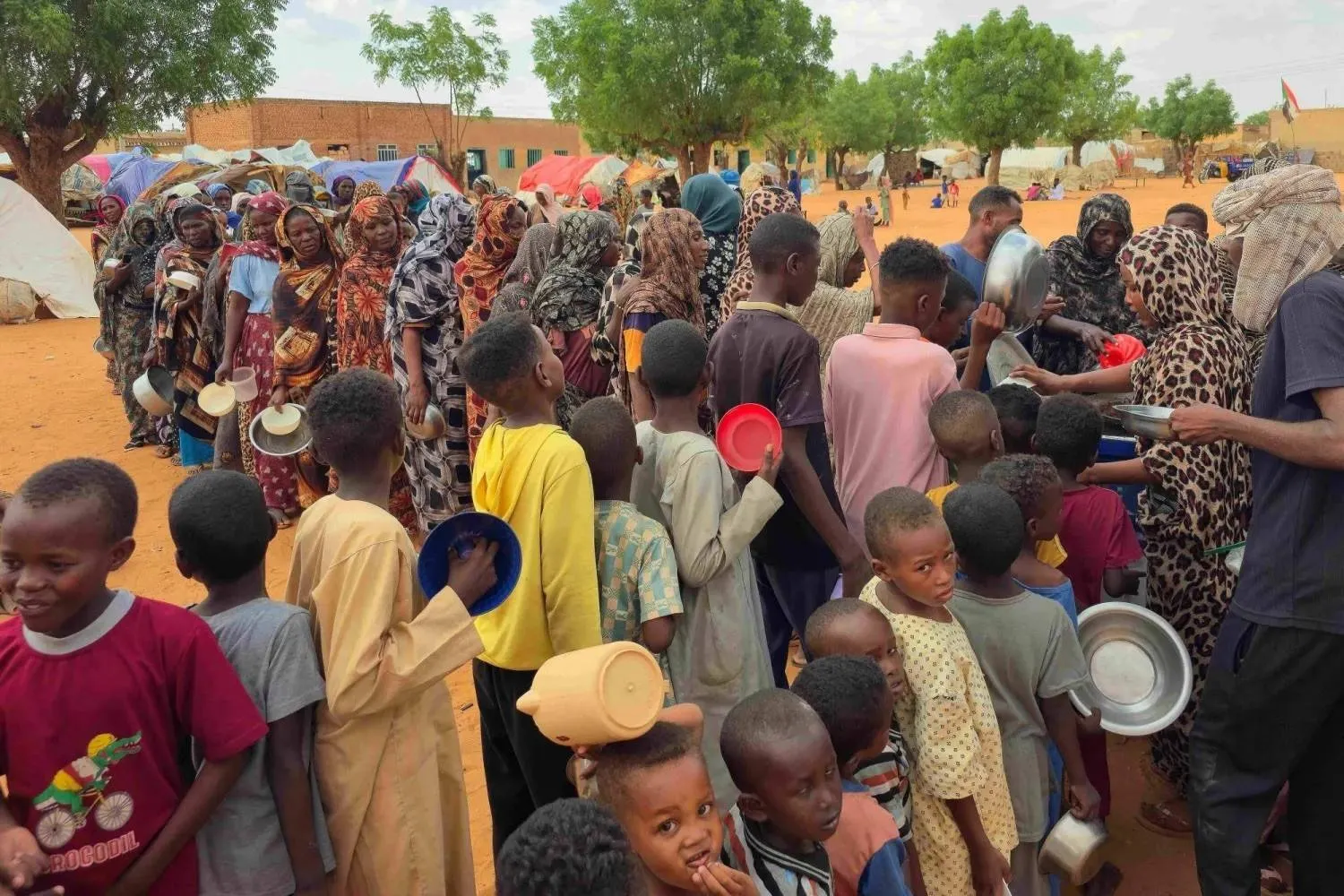
Women and children line up to receive free food aid at a displacement camp near El Obeid, North Kordofan, on June 29, 2026. (AFP)
TT

‘We Eat So We Don’t Die’: Daily Life with Hunger in Sudan

Women and children line up to receive free food aid at a displacement camp near El Obeid, North Kordofan, on June 29, 2026. (AFP)

Nahla Khalifa woke on April 15, 2023, to the sound of artillery in Omdurman. She could not have known that the war that sent her and her five children scrambling under beds and tables would upend even the most basic aspects of their lives: food, water and medicine.

At first, the family survived on what remained of its Ramadan provisions. Supplies, however, were limited. Sudan’s economic hardship had begun years before the conflict, and salaries were already insufficient to meet the needs of many households.

‘We eat so we don’t die’

Years of financial strain had forced most Sudanese to cut their daily meals to two. As the fighting dragged on and intensified, household stocks dwindled, leaving stale bread and small portions of lentils or beans supplied by communal kitchens, known as takayas, as staples.

“We ate simply so we wouldn’t starve to death,” Nahla told Asharq Al-Awsat. Meat, milk, vegetables and fruit vanished from the family’s diet, while even a cup of tea became a luxury. Her children often went to bed hungry and frightened, and her diabetic husband’s health deteriorated amid scarce food and limited access to treatment.

More than three years later, Nahla’s experience is no longer merely a reflection of the conflict’s early days. Food shortages have grown into a nationwide emergency, compounded by continued fighting, the collapse of the Sudanese pound, lost livelihoods and deteriorating public services.

Currency collapse

The Sudanese pound recently breached 6,000 to the dollar on the parallel market, compared with rates of 3,500 to 4,000 at bank exchange counters.

A currency trader told Asharq Al-Awsat that the pound’s plunge had immediately driven up the cost of basic goods as household purchasing power eroded to unprecedented levels.

Economist Mohamed al-Nayer noted that the currency had remained relatively stable for about three months, trading between 5,500 and 5,800 pounds to the dollar, before weakening again this week.

Inflation, poverty, unemployment and currency depreciation are predictable consequences of a wartime economy, al-Nayer explained, although the easing of fighting in some areas has allowed limited economic activity to gradually resume.

Any sustained recovery in the pound, he argued, hinges partly on controlling Sudan’s gold resources. Official production reached about 70 tons last year, while declared exports amounted to only 20 tons. Curbing smuggling and allowing the central bank to retain some output as reserves could bolster the currency, while the widening gap between official and parallel-market rates risks affecting remittances from Sudanese abroad.

A chronic problem

University of Khartoum economics and finance professor Ibrahim Ahmed Onour sees deeper structural problems behind the pound’s decline, pointing to the absence of effective monetary policy and weak coordination with fiscal policy.

He explained that limited central bank tools have left the exchange rate vulnerable to parallel-market speculation, while gold revenues have not been sufficiently harnessed to shore up the currency and finance imports of wheat, fuel and medicines.

Onour called for restructuring the banking sector, reassessing bank assets, increasing capital and merging struggling lenders. Without a coherent monetary and fiscal strategy, he warned, pressure on the pound will persist.

The crisis at street level

The economists’ figures translate into a harsher reality in Sudan’s markets.

Grocer Ibrahim Idris told Asharq Al-Awsat that his working capital no longer buys the quantities it once did, forcing him to concentrate on essentials as demand for other products declines.

A 36-pound container of cooking oil that cost around 170,000 pounds before the conflict now sells for about 350,000, while a sack of onions can jump from 5,000 to 7,000 pounds in a single day.

For Idris, however, the clearest indicator is his ledger of unpaid debts. More customers are buying on credit, while many can no longer repay what they owe after losing jobs or other sources of livelihood.

Shrinking household incomes

Employment alone does not guarantee security. Amal Abdullah, a pseudonym, explained that although all her children work, the family’s combined earnings cannot cover food and medical care. Before the conflict, she received kidney transplant medication free of charge. She must now pay for it herself, sometimes obtaining medicines from Egypt and borrowing from her grocer to cover expenses.

“Some days, my family makes do with one meager meal,” she told Asharq Al-Awsat.

Such accounts mirror food-security indicators showing millions of Sudanese facing acute hunger. Conditions are most severe in conflict-hit Darfur and Kordofan, where the problem extends beyond soaring prices to disrupted markets, roads and agriculture, as well as restricted humanitarian access.

Communal kitchens close

In Khartoum, takayas helped fill part of that gap for a time.

Osman al-Jundi, who oversees several communal kitchens, recalled that they once provided one meal a day. Many have since closed because of dwindling funding, rising food costs and volunteers returning to work or studies.

The return of residents to parts of the capital has not eliminated the need, he noted. Many came back without jobs or livelihoods, while fighting in Kordofan has brought a fresh influx of displaced people.

Children, the elderly, women and people with disabilities are among those most dependent on the meals.

“The war impoverished the rich and made the poor even poorer,” al-Jundi said.

Shortages beyond food

Securing a meal does not end the hardship. Power cuts halt water pumps and disrupt bakeries, workshops and shops.

Ahmed Abdullah, director general of Sudan Electricity Holding Company, told Asharq Al-Awsat that the sector had suffered enormous losses, with repairs underway on transmission and distribution lines and transformers as residential areas are gradually reconnected.

Nahla recalled that during one prolonged water outage, young men in her neighborhood reopened old wells to obtain drinking water. Intense heat and electricity cuts have also forced families at times to sit and sleep outside in search of a breeze.

During the rainy season, failing water and electricity services pose an additional health threat.

Mohamed al-Hassan al-Amir, Khartoum state’s director of preventive medicine, warned of malaria, watery diarrhea, gastrointestinal diseases and dengue fever. Stagnant pools, poor drainage, accumulated waste and murky water facilitate the spread of disease, while the suspension of some control measures during the fighting has expanded the habitat of dengue-carrying mosquitoes.

Sudan’s hardships have become mutually reinforcing: conflict has crippled production and employment, the pound’s collapse has sent prices soaring, shrinking purchasing power has reduced both the quantity and quality of meals, and the closure of takayas has weakened one of the last remaining safety nets. Electricity and water outages, meanwhile, heighten the risk of disease.

For Nahla, years of conflict can be distilled into a single image: her children going to bed hungry, her sick husband needing medicine and a family table reduced to a bowl of lentils from a communal kitchen — when one is available — marking the thin line between starvation and surviving another day.



Iraq’s Maliki Joins Chorus Rejecting Militia Disarmament

Members of Iraq’s Kataib Hezbollah carry the group’s flag in central Baghdad. (File photo - AFP)
TT

Iraq’s Maliki Joins Chorus Rejecting Militia Disarmament

Members of Iraq’s Kataib Hezbollah carry the group’s flag in central Baghdad. (File photo - AFP)

State of Law Coalition leader Nouri al-Maliki has joined a growing chorus of critics of Iraqi Prime Minister Ali al-Zaidi’s government program, unanimously approved by parliament, to restrict arms to state control.

Less than a month after the State Administration Coalition, comprising leading Shiite, Sunni and Kurdish forces, gave Zaidi full authority to determine how to handle the issue after Sept. 30 — when the remaining US troops are due to leave Iraq — armed factions, notably Kataib Hezbollah and Harakat al-Nujaba, rejected the deadline. They argue that their weapons are “ideological” and tied to the Iran-led “Axis of Resistance.”

Maliki joined them Wednesday, declaring in televised remarks that “there will be no handover of weapons” after Sept. 30.

Instead, he advocated “regulation and containment” of weapons through a mechanism still under discussion.

Maliki pointed that distinctions could be drawn among heavy, medium and light arms.

His position came despite an earlier warning from the State Administration Coalition that any armed activity outside state authority after Sept. 30 would be dealt with under the counterterrorism law.

Shifting Terms

A visit to Iraq by Iranian parliament speaker Mohammad Bagher Ghalibaf further complicated the process amid indications that Tehran was unwilling to see all factions surrender their weapons.

The government subsequently agreed to a Shiite Coordination Framework committee that would begin talks with armed groups after the end of September to persuade them to establish a mechanism for “regulating weapons, not disarming them,” as Maliki put it.

Maliki serves on the three-member committee alongside former Prime Minister Mohammed Shia al-Sudani and Badr Organization leader Hadi al-Amiri.

While Sudani has made no statement on surrendering weapons, Amiri and Maliki have taken turns, using terms such as “regulating,” “freezing” or “deferring” weapons rather than “disarmament.”

Maliki’s comments followed Amiri’s description two days earlier of the 2019 Tishreen protests as a “sedition” intended to topple the Shiite political system.

Amiri also identified the “resistance” as the so-called “third party” that carried out killings of protesters, leaving thousands dead or wounded, mostly from poor Shiite neighborhoods in Baghdad and central and southern provinces.

Political observers viewed his remarks as a deliberate message that armed factions “were, and remain, the ones protecting the political system when it is threatened.”

Akram al-Kaabi, secretary-general of Harakat al-Nujaba, meanwhile said US President Donald Trump was “deluded” if he believed he could achieve a victory in Iraq after failing to do so in Iran.

The government has maintained that the deadline for surrendering weapons remains unchanged and coincides with the US withdrawal, saying armed groups could be compelled to comply once the American presence ends and there is no longer justification for carrying arms.

Saleh al-Arbawi, head of the Wa’i Movement, told Asharq Al-Awsat that any handover could be circumvented or merely symbolic, saying armed groups follow “a transnational ideology and leadership” and have received no order to relinquish their weapons.

The government, he said, faces either confrontation or potentially lengthy dialogue and compromise. He added that the wider the current conflict becomes, the more difficult restricting arms to state control will be.


Syria Says Thwarted Escape Attempt of Man Linked to Assad-era General

A large Syrian flag flutters above Tishreen Park in Damascus, June 4, 2025. (AFP)
TT

Syria Says Thwarted Escape Attempt of Man Linked to Assad-era General

A large Syrian flag flutters above Tishreen Park in Damascus, June 4, 2025. (AFP)

Syrian authorities on Thursday said they foiled an escape attempt by a man close to a general who served ousted ruler Bashar al-Assad and led a militia linked to Assad's cousin.

Security forces in the Damascus countryside said they "thwarted an escape attempt by Alaa Zahreddine, a key associate of the criminal Ghiath Dalla and former leader of the 'Shield of the Homeland Brigade' militia", accusing him of being "implicated in crimes against civilians".

"After his identity was confirmed during a stop at a security checkpoint, Zahreddine drew his weapon and shot himself, committing suicide to avoid capture. His companion in the vehicle was arrested."

Syrian authorities had previously said that the brigade was linked to Rami Makhlouf, cousin of former Syrian president Assad who was ousted in 2024.

The operation comes days after security forces said they killed an Assad-era army commander in a firefight while trying to arrest him in the Alawite-majority Syrian coast.

Authorities said both men were linked to Assad-era general Dalla.

Dalla, a former officer in the much-feared Fourth Brigade, had announced on social media last year the formation of a "military council for the liberation of Syria".

The announcement came shortly before deadly violence targeting the Alawite minority, to which Assad's family belongs, erupted on the Syrian coast in March 2025.

Authorities accused armed Assad supporters of sparking the violence by attacking security forces.

A national commission of inquiry said at least 1,426 members of the minority were killed, while the Syrian Observatory for Human Rights monitor put the toll at more than 1,700.


DR Congo Latest to Promise Moving Israel Embassy to Jerusalem

 Felix-Antoine Tshisekedi, president of the Democratic Republic of Congo, addresses the African Water Forum in N’Djamena, Chad, on July 16, 2026. (AFP file)
Felix-Antoine Tshisekedi, president of the Democratic Republic of Congo, addresses the African Water Forum in N’Djamena, Chad, on July 16, 2026. (AFP file)
TT

DR Congo Latest to Promise Moving Israel Embassy to Jerusalem

 Felix-Antoine Tshisekedi, president of the Democratic Republic of Congo, addresses the African Water Forum in N’Djamena, Chad, on July 16, 2026. (AFP file)
Felix-Antoine Tshisekedi, president of the Democratic Republic of Congo, addresses the African Water Forum in N’Djamena, Chad, on July 16, 2026. (AFP file)

The Democratic Republic of Congo said Thursday it would move its embassy in Israel to Jerusalem, joining a small group of countries including the United States in taking the symbolic step of backing Israeli sovereignty in the contested holy city.

After a visit by President Felix-Antoine Tshisekedi, the two countries in a statement said they would take steps for "the relocation of the embassy of the Democratic Republic of the Congo from Tel Aviv to Jerusalem", without giving a timeline.

Tshisekedi and Israeli Prime Minister Benjamin Netanyahu in a meeting spoke of their "shared commitment to strengthening diplomatic relations", the statement said.

Tshisekedi has spoken warmly about Israel for years, saying his support is driven by his Christian faith. He has also been eager for support from the United States, which has increasingly pressured Rwanda over armed rebel advances in DR Congo.

The announcement comes weeks after Colombia's new hard-right president, Abelardo de la Espriella, also announced that he would move his country's embassy to Jerusalem, a sharp shift from his leftist predecessor who criticized Israel over its Gaza offensive.

The vast majority of countries, if they recognize Israel, keep their embassies in Tel Aviv on the grounds that the status of Jerusalem will be settled in a final resolution of the Palestinian-Israeli conflict.

President Donald Trump shattered that consensus in 2018 during his first term by moving the US embassy to Jerusalem, which is home to Israel's parliament, prime minister and most other major governmental institutions.

Since Trump's move, only a handful of small, US-aligned countries have followed suit -- Fiji, Guatemala, Honduras, Papua New Guinea and Paraguay.

Kosovo and Somaliland, which are not member-states of the United Nations, have also opened what they consider their embassies in Jerusalem.

Argentine President Javier Milei, another right-wing Latin American who is an outspoken supporter of Israel, has promised to move his country's embassy to Jerusalem.

The shift has not yet taken place, however, reportedly due to disagreement over an Israeli company's plans to drill in the British-ruled Falkland Islands, which Argentina claims and calls the Malvinas.

Israel captured the eastern part of Jerusalem from Jordan in the 1967 Six-Day War and annexed it, declaring Jerusalem, home to Judaism's holiest site, to be its eternal, undivided capital.