


Israel Expands Lebanon Campaign by Setting Fires to Forested Areas

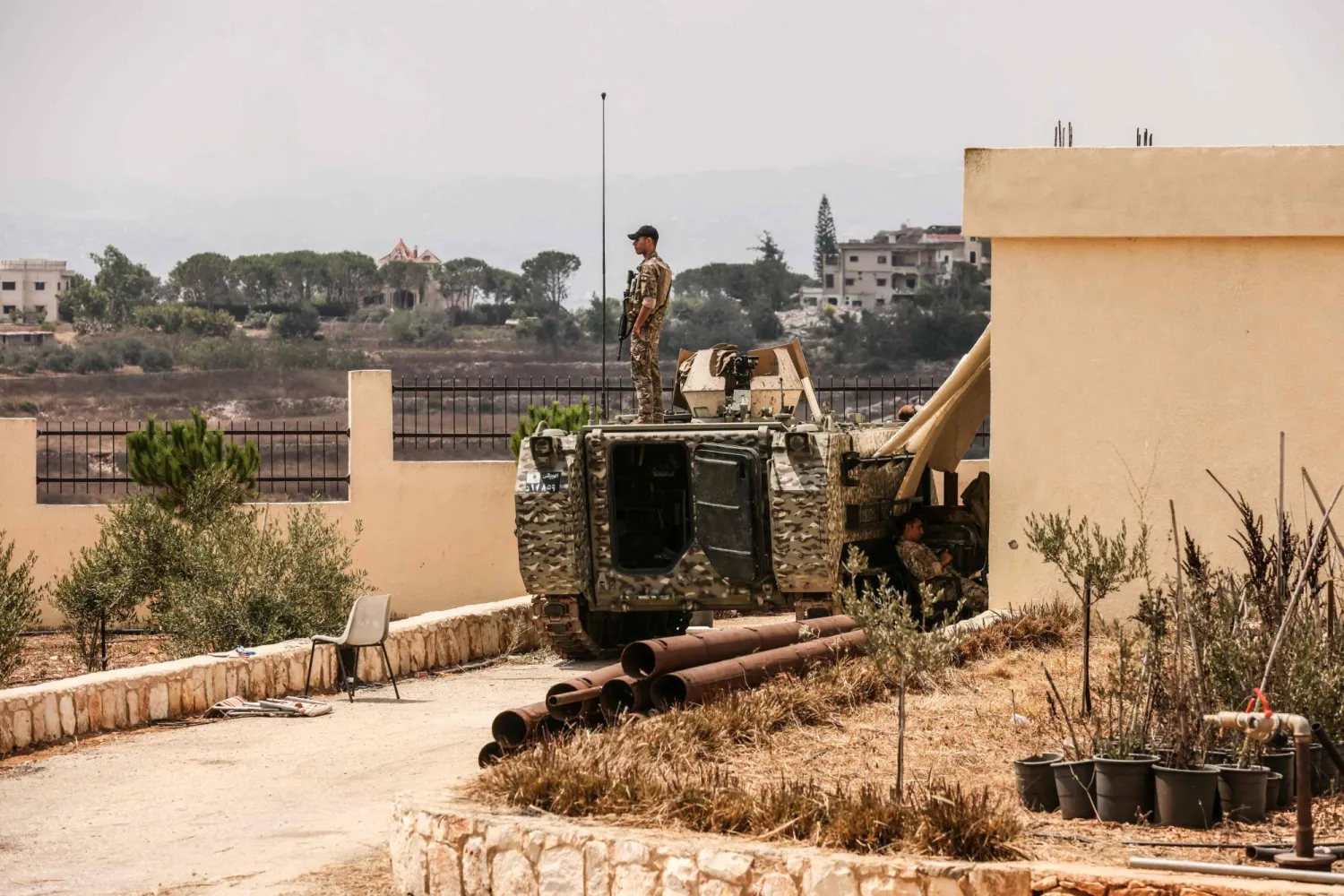
A Lebanese army soldier stands on top of his tank in the southern Lebanese village of Zawtar al-Sharqiyah as he observes the Israeli soldiers movement in the nearby village of Zawtar al-Charkiyah on August 8, 2026. (Photo by MAHMOUD ZAYYAT / AFP)
TT

Israel Expands Lebanon Campaign by Setting Fires to Forested Areas

A Lebanese army soldier stands on top of his tank in the southern Lebanese village of Zawtar al-Sharqiyah as he observes the Israeli soldiers movement in the nearby village of Zawtar al-Charkiyah on August 8, 2026. (Photo by MAHMOUD ZAYYAT / AFP)

Israeli attacks on Lebanon have expanded beyond airstrikes, artillery fire and demolitions to include the use of incendiary materials, as fires sweep through vast stretches of forests and highlands after projectiles and flammable substances were dropped by Israeli drones.

The escalation coincided with Israeli Prime Minister Benjamin Netanyahu’s announcement that Israel was “in the midst of a highly important operation in Lebanon.”

Addressing a cabinet meeting, Netanyahu described intensive military operations in recent days targeting what he called “terrorists,” including fighters in the Ali al-Taher Heights. He declined to disclose further details about the nature of the operations.

“We are in the midst of a very important operation. We are working prudently and wisely with both determination and wisdom ... and eliminating threats.”

Widespread Fires and Shelling

Large parts of South Lebanon and the Western Bekaa have faced an escalation ranging from artillery shelling and airstrikes to demolitions and ground operations. Fires have also engulfed forested and mountainous areas, adding environmental and woodland damage to the destruction of facilities and infrastructure.

Civil Defense teams are working to contain and extinguish the blazes, but rugged terrain, the scale of the fires and difficulty reaching several zones have hampered their efforts and fueled fears that the flames could spread further.

MP Qabalan Qabalan of the Development and Liberation bloc called on the army, security forces, Civil Defense and other relevant agencies to intervene urgently.

He urged full coordination and the deployment of all available resources, particularly aerial firefighting capabilities, warning that the fires threaten the region’s forests and environment.

Shelling and Demolitions Continue

The Israeli military carried out a major demolition in Zawtar al-Sharqiyah on Sunday morning, while artillery fired five shells near the Litani River in the Khardali area.

Israeli vehicles advanced from Haddatha toward the outskirts of Haris amid machine-gun fire, while intermittent artillery shelling struck the area between Mayfadoun and Zawtar al-Sharqiyah. Earlier, an Israeli airstrike targeted the Mansouri bridge over the Qasimiyeh-Ras al-Ain irrigation canal.

Since midnight Saturday, concentrated artillery fire has also targeted the Ali al-Taher Heights on the outskirts of Nabatieh al-Fawqa, along with the outskirts of Zawtar and Mayfadoun and the Dawhat Kfar Remman area.

Meanwhile, the Lebanese Army continued clearing remnants of Israeli explosives. Specialized units dismantled unexploded missiles and aerial bombs in several towns in the Marjayoun and Nabatieh districts and transferred them to safe locations.

The army urged residents in areas hit by Israeli attacks to exercise extreme caution and report any suspicious objects to the nearest military post.

Hezbollah Criticizes Negotiations

As the fighting intensifies, Hezbollah has continued to criticize Lebanese-Israeli negotiations.

Hezbollah MP Hussein Hajj Hassan argued that the direct talks, which his group had opposed from the outset, have yet to produce tangible results and have instead coincided with continued Israeli attacks and escalation.

He maintained that Israeli and US political and electoral interests were shaping the negotiations in Israel’s favor at Lebanon’s expense, warning that pursuing talks without reassessing their effectiveness could lead Lebanon to make concessions under US and Israeli pressure.



PAM Party Wins Most Seats in Morocco's Parliamentary Election

A man arrives to vote during parliamentary elections in Rabat, Morocco September 23, 2026. REUTERS/Ahmed El Jechtimi
TT

PAM Party Wins Most Seats in Morocco's Parliamentary Election

A man arrives to vote during parliamentary elections in Rabat, Morocco September 23, 2026. REUTERS/Ahmed El Jechtimi

The Authenticity and Modernity Party (PAM) won the largest number of seats in Morocco's legislative election, followed by its partners in the outgoing government, RNI, and the Istiqlal party, according to official preliminary results on Thursday.

Liberal-centrist PAM took 97 seats in the 395-seat parliament, ahead of the RNI with 66, while the Istiqlal Party secured 65 seats, the Interior Minister Abdelouafi Laftit said in a news briefing on Thursday.

The Justice and Development Party rebounded to 54 seats, from only 13 in the previous election, buoyed by the return of its former prime minister Abdelilah Benkirane.

Leftist parties such as USFP, PPS and FGD took 26, 19 and 8 seats respectively.

Turnout stood at 38.02%, down from 50% in the 2021 election, according to official data. About 27 million Moroccans are of voting age, but only 15.8 million are registered to vote, a drop of about 12% from 2021 election.

Turnout is seen as a barometer for citizens' engagement and trust in elected institutions.

The parliamentary poll is not expected to fundamentally alter the balance of power in Morocco, where the king retains sweeping powers over policy direction, defense and foreign affairs.

Under a constitution adopted in 2011, the king appoints the prime minister from the party that wins the most seats.

If King Mohammed VI appoints PAM’s current leader, Fatima Ezzahra El Mansouri, as head of government, she would become the second woman to hold such a position in the Arab region, after Tunisia’s Najla Bouden.

PAM will have to negotiate a coalition even as its leaders have ruled out partnering again with RNI as the two parties trade accusations over failed policies.

PAM campaigned on a $37 billion platform promising 1 million new jobs and continued investment in healthcare, social protection and better wages.


Norway Gives Additional $13 Million in Aid to Palestinians

Palestinian motorists wait in line to cross the Beit Furik military checkpoint, east of Nablus, West Bank, 20 September 2026. EPA/ALAA BADARNEH
TT

Norway Gives Additional $13 Million in Aid to Palestinians

Palestinian motorists wait in line to cross the Beit Furik military checkpoint, east of Nablus, West Bank, 20 September 2026. EPA/ALAA BADARNEH

Norway's government said on Thursday it will give an additional 125 million Norwegian crowns ($13.17 million) in aid to the occupied Palestinian territories through the United Nations and the World ⁠Bank, including public sector ⁠budget support.

Norway recognized a Palestinian state in 2024 and chairs the international donor ⁠group for the Palestinians.

Norway's Foreign Minister Espen Barth Eide said in a statement the need for international support was "greater than ever.”

Eide also criticized Israeli settlement activity ⁠in ⁠the occupied West Bank.

Norway is providing around 1 billion Norwegian crowns in assistance to the Palestinians in 2026.


Postwar Arrangements Top al-Zaidi’s New York Talks

Lebanese Prime Minister Nawaf Salam (L)speaks with Iraqi Prime Minister Ali al-Zaid during a Gulf Cooperation Council (GCC) multilateral meeting on the sidelines of the 81st United Nations General Assembly in New York on September 22, 2026. (Photo by Brendan SMIALOWSKI / AFP)
TT

Postwar Arrangements Top al-Zaidi’s New York Talks

Lebanese Prime Minister Nawaf Salam (L)speaks with Iraqi Prime Minister Ali al-Zaid during a Gulf Cooperation Council (GCC) multilateral meeting on the sidelines of the 81st United Nations General Assembly in New York on September 22, 2026. (Photo by Brendan SMIALOWSKI / AFP)

Iraqi Prime Minister Ali al-Zaidi is seeking to restore normal relations with neighboring and regional countries through a series of meetings in New York, where he is attending the UN General Assembly.

Al-Zaidi met US President Donald Trump on Wednesday to discuss strengthening bilateral cooperation and regional developments. The prime minister’s media office said the talks covered economic and investment partnerships between Baghdad and Washington, as well as joint efforts to bolster regional and international security and stability.

Al-Zaidi’s talks in New York have drawn particular attention, including his participation in a multilateral meeting with Trump to discuss postwar regional arrangements and his meeting with Syrian President Ahmad al-Sharaa.

Baghdad says it has been hurt by the closure of the Strait of Hormuz because of the war, but faces sharp contradictions at home because parties in the ruling Coordination Framework and armed factions are allied with Iran, one of the parties to the conflict with the United States.

Government spokesman Haider al-Aboudi said Iraq was pursuing an important program to coordinate positions and create opportunities for cooperation, noting that al-Zaidi had held several meetings in New York to coordinate policies and safeguard shared interests.

“Iraq has listened to the proposals of world leaders, but it has its own vision for producing solutions to secure energy supplies and stabilize the region,” al-Aboudi told reporters.

He explained that Iraq was guided by legal and constitutional principles of good-neighborly relations and non-interference in internal affairs while pursuing greater cooperation and integration to promote stability.

Al-Zaidi and Al-Sharaa

Al-Aboudi’s remarks followed a series of meetings al-Zaidi held with world leaders, most notably Syrian President Ahmad al-Sharaa.

Before a multilateral meeting convened by Trump on the sidelines of the UN General Assembly, journalists captured al-Sharaa and al-Zaidi shaking hands for the first time since the Iraqi premier took office.

Al-Zaidi’s office later confirmed that the two leaders met on the sidelines of the 81st UN General Assembly.

According to the statement, the talks covered regional and international developments, bilateral relations and ways to strengthen them in line with mutual interests, as well as efforts to promote de-escalation and ease regional tensions.

Al-Sharaa, for his part, told reporters that Damascus was working to provide a safe corridor for Iraqi oil exports through Syrian ports. He pointed to a strategic project to build an oil pipeline from Iraqi fields to Syrian ports, bypassing the Strait of Hormuz.

The Syrian president described Damascus’ relations with Iraq’s Kurdistan region as “very good,” citing shared interests in several areas. He also highlighted Kurdistan Democratic Party leader Masoud Barzani’s role in stabilizing Syria and integrating the Syrian Democratic Forces (SDF) into the state.

Postwar arrangements

Al-Zaidi also joined a multilateral meeting attended by Trump following what was described as a “productive” meeting between US and Iranian officials on Tuesday evening.

Al-Zaidi’s office reported that the meeting addressed security and stability, protecting global trade, securing supply chains and preserving development levels in regional economies.

Participants also discussed proposed strategies and arrangements for the postwar period and ways to advance peace and stability by prioritizing dialogue and diplomatic solutions.

The meeting included delegation heads from Saudi Arabia, Bahrain, Kuwait, the United Arab Emirates, Qatar, Oman, Jordan, Lebanon, Syria, Egypt and Türkiye, as well as the United States.

Baghdad political science professor Talib Mohammed Karim described al-Zaidi’s meetings as “an opportunity to give Baghdad greater room to build a more balanced foreign policy.”

The Iraqi government, he told Asharq Al-Awsat, was seeking security and economic cooperation and ways to protect shared interests at a complex geopolitical moment, without allowing regional relationships to become extensions of Iraq’s internal conflicts.