


Israel Defense Minister Vows Troops to Stay in Lebanon, Syria, Gaza

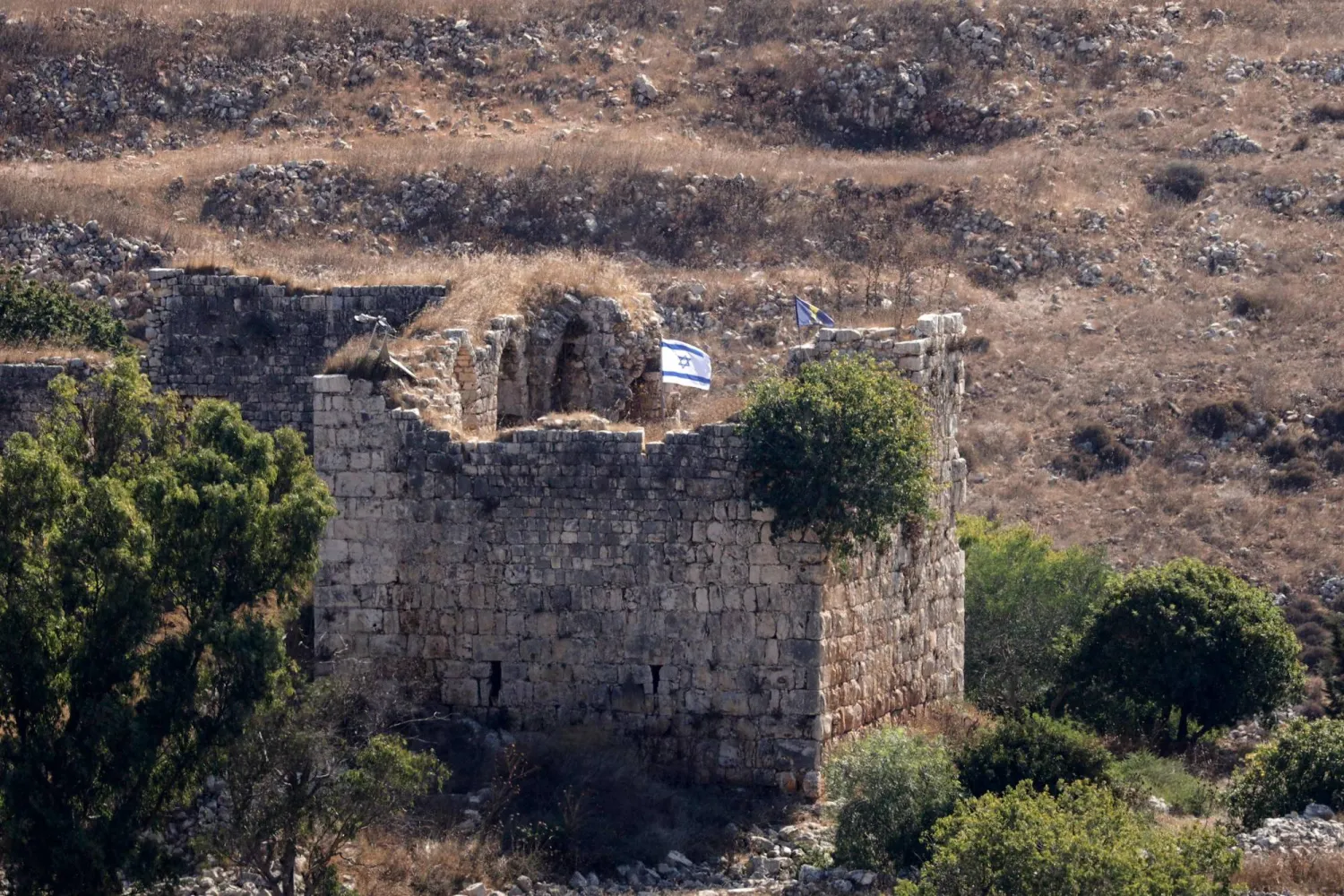
A photograph taken from the southern Lebanese village of Chaqra shows the Israeli flag as it flutters on top of the nearby Crusaders Cital of Doubieh on August 11, 2026. (AFP)
TT

Israel Defense Minister Vows Troops to Stay in Lebanon, Syria, Gaza

A photograph taken from the southern Lebanese village of Chaqra shows the Israeli flag as it flutters on top of the nearby Crusaders Cital of Doubieh on August 11, 2026. (AFP)

Israel's Defense Minister Israel Katz visited southern Lebanon on Wednesday, vowing to destroy infrastructure and keep troops in a so-called "security zone" as well as in Syria and Gaza.

The comments came almost two months after Israel and Lebanon agreed to a US-sponsored framework deal that involves the disarmament of the Iran-backed Hezbollah, a gradual withdrawal of Israeli forces from Lebanon's south and the deployment of the Lebanese army to the region, starting in test areas known as "pilot zones".

The United States plans new talks in early September in Rome between Israel and Lebanon.

Katz and Prime Minister Benjamin Netanyahu have repeatedly vowed not to withdraw from the occupied "security zone" in southern Lebanon -- a strip of territory where Israeli forces operate that reaches around 10 kilometers (six miles) into Lebanon.

"As the prime minister and I have clearly stated, we are not withdrawing from this security zone," Katz said during a visit to troops, according to a statement from his office.

The Israeli military "is here to protect the northern communities and its own forces. We will clear this area and guarantee the security of the residents of the north. We will in no way withdraw from the security zones: not in Lebanon, not in Syria, and not in Gaza," he added.

In southern Lebanon, Katz said the military was "destroying the underground infrastructure" in the area and "destroying all the houses".

Hezbollah drew Lebanon into the Middle East war in early March with rocket fire aimed at Israel to avenge the killing of Iran's supreme leader in US-Israeli strikes.

Israel responded with massive airstrikes and a ground invasion of southern Lebanon.

Israel has also carried out repeated incursions and bombings in Syria since the overthrow of longtime ruler Bashar al-Assad, saying it sought to establish a demilitarized zone in the country's south.

In Gaza, Israeli forces occupy more than 60 percent of the war-battered territory.

Last week, Netanyahu rejected a US-led plan for Gaza endorsed by Hamas, saying the Israeli military "will not carry out any withdrawal until Hamas is genuinely disarmed, and will continue to thwart threats against our forces and our citizens".



Yemeni Forces Strike Houthis on Several Fronts

Yemeni soldiers in al-Jawf. (Reuters)
TT

Yemeni Forces Strike Houthis on Several Fronts

Yemeni soldiers in al-Jawf. (Reuters)

Yemeni government forces intensified on Saturday their military operations against the Houthi group on several fronts, carrying out air raids and drone strikes and firing artillery at them in Marib, al-Jawf and Taiz after the militants expanded their control of the west coast, Mokha and areas overlooking the Bab al-Mandeb Strait.

Government strikes focused on Houthi positions in Mokha and the Dhubab district that directly overlooks Bab al-Mandeb. Field sources said the jets struck the Houthis around Mokha port and airport and Jabal al-Nar in an attempt to hamper their military and logistics movements.

Armed forces spokesman Staff Colonel Majid al-Nuzaili had urged civilians to avoid the Taiz-Mokha and Mokha-Dhubab roads until further notice as operations continued in the area.

Government attacks around Mokha port killed several Houthis and destroyed vehicles and weapons used by the group, said al-Nuzaili.

The attacks took place as the government forces were rearranging their deployment in southern Mokha after the battles shifted to east of Bab al-Mandeb near the border of the Lahj province.

In Marib, east of Sanaa, the forces launched air strikes and fired artillery against the Houthis on the southern, western and northern fronts.

Houthi militants ride on a pick-up truck while on patrol in Sanaa, Yemen, 12 September 2026. (EPA)

Field sources said the Houthis brought reinforcements, including dozens of military vehicles and fighters, from Sanaa to Marib, indicating that the fighting will continue and expand.

Government forces have maintained their defensive and offensive positions in Marib, which has for years been its military stronghold in the conflict against the Houthis.

The militants are seeking to use the latest escalation to open new fronts in the war and ease military pressure off the coast and al-Jawf.

In al-Jawf, the government used air raids and artillery fire to attack the Houthis east of al-Hazm city and kept up their siege against the militants inside the al-Labanat camp for the sixth straight day.

In Taiz, field sources detected Houthi mobilization in the Sameh district and the cities of al-Dimnat and Rahida.

On the border of the Lahj province, the Giants Brigades and Houthis were engaged in fighting around the al-Madaribah district.

Military sources said the brigades repelled the Houthi advance.


Iraq Closes Three Iran Crossings, Pursues Those Behind Attacks on Saudi Arabia

Travelers at the Shalamsheh border crossing between Iraq and Iran after Iraqi authorities ordered its closure as a precautionary measure following the latest drone attacks on Saudi Arabia on September 12, 2026 (Reuters)
TT

Iraq Closes Three Iran Crossings, Pursues Those Behind Attacks on Saudi Arabia

Travelers at the Shalamsheh border crossing between Iraq and Iran after Iraqi authorities ordered its closure as a precautionary measure following the latest drone attacks on Saudi Arabia on September 12, 2026 (Reuters)

Iraq closed three border crossings with Iran on Saturday, officials told AFP, after a drone attack on a Saudi Arabian pipeline that both Riyadh and Baghdad said was launched from Iraq.

An Iraqi security source and a government official told AFP that authorities ordered the closing of three border crossings with Iran.

The security source said the decision was "part of an intelligence effort to track down the perpetrators and prevent their escape... and to hinder the smuggling of drones through these crossings".

Both sources, who spoke on condition of anonymity because they were not allowed to speak to the media, could not specify when the crossings would reopen.

The closed crossings are Shalamsheh in Basra province, al-Shib in Missan and al-Mandali in the central province of Diyala.

Other border crossings with Iran are still open.

A security official said that "security forces found drone launchers near the Iraq-Iran border in the al-Tib" region, a remote part of Missan, close to the al-Shib crossing. A second security source gave the same account.

Military spokesperson Sabah al-Numan said the prime minister had approved "Iran's request to conduct a joint investigation into finding drone launch platforms near the Iraq-Iran border".

The government's security media cell said earlier that authorities "have started administrative and security reorganization operations at several border crossings".

It added that they had stepped up "intelligence activities" to determine "the breaches and violations that took place at these crossings".

It later announced that passengers stranded for hours at two crossings were permitted to pass.


Al-Halbousi Condemns Attacks on Saudi Arabia

Iraqi Speaker of parliament Mohammed al-Halbousi speaks with the news media as he departs the Department of State after meeting with Secretary of State Mike Pompeo, in Washington, on March 28, 2019. (AP)
TT

Al-Halbousi Condemns Attacks on Saudi Arabia

Iraqi Speaker of parliament Mohammed al-Halbousi speaks with the news media as he departs the Department of State after meeting with Secretary of State Mike Pompeo, in Washington, on March 28, 2019. (AP)

Speaker of the Iraqi Council of Representatives Haibat Al-Halbousi strongly condemned the attacks targeting the Kingdom of Saudi Arabia that originated from within Iraqi territory.

In a statement issued on Saturday, Al-Halbousi rejected the use of Iraq's territory or airspace to threaten Saudi Arabia's security or that of any neighboring state, describing such actions as unacceptable violations that contradict Iraq's national interests, stated foreign policy, and regional relations.

Al-Halbousi emphasized the critical need to restrict weapons exclusively to the state and its constitutional institutions under the authority of the commander-in-chief of the Armed Forces.

He stressed that enforcing state control over arms is vital to reinforcing national sovereignty, preserving domestic stability, and preventing Iraq from being drawn into wider regional conflicts.