

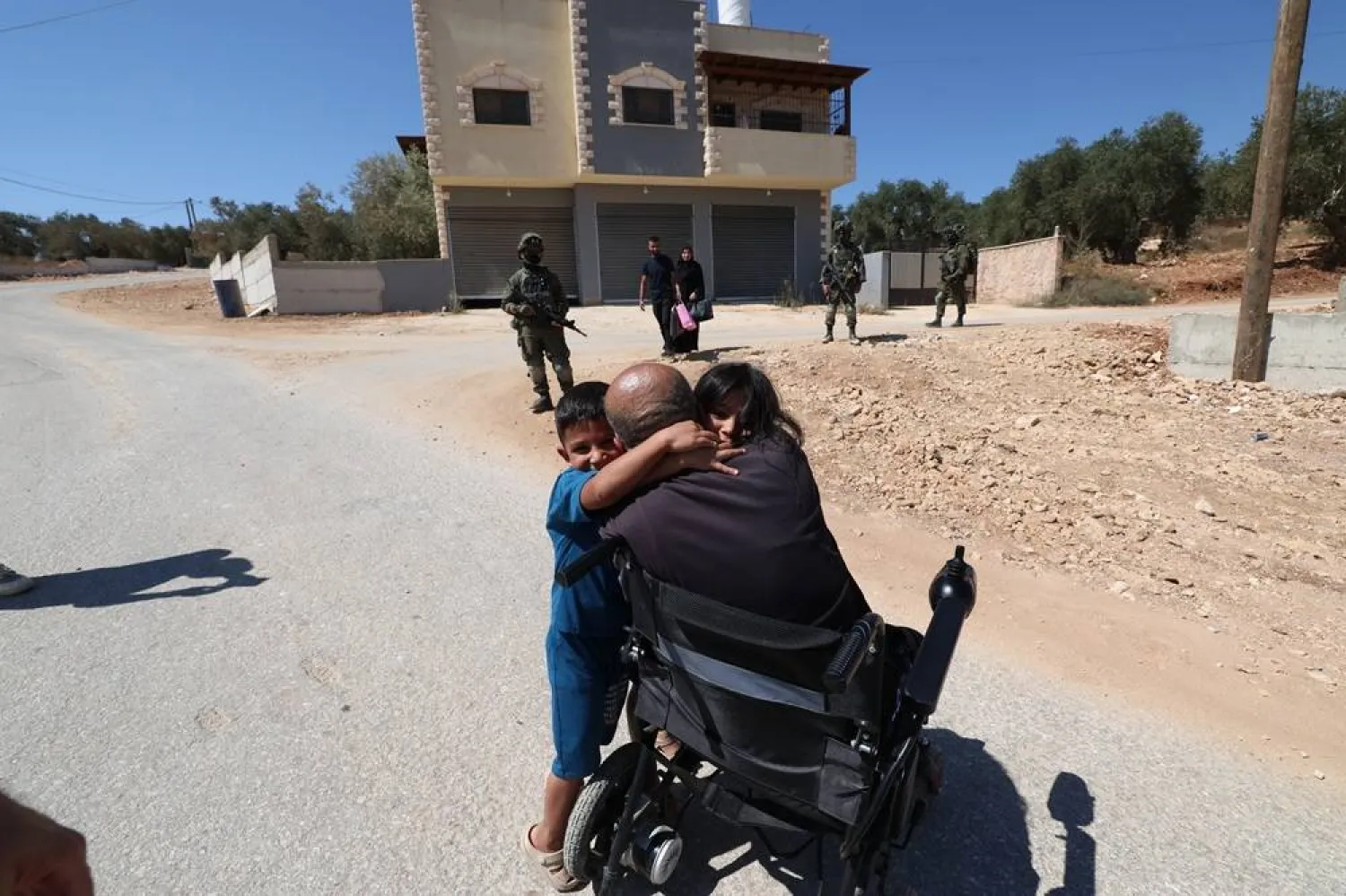

Israel Sends More Troops to West Bank Village Besieged by Jewish Settlers

Israeli soldiers observe Palestinians during a raid in the town of Qusra, south of Nablus, West Bank, 13 August 2026. (EPA)
TT

Israel Sends More Troops to West Bank Village Besieged by Jewish Settlers

Israeli soldiers observe Palestinians during a raid in the town of Qusra, south of Nablus, West Bank, 13 August 2026. (EPA)

Israel's military said on Thursday it had sent more troops to a West Bank village where settlers have trapped Palestinian families inside their homes, a siege the Palestinians say is aimed at forcibly displacing them from their land.

The siege began at the weekend when Jewish settlers closed off the road to the three homes in the Palestinian village of Qusra and set up a tent in their front yards, refusing to allow anyone to enter or leave. The settlers had earlier cut off their electricity and water.

Israel's military says it is trying to disperse ‌the settlers from the ‌area, even as a video from earlier in the ‌week ⁠showed several Israeli men ⁠in green military garb joining the settlers in a morning prayer in the tent. The military said it was taking disciplinary action against any personnel involved.

A day after troops deployed tear gas in a failed attempt to remove the settlers, the military said it had sent additional troops to Qusra "to carry out defensive missions and patrols in the area to maintain security and protect the area."

The United Nations said in a statement that some 15 Palestinians ⁠including two children were "being trapped inside their homes in a state ‌of terror, unable to attend to their basic needs ‌and without access to water or electricity."

BESIEGED FAMILIES APPEAL FOR HELP

The military has come ‌under increasing pressure to halt rogue land seizures by settlers emboldened by the right-wing government ‌of Prime Minister Benjamin Netanyahu, which has spearheaded a rapid expansion of settlements in the occupied West Bank.

The two families under siege in the area say they have no food or medicine, and that the settlers have been damaging their property, throwing stones at their homes and shouting insulting language ‌at them.

"We appeal to government institutions and to every free and honorable person to help us secure food and medicine," ⁠said Qusay Abu Reeda, ⁠a Palestinian-American who is trapped with his family inside one of the homes.

The US Ambassador to Israel, Mike Huckabee, said the Israeli military and police "have gone at our request to remove the Israeli terrorists doing this," adding: "The actions of those doing this to this family's home is criminal."

Palestinians say the Israeli military allows settlers to seize land and resources across the West Bank with impunity, including in areas where they hold Israel-issued ownership documents.

Incidents of settler land seizures are especially common in areas on the outskirts of villages, like Qusra, which sits in an area under complete Israeli security control.

The West Bank, territory Israel captured in the 1967 Middle East war, is home to some three million Palestinians and 500,000 settlers. There are some 146 settlements in the West Bank, as well as 390 smaller outposts, according to the Israeli settlement watchdog group Peace Now.



RSF Drones Attack Sudan Capital for Second Day

People clear debris from a mosque that residents said was damaged in a drone strike in Khartoum, Sudan, Wednesday, Aug. 12, 2026. (AP)
TT

RSF Drones Attack Sudan Capital for Second Day

People clear debris from a mosque that residents said was damaged in a drone strike in Khartoum, Sudan, Wednesday, Aug. 12, 2026. (AP)

Paramilitary drones on Thursday attacked the Sudanese capital Khartoum for the second day in a row, an AFP correspondent and witnesses reported.

Since April 2023, Sudan has been ravaged by war between the Sudanese military, led by its chief Abdel Fattah al-Burhan, and the paramilitary Rapid Support Forces (RSF), commanded by Burhan's former deputy Mohamed Hamdan Daglo.

The latest attack comes a day after the RSF launched far-reaching coordinated drone strikes targeting five army-controlled cities hundreds of kilometers apart.

On Thursday, an AFP correspondent in the capital reported the firing of anti-aircraft missiles from Omdurman, Khartoum's twin city, followed by the sound of an explosion.

"Military air defenses engaged with the militia's drones and downed them," an army source told AFP.

Witnesses in central Khartoum and Khartoum North across the Nile river also reported seeing drones in the sky and hearing explosions.

Across the country, aid workers estimate more than 200,000 people have been killed in what the UN calls a "war of atrocities". The conflict has also caused the world's largest hunger and displacement crises.

Burhan and Daglo, allies until they fell out in a bitter power struggle, have spent most of the war in a relative stalemate, unwilling to hold negotiations while vying for a decisive battlefield advantage.

The RSF last year consolidated its hold on the vast western region of Darfur and has since pushed to seize territory in the southern Kordofan region and along the southeastern Ethiopian border.

The army holds Sudan's center, north and east, and last month clinched a victory in Kordofan by pushing the RSF off a key highway leading to the capital.

Daglo in the aftermath said he would "unleash" his fighters -- already accused of war crimes including genocide -- and his forces have since repeatedly threatened a large-scale retaliatory attack.


US Ambassador to Israel Denounces Settler Siege on Palestinians as ‘Terror’

 Israeli soldiers stand guard next to settlers in front of Palestinian homes that they have blockaded in the village of Qusra, south of Nablus, in the occupied West Bank, Wednesday, Aug. 12, 2026. (AP)
Israeli soldiers stand guard next to settlers in front of Palestinian homes that they have blockaded in the village of Qusra, south of Nablus, in the occupied West Bank, Wednesday, Aug. 12, 2026. (AP)
TT

US Ambassador to Israel Denounces Settler Siege on Palestinians as ‘Terror’

 Israeli soldiers stand guard next to settlers in front of Palestinian homes that they have blockaded in the village of Qusra, south of Nablus, in the occupied West Bank, Wednesday, Aug. 12, 2026. (AP)
Israeli soldiers stand guard next to settlers in front of Palestinian homes that they have blockaded in the village of Qusra, south of Nablus, in the occupied West Bank, Wednesday, Aug. 12, 2026. (AP)

The US ambassador to Israel, a staunch supporter of West Bank settlements, on Thursday denounced as "terror" a siege by settlers against Palestinians that drew an unsuccessful intervention by the army.

Settlers near Nablus since Sunday have blockaded Palestinian homes, including one owned by a US citizen, with residents saying they have been cut off from food and other supplies.

"Actions by those who carried out this horrific act of terror meant to intimidate and harass this family are disgusting," Mike Huckabee, the US ambassador in Jerusalem, wrote on X in response to criticism of the US response.

"No excuse for such thuggish behavior," he wrote.

Huckabee said Israel had intervened at the request of the United States, its crucial ally.

The remarks are especially striking from Huckabee, an evangelical Christian pastor who in the past has embraced Jewish settlement in the West Bank, which Israel has occupied since 1967, and rejected the idea of a Palestinian state.

The Israeli military on Wednesday sent in forces who took away a tent, but witnesses said settlers defiantly remained at the site with blankets.

The army announced later Wednesday that it would send a new battalion to try to impose order.

Violence against Palestinians by Israeli settlers in the West Bank has increased dramatically since the October 7, 2023, attack on Israel by Hamas from the Gaza Strip.

More than 500,000 Israelis live in settlements in the West Bank, which are illegal under international law, among some three million Palestinians in the territory.


Crisis Looms in Southern Iraq over Water, Electricity Shortages

People protest in Dhi Qar over frequent power outages. (Social media)
TT

Crisis Looms in Southern Iraq over Water, Electricity Shortages

People protest in Dhi Qar over frequent power outages. (Social media)

The worsening electricity crisis in Iraq continues to burden most of the population, amid rising temperatures that have surpassed 50 degrees Celsius in some southern governorates.

There are fears that the crisis could lead to local conflicts between some governorates, given that some receive up to 20 hours of power, while others receive only about 10 at best.

In Dhi Qar, a number of residents threatened to cut off water from the Al-Bidaa canal and prevent it from reaching the Basra Governorate in the far south if they do not receive more hours of electricity. A video showed dozens of citizens holding signs that read: "Water for electricity."

The canal is a main channel for drinking water to Basra, flowing from the Tigris River through Dhi Qar. Cutting it off may lead to a humanitarian and service crisis for millions of Basra residents, who already suffer from water salinity and irregular supply to their homes.

An official source in Dhi Qar dismissed the citizens' ability to cut off the water supply. The source told Asharq Al-Awsat that the protests reflect anger over deteriorating electricity services in the governorate, but it will not reach the stage of cutting off water or bartering it for electricity.

The source said the problem relates to the Al-Fuhoud and Al-Chibayish areas bordering Basra.

Al-Chibayish receives enough electricity from Basra, unlike the Al-Fuhoud, which receives around two hours for every four-hour cut from Dhi Qar, making the residents’ anger justified, added the source.

The official source said the crisis is not limited to Dhi Qar, but affects most of Iraq, especially the south.

Citizens in six governorates, including Baghdad, demonstrated a few days ago to protest the shortage of electricity.

In Wasit, which borders Dhi Qar, hundreds took to the streets over the past two days in protest against the power cuts.

The demonstrations led to clashes with police and anti-riot forces, who were forced to use water cannons and tear gas to disperse the protesters, prompting criticism from MPs who demanded a probe into the unrest.

Energy officials and experts warned that the crisis will likely continue for years due to the stark disparity between demand and production capacity. The country's needs are estimated at around 60,000 megawatts, while current production does not exceed 25,000 megawatts.