

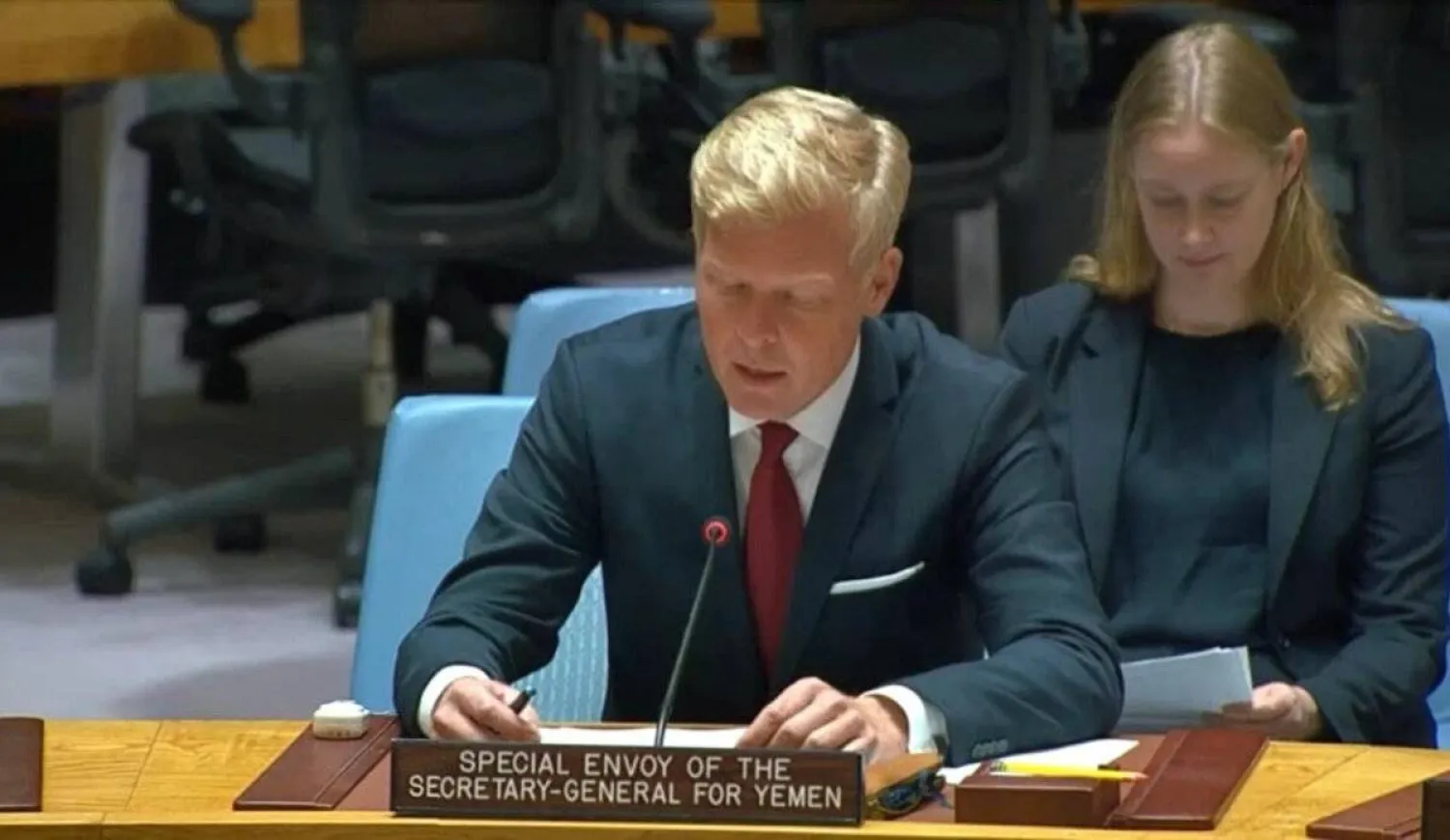

Grundberg Condemns Houthi Escalation, Fears War in Yemen Could Return at Any Point

UN Envoy to Yemen Hans Grundberg (United Nations)
TT

Grundberg Condemns Houthi Escalation, Fears War in Yemen Could Return at Any Point

UN Envoy to Yemen Hans Grundberg (United Nations)

With ongoing Houthi drone and missile attacks on government-controlled Yemeni areas, United Nations Special Envoy Hans Grundberg has warned that Yemen today faces a more serious risk of return to large-scale conflict than at any point since the 2022 UN-mediated truce.

In a briefing to the UN Security Council on Thursday, Grundberg said there has been an intensification of military activity along frontlines, with recent Houthi attacks in Marib, Hadramout, Mocha and beyond, causing casualties among both military personnel and civilians.

He added that with regional trade and energy flows already under intense pressure from the crisis in the Strait of Hormuz, Houthis’ renewed attacks on commercial vessels in the Red Sea and the Gulf of Aden, risk deepening Yemen’s entanglement with the wider regional confrontation.

“These attacks also put seafarers’ lives at risk; two days ago, a missile attack on a vessel killed several crew members,” he noted.

The envoy explained that tension had already been mounting prior to these developments.
In July, he said, an unauthorized flight from Tehran toward Sanaa was followed by airstrikes on Sanaa airport, and missile attacks on Abha airport and oil facilities in Saudi Arabia.

He made clear that Yemen stands to lose on the years of relative calm.

“For four years, and well beyond its formal expiry, the truce kept Yemen’s front lines relatively quiet. Remarkably, even through the regional turmoil since 2023, this calm mostly held inside Yemen, giving civilians the most sustained respite since the start of the conflict,” he said.
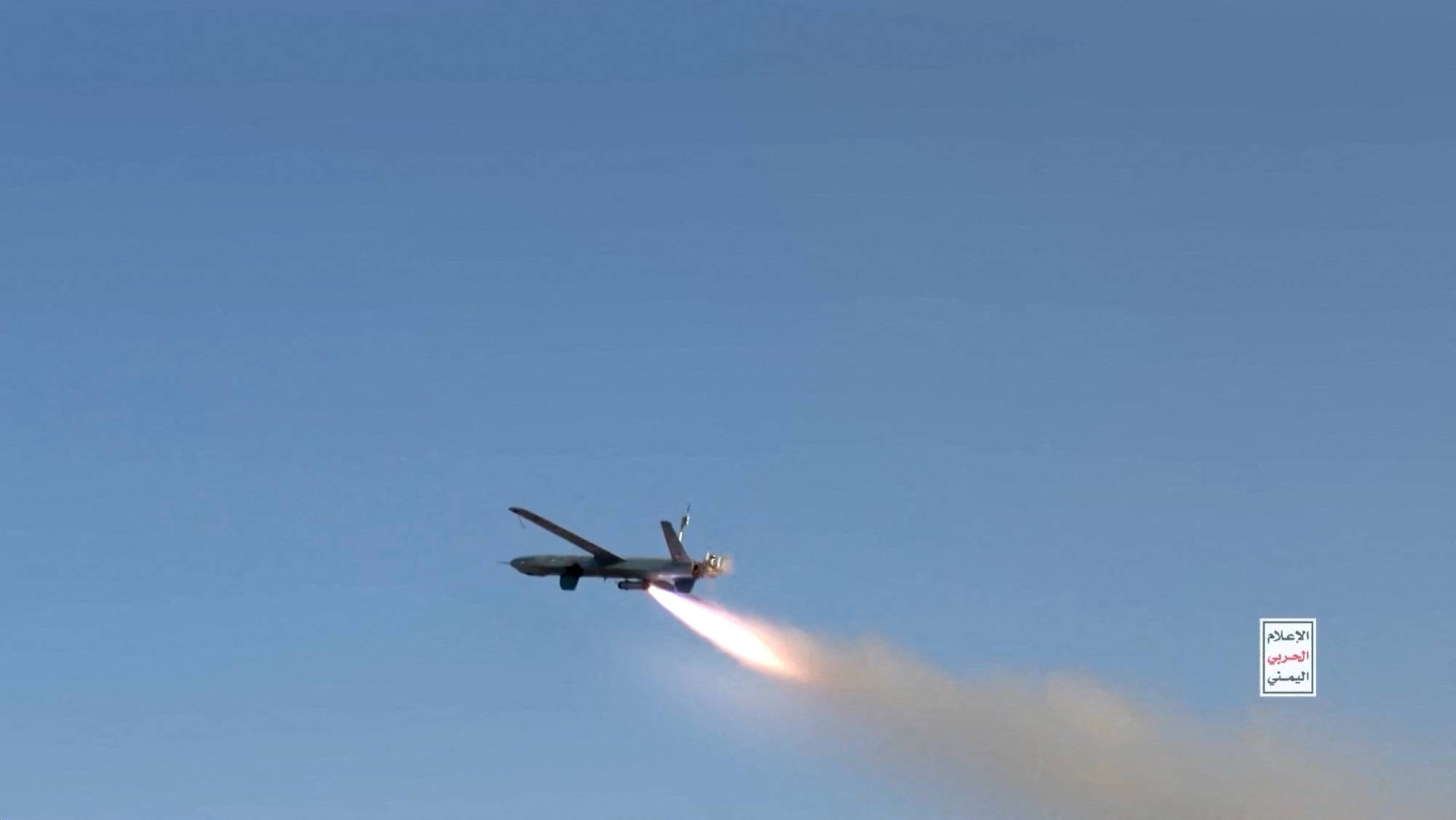
A drone is launched in what Yemen's Iran-aligned Houthis say is an attack on the Red Sea port city of Mocha, Yemen, at an unknown location in this still image taken from video released August 9, 2026. REUTERS

Grundberg warned that the calm cannot hold indefinitely amid the absent progress on the political process, particularly as Yemen’s state institutions are fragmented by over a decade of conflict, its economy left with little margin to absorb another shock, and the wider region engulfed by war.

Three Ways

The UN envoy proposed three ways to reverse the escalation and forge a credible path to a political solution in Yemen, mainly through de-escalation and working towards a robust ceasefire.

He said the calm along Yemen’s frontlines must be restored, adding that attacks and threats against shipping must stop, and freedom of navigation in the Red Sea and the Gulf of Aden must be upheld while cross-border attacks must stop.

The UN official said a mechanism for managing incidents and de-escalation already exists. “Military representatives from the Yemeni government and Houthis, together with the Saudi-led Joint Forces Command, have previously met under the UN auspices through the Military Coordination Committee.”

Therefore, he urged them to make full use of this channel and repeated his call on the parties to respect their obligations to protect civilians and civilian infrastructure and to protect Yemen from being drawn further into the vortex of the already complex regional dynamics.
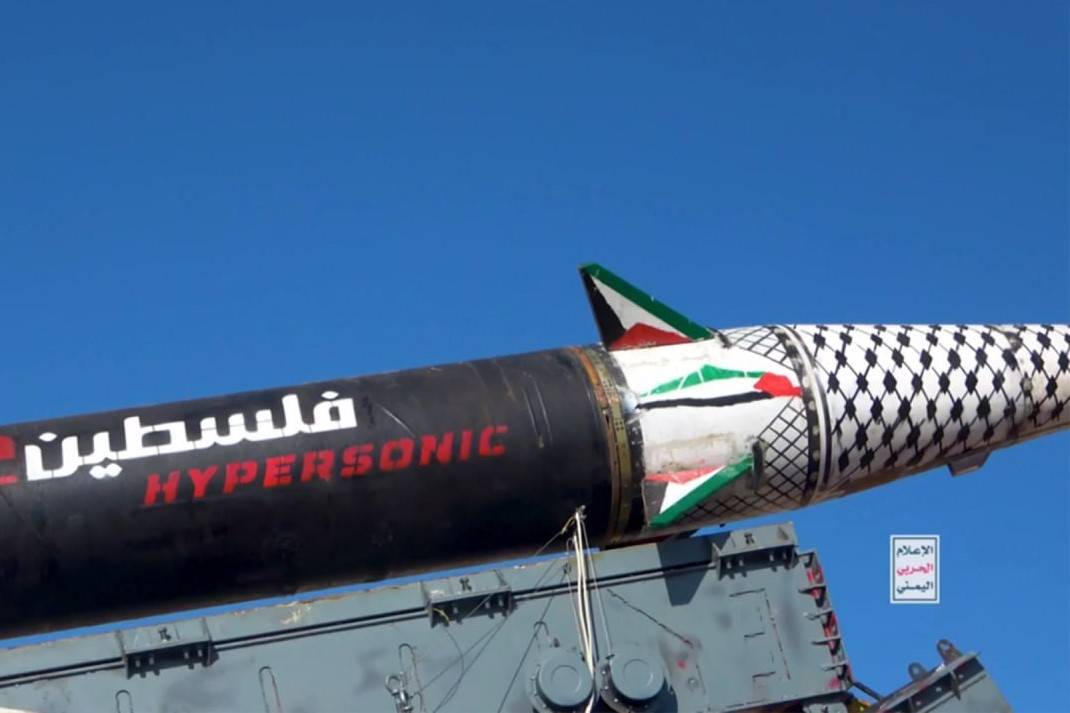
Some of the ballistic missiles used by the Houthis in their attacks (Houthi media)

According to Grundberg, the second way to reach a political solution in Yemen is economic de-escalation.

He said Yemen’s economy has itself become a frontline, with salaries, currency, trade, revenues, transport and essential services increasingly politicized.

Addressing these issues, he said, will require the parties to negotiate arrangements in which they have more to gain from cooperation than confrontation, adding that resuming oil exports, with appropriate security guarantees for production and export infrastructure, would provide a critical source of income and it would also support the country’s recovery.

Also, commercial vessels must continue to reach Yemeni ports, delivering the food and other essential goods Yemenis depend on, he said.

“The parties will also need to negotiate durable arrangements on the economic issues that touch Yemenis' daily lives more directly, including the payment of civil servant salaries, and the restoration of essential services,” the envoy added.

As for the third requirement, Grundberg said “is sustained engagement with the UN to consolidate these gains and relaunch an inclusive, Yemeni-owned political process.”

He said: “This remains the only credible path to comprehensively ending the conflict, ensuring that differences are resolved through dialogue rather than force, and establishing legitimate and accountable institutions that reflect Yemen’s political and social diversity.”

Therefore, the Yemeni parties must choose dialogue, he said. “No party controls where escalation leads; the only certainty is that the Yemeni people will pay the price,” the envoy noted.

File of Conflict-Related Detainees

Grundberg recalled that in May, the Yemeni parties agreed under UN auspices to release more than 1,600 conflict-related detainees.

Preparations to implement the releases are progressing, albeit slowly, he said, expressing his concerned that the wider escalation could stall this process further.

“I urge the parties to cooperate with the International Committee of the Red Cross to complete the remaining technical and operational preparations as swiftly as possible,” he said.

Grundberg then requested the release of 73 UN personnel, alongside colleagues from non-governmental organizations, civil society and diplomatic missions, arbitrarily detained by Houthis.

“Despite sustained United Nations efforts to find a solution, we have yet to see progress towards their releases. And I urge this Council to maintain its attention and use every available avenue of influence to help secure their immediate and unconditional release,” he said.



Israel Considers Expelling British Officials from Post-war Gaza Headquarters, FT Reports

Palestinians look at a food-aid warehouse damaged in an Israeli airstrike that targeted a nearby house in Deir al-Balah, central Gaza Strip, Wednesday, Aug. 26, 2026. (AP Photo/Abdel Kareem Hana)
TT

Israel Considers Expelling British Officials from Post-war Gaza Headquarters, FT Reports

Palestinians look at a food-aid warehouse damaged in an Israeli airstrike that targeted a nearby house in Deir al-Balah, central Gaza Strip, Wednesday, Aug. 26, 2026. (AP Photo/Abdel Kareem Hana)

Israel is considering expelling British, and possibly other European officials, from the US-led coordination center for ‌post-war Gaza, ‌the Financial ‌Times reported ⁠on Thursday.

The Israeli ⁠government in recent weeks has discussed removing the UK ⁠from the ‌International ‌Gaza Support ‌Center, the multinational ‌headquarters established to monitor the US-brokered ceasefire between ‌Israel and Hamas, the newspaper said, ⁠citing ⁠people familiar with the matter.

Reuters could not immediately verify the FT report.


Arab League: Violations in Palestine Worsen Humanitarian Crisis, Undermine International Law

The League of Arab States logo
TT

Arab League: Violations in Palestine Worsen Humanitarian Crisis, Undermine International Law

The League of Arab States logo

The General Secretariat of the League of Arab States expressed deep concern over continued Israeli violations in the occupied Palestinian territories. It described them as part of a persistent pattern targeting civilians, journalists, and humanitarian institutions and undermining protections afforded under international law, the Saudi Press Agency said on Wednesday.

In a statement marking the first anniversary of the Israeli bombing of Nasser Hospital in Khan Younis, which resulted in the killing of five Palestinian journalists, the general secretariat condemned Israeli measures targeting facilities belonging to the United Nations Relief and Works Agency for Palestine Refugees in the Near East (UNRWA) in Kafr Aqab, north of occupied Jerusalem, with the aim of evacuating and demolishing the facilities.

The general secretariat stressed the need to protect journalists and humanitarian workers and ensure accountability for violations against them.

It also warned that undermining humanitarian operations and restricting aid deliveries to the Gaza Strip are worsening living conditions, particularly for children. It called for the sufficient and sustained flow of humanitarian aid, the opening of crossings, and the expansion of humanitarian space.

The general secretariat stressed that the continuation of such violations without accountability further exacerbates human suffering and undermines confidence in the credibility of the international system.


What Outcomes Will Hezbollah MP’s Visit to Tehran Have on Lebanon?

Lebanese lawmaker Hassan Fadlallah, a member of Hezbollah’s parliamentary bloc. (AFP)
TT

What Outcomes Will Hezbollah MP’s Visit to Tehran Have on Lebanon?

Lebanese lawmaker Hassan Fadlallah, a member of Hezbollah’s parliamentary bloc. (AFP)

The importance of Lebanese lawmaker Hassan Fadlallah’s latest visit to Tehran lies not in the trip itself. Hezbollah’s alliance with Iran is public and well established. What stands out is its timing and the way it was announced.

Iran’s Foreign Ministry disclosed the visit as the Lebanese state seeks to chart a political course free from regional rivalries and assert that decisions concerning Lebanon must run through state institutions.

Iran’s Foreign Ministry said two days ago that Foreign Minister Abbas Araghchi received Fadlallah, a member of Hezbollah’s parliamentary bloc, in Tehran. Hezbollah’s representative in Iran, Abdallah Safieddine, attended the meeting.

The ministry said the talks covered the latest developments in Lebanon and Israeli attacks. Araghchi reaffirmed Iran’s support for Lebanon and its “defense of its territorial integrity, dignity and national sovereignty.”

Fadlallah praised Iran’s position and what he called its strong diplomacy, urging a unified Islamic stand against Israel.

Outcomes of the visit

Ministerial sources said Hezbollah’s relationship with Iran “requires no interpretation. It is an alliance both sides openly take pride in.”

“At a time when Lebanese officials are working to separate the two tracks, this visit again raises questions about whether the party respects the role of the state and the positions of its officials,” they said.

The sources told Asharq Al-Awsat: “This is certainly not the first time a Hezbollah official has visited Tehran, nor will it be the last. But it may be the first time such a visit has been announced in this way — through an official statement from the Iranian Foreign Ministry.”

“That gives the meeting an official character that goes beyond receiving a Lebanese lawmaker. It appears almost as a meeting between officials of two states.”

Still, the sources said the key question was what the visit would produce: whether it would ease the process now underway or make it even more difficult, particularly because Fadlallah is responsible for negotiations with the Lebanese presidency.

“Will Hezbollah cooperate with the state in the process it is managing, particularly over negotiations with Israel? Or will it continue rejecting decisions made by state institutions and escalate further?” they asked.

The question is even more pressing as Iranian-American negotiations falter and threaten repercussions in Lebanon, they warned.

Communications cut

The sources said communications between President Joseph Aoun and Hezbollah had been cut, with no recent contact. The only remaining channel is with Parliament Speaker Nabih Berri, Hezbollah’s key ally.

The visit came days after the United States imposed new sanctions on Hezbollah, targeting 10 individuals and a network Washington accused of moving funds between Iran’s Revolutionary Guards’ Quds Force and the Lebanese group.

Hezbollah responded by declaring its pride in its relationship with Iran and reaffirming its commitment to the “path of resistance.”

El Hage: They challenge the state every day

Lebanese Forces parliamentary bloc member Razi El Hage said there was “nothing unusual” about Fadlallah’s visit to Tehran.

Hezbollah has never let a day pass without treating Iran as the foundation of the equation. The group opposed the state and sought to place Lebanon within the framework of Iranian-American negotiations, he told Asharq Al-Awsat.

“This is not a new challenge to the state. They challenge it every day through their positions and their insistence on keeping Lebanese decision-making tied to foreign powers,” El Hage said.

“They must understand that the clock will not be turned back. The state has embarked on a course from which there can be no retreat.”

“They are making the decision to slaughter Lebanon,” El Hage added.

“Our position will remain firm. We will not retreat from our demand that the state alone hold decision-making authority and continue along the path it has begun.”

El Hage also called on the government to enforce its decisions more firmly, saying the state must prove it can assert its authority and protect Lebanon from attempts to keep it an arena for other countries’ conflicts.

Lebanese decisions first

Fadlallah’s visit came as President Joseph Aoun and Prime Minister Nawaf Salam have taken clear positions on keeping Lebanon out of other countries’ conflicts.

Aoun previously said Iran was “using Lebanon as a bargaining chip” in its negotiations with the United States.

He said he was working to implement a policy of distancing Lebanon from regional conflicts and insisted that decisions affecting the country’s sovereignty and security must rest exclusively with the Lebanese state.

Salam previously said: “Once again, the South and its people are paying the price for a decision they did not take. If I may address Iran directly: have mercy on our south and stop treating it as a bargaining chip in your negotiations.”

“Lebanon is not a mailbox for others’ messages, nor a battlefield for their wars,” he stated.