

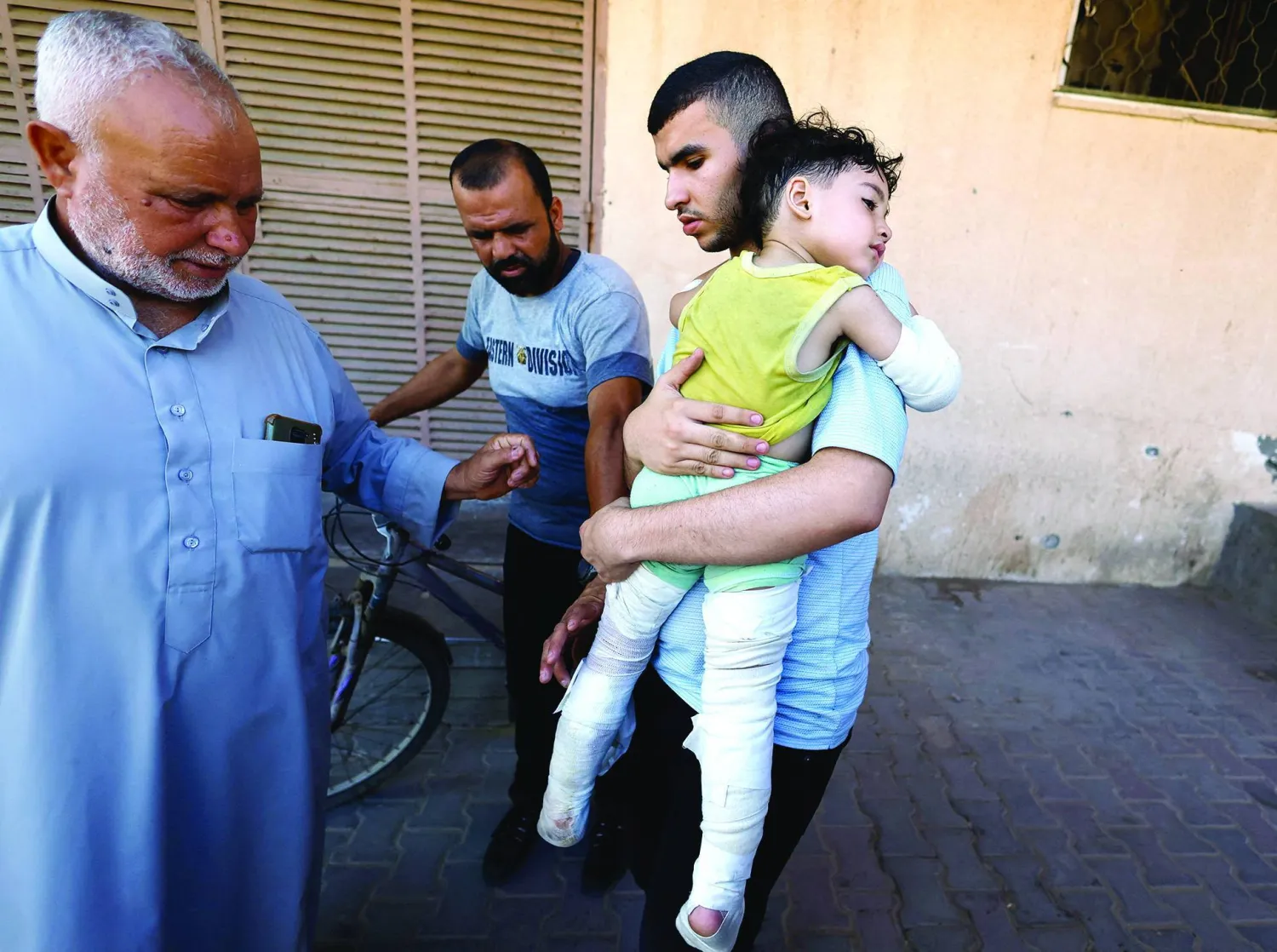

Gaza Health Sector Faces Mounting Crises, Risk of Total Collapse

A Palestinian carries a child wounded in an Israeli strike that killed the child’s parents at Al-Aqsa Martyrs Hospital in Deir al-Balah, central Gaza Strip, July 15, 2026 (Reuters) 
TT

Gaza Health Sector Faces Mounting Crises, Risk of Total Collapse

A Palestinian carries a child wounded in an Israeli strike that killed the child’s parents at Al-Aqsa Martyrs Hospital in Deir al-Balah, central Gaza Strip, July 15, 2026 (Reuters) 

Gaza’s health sector is facing a deepening series of crises amid the devastation caused by the Israeli war that followed Hamas’ Oct. 7, 2023 attack.

Israel has not only damaged hospitals through raids and strikes but continues to control the entry of medicines and medical supplies, as well as the departure of patients seeking treatment abroad, further complicating an already dire health situation.

Gaza’s Health Ministry warned Saturday that the operating capacity of the remaining oxygen stations had been fully exhausted and that they were working beyond their limits amid repeated breakdowns.

Only 12 of 34 oxygen stations remain operational, under highly difficult technical and mechanical conditions that make it increasingly hard to meet the needs of health facilities and other service providers. The ministry said just four of 30 oxygen-cylinder filling units remain functional and could stop at any moment because engineering teams lack the means to carry out emergency maintenance.

It warned that the remaining stations risk complete shutdown, threatening oxygen supplies to hospitals and patients receiving care at home. The ministry called for the immediate entry of spare parts and technical equipment, as well as the urgent supply of new oxygen stations.

The crisis is also placing severe pressure on kidney patients. The Hind al-Daghma Dialysis Center at Nasser Medical Complex is treating more than 200 patients from across Gaza amid acute shortages of medical supplies, medicines and equipment.

Riyad Barbakh, head of the dialysis department, said demand was rising as equipment and treatment supplies dwindled, creating harsh conditions that had contributed to patient deaths.

Dialysis sessions are the only barrier between life and death for these patients, Barbakh said, warning that any disruption to supplies or equipment could pose an immediate threat to hundreds of lives.

Cancer patients face similarly grave conditions

Mohammed Abu Nada, medical director of the Gaza Cancer Center, warned of an unprecedented deterioration in the condition of cancer patients, saying severe shortages of essential treatments and restrictions on travel threaten about 11,000 people.

Abu Nada said three cancer patients were dying each day from complications, while about 4,000 patients holding official medical referrals for treatment or diagnosis abroad remained unable to leave because of tight restrictions and continued crossing closures.

He pointed that Gaza lacks radiotherapy entirely and faces severe shortages of chemotherapy, with cancer drugs accounting for 61% of medicines in short supply. The destruction of specialized treatment centers has forced medical teams to make difficult clinical decisions, including performing full mastectomies in some early-stage breast cancer cases because radiotherapy is unavailable and travel abroad remains difficult.

Abu Nada called on international health organizations to urgently provide sufficient and sustainable supplies of chemotherapy and specialized medicines and facilitate the evacuation of patients requiring treatment abroad.

The crisis comes as Israel has failed to implement humanitarian provisions of a recent agreement reached in Cairo, including commitments to repair hospitals and allow medicines and medical equipment into Gaza.

Field tensions have also continued despite a partial reduction in Israeli strikes deep inside the enclave.

Three Palestinians were wounded shortly before noon Saturday, one seriously, in an Israeli drone strike targeting a motorcycle in Deir al-Balah in central Gaza. They were taken to Al-Aqsa Martyrs Hospital.

Israeli artillery also shelled several areas, particularly near the Yellow Line, while major demolitions were reported east of Khan Younis. Israeli vehicles and drones opened fire in several locations, while naval vessels targeted fishing boats operating within one nautical mile of the coast off Gaza City, central Gaza and Khan Younis.


Israeli Strike Kills Two People in Gaza, Medics Say

Internally displaced Palestinians walk among the ruins of destroyed residential buildings in the Al-Sheikh Radwan neighborhood, east of Gaza City, Gaza Strip, 10 September 2026. (EPA)
TT

Israeli Strike Kills Two People in Gaza, Medics Say

Internally displaced Palestinians walk among the ruins of destroyed residential buildings in the Al-Sheikh Radwan neighborhood, east of Gaza City, Gaza Strip, 10 September 2026. (EPA)

An ‌Israeli airstrike on Sunday killed at least two Palestinians in a vehicle and wounded 13 others in the Gaza Strip, medical staff said.

The strike in the Tel Al-Hawa neighborhood in western Gaza City, left the vehicle mangled, according to footage circulated on social media. Local medical staff told ‌Reuters that ‌they urged people to provide ‌information ⁠that could help identify ⁠the two people who were killed and whose bodies were dismembered by the explosion.

The Israeli military said the strike targeted two Hamas fighters, without giving further information.

An October 2025, ⁠US-backed, ceasefire halted large-scale fighting in ‌Gaza, but ‌it has not ended Israeli strikes and ‌there has been little progress on ‌steps towards permanent peace.

Hamas accuses Israel of violating the ceasefire and undermining efforts to implement US President Donald Trump's broader plan ‌to end the Gaza conflict, which includes the Israeli withdrawal ⁠from ⁠the strip and the disarmament of Hamas.

Israel says Hamas has been violating the deal.

More than 1,300 Palestinians, mostly civilians, have been killed in Gaza since the ceasefire took effect, according to the territory's health officials, while the Israeli military says four Israeli soldiers have been killed.

Hamas does not usually disclose information about fatalities among its fighters.


Syria Rejects Sovereignty Violations, Netanyahu’s Entry into Its Territory

An Israeli observation post overlooking the village of Beit Jinn in southern Syria (AFP) 
TT

Syria Rejects Sovereignty Violations, Netanyahu’s Entry into Its Territory

An Israeli observation post overlooking the village of Beit Jinn in southern Syria (AFP) 

Syria on Saturday renewed its rejection of violations of its sovereignty and Israeli Prime Minister Benjamin Netanyahu’s entry into its territory, as Israeli forces continued a weeklong escalation of artillery fire and incursions around Beit Jinn, on the slopes of Mount Hermon in western rural Damascus.

Residents fear an Israeli incursion into the town could lead to a repeat of events in late 2025, when dozens were killed or wounded in clashes between residents and an Israeli patrol that entered Beit Jinn.

Syrian Foreign Minister Asaad al-Shaibani said Syria had clearly reaffirmed before the UN Security Council, with the support of more than 40 countries, its rejection of violations of its sovereignty and Netanyahu’s entry into Syrian territory.

In a post on X, al-Shaibani stressed that Damascus remained committed to the country’s unity, independent decision-making and territorial integrity. He welcomed the international response supporting Syria in the face of continuing Israeli violations and said Damascus would continue to defend its national rights through legitimate political and diplomatic means under international law and the UN Charter.

Representatives of several UN member states, joined by Syria’s Permanent Representative to the UN Ibrahim Olabi, gathered outside the Security Council in New York on Friday to denounce Netanyahu’s entry into Syrian territory and reaffirm Syria’s sovereignty, unity and territorial integrity.

Netanyahu, accompanied by Israeli Defense Minister Israel Katz, entered the Syrian side of Mount Hermon on Sept. 9, where Israeli forces are deployed.

Damascus strongly condemned what it called Netanyahu’s “illegal entry” into Syrian territory and his tour of Mount Hermon, describing it as a flagrant violation of Syria’s sovereignty, territorial integrity and international law.

Syria held Israel fully responsible for the consequences of the violations and called on the UN, international organizations and influential countries to act to halt the attacks and ensure a return to the Disengagement Agreement.

Meanwhile, local sources in Beit Jinn told Asharq Al-Awsat that more than 10 Israeli military vehicles and two tanks had entered farmland belonging to the village of Mazraat Beit Jinn, east of the town.

The incursion came hours after Israeli artillery fire struck the Ain al-Shaara area north of Beit Jinn, with the shell landing on agricultural land.

Israeli forces had repeatedly shelled areas around Mazraat Beit Jinn and Bat al-Warda hill since Sept. 3, without reported casualties or material damage. An Israeli drone had also struck a civilian vehicle on the road to the town, wounding several civilians.

Local sources voiced fears of a repeat of Nov. 28, 2025, when an Israeli military patrol entered Beit Jinn, triggering fierce clashes with residents that killed 13 people from the town and wounded 24 others.

The escalation in western rural Damascus comes as Israeli forces continue incursions and attacks on towns and villages in rural Daraa and Quneitra near the ceasefire line. The operations have continued since the first day following the fall of former President Bashar al-Assad’s government on Dec. 8, 2024.


Fatah Demands Apology for Oct. 7 ‘Catastrophe’ as Hamas Hits Back

A meeting of Fatah’s Revolutionary Council in Ramallah (WAFA) 
TT

Fatah Demands Apology for Oct. 7 ‘Catastrophe’ as Hamas Hits Back

A meeting of Fatah’s Revolutionary Council in Ramallah (WAFA) 

A heated Palestinian debate erupted after Fatah Central Committee member Majed Faraj called on Hamas to apologize to the Palestinian people for what he described as the “catastrophe” that followed Oct. 7, 2023.

Speaking to Fatah activists at a public gathering ahead of legislative elections, Faraj said Hamas should apologize before returning to political life as a Palestinian faction like any other.

“This is a personal opinion and not an official position,” he added.

Fatah supporters and several of its leaders applauded, including Zakaria Zubeidi, who was recently released from an Israeli prison under a Hamas-Israel prisoner exchange deal. His reaction drew criticism from Hamas activists and freed prisoners.

Bassem Naim, a member of Hamas’ political bureau, hit back at Faraj, Fatah and the Palestinian Authority, arguing that the Oct. 7 attack had strategic consequences not only for Palestine but for the region and the world.

In a Telegram post, Naim said that if Hamas were required to apologize, Faraj should also demand apologies from Fatah and the late Yasser Arafat for what, by Faraj’s own standard, were “catastrophes” inflicted on Palestinians over decades. He cited the Al-Aqsa Intifada, which was followed by Israel’s Operation Defensive Shield and the reoccupation of the West Bank, as well as earlier events in Jordan, Lebanon and the first Gulf War.

Naim said Palestinians had the right to assess every stage of their national struggle and demand accountability, but argued that such scrutiny should not be selective or serve foreign agendas. He described the Oslo process as a “major mistake” that had proved a catastrophic failure.

He added that Hamas had repeatedly called for comprehensive national dialogue to review all paths, including the “Al-Aqsa Flood,” but accused Fatah of rejecting such efforts, most recently at meetings in Ankara and El Alamein.

Fatah Revolutionary Council member Monzer al-Hayek defended his movement, saying the only thing Fatah could apologize for was failing so far to achieve an independent Palestinian state.

He noted that Fatah had built a national authority, given Palestinians an entity, identity and passport, and advanced the statehood project until Palestine achieved UN non-member observer state status.

Al-Hayek accused Hamas of obstructing the national liberation process, weakening the political track and helping create conditions that brought Israel’s far right to power.

The dispute comes amid mutual accusations that each movement is seeking to obstruct or postpone the elections. Hamas has sought to form a broad electoral coalition of several factions, while Fatah has worked to block the effort and persuaded PLO factions, including the Popular Front for the Liberation of Palestine, not to join.

Fatah’s Revolutionary Council said the movement would contest legislative elections scheduled for Nov. 28 on an official national list in consultation with PLO factions. It called for comprehensive national dialogue, Palestinian unity within the PLO framework and a fully sovereign Palestinian state on the June 4, 1967 borders.

President Mahmoud Abbas reaffirmed his commitment to holding legislative elections on Nov. 28, 2026, and urged the international community to pressure Israel not to obstruct voting in Jerusalem and the Gaza Strip.
