

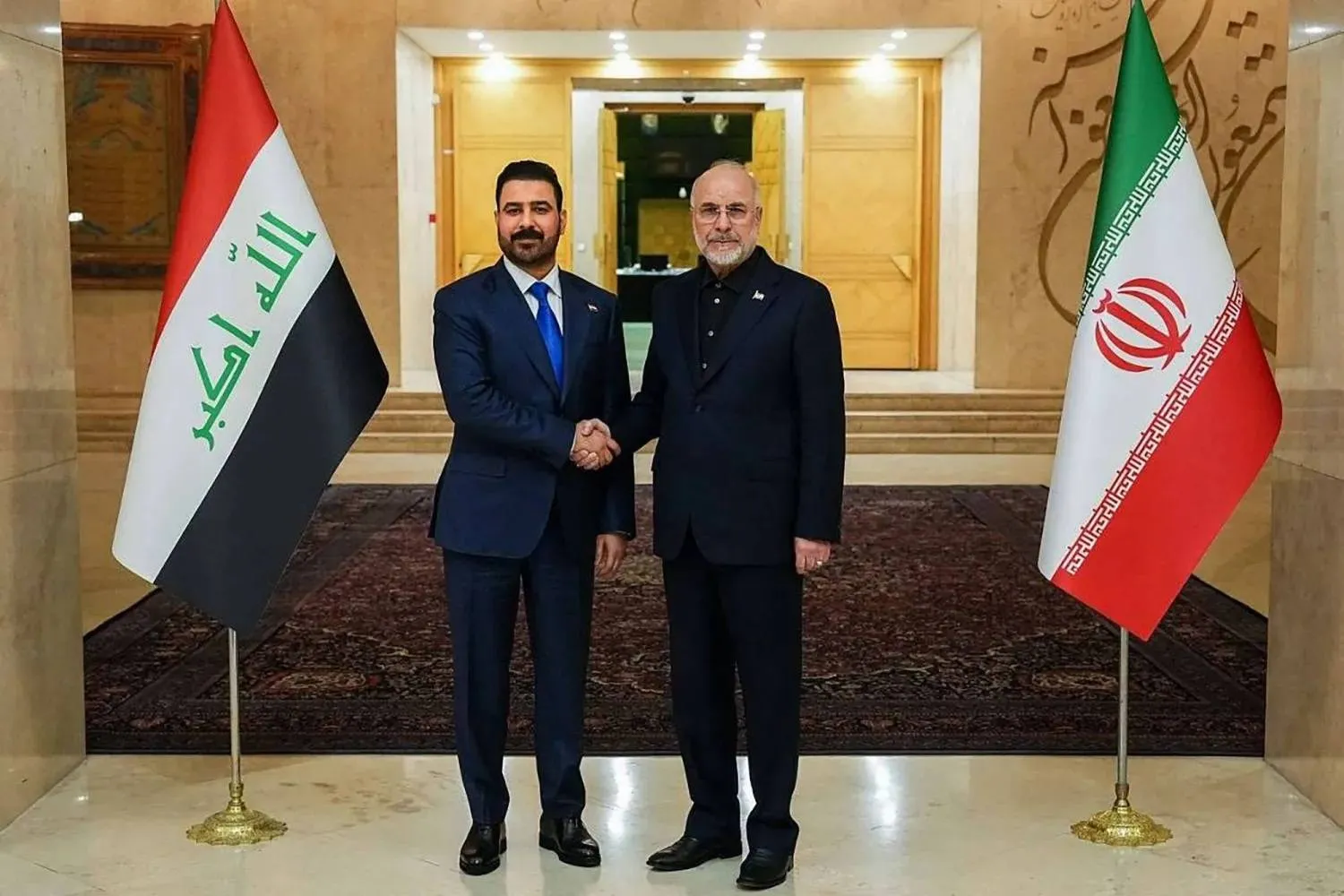

Iran Parliament Speaker to Visit Iraq on Wednesday

Iranian parliament Speaker Mohammad Bagher Ghalibaf (R) and Iraqi Prime Minister Ali al-Zaidi meet in Tehran in July. (AFP)
TT

Iran Parliament Speaker to Visit Iraq on Wednesday

Iranian parliament Speaker Mohammad Bagher Ghalibaf (R) and Iraqi Prime Minister Ali al-Zaidi meet in Tehran in July. (AFP)

Iranian parliament Speaker Mohammad Bagher Ghalibaf will travel to Iraq on Wednesday at the head of a high-level parliamentary delegation to hold talks on regional developments.

Iran’s IRNA news agency reported on Tuesday that Ghalibaf will depart on Wednesday morning for Iraq to discuss regional developments, ways to boost strategic cooperation between Tehran and Baghdad, and joint mechanisms to help consolidate stability and security in West Asia.

Ghalibaf's visit comes amid discussions within Iraq's ruling coalition about the fate of the weapons of pro-Iran armed factions following the planned withdrawal of US forces on September 30. Tensions are mounting in Iraq after the arrest of a leader in the pro-Iran Al-Nujaba Movement.

Ghalibaf is scheduled to meet with several senior Iraqi officials to discuss developing bilateral relations, border security, countering terrorism, expanding economic cooperation, and implementing joint agreements between the two countries, said IRNA.

Iraq is under pressure from Washington to disarm powerful Iran-backed armed factions that have gained significant political and financial influence in the country.

Ghalibaf's visit comes two days after the office of the Prime Minister of the Iraqi Kurdistan Region, Masrour Barzani, and the residence of the local intelligence director in Erbil were targeted by two drones that Erbil said were launched from Iran.

Barzani slammed the "reckless and unacceptable" attacks that are a "dangerous escalation and a direct threat to the region's security and stability."

Iraqi Prime Minister Ali al-Zaidi ordered a probe into the attacks on Monday.

In a statement, the Iraqi Ministry of Foreign Affairs said that Iranian Foreign Minister Abbas Araghchi informed his Iraqi counterpart, Fuad Hussein, that "he does not possess information indicating the attacks originated from Iranian territory," and that "there is no justification for such actions."

He underscored "the positive and solid relations between the Iranian government with the Kurdistan Regional Government, particularly with the two main parties in the region".

"Kurdish friends must exercise caution regarding false flag ploys aimed at sowing discord between neighbors," he warned.



Iraq Tests Limits of State Power in Push to Rein in Armed Factions

A member of the Iraqi security forces in Baghdad. (AFP)
TT

Iraq Tests Limits of State Power in Push to Rein in Armed Factions

A member of the Iraqi security forces in Baghdad. (AFP)

The Iraqi government appeared to test how far it could push efforts to bring weapons under state control by arresting a senior al-Nujaba Movement figure, then handing him over to the security arm of the Popular Mobilization Forces — a move that may have been designed to prevent a broader clash with armed factions.

Iraq's Counter-Terrorism Service arrested Abbas Hussein al-Yaqoubi, al-Nujaba's intelligence chief and a PMF official, in the Dhi Qar province on Monday under a judicial warrant over suspected involvement in attacks targeting the US presence and interests in Iraq.

Judicial authorities have not said why al-Yaqoubi was arrested or what charges he faces.

Hours later, the PMF said it had taken custody of him. Its media official, Muhannad al-Aqabi, said al-Yaqoubi had been handed to the PMF's General Directorate of Security "to follow up on legal proceedings with the judiciary," without giving further details.

The transfer suggested that the government, after showing it was prepared to deploy state security agencies against a prominent figure in a major armed faction, chose to contain the confrontation before it escalated, particularly after threats were directed at Prime Minister Ali al-Zaidi.

Local reports say al-Yaqoubi oversees security in areas of Baghdad's southern belt.

The al-Nujaba Movement is aligned with Iran and continues to reject the Iraqi government's plan to bring weapons under state control by September 30.

Government spokesperson Haider al-Aboudi said al-Yaqoubi's arrest was carried out under a judicial order and that the government would deal according to law with anyone refusing to place weapons under state authority, according to remarks carried by Iraqi media.

The message was clear: the state claims authority over arms.

Test of strength

The arrest marked the clearest test yet of al-Zaidi's attempt to enforce state control over weapons, one of Iraq's most sensitive issues.

Several armed factions are tied to powerful political forces and retain military capabilities beyond the country's traditional security institutions, making any attempt to curb their autonomy, politically and militarily, fraught.

An official in the al-Nujaba Movement called the arrest a “dangerous escalation” by al-Zaidi and said the group would announce its position within hours.

The warning came after another pro-Iran group, Kataib Hezbollah, threatened al-Zaidi, prompting Badr Organization leader Hadi al-Amiri to call for calm between the government and the “resistance factions.”

Al-Amiri warned against “hasty, ill-considered or provocative moves” and urged all sides to avoid inflammatory rhetoric and miscalculations.

Kataib Hezbollah security official Abu Mujahed al-Assaf escalated the rhetoric further on Tuesday, issuing a strongly worded warning to al-Zaidi and accusing him of “terrorizing the families of the mujahideen” through raids on homes under direct US supervision.

He set three conditions for defusing the crisis: “the complete and genuine departure of the Americans, the removal of Turkish forces from northern Iraq and the dissolution of the Peshmerga forces belonging to the Kurdistan Region.”

He described those demands as the basis for resolving what he called “the bravado of this young man” and for any future rapprochement or framework for dealing with the government.

Iraqi reports also said an extraordinary session between al-Zaidi and lawmakers on the Security and Defense Committee over legislation to bring weapons under state control was marked by objections, defenses of the factions and questions over what would happen to their weapons, fighters and families.

The reaction underscored the government's narrow room for maneuver.

Any attempt to impose a full state monopoly over weapons could quickly shift from a legal measure into a wider political and security crisis.

‘Iraq’s isolation’

Al-Aboudi said the government was trying to spare Iraq further consequences, saying the country had come close to isolation because of the weapons issue.

That may explain the government's balancing act: show that judicial orders can be enforced even against a senior figure in an armed faction, then contain the fallout before the confrontation spreads.

The timing is particularly sensitive as the international coalition's mission in Iraq approaches its end.

Al-Aboudi said the coalition was accelerating steps to conclude its mission by the end of September, while al-Zaidi was giving particular attention to strengthening Iraq's air defense capabilities.


Gaza Health Officials Say Israeli Strike on Port Kills Six

A Palestinian inspects the site of an Israeli strike on a cafe, at the seaport of Gaza City, August 18, 2026. (Reuters)
TT

Gaza Health Officials Say Israeli Strike on Port Kills Six

A Palestinian inspects the site of an Israeli strike on a cafe, at the seaport of Gaza City, August 18, 2026. (Reuters)

Gaza health officials said Tuesday that an Israeli airstrike killed six people in the port of Gaza City and wounded a dozen more, while the Israeli army said it had targeted several Hamas commanders.

Mahmoud Bassal, a spokesperson for Gaza's civil defense agency, which operates under Hamas authority, told AFP, that at least six were killed, "including a child, and a large number were wounded, as a result of an Israeli raid on tents of displaced people in Gaza port."

The Al-Shifa hospital in Gaza City said it had received five bodies and 13 injured, one of whom died later in the evening.

Eyewitness Mohammed Alghoul told AFP: "Israeli warplanes fired two missiles at the 'Sweet and Bitter' cafe on the fishermen's port west of Gaza City."

The Israeli army said it carried out a "precise aerial strike" against "several Hamas commanders" who "planned to carry out terror attacks against Israeli troops operating in the Gaza Strip" and that "steps were taken to mitigate harm to civilians."

According to Israeli media reports, the Israeli army has curbed its operations in the Gaza Strip in recent days under US pressure, and has only been carrying out strikes to remove imminent threats to its troops, or to eliminate those who participated in the October 7, 2023, attack against Israel that sparked the Gaza war.

The strike came one day after White House envoy Jared Kushner met Israeli Prime Minister Benjamin Netanyahu, who reiterated his position that a withdrawal of the Israeli army would only take place after Hamas is fully disarmed.

The Palestinian group, whose leader Khalil al-Hayya sat down with Kushner on Sunday, has said it is committed to the US-sponsored peace plan, and has demanded that the US administration pressure Netanyahu to adhere to it.


Lebanese President to Visit Rome for Talks on UN Force’s Future, Says Official

A UN vehicle drives, during a Reuters' visit at Camp Shamrock where Irish and Polish peacekeepers of the United Nations Interim Force in Lebanon (UNIFIL) are stationed near Maroun al-Ras village close to the Lebanese-Israeli border, in southern Lebanon November 29, 2023. (Reuters)
TT

Lebanese President to Visit Rome for Talks on UN Force’s Future, Says Official

A UN vehicle drives, during a Reuters' visit at Camp Shamrock where Irish and Polish peacekeepers of the United Nations Interim Force in Lebanon (UNIFIL) are stationed near Maroun al-Ras village close to the Lebanese-Israeli border, in southern Lebanon November 29, 2023. (Reuters)

Lebanese President Joseph Aoun will head to Rome this week for talks focusing on future of the United Nations peacekeeping force in south Lebanon, whose mandate ends this year, a Lebanese official told AFP.

The visit scheduled for Thursday comes after Italy and France said in June that they wanted to set up a multinational coalition to succeed the UN Interim Force in Lebanon (UNIFIL).

Both countries have large troop contingents in UNIFIL.

Aoun is to meet his counterpart Sergio Mattarella and Prime Minister Giorgia Meloni, to discuss "the future of the international forces, particularly in light of the French-Italian initiative to set up a force to replace UNIFIL", the official told AFP, speaking on condition of anonymity.

Aoun will also meet Pope Leo XIV at the Vatican and brief him on "the contacts Lebanon has been making since negotiations began" with Israel, the official added.

Lebanon and Israel launched US-sponsored direct talks after the Iran-backed Hezbollah group drew Lebanon into the Middle East war in March by attacking Israel, which responded with airstrikes and a ground invasion.

Rome has hosted the last two rounds of talks.

Aoun has said Lebanon's preferred choice is an extension of UNIFIL's mandate, a move opposed by Israel.

On Monday, he said that "the second choice is adopting a formula that ensures the continued presence of international forces in the south" alongside Lebanon's army "and in coordination with it".

A framework agreement reached in June between Israel and Lebanon calls for the disarmament of Hezbollah, a gradual withdrawal of Israeli forces from south Lebanon and the deployment of the Lebanese army to the region, starting in "pilot zones".

Despite a weeks-long lull in fighting, Israel has kept up intermittent strikes and heavy demolition operations in south Lebanon, where its forces are operating in a strip of territory around 10 kilometers (six miles) deep inside the Lebanese border.

Lebanon and several other countries fear a security vacuum if UNIFIL pulls out without an alternative in place.

In a June report, UN chief Antonio Guterres said peacekeepers would be needed after UNIFIL's mission ends and proposed three options ranging from nearly 2,000 to more than 5,500 UN personnel.

Last month, 86 Lebanese lawmakers signed a letter urging the Security Council to keep the peacekeepers.

UNIFIL, which now counts some 7,500 personnel from nearly 50 countries, has been in place since 1978, although its presence has not prevented repeated outbreaks of conflict.