France, Germany, UK and Italy Condemn Israel's 'E1' West Bank Plan

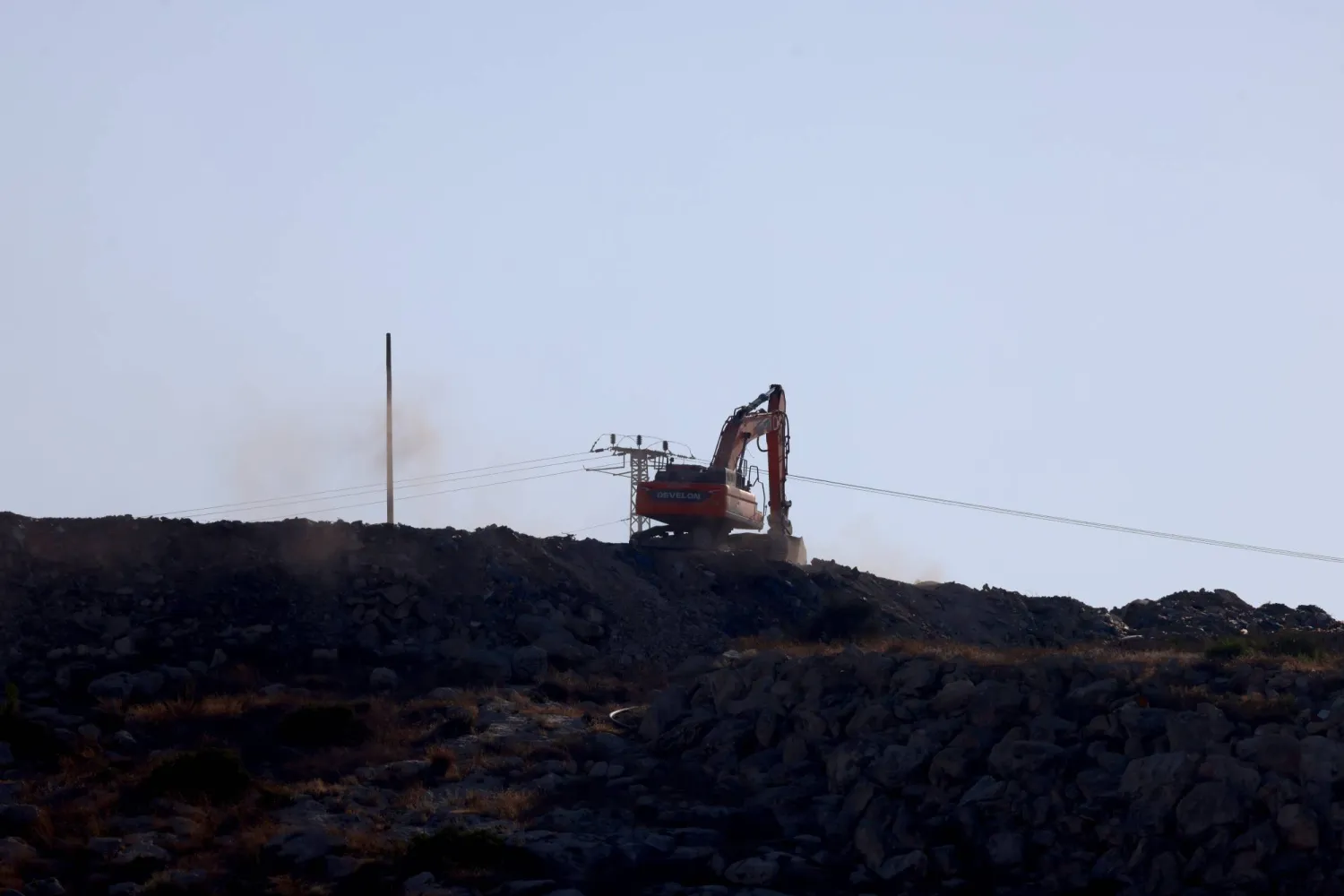
A bulldozer prepares roads at the site of the former Israeli settlement of Kadim near the West Bank city of Jenin, 19 August 2026. EPA/ALAA BADARNEH
TT

France, Germany, UK and Italy Condemn Israel's 'E1' West Bank Plan

A bulldozer prepares roads at the site of the former Israeli settlement of Kadim near the West Bank city of Jenin, 19 August 2026. EPA/ALAA BADARNEH

France, Germany, Britain and Italy condemned on Thursday plans by Israel to open up construction tenders for a residential property project called 'E1' in the occupied West Bank.

"The decision by the Israeli government ⁠to publish bid offers ⁠for construction projects within the framework of the E1 settlers' project is unacceptable," said ⁠a joint statement by the leaders of those four countries.

"At a time of grave instability in the West Bank with unprecedented levels of violence by settlers against civilians, and serious restrictions on the Palestinian economy, this decision is even more concerning," said the statement, urging Israel "to retract these plans immediately and end its expansion of settlements in the West Bank."

Hundreds of thousands of Israelis have settled among millions of Palestinians in land captured by Israel in a 1967 war.

Nearly all ⁠countries ⁠and a range of UN bodies consider that such settlements violate international law.


Iraq Court Delays Ruling on Dissolving Kurdistan Parliament, Government

Barzani announces the start of the new school year (Kurdistan Regional Government)
TT

Iraq Court Delays Ruling on Dissolving Kurdistan Parliament, Government

Barzani announces the start of the new school year (Kurdistan Regional Government)

Iraq’s Federal Supreme Court on Sunday postponed consideration of two lawsuits challenging the continued legitimacy of the Kurdistan Region’s parliament and government, setting Oct. 26 as a new date for a ruling.

The cases seek the dissolution of the regional parliament and an end to the government’s full powers following nearly two years of political deadlock that has prevented the legislature elected in October 2024 from functioning normally.

Meanwhile, Kurdistan Region Prime Minister Masrour Barzani, speaking at a ceremony marking the start of the 2026-2027 school year in Erbil on Sunday, called for the rule of law to prevail throughout Iraq.

“All weapons outside the authority of the state, the government and legitimate institutions must be disarmed,” Barzani said.

Armed factions have made their own disarmament conditional on the decision also applying to the Kurdish Peshmerga and on the force being placed under the orders of Iraq’s commander-in-chief rather than the regional government.

Kurdish authorities reject that demand, citing Article 121(5) of Iraq’s constitution, which grants the regional government responsibility for establishing and organizing internal security forces, including police, security services and regional guards.

Barzani also urged members of the Kurdistan Parliament to “end their boycott of sessions and fulfill their national and oversight duties,” stressing that reactivating parliament was the “first and essential step” toward forming a new regional government.

Political deadlock

The Kurdistan Region has been mired in political paralysis since its October 2024 parliamentary elections. The new legislature has met only once, in January 2025, and has failed to elect a permanent speaker or pave the way for the formation of a new government.

The Kurdistan Democratic Party (KDP), led by Masoud Barzani, won 39 of the 100 seats, while the Patriotic Union of Kurdistan (PUK), headed by Bafel Talabani, secured 23. The New Generation Movement came third with 15 seats.

Deep disagreements between the KDP and PUK over the composition of the government and distribution of senior posts have stalled the process.

Former regional lawmaker Ali Hama Salih filed the two lawsuits with the Federal Supreme Court.

The first challenges the constitutionality of allowing the current parliament to continue after it failed to perform its legislative duties following its inaugural January 2025 session.

The second seeks to strip the Kurdistan Regional Government of its full governing mandate and reduce it to caretaker status, barring it from making strategic decisions or entering into long-term contracts and legal commitments.

Court weighs cases

Commenting on the postponement, Kurdish writer and adviser Kifah Mahmoud said the Federal Supreme Court appeared to want more time to examine the situation and consult the parties to the cases.

Mahmoud told Asharq Al-Awsat that governments normally assume caretaker status once a parliament’s term ends, but argued that Kurdistan’s circumstances were different because the current government had continued implementing strategic road, water and electricity projects despite financial difficulties.

He attributed part of the political impasse to one party seeking greater gains than its parliamentary representation warranted, an apparent reference to the PUK.

Mahmoud nevertheless described negotiations between the KDP and PUK as “positive,” saying they could lead to a coalition government.

KDP spokesman Mahmoud Mohammed separately confirmed that his party was holding “serious and intensive” talks with political forces to resolve outstanding issues.

He said meetings between the KDP and PUK would continue away from media spotlight in an effort to reactivate parliament and move ahead with forming a new Kurdistan Regional Government.

The resumption of parliamentary activity, he added, would depend on the outcome of those talks.


Yemeni Army Repels Houthi Attempts to Advance West of Taiz

A member of the Saudi-backed Yemeni government forces, including National Army and Taiz Axis forces, mans a turret mounted on the back of a pickup truck at a checkpoint along the Kadha frontline west of Taiz in western Yemen on September 13, 2026. (Photo by AFP)
TT

Yemeni Army Repels Houthi Attempts to Advance West of Taiz

A member of the Saudi-backed Yemeni government forces, including National Army and Taiz Axis forces, mans a turret mounted on the back of a pickup truck at a checkpoint along the Kadha frontline west of Taiz in western Yemen on September 13, 2026. (Photo by AFP)

Yemeni government forces recaptured the strategic Mount Numan in western Taiz province early Sunday as fierce fighting continued with the Iran-aligned Houthis along a chain of highlands southwest of the province.

Government forces are seeking to prevent further Houthi advances toward mountains overlooking Bab al-Mandeb and the only remaining overland route linking Taiz city to Al-Turbah, then Lahj and Aden.

Military and local sources reported that forces from the Taiz Axis Forces secured Mount Numan, west of Jabal Habashi, in the early hours of Sunday after clashes with the Houthis. Retaking the position reconnects the Bani Bakari and al-Kadha fronts and secures the Bani Bakari-Al-Ashruh-Al-Bireen road, they added.

Control of the mountain leaves remaining Houthi positions in Al-Sharajah exposed to fire and gives government forces high ground in an area connected to routes leading toward the western coast.

The advance comes as the Houthis seek to consolidate gains from their latest offensive along the western coast. The group seized Hays, al-Khokha and Mokha about 10 days ago before advancing to Bab al-Mandeb, Mayyun Island and several other Yemeni islands in the southern Red Sea, according to field reports from the area.

Fighting in western and southwestern Taiz is concentrated on highlands controlling routes between the interior and the coast, particularly Rasn, Numan, Jardad, al-Kadha and Al-Wazi’iyah. The Houthis are seeking higher ground to protect recently captured coastal areas, secure supply lines and facilitate the southward movement of their forces.

The front is particularly important for Taiz city. Field sources reported that the group is seeking to move closer to the road that still provides the city with an overland connection to Al-Turbah, Lahj and Aden, potentially allowing it to pressure the route and threaten one of the most important remaining lines of movement and supply for government forces and residents.

In southwestern Taiz, government forces and allied tribesmen repelled heavy Houthi attacks in Al-Damdam, Sharirah and Al-Wazi’iyah, while other attempts to advance toward Mount Rasn failed, according to the sources.

They noted that control lines around Mount Jardad in Bani Omar have remained unchanged since the failure of an initial Houthi assault. The group later sent reinforcements and launched an attack toward Rasn, but government forces and local fighters repelled it after hours of clashes.

Houthis Seek to Secure Gains

The battles are part of broader Houthi efforts to secure their newly established control over the western coast and Bab al-Mandeb by advancing from coastal areas toward the eastern highlands overlooking them.

AFP reported Saturday, citing two Houthi military sources, that experts from Iran’s Revolutionary Guards had visited the Bab al-Mandeb area, Mokha port and airport, and the Jabal al-Nar camp east of the city.

The sources reported that the experts oversaw tunnel excavation in hills overlooking Mokha and Bab al-Mandeb and discussed installing radars near Mokha and on Zuqar Island in the southern Red Sea.

They arrived from Hodeidah and made separate visits Thursday and Friday, while Yemeni government sources told AFP that fighting had intensified around the Kahbub mountains overlooking Bab al-Mandeb.

Mounting Casualties

Military sources told AFP Saturday that at least 48 people were killed in 24 hours of fighting between government forces and the Houthis along the Taiz-Lahj border, including 17 government troops and 31 Houthi fighters, according to accounts from the two sides.

The government-aligned Tur al-Bahah Military Axis also announced that 13 of its soldiers had been killed over the previous two days on fronts between Lahj and Taiz.

The Houthis, meanwhile, held funerals Saturday for about 75 members, including around 25 who held senior military ranks, from 10 Yemeni provinces.

Fighting also continued on other fronts. Giants Brigades forces targeted Houthi gatherings and vehicles on the Al-Bayda front, while government artillery struck Houthi positions and vehicles on the western front of Marib province.

In Marib, air and ground strikes continued against Houthi concentrations at the Umm Rish camp and Aqabat Mala’a. Government forces reported foiling three infiltration attempts and repelling a Houthi attack, while military media reported that 12 members of the group were killed.


Israel Steps Ups Military Reinforcements in West Bank Ahead of Yom Kippur

Israeli forces stand in the site where a man was killed in a shooting attack at a spring near the West Bank settlement of Neve Tzuf (AP) 
TT

Israel Steps Ups Military Reinforcements in West Bank Ahead of Yom Kippur

Israeli forces stand in the site where a man was killed in a shooting attack at a spring near the West Bank settlement of Neve Tzuf (AP) 

Israeli military on Sunday have ramped up their forces in the West Bank and elevated their operational readiness to the highest alert level across all commands ahead of Yom Kippur, the Jewish Day of Atonement that begins on Sunday evening and ends Monday.

Israeli authorities set up military checkpoints at the main entrances of two villages in Jerusalem, and raided a village east of the governorate.

The official Palestinian news agency Wafa said a checkpoint was set up at the main entrance of the village of Battir, west of Jerusalem and another at the entrance of Wadi Fukin. It said the Israeli forces continued measures to isolate the area by closing its access routes and digging a trench that prevents the movement of Palestinians and vehicles.

Israeli media outlets quoted Israeli military sources as saying that the army has decided to ramp up its forces on the fronts with Lebanon, the Gaza Strip, the West Bank and Syria while an Israeli official said the army has maintained continuous readiness to pivot immediately from regional ceasefires to renewed combat, including against Iran.

On Sunday, a Palestinian was killed after Israeli forces opened fire at a vehicle near Haddad Tourist Village, east of Jenin city.

Local sources told WAFA that Israeli forces opened live fire at the vehicle, killing the young man and injuring another person. The forces withheld the victim's body.

The sources added that Israeli forces prevented Palestine Red Crescent Society crews from approaching the site to provide medical assistance and evacuate the casualties.

Israeli settlers set a vehicle on fire, assaulted residents, and attempted to kidnap a child during a raid in the Safa area of the town of Beit Ummar, north of Hebron.

Israelis Raid Jerusalem

After Israeli Prime Minister Benjamin Netanyahu, accompanied by ministers and settlers under the protection of Israeli forces, raided the Western Wall Plaza in Jerusalem's Old City on Saturday, National Security Minister Itamar Ben-Gvir stormed on Sunday the Al-Aqsa Mosque compound with a group of settlers.

Ben-Gvir was and heavily escorted by Israeli occupation police, and performed Talmudic rituals in the eastern area of Al-Aqsa Mosque, the Jerusalem Governorate said.

The Palestinian Ministry of Endowments (Awqaf) and Religious Affairs expressed its strong denunciation of this move, stressing that these repeated incursions and provocative actions constitute flagrant encroachment and an attempt to enforce a new reality and alter the historic and legal status quo at the compound.

These unabated, methodical violations stoke bouts of rage among Muslims around the globe and constitute a repudiation of international laws and charters that call for respecting worshippers and protecting holy places, the ministry contended.

It called on the international community, human rights organizations, and Arab and Islamic nations to undertake their responsibilities and intervene immediately to halt these abuses and the persistent encroachments on occupied Jerusalem and Islamic and Christian holy sites.

With an overall area of 144 dunams, Al-Aqsa Mosque is exclusively dedicated to Muslim worship, the ministry underscored, reiterating that any attempt to divide the mosque or share its space is a non-starter.

Meanwhile, the ministry lambasted the closure of the Ibrahimi Mosque to Muslim worshippers under the pretext of Jewish holidays and the forcing of its custodians and staff to evacuate the site from 2 pm Sunday until 10 pm Monday.

What is happening at the Ibrahimi Mosque is extremely dangerous, the ministry warned, noting that it flagrantly provokes Muslims' sentiments and amounts to an assault on freedom of worship and on the religious and historic character of the mosque, amid continuous Israeli measures against worshippers and mosque staff.

The ministry noted that the occupation forces have continued to prevent the call to prayer from being made at the mosque for the 90th consecutive day, citing flimsy alibis and kept throttling Muslims' freedom of access.

Israeli Killed

Meanwhile, violence flared in the occupied West Bank on Sunday when a suspected Palestinian shot dead an Israeli man, police said.

The suspect opened fire from his vehicle at Israelis gathered at a spring near the settlement of Neve Tzuf, near Ramallah, according to the Israeli military and police.

The suspect was located a few hours later at a hospital in Ramallah and arrested, police said.

Palestine’s official WAFA News Agency reported that Israeli forces raided H-Clinic Specialized Hospital in Ramallah and detained an injured Palestinian receiving treatment there.

Israeli Prime Minister Benjamin Netanyahu earlier said Israeli forces were pursuing the attacker.

“Our forces are pursuing the terrorist who carried out the deadly attack,” Netanyahu said, according to AFP.

An Israeli military official said Sunday’s shooting of a settler in the heart of the West Bank is a proof that alert measures must be taken urgently.

However, the official refrained from explaining how the Israeli man was killed amid tight security.

“Our enemies benefit from Jewish festivals to attack us. Yom Kippur, when we fast for 14 hours and most of us are immersed in prayer, is their favorite opportunity to carry out attacks, as happened in the October 1973 War and the October 2023 War,” the official said.

Israeli President Pardons Soldier Who Killed Palestinian Injured

On Saturday, Israel’s President granted a pardon to a former soldier who gunned down a Palestinian in 2016 after he had already been incapacitated by troops in the West Bank city of Hebron.

Elor Azaria had been freed from prison in May 2018 after serving nine months behind bars, half his original sentence, for the manslaughter of Abdul Fatah Al-Sharif.

Israeli President Isaac Herzog said he “decided to grant the request of Elor Azaria to erase the remaining period of his criminal record and continue with his life.”