


US Hits Hezbollah with Fresh Sanctions, Says Iran Controls it

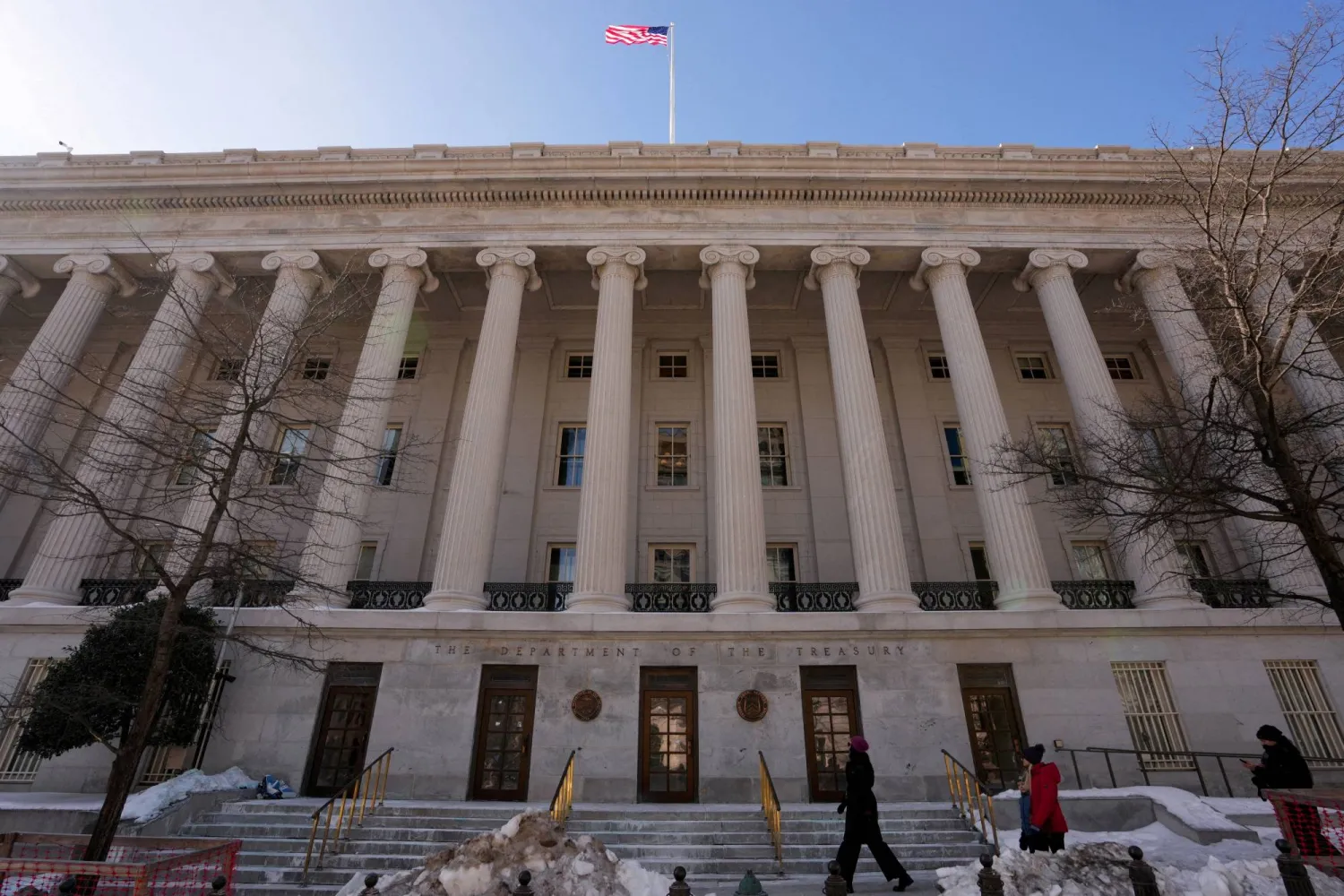
FILE PHOTO: A general view of the US Department Of The Treasury on day two of a partial government shutdown in Washington, D.C., US, February 1, 2026. REUTERS/Ken Cedeno/File Photo
TT

US Hits Hezbollah with Fresh Sanctions, Says Iran Controls it

FILE PHOTO: A general view of the US Department Of The Treasury on day two of a partial government shutdown in Washington, D.C., US, February 1, 2026. REUTERS/Ken Cedeno/File Photo

The United States announced new sanctions Thursday against a Hezbollah financing network, while highlighting the Lebanese armed group's close ties to Iran's Revolutionary Guards.

Hezbollah's legal designation as a terrorist organization has been amended to note that it operates in "service to the Iranian regime under the command of Iran's Islamic Revolutionary Guard Corps," particularly the elite Quds Force, the Treasury Department said in a statement.

The new redesignation "specifies that Hezbollah is an Iranian proxy, not a stand-alone operation as implied by the previous designation," a State Department official said.

"This underscores that Hezbollah operates with little to no regard for Lebanese sovereignty, the Lebanese people, or the Lebanese state."

Hezbollah drew Lebanon into the broader Middle East war in March with rocket fire at Israel in support of its backer Iran.

Israel responded with a heavy air campaign and ground invasion that Lebanese authorities say have killed more than 4,300 people.

"This action builds on years of US designations that have repeatedly documented the operational, financial, and logistical integration between Hezbollah and the IRGC-QF," the State Department official said, calling Hezbollah "an extension" of the latter.

"It is not a Lebanese resistance movement," as Hezbollah describes itself, the official said.

The new sanctions target 10 people who are allegedly part of a network that transfers cash to Hezbollah, which has already been punished with US sanctions many times, the Treasury statement said.

The network utilizes couriers travelling on commercial airline flights “to move up to hundreds of millions of dollars between jurisdictions, providing an avenue outside the formal financial system for Hezbollah to obtain foreign currency and evade sanctions," the statement said.

US Treasury Secretary Scott Bessent said earlier on Thursday that he would hold a press conference on Monday about "the toughest sanctions in history" that Washington plans to impose on Iran.

He said that a plan to sharply increase pain from economic sanctions on Iran aims to "collapse" the country's government.

"It is going to work in Iran and we are going to collapse this regime," he told CNBC. "This is going to be the greatest coordinated economic isolation in the history of the world."



Arab League Chief Condemns Israeli Violations in Palestinian, Syrian, Lebanese Territories

Arab League headquarters in Cairo (The League's official Facebook page)
TT

Arab League Chief Condemns Israeli Violations in Palestinian, Syrian, Lebanese Territories

Arab League headquarters in Cairo (The League's official Facebook page)

Secretary-General of the Arab League Nabil Fahmy denounced Israel’s violations against Palestinian, Syrian, and Lebanese territories saying they cannot be viewed as isolated incidents or justified by fabricated security claims.

He said these actions reflect a persistent approach marked by the use of force, the imposition of a fait accompli, and violations of states' sovereignty and territorial integrity, the Saudi Press Agency said on Thursday.

In a statement, Fahmy asserted that Israel continues to act as a state that disregards international law. He called on the UN Security Council and the international community to take responsibility and implement practical measures to stop these violations and end the policy of impunity.

Fahmy underscored that Israel's actions not only threaten countries in the region but also undermine the credibility of the international legal order. He said they reinforce the notion that force can serve as an alternative to international legitimacy.


Abdi Announces Completion of SDF’s Civil, Military Integration with Damascus

(FILES) Syrian Democratic Forces (SDF) commander-in-chief Mazloum Abdi, speaks during a press conference in Syria's northeastern city of Hasakeh on December 6, 2024. (Photo by Delil SOULEIMAN / AFP)
TT

Abdi Announces Completion of SDF’s Civil, Military Integration with Damascus

(FILES) Syrian Democratic Forces (SDF) commander-in-chief Mazloum Abdi, speaks during a press conference in Syria's northeastern city of Hasakeh on December 6, 2024. (Photo by Delil SOULEIMAN / AFP)

The integration of the Kurdish administration within Syria's state institutions is now complete, Syrian Kurdish leader Mazloum Abdi said on Thursday.

The announcement follows months of negotiations between the two sides after a January agreement that called for the full integration of Kurdish civil and military institutions into the state -- a move Washington deemed "historic.”

"I want to say that the phase of integrating military, security and administrative institutions into national state institutions is complete and finished," Abdi, who heads the Kurdish-led Syrian Democratic Forces, said at an event in Qamishli in northeastern Syria.

"From now on, we begin a new phase," he added.

"Our struggle will continue, to cement our people's rights in the constitution."

Syrian President Ahmed al-Sharaa shakes hands with Mazloum Abdi, commander of the Syrian Democratic Forces (SDF), in Damascus on March 10, 2025 (SANA)

The January agreement, signed by Abdi and Syrian President Ahmed al-Sharaa, followed clashes between Syrian Kurdish fighters and the new authorities' forces that saw the Kurds lose swathes of territory they held in the oil-rich north and northeast.

Amid the violence, al-Sharaa signed on January 16 a decree enshrining the Kurds' national rights and recognizing Kurdish as a national language.

A photo showing SDF Commander Mazloum Abdi with his fighters wearing the military uniform of the Syrian Ministry of Defense as part of the integration steps last February (social media)

In February, Noureddine Ahmed Eissa, a Kurd from the city of Qamishli, was appointed governor of Hasakeh. In March, senior Kurdish military official Sipan Hamo was appointed regional assistant defense minister.

As part of the deal's implementation, government forces entered the cities of Hasakeh and Qamishli, and Damascus took over the management of Qamishli airport and key oil fields.

US troops also transferred more than 5,700 ISIS detainees in previously Kurdish-controlled camps to neighboring Iraq.


Are Defections Eroding Sudan’s Rapid Support Forces From Within?

Rapid Support Forces fighters (File photo - AP)
TT

Are Defections Eroding Sudan’s Rapid Support Forces From Within?

Rapid Support Forces fighters (File photo - AP)

A force of dozens of fighters led by General Musa Khamsin has defected from Sudan’s Rapid Support Forces (RSF) and joined the army, the latest in a series of defections in recent months involving field commanders, fighters, and political officials from the RSF-led Sudan Founding Alliance (Tasis).

The defections are raising questions over what is happening inside the RSF: whether they mark the start of deeper military and political erosion, or remain limited losses that its leadership can contain and replace.

Khamsin said that after reaching army-held territory, his group had come from North Darfur and that Major General al-Nour Ahmed al-Qubba, one of the most prominent RSF defectors, had helped them reach Khartoum.

He also cited disappointment with the Tasis project, saying they had initially believed it would establish a new state but later reached a different conclusion.

Welcoming Khamsin and his fighters, al-Qubba said he expected more commanders and forces to defect. He urged RSF fighters in Darfur and Kordofan to join the army.

Army moves to absorb defectors

The latest defection comes as the army takes further steps to integrate former RSF members.

On Wednesday, it said it had completed the first phase of procedures to regularize the status of those who had joined its ranks. The process included taking an oath and completing security and administrative arrangements ahead of their deployment to army formations and units.

The army did not disclose how many people were involved.

Major General al-Walid Abdel Qader Ajabna, director of the army’s Administration Branch, welcomed the new arrivals and praised what he called their decision to “side with the state” and leave the RSF.

One of the most significant defections came in October 2024, when Abu Aqla Keikel, commander of the Sudan Shield forces and a senior RSF commander responsible for Gezira state in central Sudan, left the RSF and joined the army.

The trend gathered momentum this year.

In April, Major General al-Nour al-Qubba, one of the RSF’s most prominent commanders in Darfur, defected and joined the army. He later said he had been the “third man” in the RSF by military rank and had left with three groups, along with their vehicles and equipment.

More defections follow

Further defections followed.

In May, field commander Ali Rizqallah, known as al-Safna, announced his departure from the RSF after fighting on several fronts. Smaller defections were also reported in Kordofan.

The trend spread to Blue Nile state in southern Sudan, where Dhaifallah Adam, deputy commander of the Fourth Combat Group, defected in June.

He said his decision was driven by what he described as “racism and the absence of a cause or purpose for the war.”

The defections have also reached the RSF’s political circle.

Faris al-Nour, a former adviser to the RSF commander and a member of the Tasis alliance’s Presidential Council, resigned from the council and from his post as governor of Khartoum.

He was followed this month by Hamed Mohammed Khalifa, a Presidential Council member whom the alliance had appointed governor of the Kordofan region.

The resignations add a political dimension to the military defections, as Tasis seeks to present itself as the political framework for the RSF-led project and its allies.

Questions over loyalty

Journalist and political analyst Osman Mirghani said the developments represented a “major shift” that had moved beyond the military sphere into politics.

He said the defections reflected the “collapse of the political project” and declining belief among some RSF members that there was a genuine political cause worth fighting for.

Mirghani said the way the government and army received defectors, particularly al-Qubba, had encouraged others to follow, after seeing that the army was prepared to accept and absorb them.

At the same time, comments by Major General Ahmed Qajja, a senior RSF commander, have raised concerns within the group about the loyalty of some political and military figures.

Qajja recently said there was what he called a “fifth column” inside both the RSF and Tasis.

He said his forces had information raising suspicions about around 50% of political advisers, without providing evidence.

He also said he had information about politicians planning to defect and that a file containing their names was being prepared for submission directly to the RSF leadership. He added that there were similar concerns among military personnel.

Qajja called for tighter controls on the movements of senior leaders, saying: “No senior political figure should move without the commander-in-chief’s permission.”

He denied the existence of any agreement with the army and described joining it as “a betrayal of the cause.”

RSF still able to fight

Despite signs of internal strain, the RSF has not yet lost its ability to operate militarily.

It remains capable of mobilizing fighters, moving forces and launching attacks on several fronts, as seen recently in North Kordofan and Blue Nile, despite conflicting accounts from the two sides over the outcome of those battles.

That continuing capacity makes it difficult to treat the defections alone as evidence of an imminent military collapse.

As long as the RSF can recruit, move units and sustain operations across distant fronts, the impact of the defections remains uncertain.

Retired army Lieutenant Colonel al-Tayeb al-Malkabi cautioned against viewing them as proof that the RSF’s collapse was inevitable.

He described the defections as “an indicator that needs to be monitored.”

Their impact, he said, depended on the importance of the commander who defects, the size of the force leaving with him and the RSF’s ability to replace its losses.

Still, al-Malkabi said the defections were “not a good sign” for the RSF because of their potential effect on cohesion and troop movements, as well as their psychological and political impact.

What does the army gain?

The defections also raise questions about the army’s motives for absorbing former RSF members.

Is it mainly seeking to turn the defections into a political gain and weaken its rival from within, or is integrating them also a way to make up for any shortage in its own fighting forces?

With defections spreading from the battlefield into politics, public concern inside the RSF over the loyalty of some advisers and military personnel, and the army moving to absorb those leaving its rival, the picture remains mixed.

Pressure on RSF cohesion is growing, but the group has so far retained its ability to mobilize, fight and open new fronts.

The key test will be whether the RSF can replace those who leave and preserve cohesion in its command and control.

That will determine whether the current defections remain manageable losses or mark the start of a broader process of internal erosion.