


Experts to Asharq Al-Awsat: Expanded Yemeni Army Deterrence Operations Pave Way for Wider Battle

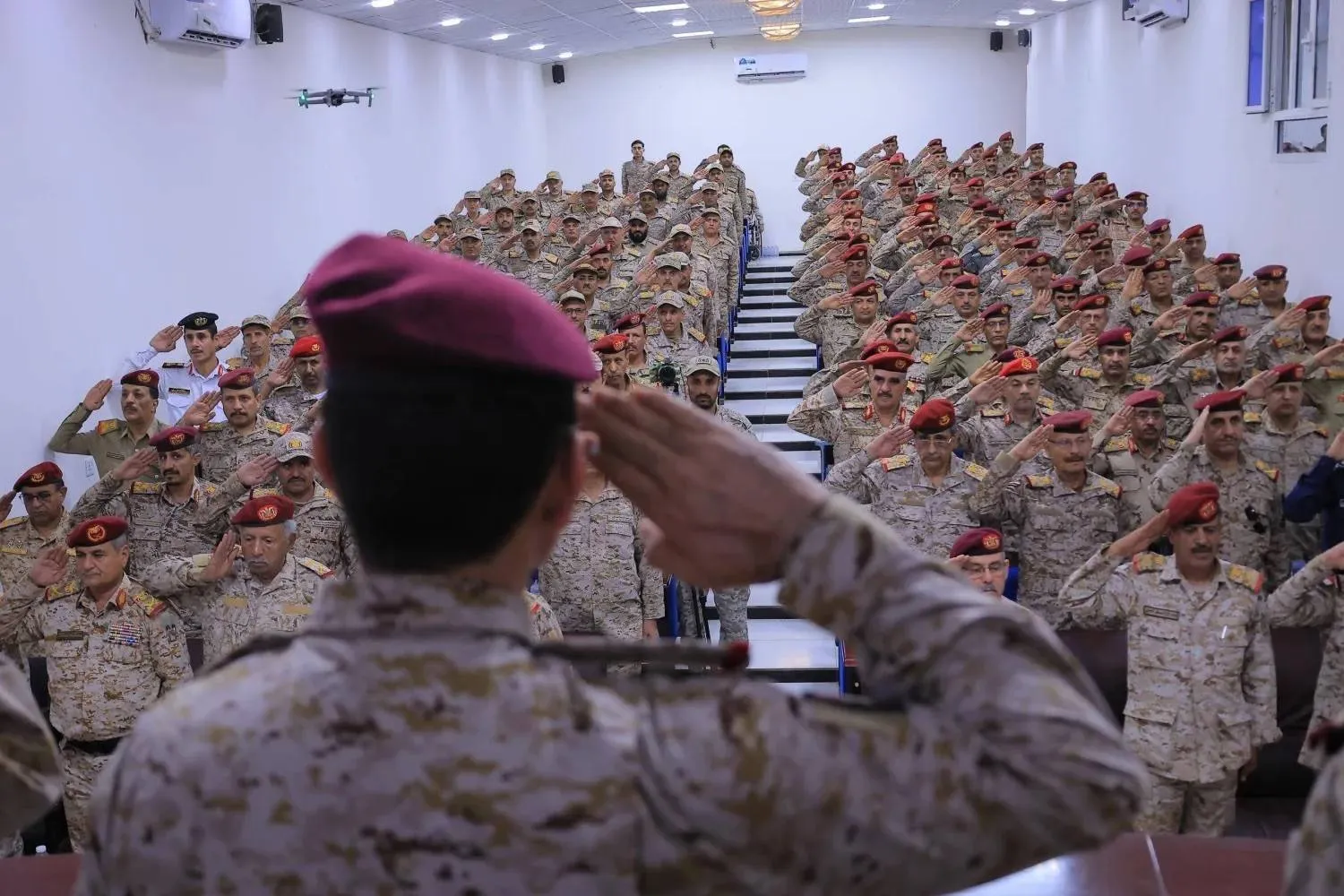
Yemeni Defense Minister Lt. Gen. Taher al-Aqili during a meeting with military commanders in Marib. (SABA)
TT

Experts to Asharq Al-Awsat: Expanded Yemeni Army Deterrence Operations Pave Way for Wider Battle

Yemeni Defense Minister Lt. Gen. Taher al-Aqili during a meeting with military commanders in Marib. (SABA)

Military escalation in Yemen is entering a new phase after the National Defense Council ordered an expansion of air and missile deterrence operations against the Houthis, a move military experts say lays the groundwork for shifting from repelling attacks to striking their sources.

Experts told Asharq Al-Awsat that the deployment of government drones marks a significant change in the balance of power. They believe government forces may possess more advanced drones that have yet to be deployed, while cautioning that the confrontation remains tied to regional tensions and calculations in Iran and the United States.

From defense to preemptive strikes

Brig. Gen. Yasser Saleh, a Yemeni military and strategic expert, said the National Defense Council’s directive aims to neutralize Houthi missile and drone capabilities amid the group’s continued escalation on battlefronts and attacks on vital facilities and infrastructure.

Government operations initially focused on repelling attacks because forces lacked sufficient air defense systems to intercept missiles and drones, Saleh explained.

Raising the level of deterrence would mean conducting preemptive strikes against launch sites and other sources of fire, reducing the Houthis’ ability to mount further attacks, he added.

Saleh described the deployment of government drones as a major development because ground forces require close air support. Drones can conduct reconnaissance, identify targets and strike enemy movements, potentially becoming a key asset if developments lead to a decisive battle.

Government forces are currently using small loitering drones and others capable of dropping munitions, while they are believed to possess more advanced aircraft capable of carrying guided missiles, flying longer distances and striking targets deep inside Houthi-held territory, he said.

Unifying government forces would also allow simultaneous operations on multiple fronts, preventing the Houthis from choosing the time and place of battle or concentrating their forces on a single axis, Saleh went on to say.

Possible offensive

Brig. Gen. Mohammed Al-Kumaim, a Yemeni military expert, said expanded deterrence operations could pave the way for the use of strategic-range drones alongside advanced rocket launchers with ranges of 40 to 60 kilometers.

Potential targets could include command, control and communications centers, supply and reinforcement routes, and missile and drone launch sites.

Al-Kumaim described heavy fire against forward Houthi positions as “preparatory fire” that typically precedes offensive operations, particularly as the group continues to mass forces across several fronts.

He called the deployment of drones a “qualitative shift,” although those seen so far have limited range and capabilities.

Government forces are believed to possess other systems that have yet to enter combat, including the Naqam, Ayban and Shaheen, as well as specialized units trained to operate them.

Al-Kumaim said government forces are better organized than they were in 2022, with a unified operations room and stronger coordination among military fronts and formations.

Rebuilding deterrence

Political and military expert Abdul Wahab Buhaibeh said the council’s directives shift government forces from reacting to Houthi attacks toward seizing the initiative.

He expects longer-range drones to be deployed for reconnaissance, intelligence gathering, artillery and missile fire correction, as well as direct strikes.

The directives also include heightened readiness, stronger early-warning capabilities, intensified intelligence operations and tighter security and maritime measures to track weapons-smuggling routes to the Houthis, alongside preparations for possible ground operations.

Buhaibeh described the approach as a multidimensional strategy combining air and missile operations with security, intelligence and maritime efforts to rebuild deterrence after years in which the Houthis benefited from their relative superiority in missiles and drones and divisions among their opponents.

Yemen and the regional conflict

The experts agreed that Yemen’s escalation cannot be separated from the broader regional conflict.

Saleh said Tehran could push its allies to widen the confrontation if fighting with Washington resumes, while Buhaibeh warned that continued Houthi control of Hodeidah and the Red Sea coast gives Iran leverage over international shipping.

Speaking to AFP, Yemen’s information minister had warned of a Houthi plan to seize coastal areas near the Bab el-Mandeb Strait.

Three Houthi military sources and a spokesman for government forces stationed near the strait also told the agency that the group was planning to advance toward those areas.

Saleh said mounting domestic pressure on the Houthis, combined with regional tensions, could lead to a broader confrontation and potentially pave the way for what he called a “battle of liberation.”

Al-Kumaim, meanwhile, stressed the need for a decisive move before Yemen’s crisis again becomes part of potential US-Iran arrangements, saying the situation is heading toward further escalation but remains dependent on regional and international developments.



At Oct 7 Memorial, Netanyahu Says Will Be No Hamas Rule in Gaza

Israeli Prime Minister Benjamin Netanyahu speaks at the State Memorial Ceremony for the three year anniversary of the October 7, 2023, Hamas attack - REUTERS
TT

At Oct 7 Memorial, Netanyahu Says Will Be No Hamas Rule in Gaza

Israeli Prime Minister Benjamin Netanyahu speaks at the State Memorial Ceremony for the three year anniversary of the October 7, 2023, Hamas attack - REUTERS

Israeli Prime Minister Benjamin Netanyahu on Monday vowed there would be no Hamas rule in Gaza as he attended a memorial event marking three years since the October 7, 2023 attack.

Speaking during a state ceremony at the Mount Herzl military cemetery in Jerusalem, Netanyahu said "we have achieved enormous accomplishments, but there are still missions ahead of us, and we intend to complete them".

"There will be no Hamas rule in Gaza," he added, vowing to continue targeting anyone who was involved in the attack or who held hostages.

The Hamas-led attack resulted in the deaths of 1,221 people, according to an AFP tally based on official Israeli figures. Militants also dragged 251 hostages into Gaza, 44 of them already dead.

In response, Israel launched a massive military offensive that has killed more than 74,200 people in Gaza, according to the territory's health ministry, which is under Hamas authority and whose figures are considered reliable by the United Nations.

Since a ceasefire was declared last October, Israeli forces have killed more than 1,440 people in Gaza, according to the ministry.

Plans for Gaza's post-war governance have begun to take shape, but the issue remains largely unresolved in practice.

Since Hamas's October 2023 attack, Israel has fought wars on several fronts, including against Iran-backed Hezbollah in Lebanon.

During his speech on Monday, Netanyahu also vowed to keep striking Hezbollah to "create an opportunity for peace with a country whose people, for the most part, want peace with us".

Netanyahu also hit out at the clerical leadership in Iran, where Israel and the United States launched a joint attack on February 28, triggering the Middle East war.

"We will not allow the ayatollah regime in Tehran to threaten our existence," Netanyahu said, adding the Iranian leadership was "weaker than it has been since its establishment".


Israeli Soldiers Kill Palestinian in West Bank

A blue body bag containing the body of a Palestinian man shot by Israeli forces in an incident in which a car hit a military jeep, is guarded as it lies on the road close to the Israeli-occupied West Bank town of Bani Naim on October 5, 2026. (Photo by Ahmad GHARABLI / AFP)
TT

Israeli Soldiers Kill Palestinian in West Bank

A blue body bag containing the body of a Palestinian man shot by Israeli forces in an incident in which a car hit a military jeep, is guarded as it lies on the road close to the Israeli-occupied West Bank town of Bani Naim on October 5, 2026. (Photo by Ahmad GHARABLI / AFP)

Israeli forces killed one Palestinian and injured two others in the occupied West Bank on Monday, Palestinian authorities said, while the military said troops fired at a car that had hit an army vehicle.

The military said a "vehicle carrying three suspects... accelerated toward an army vehicle and hit it" in the area of Bani Naim, north of the city of Hebron.

In a statement, it said no injuries were reported among Israeli forces and that soldiers "responded by firing toward the vehicle, and hits were identified."

The Palestinian General Authority for Civil Affairs said "Israeli forces opened fire on a civilian vehicle" at the entrance to Bani Naim, without giving details on whether those inside had been attempting to ram soldiers, according to AFP.

"One citizen was killed and two young men sustained serious and moderate injuries," it added, saying the wounded had been transferred to hospitals inside Israel and that the identity of the deceased remained unknown.

Israel has occupied the West Bank since 1967 and violence there has surged since October 7, 2023.

More than 500,000 Israelis live in the West Bank in settlements illegal under international law, a minority of whom engage in violence towards Palestinians.

According to an AFP tally based on data from the Palestinian health ministry, Israeli forces or settlers have killed 1,112 Palestinians in the territory since the start of the Gaza war.

Israeli figures show at least 49 Israelis, including civilians and security personnel, have been killed in Palestinian attacks or during Israeli military operations during the same period.


Al-Alimi Launches ‘Yemen Dawn’ Operation to Retake Sanaa, End Houthi Rule

Yemeni President Rashad al-Alimi addresses the nation in a televised address in Riyadh, Saudi Arabia October 4, 2026. Yemen News Agency/Handout via REUTERS
TT

Al-Alimi Launches ‘Yemen Dawn’ Operation to Retake Sanaa, End Houthi Rule

Yemeni President Rashad al-Alimi addresses the nation in a televised address in Riyadh, Saudi Arabia October 4, 2026. Yemen News Agency/Handout via REUTERS

Yemeni Presidential Leadership Council Chairman Rashad al-Alimi announced on Monday the launch of a military operation dubbed Yemen Dawn aimed at restoring state institutions, retaking the capital Sanaa and ending the Iran-backed Houthi militia’s control.

In a post on X, al-Alimi said the operation would advance with the support of Yemen’s armed forces and military formations, as well as backing from allies and partners. He said Yemen was moving toward a new era of freedom, peace and stability.

The announcement came hours after the Coalition to Support Legitimacy in Yemen said it was providing full operational support to Yemeni forces and would continue backing the government until state institutions were restored and the Houthi militia’s threat to freedom of maritime navigation was ended.

On Sunday, al-Alimi had said that the government had turned to military action after exhausting peace efforts, while stressing that the campaign was not aimed at civilians and that authorities would protect civilians and property and reject retaliation.