


New US Sanctions Tighten Grip on Hezbollah, Test Lebanon

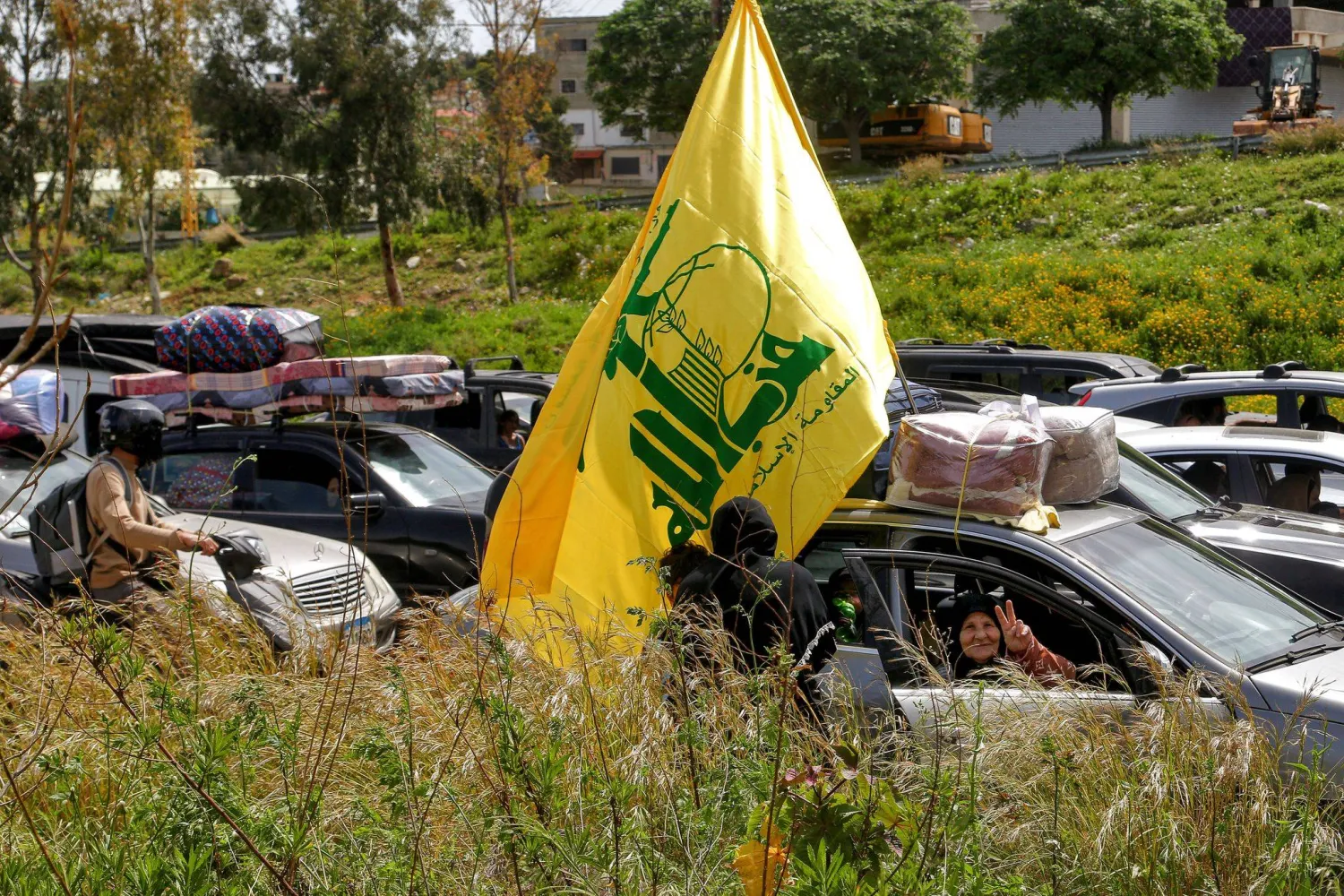
17 April 2026, Lebanon, Jiyyeh: A displaced Lebanese woman flashes the victory sign and displays Hezbollah and Iranian flags as they drive along the highway linking Beirut to southern Lebanon in the Jiyyeh area. (dpa)
TT

New US Sanctions Tighten Grip on Hezbollah, Test Lebanon

17 April 2026, Lebanon, Jiyyeh: A displaced Lebanese woman flashes the victory sign and displays Hezbollah and Iranian flags as they drive along the highway linking Beirut to southern Lebanon in the Jiyyeh area. (dpa)

New US sanctions on Hezbollah go beyond targeting money-transfer networks, signaling a broader shift in Washington’s approach to the group and its relationship with the Lebanese state.

By relisting Hezbollah on its sanctions list and targeting a network accused of moving millions of dollars to the group, Washington is stepping up pressure on Hezbollah while putting Lebanese institutions to a sensitive test: whether they can tighten oversight of money flows and transfers and meet their obligations without worsening the country’s internal crisis.

The US Treasury Department’s Office of Foreign Assets Control (OFAC) announced sanctions on 10 people “that are part of a network responsible for transferring cash to Hezbollah.”

“The network utilizes couriers travelling on commercial airline flights between Lebanon, Türkiye, the UAE, and Iran to move up to hundreds of millions of dollars between jurisdictions, providing an avenue outside the formal financial system for Hezbollah to obtain foreign currency and evade sanctions,” it said.

OFAC also re-designated Hezbollah “for service to the Iranian regime under the command of Iran’s Revolutionary Guard Corps-Quds Force (IRGC-QF).”

Lebanese institutions under scrutiny

The US move is unlikely to stop with the targeted individuals and entities. It puts Lebanese banks, financial institutions, and regulatory bodies under closer US scrutiny, testing their ability to detect financial activity that could be linked to Hezbollah, its institutions, or its networks.

An official Lebanese source told Asharq Al-Awsat that the sanctions “pose challenges for the Lebanese state and its security, judicial and financial institutions.”

The source said the “tough US measures require tighter oversight of any assets linked to Hezbollah and its institutions, because any delay in doing so could leave the state facing consequences it can ill afford.”

OFAC said that “Hezbollah and its allies exploit financing schemes including oil smuggling, illicit shipping, commodities sales, and bulk cash smuggling to generate and move funds across the region.”

The US Treasury linked the targeted network to Behnam Shahriyari, a former Quds Force finance official, saying it was “one example of the methods used to funnel support to terrorist proxy groups throughout the region.”

Beyond Lebanese framework

But the strongest message in the sanctions, according to one Lebanese political reading, is directed at Lebanon itself.

Sami Nader, director of the Levant Institute for Strategic Affairs, said the latest measures differ from previous sanctions because Washington is “dealing with Hezbollah under a new classification that places it outside the traditional Lebanese framework and presents it as an Iranian faction and part of the broader US confrontation with Iran.”

Nader told Asharq Al-Awsat that the shift “will have repercussions inside Lebanon and for the authorities and official institutions, particularly in light of the political and even financial relationship linking the group to some Lebanese factions.”

Under the new US approach, he said, Hezbollah “is no longer viewed as a representative of the Shiite community, but as an Iranian faction occupying Lebanon.”

He said the implications could extend well beyond financial sanctions.

“Any party dealing with Hezbollah could be viewed by the United States as being involved in dealings with Iran’s Revolutionary Guards,” Nader said, adding that this could trigger “political and legal repercussions that go beyond direct financial sanctions.”

The effects of the new approach also extend into the political and diplomatic sphere, particularly Lebanese-Israeli negotiations.

Nader said tougher sanctions “could give Washington greater room to manage negotiations with Israel, allowing it to pressure Hezbollah” and “keeping the issue of ending Hezbollah’s influence part of the broader US confrontation with Iran.”

Europe’s response in focus

Attention is also turning to Europe and whether it will follow Washington’s lead.

Nader pointed to what he called “the recent hardening of the French and British positions toward Iran.”

“If the US approach extends to Europe, Lebanon could find itself entering a more complicated phase,” he said.

In that case, compliance with international sanctions would become “not merely a political choice, but an additional test of the state’s ability to protect its financial system and institutions from the repercussions of a regional and international conflict that extends beyond its borders,” he explained.

Hezbollah rejects US designation

Hezbollah rejected the US position, saying the claim that it is under the control of the Quds Force was merely a pretext for relisting it under sanctions.

The party described the move as “part of the continued policies of US administrations to target the resistance, its community, its support base and to besiege them and exert political, financial and security pressure on them.”

Hezbollah said Washington “continues to deal with Lebanon from a position of tutelage.”

It accused the US of choosing, instead of pressuring Israel to withdraw from southern Lebanon and halt its attacks, to “besiege the Lebanese and work to strip Lebanon of all sources of strength.”

On its relationship with Iran, Hezbollah said: “Our close and brotherly relationship with Iran is one we cherish and take pride in.”

But it stressed that it “does not await anyone’s certification of its Lebanese identity or patriotism.”

The party said sanctions and designations “will not deter us from adhering to the option of resistance and to the right of Lebanon and the Lebanese people to defend their land, sovereignty, and resources.”



Iraqi Army Commander Sacked After Drone Attacks Targeted Saudi Arabia

Iraqi Prime Minister Ali Al-Zaidi (Reuters)
TT

Iraqi Army Commander Sacked After Drone Attacks Targeted Saudi Arabia

Iraqi Prime Minister Ali Al-Zaidi (Reuters)

The office of Iraqi Prime Minister Ali al-Zaidi announced on Saturday the dismissal of the commander in charge of the southern Maysan province after Saudi Arabia said drones launched from Iraq hit the East-West pipeline and led to its closure.

The commander was fired following the "confirmation that the attacks targeting our brethren in the Kingdom of Saudi Arabia originated from a location within the governorate,” said al-Zaidi’s office.

The Saudi Foreign Ministry condemned "the targeting of the East-West pipeline in the Riyadh and Madinah regions by several drones coming from Iraq, which caused human injuries and damage.”

"The pipeline was stopped as a precaution, and the attacks resulted in some injuries," an Energy Ministry official told the SPA news agency earlier.

"At the request of the Iraqi Prime Minister... (Riyadh) has chosen not to respond at this stage and to support the efforts of the Iraqi government ... to prevent attacks launched from Iraq against the Kingdom and neighboring countries," the Foreign Ministry said.


Israel-Lebanon Talks in Rome Next Week Reportedly Postponed

(2L/R) Israel's Ambassador to the US Yechiel Leiter, State Department Chief of Staff Daniel Holler, US Ambassador to Lebanon Michel Issa and Lebanese Ambassador to the US Nada Hamadeh attend a meeting between Israeli and Lebanese delegations hosted by the United States at the State Department in Washington, DC, on June 3, 2026. (Photo by Oliver Contreras / AFP)
TT

Israel-Lebanon Talks in Rome Next Week Reportedly Postponed

(2L/R) Israel's Ambassador to the US Yechiel Leiter, State Department Chief of Staff Daniel Holler, US Ambassador to Lebanon Michel Issa and Lebanese Ambassador to the US Nada Hamadeh attend a meeting between Israeli and Lebanese delegations hosted by the United States at the State Department in Washington, DC, on June 3, 2026. (Photo by Oliver Contreras / AFP)

Talks between Israel and Lebanon that were scheduled to take place in Rome next week have been postponed and will occur instead in ⁠October, Axios reported ⁠on Friday, citing a US official.

Jewish holidays, a Paris conference ⁠and UN General Assembly preparations meant participants could not convene in Rome, Axios cited a source as saying.

The Lebanese and Israeli ambassadors are ⁠due ⁠to meet in Washington, according to the post on X.


Houthi Casualties Strain Sanaa Hospitals’ Capacity

Houthis use images of their dead to recruit more fighters (X)
TT

Houthi Casualties Strain Sanaa Hospitals’ Capacity

Houthis use images of their dead to recruit more fighters (X)

The fallout from the Houthis’ military escalation in Yemen is straining hospitals and endangering civilians in areas under the group’s control, while fueling rare criticism from within its own ranks.

Activists and former fighters accuse the group of exploiting poverty to recruit young men, trading on fighters’ blood and diverting resources to the war effort at the expense of civilian needs.

Medical sources in the Houthi-held capital Sanaa told Asharq Al-Awsat that the group’s Health Ministry had recently ordered several government hospitals to limit admissions of critically ill patients.

Intensive care units, emergency departments and other wards have instead been reserved for wounded Houthi fighters arriving from the front lines.

The measures cover Al-Thawra, Al-Jumhouri, Police, Military, Al-Quds, 48 and Kuwait hospitals — among the capital’s leading medical facilities. Their capacity to treat civilians has consequently shrunk, particularly for patients needing urgent care or intensive treatment.

The restrictions coincided with the arrival in Sanaa of large numbers of dead and wounded Houthi fighters following battles on several fronts across Yemen.

Health workers said hospitals were taking in growing numbers of casualties and setting aside beds, equipment and wards for those arriving from combat zones, including fighters requiring surgery or intensive care.

Hospitals under strain

The Houthis have tightened security around several medical facilities, barred media access and withheld information about the identities and conditions of casualties arriving from the front lines.

Health workers said the influx of wounded fighters had pushed hospitals closer to capacity, leaving less room for civilian patients.

Ahmed, whose relative needed treatment in Sanaa, said his family struggled to obtain the necessary care at Al-Jumhouri Hospital and was forced to look elsewhere because the facility lacked the resources to treat the patient.

He accused the Houthis of channeling available medical resources into the war effort, warning that civilians — particularly children, older people, chronically ill patients and emergency cases — faced growing risks.

The measures come as the health system in Houthi-held areas reels from years of war, dwindling funding and severe shortages of medicine, supplies and medical staff. Health facilities have also been damaged, forcing some to close.

The strain extends beyond Sanaa. The capital’s main hospitals routinely receive referrals from other provinces and regions, meaning their reduced capacity affects a far wider population under Houthi control.

Dissent from within

As the escalation weighs on the health sector, criticism is also mounting among figures and activists aligned with the Houthis.

Their complaints center on the war’s human cost, the treatment of fighters and the families of those killed or wounded, and recruitment practices that prey on economic hardship.

In the latest rebuke, activist and former Houthi fighter Abdullah Sharaf al-Mahdi attacked the group’s leaders and supervisors, accusing them of trading on fighters’ blood and sidelining bereaved and wounded families for personal gain.

Fighters and their families bear the cost of the war, al-Mahdi said, while officials and supervisors receive privileges including property and financial allocations. The conflict, he added, had become a vehicle for advancing the interests of factions within the group.

Al-Mahdi said he regretted the years he had spent fighting for the Houthis and would not support them again. His comments reflect a shift among some critics from opposing the group’s policies to questioning its motives for prolonging the war.

Criticism has also emerged from within Houthi-controlled institutions.

Abdu Bishr, a member of the Houthi-controlled parliament in Sanaa, accused the group of ignoring Yemenis’ suffering and pursuing what he called “futile” wars. He urged it to keep economic and humanitarian issues out of the conflict.

Bishr called for salaries to be paid, detainees released and airports reopened. He warned that what he described as “taking pleasure in bloodshed” would deepen the humanitarian catastrophe and urged the group to ease people’s suffering or “leave the scene.”

Houthi activist and writer Zaid al-Kibsi also criticized the group’s recruitment of young people and adolescents, saying it exploited poverty and worsening economic conditions to push more of them toward the front lines.

He accused the Houthis of using religious and sectarian rhetoric, along with slogans of “jihad and martyrdom,” to recruit young people as many families struggle to meet their basic needs.

Some recruits depend on the group’s modest payments to support their families while risking death or injury in combat, al-Kibsi said.

Many are young men who have had no chance to build their lives or start families, leaving their relatives to bear the consequences when they are killed or wounded.