


Houthis Tighten Security Grip in Ibb

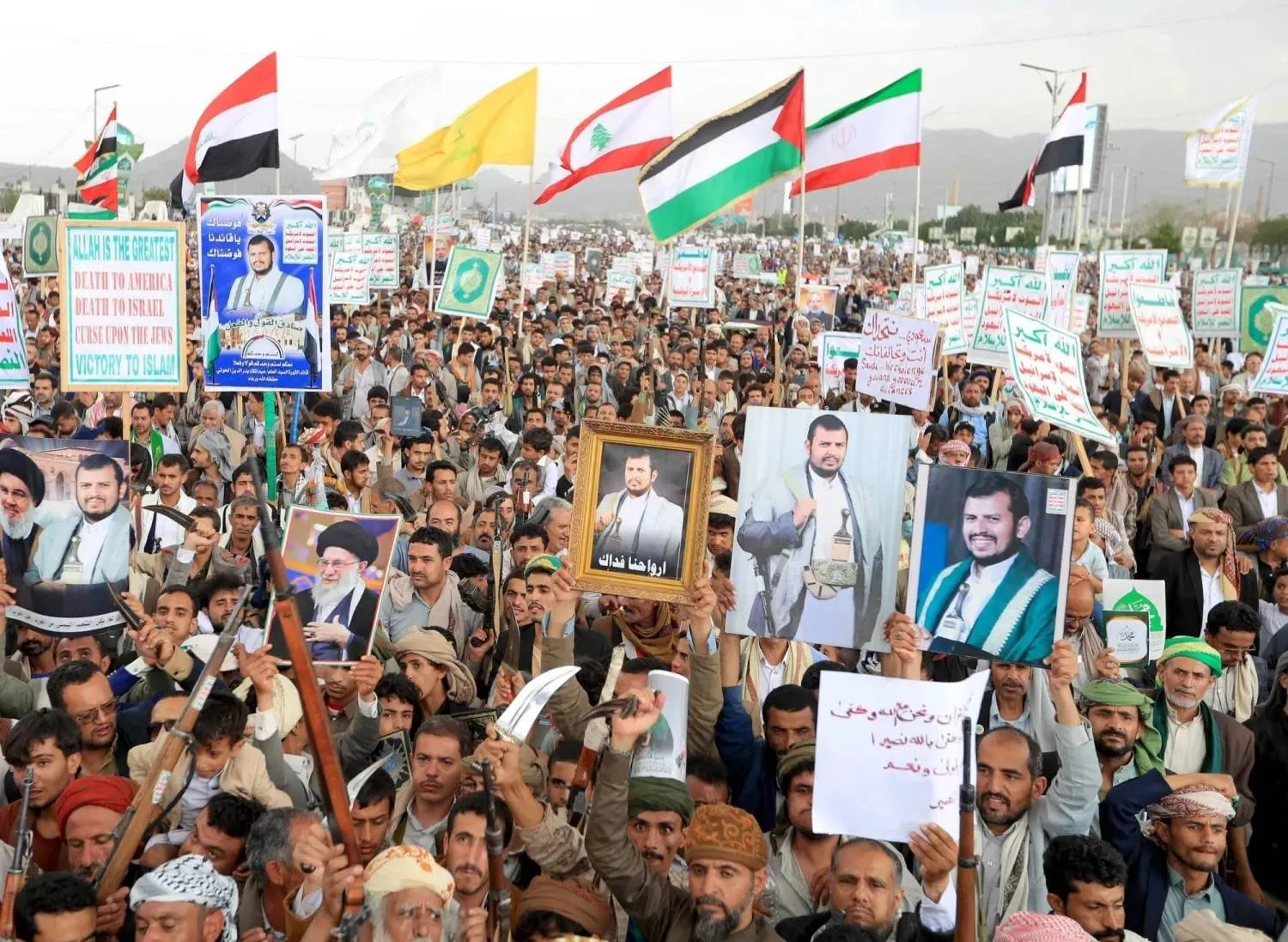
 A Houthi rally in Sanaa called by the group’s leader in support of land and maritime attacks (AFP) 
 A Houthi rally in Sanaa called by the group’s leader in support of land and maritime attacks (AFP) 
TT

Houthis Tighten Security Grip in Ibb

 A Houthi rally in Sanaa called by the group’s leader in support of land and maritime attacks (AFP) 
 A Houthi rally in Sanaa called by the group’s leader in support of land and maritime attacks (AFP) 

The Iran-backed Houthi group has tightened its security grip on Yemen’s Ibb governorate amid rising tensions and clashes along surrounding front lines, deploying elite units to areas near battlefronts with Taiz, Hodeidah and Al-Dhale.

Local sources told Asharq Al-Awsat that the group had intensified its security presence in Ibb city and areas near the front lines in the west of the governorate, reinforced routes leading to the fronts and imposed tighter surveillance on residents’ movements and communications.

Ibb is strategically important because it lies along supply routes linking Houthi-controlled areas with fronts in Hodeidah, Taiz and Al-Dhale, about 192 kilometers (119 miles) south of Sanaa.

The Houthis have moved the headquarters of the military command covering Ibb, Al-Dhale and Taiz to Damt, east of Ibb, and deployed two elite units known as the Al-Samad Brigades near the front lines, the sources said.

The group sent fighters recruited from Ibb to frontline positions while keeping the two Al-Samad units behind the front to monitor the forces and prevent local fighters from fleeing or retreating during clashes.

According to the sources, the deployment reflects distrust of fighters recruited from the governorate as the Houthis tighten security in cities and towns and along roads leading to combat zones.

Operations Hub

The Houthis have turned eastern Ibb into a center for managing military operations on surrounding fronts while redeploying units near the frontlines.

The moves come amid mounting tensions on several fronts and as the group strengthens its security grip over Ibb, one of its main recruitment and supply areas.

They coincide with the first anniversary of a sweeping arrest campaign in Ibb that targeted more than 115 educators, academics, doctors and engineers, according to local sources.

The campaign lasted more than three months, from late May to October last year. Fourteen detainees have since been released at different times, the latest about a week ago, while the others remain in custody.

Several people wanted by the Houthis remain unable to leave the governorate for government-controlled areas, while around 260 families have managed to flee Houthi-held territory and reach areas under government control.

Siham al-Abab, daughter of educator Sadiq al-Abab, meanwhile revealed that her father’s health had deteriorated after more than a year in Houthi detention, with his family unable to visit him or obtain information about his condition. Her father called several days ago and sounded clearly tired, she said, adding that the family did not know what was wrong with him and could neither see nor check on him.

She added that the call had a profound psychological impact and that her father’s voice remained with her afterward. She had previously described her family’s suffering in his absence, saying he had left behind a small family in need of support while remaining imprisoned without the family knowing what charges he faced.

The Houthis detained Sadiq al-Abab during a sweeping arrest campaign targeting hundreds of people in Ibb, Taiz and Al-Bayda, including doctors, teachers, lawyers, employees and community figures, according to local sources.

Detention Without Legal Process

Zakaria al-Jaberi said his father has been forcibly detained by the Houthis at the Political Security headquarters in Ibb since June 12, 2025.

The family has communicated with him only three times. Its sole permitted visit came more than 11 months after his detention, before further visits were barred.

Al-Jaberi noted that the Houthis had allowed only limited phone calls, leaving the family unaware of his detention conditions or physical and psychological state despite authorities knowing he has health problems.

The family has approached numerous officials and individuals seeking answers or assistance, but was often told that those responsible knew nothing about the case and that the authority handling it was in Sanaa.

Al-Jabri questioned who had ordered his father’s detention, why he had not been referred to prosecutors and why the family had not been informed of the charges or any legal process.

The family does not know “who has the authority to make the decision or who can end this detention,” he underlined, adding that the prolonged detention had taken a heavy psychological and social toll. He said the case reflected the absence of any clear official authority the family could turn to despite repeated appeals to government bodies, civil society organizations and local dignitaries.


Israel Assassinates Qassam’s Commander of the Khan Younis Brigade

Mohammad al-Yazouri, also known as "Abu Al-Haitham," commander of Gaza's Khan Younis Brigade in the Qassam Brigades.
TT

Israel Assassinates Qassam’s Commander of the Khan Younis Brigade

Mohammad al-Yazouri, also known as "Abu Al-Haitham," commander of Gaza's Khan Younis Brigade in the Qassam Brigades.

The Israeli army assassinated Mohammad al-Yazouri, also known as "Abu Al-Haitham," commander of Gaza's Khan Younis Brigade in the Qassam Brigades, the armed wing of the Hamas movement.

He and Hudhaifa Abu Muammar, an engineer in the Qassam Brigades, were killed in an Israeli drone strike while they were walking in the Al-Mawasi area at midnight Thursday-Friday.

Field sources told Asharq Al-Awsat that al-Yazouri was not quickly identified, as he was in pieces and his body, including his face, was disfigured.

The sources revealed that the sudden loss of contact with him prompted some of those close to him to try to find out if he was the target, and it became clear in the early hours of dawn that he was among the victims.

According to two sources, Al-Yazouri assumed responsibility for the Khan Younis Brigade shortly after the assassination of the brigade leaders Ezzedine al-Haddad and Mohammad Oudeh, who were assassinated within ten days in May.

Al-Yazouri was the commander of central and western Khan Younis, before becoming the general commander of the brigade.

He worked for years in other positions within the Qassam leadership, including the intelligence apparatus, which was one of the agencies that worked on gathering security information in preparation for the October 7, 2023, attack.

A third source said al-Yazouri escaped several assassination attempts, whether during the current war or years before it.

One of the most prominent attempts occurred when he was with Rafe Salama, Mohammad Sinwar, and Yahya Sinwar in a tunnel in Khan Younis in 2021. Israeli planes bombed the site with several missiles during what was known as the battle of the "Sword of Jerusalem," which Israel named "Guardian of the Walls." Everyone survived the attack.

Al-Yazouri was one of the leaders who supervised the October 7 attack, and he also played a role in the operations of handing over the abducted Israelis during the exchange deals.

Abu Muammar was an engineer in the Qassam Brigades who was responsible for developing the military capabilities of the brigades and was close to its prominent leaders.

He was responsible for several attacks against Israeli forces during the Gaza war and others before it.


Iraq Says Dialogue over Factions’ Weapons to Continue After Sept. 30 Deadline

Vehicles of the Iraqi army at the entrance to the capital Baghdad’s suburb of Sadr City. (AFP file)
TT

Iraq Says Dialogue over Factions’ Weapons to Continue After Sept. 30 Deadline

Vehicles of the Iraqi army at the entrance to the capital Baghdad’s suburb of Sadr City. (AFP file)

The Iraqi government said on Thursday that the plan to impose state monopoly over weapons will begin after the complete withdrawal of anti-ISIS coalition forces by the September 30 deadline.

It stressed that dialogue is taking place at the highest levels with armed factions to ensure the success of the plan.

Spokesperson for the commander-in-chief of the Iraqi Armed Forces Sabah al-Numan said September 30 is the final deadline for ending the mission of the coalition and for the remainder of foreign forces to pull out of Iraq.

The withdrawal process is accelerating with the foreign forces showing a commitment to the deadline to end their mission in the country, he added.

ISIS has been defeated militarily in Iraq despite the continued presence of cells and remnants of the group, he remarked.

The armed forces are at the highest level of readiness to confront and destroy them, he declared.

On the armed factions, Numan said dialogue was ongoing with them over having them lay down their weapons, but the implementation will take place after the coalition ends its mission in Iraq.

Prime Minister Ali al-Zaidi had set as a priority the issue of imposing state monopoly over weapons. In remarks in June, he said there was no need for the “resistance” to remain after US troops pull out of Iraq.

The plan to impose state monopoly over weapons has lost momentum in recent weeks. Circles close to the government said they were hoping that negotiations with the factions would be a success.

Security expert Hussein Allawi told Asharq Al-Awsat that the negotiations between the government and factions have entered a second phase through the formation of a committee that will facilitate the dialogue and reach common ground over “organizing the weapons”.

The government’s strategy after September 30 will focus on implementing its program with regards to development, reconstruction, investment and economic reform, as well as consolidating security, he added.

Professor at Al-Mustansiriya University Taleb Karim told Asharq Al-Awsat that the success of the plan is not measured by its existence on paper, but by the state’s ability to unify security decision-making and invest years of field experience in institutions and sustainable abilities in order to prevent Iraq from being used as an arena for the conflicts of others.

On the Kurdistan Region, spokesman Numan said coordination is ongoing between it and the federal government in Baghdad.

A high-level security meeting was held this week that included leaders of the Peshmerga forces during which urgent recommendations were raised for implementation, including securing border crossings.

The Kurdistan government is meanwhile ensuring that counter-terrorism efforts will continue with the international coalition.

President Nechirvan Barzani received Vice Admiral Edward Ahlgren, the UK Defense Senior Advisor to the Middle East and North Africa, for talks on joint coordination to fight ISIS remnants and terrorist threats,

A joint statement said they tackled the Iraqi government’s efforts to impose state monopoly over weapons and to unify Peshmerga forces.


Yemeni Forces Reposition Themselves in Southern Mokha

Yemeni government forces fire a tank during clashes with Yemen's Iran-aligned Houthis in a location given as near al-Hazm, Yemen, in this screengrab obtained from a handout video released September 9, 2026. (Media Center of the Yemeni Armed Forces/Handout via Reuters)
TT

Yemeni Forces Reposition Themselves in Southern Mokha

Yemeni government forces fire a tank during clashes with Yemen's Iran-aligned Houthis in a location given as near al-Hazm, Yemen, in this screengrab obtained from a handout video released September 9, 2026. (Media Center of the Yemeni Armed Forces/Handout via Reuters)

Battles on the Yemeni western coast and west of Taiz entered a new phase on Thursday as government forces reorganized their deployment south of the city of Mokha, and formed an alternative command center in the Dhubab district toward Bab al-Mandeb, following breakthroughs achieved by the Iran-backed Houthi group on a number of fronts during the past hours.

The development came following days of violent battles on the west coast, during which the Houthi forces managed to advance in al-Waziyah and Mawza and seize control of important positions as government forces withdrew from positions in Hays and al-Khawkha. The Houthis continued to push large human reinforcements to the confrontation lines, using missiles, drones, and heavy weapons.

Member of the Presidential Leadership Council and commander of the National Resistance Tareq Saleh said the armed forces on the west coast were regrouping in preparation for the next phase in the fighting.

According to local media, Saleh said the armed forces on the west coast “have paid a heavy cost, including martyrs and wounded, in the days they have been fighting the Houthi assault.”

The armed forces include the National Resistance, Giants Brigades and National Shield forces.

He said the forces confronted an attack “planned and supported by Iran.” He also accused Iran of being involved in the fight “though its various tools.”

The military media of the National Resistance announced the formation of the new command center in the Dhubab region, south of Mokha, in the direction of Bab al-Mandeb to positions closer to the city of Mokha.

Houthi militants had seized control Wednesday of al-Waziyah, southwest of Taiz, and Mawza, east of Mokha, in addition to the Khalid bin Al-Walid camp in the Mawza district, following violent battles with government forces.

National Resistance and other forces withdrew from areas in the Hays district north of Mokha and Khawkha south of Hays. The Houthis continued their advance on the northern and eastern axes leading to Mokha.

Military media sources reported that the Houthis stormed several areas in the Mokha district, seizing control of the Jabal al-Nar camp, which housed the headquarters of the military forces command on the western coast. Zuqar Island was struck by two ballistic missiles amid escalation that included wide areas of the coast and the Red Sea.

Air strikes meanwhile hit Houthi positions in al-Tahita, al-Salif, and Kamran island in Hodeidah. More air raids sough to weaken the group’s fire power and cut its supply routes.

These developments come a week after a broad Houthi attack began in western Taiz and southern Hodeidah, during which the group managed to mobilize large numbers of fighters and open more than one front at the same time, with heavy use of missiles, drones, and artillery shelling to cover its ground movements.

Despite the Houthis’ heavy losses, they continued to bring more reinforcements to the fronts amid apparent disarray in government forces and a depletion of their reserves.
