Israeli Strike Kills Three in West Bank; Israel Says It Targeted Hamas Operative

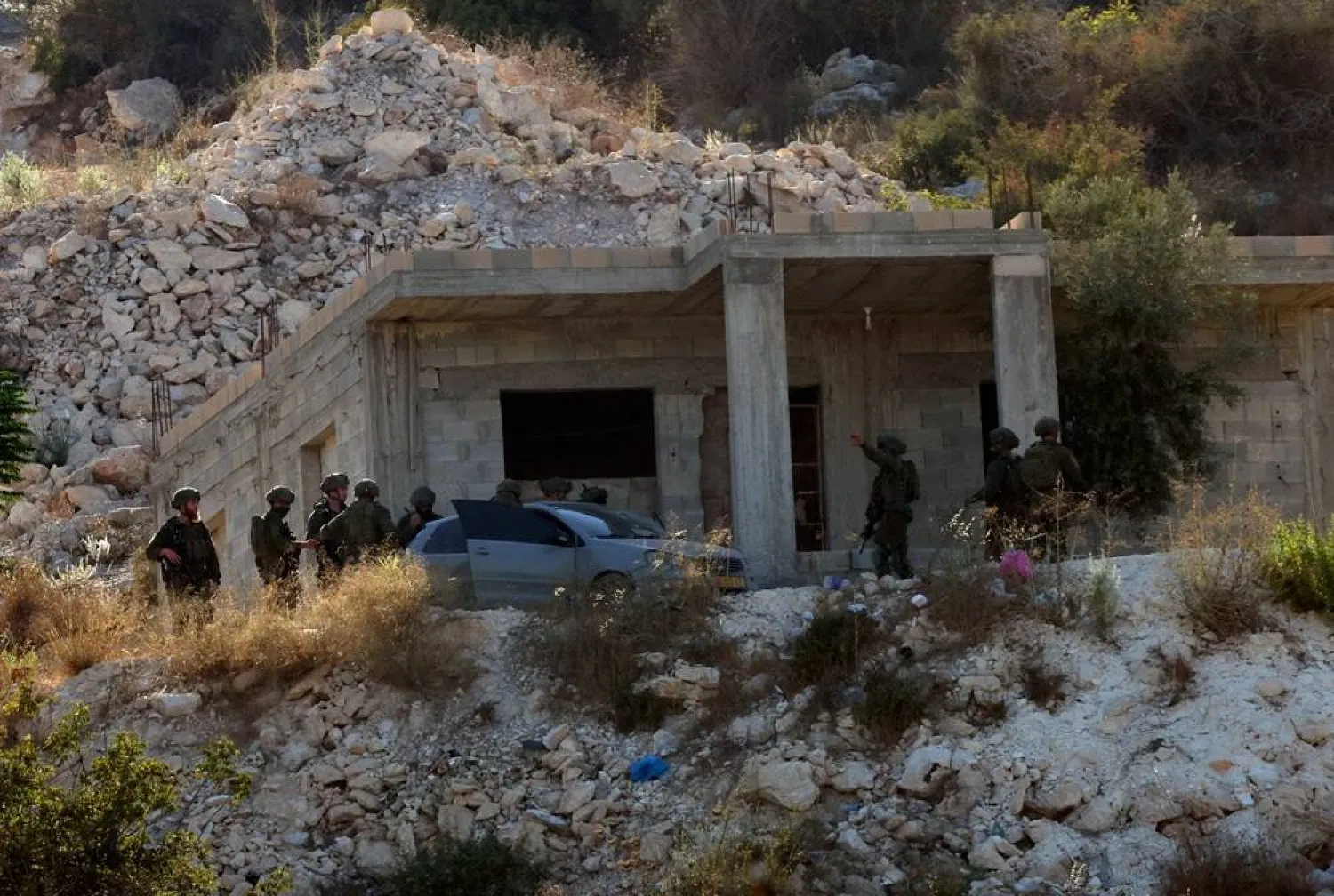
Israeli troops search the area following an airstrike that killed three Palestinians near the West Bank city of Jenin, 28 August 2026. (EPA)
TT

Israeli Strike Kills Three in West Bank; Israel Says It Targeted Hamas Operative

Israeli troops search the area following an airstrike that killed three Palestinians near the West Bank city of Jenin, 28 August 2026. (EPA)

Israel's military said it ‌carried out an airstrike in the West Bank on Friday that killed a Palestinian it described as a Hamas operative, as well as two of his accomplices, in a rare use of deadly Israeli air power in the occupied territory.

Hamas condemned the strike but did not claim the person targeted, whom the Israeli military named as Qais Bitawi, as a member. The strike targeted a car in the area of Jenin in the northern West Bank, the military and medics said.

The West Bank has seen a surge ‌in militant ‌Israeli settler attacks on Palestinians, as well as military ‌raids ⁠into Palestinian towns. The ⁠northern West Bank, where Jenin sits, was the site of a major Israeli assault last year, which the military says was aimed at targeting militant strongholds.

In a statement, the military said Bitawi was involved in directing, funding and executing attacks on Israeli civilians and security forces. It said he maintained ties with Hamas members in Gaza, ⁠where the group is based, as well as ‌abroad.

The Palestine Red Crescent ambulance ‌service said Israeli ground troops raided the site of the drone strike, briefly detained ‌medics and prevented them from transporting those wounded or killed ‌to hospital.

Israel's military did not immediately provide comment on the ambulance service's statements.

Israel's 2025 operations in the northern West Bank forced thousands of Palestinians from their homes, with Israeli forces clearing out refugee camps and maintaining their ‌longest presence in some West Bank cities for decades.

Human Rights Watch has accused Israel of war ⁠crimes and crimes ⁠against humanity over what it said were forced expulsions. Israel denies committing such crimes.

In Gaza, where the US has been working to salvage a deal that would disarm Hamas in exchange for Israel withdrawing from the territory, at least five Palestinians were killed in three Israeli strikes on Friday, Gaza health officials said.

Those incidents included an Israeli strike near Deir Al-Balah that killed three people from the same family; a strike on a motorbike that killed one in Gaza City; and a separate strike in Gaza City that killed one Palestinian, according to health officials.

The Israeli military did not immediately provide comment on the strikes.


US Revokes Visa of Former Iraqi Finance Minister

The seal of the United States Department of State is seen in Washington, US, January 26, 2017. (Reuters)
TT

US Revokes Visa of Former Iraqi Finance Minister

The seal of the United States Department of State is seen in Washington, US, January 26, 2017. (Reuters)

The Trump administration has revoked the U.S. visa of a former Iraqi finance minister who was honored in 2022 with an “International Women of Courage” award by the State Department.

The department said Friday it had revoked the visa of Taif Sami Mohammed Al Shakarchi, who served as Iraq’s finance minister from 2022 until July.

Earlier this month she was implicated by Iraqi authorities in a possible corruption scheme.

The department said her visa was revoked after the FBI added her to its “terrorism watchlist.”

It was not clear why she had been added to the watchlist but officials said she had left the United States before her visa revoked.


Drone Strikes Kill 8 Civilians in Sudan’s North Kordofan

Sudanese army solders take part in a military parade on August 17, 2026, in the city of Gedaref in eastern Sudan during celebrations to mark the 72nd anniversary of the Sudanese Armed Forces. (Photo by AFP)
TT

Drone Strikes Kill 8 Civilians in Sudan’s North Kordofan

Sudanese army solders take part in a military parade on August 17, 2026, in the city of Gedaref in eastern Sudan during celebrations to mark the 72nd anniversary of the Sudanese Armed Forces. (Photo by AFP)

Drone strikes have killed eight civilians and wounded dozens in Sudan's Kordofan region, a rights group said Friday.

Emergency Lawyers, an independent group documenting atrocities in Sudan, said a drone targeted a group of civilians traveling Thursday in the desert town of Sowdari in North Korodofan state. As others rushed to help the victims, a second drone struck, the group said.

The group said in a statement posted on Facebook that targeting civilians and then attacking again while they were being rescued amounts to a violation of international humanitarian law and is a war crime. It called for an independent investigation to determine who was responsible.

Sudan plunged into all-out war in April 2023 as fighting erupted between the Rapid Support Forces and the Sudanese military. The conflict has killed at least 59,000 people killed, according to Armed Conflict Location & Event Data, a conflict monitoring group. Aid groups say the figure is an undercount and the true number could be many times higher.

Drone warfare has become a defining feature in the country's war, with both sides carrying out strikes. Drone strikes are now the leading cause of death in Sudan, according to the United Nations, accounting for 80% of civilian deaths during the first four months of 2026.


Yemen Strengthens Defensive Measures Against Houthi Threat

Part of the latest Yemeni government meeting in the interim capital, Aden (Saba)
TT

Yemen Strengthens Defensive Measures Against Houthi Threat

Part of the latest Yemeni government meeting in the interim capital, Aden (Saba)

The escalating Houthi threat is no longer confined to front lines or direct military attacks. It is increasingly targeting ports, economic infrastructure and maritime routes, as the Yemeni government seeks to reorganize the state's capabilities to confront a threat it sees as extending beyond the domestic conflict to the security of maritime navigation and international trade.

The government measures come amid an escalation along the western coast and the Red Sea. The latest developments in recent hours have included the launch of ballistic missiles toward liberated islands and areas near international shipping lanes, as well as an attempt to deploy a suicide drone. At the same time, the Yemeni navy thwarted an attempt by Houthi boats to approach liberated islands, according to military media.

These developments have placed the Yemeni government before a complex equation. Its institutions are tasked not only with containing military attacks, but also with protecting civilian and commercial infrastructure, securing supply chains and preserving the economy's ability to function in a country already battered by years of war triggered by the Houthis, as well as financial and monetary fragmentation.

The Yemeni cabinet, at its latest meeting in Aden, treated the Houthi escalation as part of a campaign targeting the foundations of the state rather than as a series of isolated military operations. It focused on Houthi attacks against economic infrastructure and civilian and commercial facilities, foremost among them Mokha Port, viewing them as an attempt to disrupt trade, maritime traffic and supplies.

Mokha's significance extends beyond its local importance given its proximity to one of the world's most critical maritime routes. Any threat to the port or surrounding coastal areas therefore affects not only Yemen's economy, but also adds another layer of risk to maritime security in the Red Sea and the Bab al-Mandab Strait.

Expanding the Confrontation

While the Yemeni government seeks to present itself as capable of managing the confrontation through parallel military, security and economic tracks, the cabinet ordered authorities to maintain the highest levels of readiness, strengthen surveillance, early-warning and response systems, and increase coordination among military, security and civilian agencies. The aim is to enable a rapid response to threats while protecting state institutions, facilities and national interests.

The measures, however, have not been limited to security. The cabinet also discussed electricity and gas supplies, supply bottlenecks, market oversight and supply chains, alongside tighter controls over border crossings and revenues and intensified efforts to combat smuggling and the financing of illicit activities.

The package reflects an attempt to link economic security with military security. The government sees the state's ability to withstand the escalation as dependent on preventing disruption to markets and supplies while simultaneously cutting off resources that the Houthis could use to finance their military operations.

It also reflects an official recognition that any prolonged escalation in the Red Sea could compound the pressures on an already fragile economy, particularly if it disrupts ports or affects the movement of goods, food and medicine.

Against this backdrop, the Yemeni cabinet stressed that anti-smuggling measures must not become an obstacle to legitimate trade, seeking to strike a balance between cutting off illicit sources of financing and maintaining the flow of essential supplies to the population.

International Partnership

Alongside the government's moves, Yemen has called for an expanded partnership with the international community, particularly the United States, to address risks that are no longer confined within Yemen's borders.

During a video conference with US Chargé d'Affaires to Yemen Neil Hop, Presidential Leadership Council member Sultan al-Arada stressed that security in the Red Sea and Bab al-Mandab is a shared responsibility. He said protecting freedom of navigation and global trade routes requires greater political and economic pressure on the Houthis, alongside efforts to cut off their sources of financing and weapons supplies.

Through this rhetoric, Yemen's leadership is seeking to shift the discussion from the framework of the Yemeni war to a broader question of international maritime security, arguing that continued instability in Yemen has a direct impact on regional security and the movement of global trade.

According to Yemeni state media, the US side reaffirmed its support for the Presidential Leadership Council and the government, and its readiness to continue supporting state institutions and strengthening their capacity to confront security, economic and humanitarian challenges, with a focus on curbing the Houthis' sources of financing and weapons.