


Iran Links Hamas, its Allies’ Weapons in Lebanon to Hezbollah’s Arms

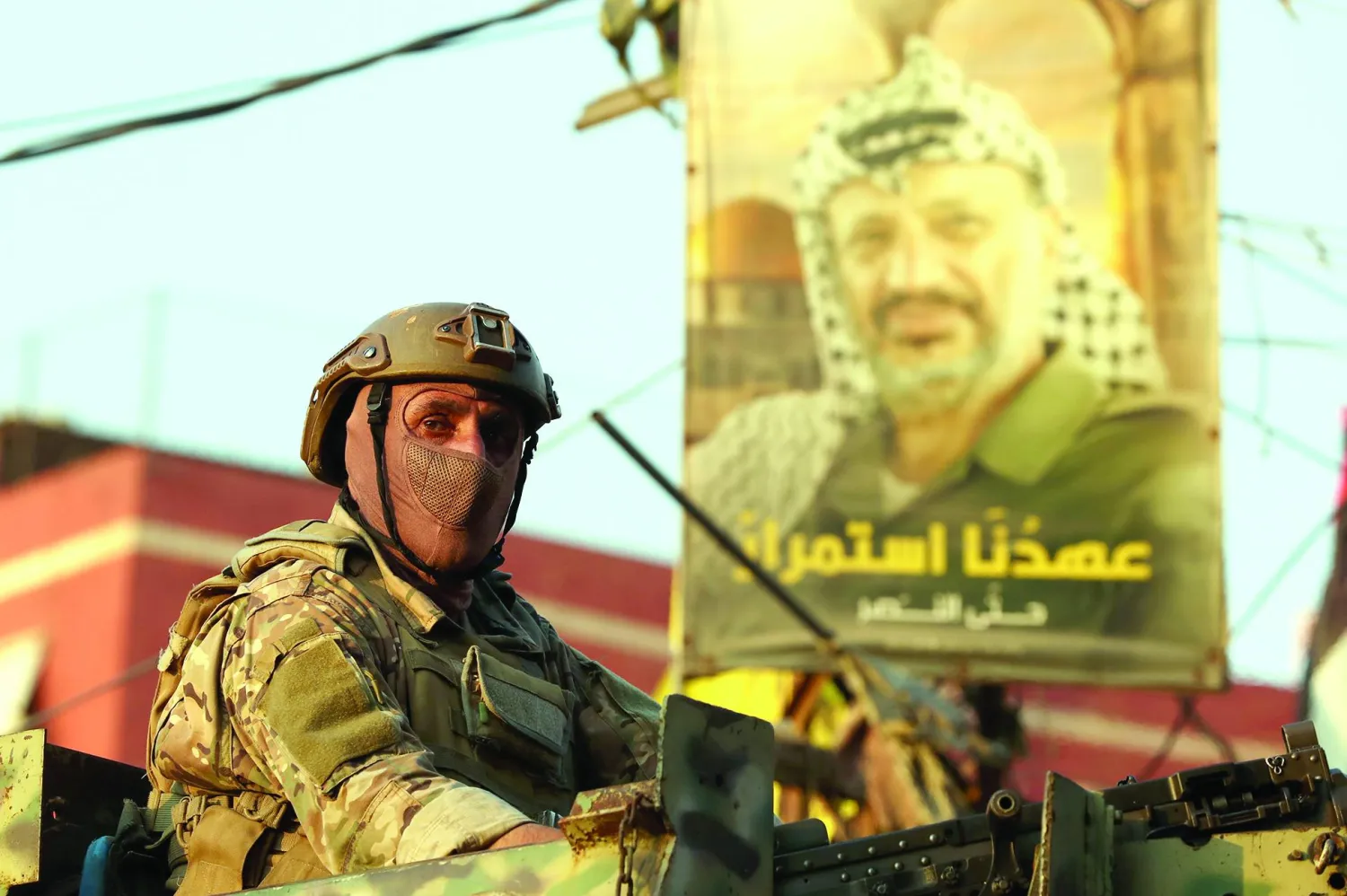
A Lebanese soldier sits on an armored personnel carrier at the entrance of Burj Barajneh Palestinian refugee camp in southern Beirut, Lebanon, 21 August 2025.   EPA/WAEL HAMZEH
A Lebanese soldier sits on an armored personnel carrier at the entrance of Burj Barajneh Palestinian refugee camp in southern Beirut, Lebanon, 21 August 2025. EPA/WAEL HAMZEH
TT

Iran Links Hamas, its Allies’ Weapons in Lebanon to Hezbollah’s Arms

A Lebanese soldier sits on an armored personnel carrier at the entrance of Burj Barajneh Palestinian refugee camp in southern Beirut, Lebanon, 21 August 2025.   EPA/WAEL HAMZEH
A Lebanese soldier sits on an armored personnel carrier at the entrance of Burj Barajneh Palestinian refugee camp in southern Beirut, Lebanon, 21 August 2025. EPA/WAEL HAMZEH

As efforts to address Hezbollah’s weapons continue to stall, along with the domestic dialogue over the issue, discussion of Palestinian weapons inside the refugee camps has simultaneously receded, despite the fact that the process of withdrawing those weapons actually began some time ago.

With key stages in the handover of weapons belonging to Palestinian factions of the Palestine Liberation Organization now completed, attention has turned primarily to weapons held by factions close to Hezbollah, foremost among them Hamas and Palestinian Islamic Jihad.

Both movements have refused to cooperate with the official Lebanese-Palestinian understanding on the issue, raising questions over whether the fate of these weapons will be addressed separately or whether it has, in one way or another, become tied to the fate of Hezbollah’s own weapons.

Since August 2025, the Lebanese Army has taken possession of a large portion of the medium and heavy weapons belonging to PLO factions. The process took place in stages, in implementation of the resolutions of the Lebanese-Palestinian summit held on May 21, 2025, between Lebanese President Joseph Aoun and Palestinian President Mahmoud Abbas.

The resolutions affirmed Lebanon’s sovereignty over its entire territory, the extension of state authority, and the principle that weapons must be held exclusively by the state.

However, Hamas, Palestinian Islamic Jihad, and other allied factions rejected the resolutions of the Lebanese-Palestinian summit. They believe the Lebanese state should address the Palestinian issue in Lebanon as a single package, meaning that priority should not be given to weapons over Palestinian rights and demands.

A Bargaining Chip

After US President Donald Trump announced at the end of July that the “Board of Peace” he chairs had reached an agreement calling for the “full disarmament” of Hamas and other armed groups in the Gaza Strip, questions emerged over whether the fate of Hamas's weapons in Lebanon was linked to the fate of its weapons in Gaza.

However, a senior Lebanese official told Asharq Al-Awsat that “what is preventing the completion of the process of taking possession of Palestinian weapons deployed inside the camps, specifically the weapons of Hamas, Palestinian Islamic Jihad, and their allies, is that Iran and Hezbollah have linked the fate of these weapons to the fate of Hezbollah’s weapons, believing that they can be used as a bargaining chip in any future negotiations.”

He noted that “when Hamas is asked to hand over its weapons in Lebanon, it says the matter is in Hezbollah’s hands. When Hezbollah is asked about the issue, it says the time is not right to settle it.”

The source explained that “around 60 percent of the weapons belonging to PLO factions have been handed over, and most of the remaining weapons are small arms that the factions say they need to maintain security in the camps and defend themselves in any internal Palestinian conflict.” He added that “Hamas's main weapons are concentrated in Rashidieh camp south of the Litani River, including the Grad rockets located there.”

Hamas's Position

On whether the fate of Hamas's weapons in Lebanon is linked to the fate of its weapons in Gaza, sources within the movement said that, regarding Palestinian weapons in the Gaza Strip, “the discussion was about restricting and collecting the weapons, not handing them over, with the weapons to be collected by a Palestinian party, whether the local administration in the Gaza Strip or the Palestinian factions.” They stressed that “the weapons in Gaza cannot be compared with those in Lebanon because Gaza is under Israeli occupation, and the Palestinian people have the right to resist the occupation with all the means at their disposal.

As for the weapons in Lebanon, the movement does not have heavy weapons in Lebanon. There are many Palestinian factions that possess weapons, and they predate Hamas in terms of their presence in the camps and may possess quantities of weapons far greater than those held by Hamas. Therefore, we said that in Hamas's case in Lebanon, the discussion primarily concerns small arms held by the Palestinian resistance or by the movement, rather than heavy weapons in the conventional sense.”

The source told Asharq Al-Awsat that “the movement supports any steps that would strengthen Lebanon’s stability and security. It has held several meetings with the Lebanese-Palestinian Dialogue Committee to reach a comprehensive solution to the conditions of Palestinians, covering humanitarian, social, economic, and rights-related aspects. But recently we have observed new measures restricting Palestinians, contrary to what had been agreed, including preventing them from owning property and denying Palestinians certain professional and social rights.”

The source added: “As for the weapons, they have been there for decades and are historically linked to the issue of the Israeli occupation. Today, their presence is more symbolic than a means of confronting the occupation. If the Lebanese state wants to address this issue, we are open to dialogue and understanding to reach solutions that satisfy everyone, away from any tension or confrontation.”

Palestinian Factions in Lebanon

Palestinian armed forces in Lebanon are broadly divided into three main groups, although their situations today differ significantly.

The first group consists of PLO factions, most notably Fatah, the largest Palestinian force in Lebanon, the Popular Front for the Liberation of Palestine, the Democratic Front for the Liberation of Palestine, and the Palestine Liberation Front, along with smaller factions.

The second group consists of Hamas and Palestinian Islamic Jihad, the two most prominent Palestinian Islamist armed forces outside the PLO.

The two movements were part of the Palestinian forces alliance, which also included factions historically linked to Syria. In 2025, they announced that their weapons were tied to the “Palestinian cause,” rather than to PLO weapons, and therefore did not take part in the handover process that began in August 2025 in the same manner.

The third group consists of factions that were linked to the former Syrian regime and whose presence inside the camps has now become largely symbolic. Three main forces fall into this category: the Popular Front for the Liberation of Palestine-General Command, the most prominent Palestinian faction that was closely linked to the Assad regime and maintained military bases outside the camps, most notably Qusaya and Sultan Yacoub in the Bekaa.

Fatah al-Intifada was also closely linked to Syria and maintained positions and weapons outside the camps, most notably in Naameh, south of Beirut, and in the Bekaa in eastern Lebanon. The third was Al-Sa'iqa, a Palestinian faction established by Syria's former leadership. Its ties to the Syrian regime were direct, although weaker in Lebanon than those of the General Command and Fatah al-Intifada.

These three factions effectively lost their Syrian political and military backing after the fall of the Assad regime in December 2024. The Lebanese state did not wait for a comprehensive agreement on disarming Palestinian factions inside the camps. Instead, the Lebanese Army began dealing with the military bases of Syria-linked factions outside the camps. It took control of General Command positions in Qusaya and Sultan Yacoub, including their weapons, equipment, and rockets. Several positions belonging to other factions were also dismantled.

Notably, this took place at the end of 2024 and beginning of 2025, before the process of handing over weapons in PLO camps began in August 2025.

Fatah al-Intifada, meanwhile, maintained a presence in some of the camps, and the handover of its weapons was not directly linked to the transfer of control over General Command bases. A month ago, the movement began handing over its heavy and medium weapons to the Lebanese Army at Beddawi camp in northern Lebanon, in a move described as the first instance of a Palestinian faction outside the PLO proceeding to hand over its weapons.



Yemeni Army Thwarts Houthi Attempts to Consolidate Gains in West

Yemeni army forces battle the Houthis in a war of attrition on the Taiz fronts (Military Media) 
TT

Yemeni Army Thwarts Houthi Attempts to Consolidate Gains in West

Yemeni army forces battle the Houthis in a war of attrition on the Taiz fronts (Military Media) 

Yemeni government forces have repelled Houthi attempts to seize strategic high ground east of Bab al-Mandab and west of Taiz, as the group seeks to consolidate its control of the strait, Mayyun Island and the western coast by securing key mountain positions and supply routes.

The Kahboub and Al-Wazi’iyah fronts saw heavy fighting over the past 24 hours, accompanied by airstrikes targeting Houthi gatherings and vehicles. Government military sources said the forces had thwarted attacks and attempted advances, inflicting casualties and equipment losses.

At Kahboub, in the highlands separating Lahj and Taiz and overlooking Bab al-Mandab, the Yemeni army announced it had repelled a Houthi attack lasting more than three hours, breaking the assault three times and forcing the attackers to retreat.

Government forces are also seeking to secure positions in the Kahboub mountain range, including Jabal San Sanfa, and open the Al-Nabiyah route linking coastal areas around Ras al-Ara with the highlands. The positions are particularly important because they overlook roads leading to the coast and areas surrounding the strait.

In Al-Wazi’iyah, west of Taiz, the Houthis sent reinforcements and attempted to advance toward new high ground, while government forces responded with ground attacks and airstrikes.

A military source in the Taiz command said the clashes killed 30 Houthis and wounded more than 60 others, while six combat vehicles and two tanks were destroyed.

Local sources reported that warplanes struck Houthi vehicles and gatherings in the Al-Dharifah area, while armed forces spokesman Col. Majed al-Nazili said government forces targeted Houthi supplies and positions in Mokha and on several Taiz fronts.

Preventing Consolidation

The operations are part of government forces’ efforts to prevent the Houthis from turning their control of Bab al-Mandab, Mayyun Island and the western coast into an entrenched military reality. After seizing those coastal positions, the group needs to secure the surrounding territory, particularly high ground controlling routes between the coast and the interior.

The Kahboub and Al-Wazi’iyah mountains form part of the highland belt separating the coast from inland areas, making control of them important to protecting or threatening coastal positions. The Houthis are therefore seeking to capture additional peaks and elevated positions, while government forces are working to keep the area contested, preventing the group from consolidating its defenses and expanding its control.

Clashes have also intermittently spread to the southern and western outskirts of Taiz, particularly around Jabal Jardad toward Al-Shamayatayn district via the Rasn axis, as well as Al-Rahidah, Al-Dimnah and Mafraq Al-Dhikrah, accompanied by airstrikes on Houthi positions.

Civilian Toll

In Al-Wazi’iyah, Houthi shelling of Al-Turairah village in the Al-Dharifah subdistrict killed three children Friday, according to official sources. They were Nour al-Din Yaqoub Abdo al-Dharafi, 4; Asawer Fahd Mohammed Ghanem al-Dharafi, 14; and Tala Mohammed Ahmed al-Dharafi, 2.

In Marib, cautious fighting continued on the western and southern fronts, with government forces using artillery, snipers, drones and warplanes to target Houthi positions and movements.

Brig. Gen. Akram al-Adimi, commander of the 13th Infantry Brigade, said his forces had neutralized dozens of Houthi fighters and seized weapons and equipment.

On the political front, Presidential Leadership Council Chairman Rashad al-Alimi, during a meeting with French Ambassador to Yemen Catherine Corm-Kammoun, affirmed that government forces were capable of regaining the initiative on the western coast, pointing to continuing operations in Taiz, Marib, Lahj, Al-Jawf, Hajjah, Al-Bayda and Al-Dhalea.

Al-Alimi said the repositioning of forces and strengthening of their capabilities were aimed at preventing any temporary battlefield gain from becoming a fait accompli or a platform for threatening waterways, stressing that the state was working to secure its territory, coastline and territorial waters.


Sudanese Army Repels Blue Nile Attack, Advances in Kordofan

Sudanese army troops take part in a military parade in Gedaref (AFP) 
TT

Sudanese Army Repels Blue Nile Attack, Advances in Kordofan

Sudanese army troops take part in a military parade in Gedaref (AFP) 

Fighting between the Sudanese army and the paramilitary Rapid Support Forces (RSF) has spread from the Kordofan fronts to the Blue Nile region, where local authorities reported repelling an attack on Al-Kaili in Kurmuk locality, while the army announced it had retaken 11 areas in North Kordofan after battles with the RSF.

Authorities in Kurmuk reported that army forces prevented the RSF from entering Al-Kaili, adding that the attacking force had crossed from Ethiopian territory.

The army, for its part, said a preemptive attack south of the area killed a number of RSF fighters and destroyed nine combat vehicles.

The route taken by the attacking force and the casualties reported by the army could not be independently verified.

In North Kordofan, the army announced Thursday that it had retaken 11 areas west of El Obeid, including Kajmar, Sharshar, Al-Qulay’at and Awlad Hazmah, as well as the area surrounding Al-Mazrub.

Sudan’s official news agency SUNA reported the army’s announcement that it had “liberated several areas” in the state.

According to the military, its forces fought battles with the RSF and carried out sweeping operations in areas into which they had advanced. There was no independent confirmation, however, that the army controlled all the locations it listed.

The developments come amid escalating fighting on several fronts across Kordofan.

According to military sources, army forces and their allies had advanced around the city of Bara and moved toward Sodari in the northwestern part of North Kordofan, while other sources reported the recapture of Al-Farshaya in South Kordofan and Al-Mamsouka in West Kordofan.

Pro-army platforms reported fighting west of Bara and indicated that army forces had entered villages where RSF fighters had been stationed.

At the same time, reports emerged that eight people had been killed and others wounded in an attack in North Kordofan attributed to the RSF, although sufficient independent details about the circumstances were not available.

Sodari is militarily significant because of its location along routes linking North Kordofan with Darfur, making control of surrounding roads important for the movement of troops and supplies westward.

Fighting in recent months has altered the map of territorial control around Bara and along the Export Road linking Khartoum and El Obeid.

In South Kordofan, military operations have focused on routes linking Kadugli, Dilling and El Obeid.

Field sources indicated that the recapture of Al-Farshaya, if confirmed, could improve army movements along the Dilling axis. They also reported movements toward Al-Dibaybat, along roads leading to West Kordofan.

The army has expanded its area of control in North Kordofan in recent months following heavy fighting in which it regained control of Bara, Umm Sayala, Jabra al-Sheikh, Jireikh, Umm Qirfa and other areas, allowing it to reopen the Export Road linking Khartoum and El Obeid.


Syria Arrests Five Former Officers over Assad-era Airstrikes

A man holds Syrian opposition flags as he celebrates after Syria's army command notified officers that President Bashar al-Assad's 24-year authoritarian rule has ended, in Aleppo, Syria December 8, 2024. REUTERS/Karam al-Masri
TT

Syria Arrests Five Former Officers over Assad-era Airstrikes

A man holds Syrian opposition flags as he celebrates after Syria's army command notified officers that President Bashar al-Assad's 24-year authoritarian rule has ended, in Aleppo, Syria December 8, 2024. REUTERS/Karam al-Masri

Syrian security forces said on Friday they had arrested five former air force officers accused of involvement in airstrikes on civilians during the rule of ousted President Bashar al-Assad.

Over more than 13 years of a civil war that claimed more than half a million lives, Syrian forces relentlessly shelled areas held by the opposition forces before Assad was toppled in December 2024 and the current government came to power.

The Internal Security Forces said in a statement that they carried out a series of operations that led to "the arrest of five senior Air Force officers and commanders from the former regime".

The force said investigations were ongoing ahead of the suspects' referral to the judiciary.

The detainees were involved "in planning, managing and carrying out aerial bombardment operations, and in using the air force, air bases and field command centers to conduct intensive combat airstrikes targeting populated areas", the statement said.

Since Assad was overthrown in December 2024, Syria's new authorities have arrested dozens of former security officials, while trials began in April.

Earlier this month Syrian authorities said they had arrested nine former pilots including three generals accused of taking part in lethal bombings of towns and villages under Assad's rule.

Syria sentenced Bashar al-Assad, his brother Maher al-Assad, and five other security officials to death in absentia in August for atrocities committed during the civil war.

The former president fled Syria as his government fell and is believed to be living in Russia.