


Houthis Commit More Violations in Taiz and Lahj, Drawing EU Condemnation

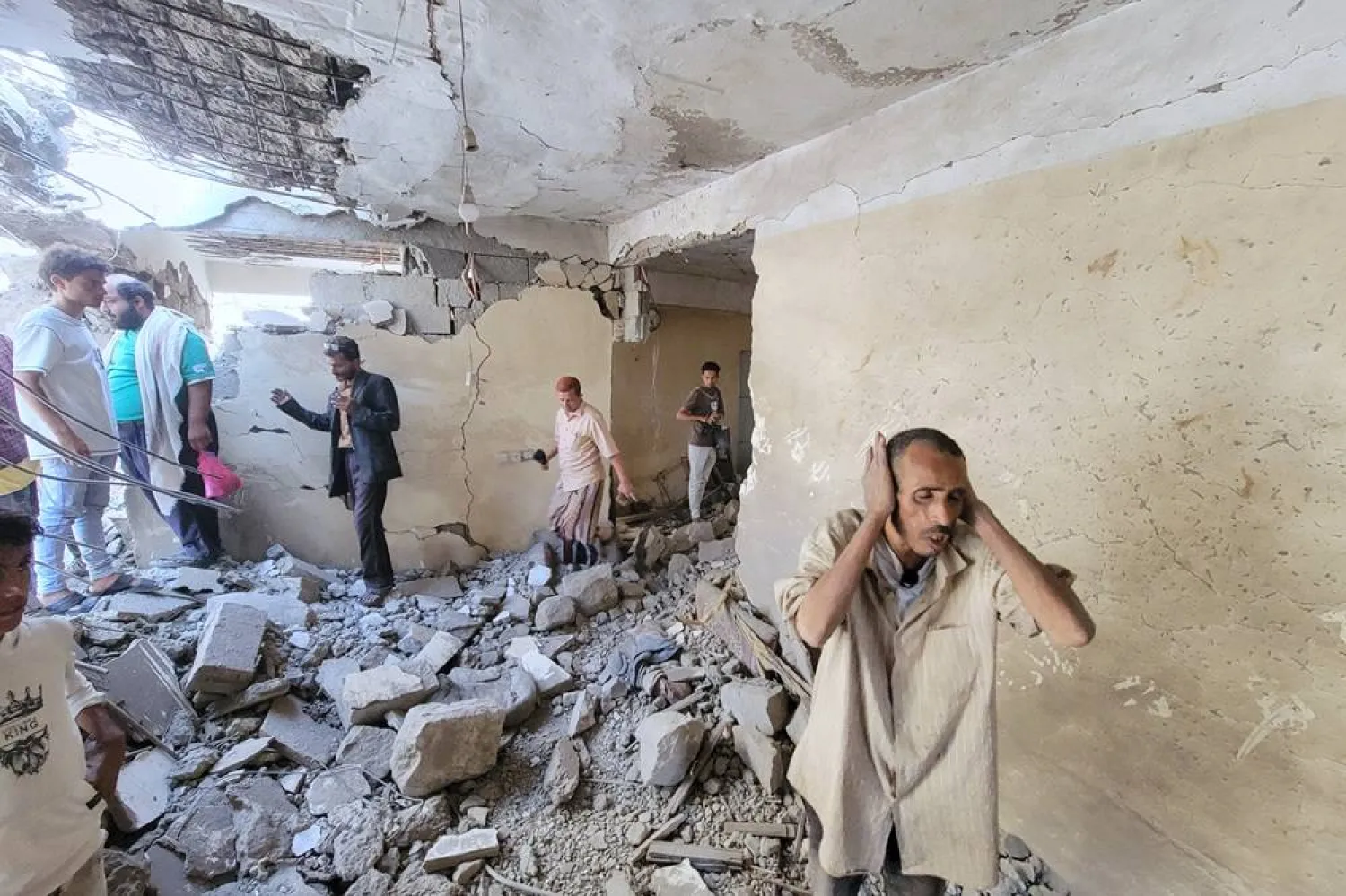
 Residents walk on debris of their homes at Seina district in Taiz, Yemen, after a missile strike, Tuesday, Oct. 20, 2026. (AP)
Residents walk on debris of their homes at Seina district in Taiz, Yemen, after a missile strike, Tuesday, Oct. 20, 2026. (AP)
TT

Houthis Commit More Violations in Taiz and Lahj, Drawing EU Condemnation

 Residents walk on debris of their homes at Seina district in Taiz, Yemen, after a missile strike, Tuesday, Oct. 20, 2026. (AP)
Residents walk on debris of their homes at Seina district in Taiz, Yemen, after a missile strike, Tuesday, Oct. 20, 2026. (AP)

The Yemeni Network for Rights and Freedoms documented 164 crimes and violations committed by the terrorist Houthis within 48 hours across the Taiz and Lahj governorates, reflecting the widening scope of their targeting of civilians and vital infrastructure in southwestern Yemen.

The attacks involved firing around 450 projectiles at populated areas, killing 28 civilians and injuring 57 others. The surge in violence coincided with the targeting of a health center in Lahj and a popular market in Taiz, drawing sharp condemnations from government officials, human rights organizations, and the European Union.

This Houthi offensive comes amid mounting humanitarian pressure on local populations, particularly in Taiz, which continues to endure a relentless blockade alongside severe restrictions on the delivery of supplies and aid.

Meanwhile, military clashes are expanding across the southern and western fronts of the governorate, as civilian and medical facilities are increasingly transformed into targets.

In its report on Tuesday, the Network stated that the death toll reached 28 civilians, including five children and three women. Furthermore, 57 others were injured, including 14 children and six women, with 10 healthcare workers among the casualties.

According to the report, the Houthi violations included killing and injuring individuals through shelling and sniper fire, committing two massacres against civilians, abduction, and detention. The acts also involved targeting residential neighborhoods, public roads, ambulance crews, and private vehicles, alongside recruiting young people from marginalized groups and subjecting them to enlistment programs.

Among the most prominent incidents documented by the rights network was the Houthi targeting of the Al-Saqiya health center in the Al-Mudharaba district in Lahj on Monday with a ballistic missile.

The attack caused deaths and injuries among medical personnel and triggered a wave of official condemnations, as it was a direct assault on a facility providing humanitarian services to civilians.

The Ministry of Public Health and Population announced that the attack resulted, according to an initial toll, in the death of five people, including three members of the medical team working at the center, and the injury of 15 others, including seven healthcare workers.

It said the attack was a blatant violation of humanitarian, international laws and norms that guarantee the protection of medical facilities, their workers, patients, and visitors, warning of the dangerous repercussions of such attacks on the capacity of health facilities, which are already limited, to continue providing their services.

It called on the United Nations, the international community, and humanitarian organizations, foremost among them the World Health Organization and the International Committee of the Red Cross, to condemn the attack, investigate it, hold those responsible accountable, and work toward providing the necessary protection for health facilities, medical personnel, and ambulance crews.

Yemeni Prime Minister Shaya Al-Zindani described the attack as a "full-fledged terrorist crime" and a violation of international humanitarian law.

It reveals a pattern of targeting civilian and medical facilities, and an assault on citizens' rights to life and medical treatment, he said in a telephone call with Lahj Governor Murad Al-Halimi.

European condemnation

In a statement on Monday, the European Union “strongly condemned the Houthis' continued military escalation in Yemen and their attacks against Saudi Arabia, particularly those targeting civilians and civilian infrastructure.”

“We express our full solidarity with the legitimate Government of Yemen and the Kingdom of Saudi Arabia and their people,” it declared.

“The recent attacks against Aden’s Al-Maashiq palace, the continued siege of Taiz, the military action along Yemen's west coast, and attacks against Saudi Arabia, were heinous acts. All Houthi military action must end immediately,” it demanded.

“We call on all actors, including Iran to cease all military support to the Houthis, in violation of several United Nations Security Council resolutions,” it added.

“The EU reaffirms its firm commitment to Yemen's unity, sovereignty, independence and territorial integrity. We remain fully committed and will increase our support to the legitimate Government of Yemen and the Presidential Leadership Council, including in their efforts to advance reforms, strengthen governance and address the deteriorating economic, humanitarian and human rights situation,” it said.

“The EU reiterates that there can be no military solution to the conflict in Yemen and reaffirms its full support to the UN Special Envoy and for UN-led peace efforts in Yemen, in line with relevant UN Security Council Resolutions, including UNSCR 2216, aimed at achieving an inclusive, sustainable, Yemeni-led and Yemeni-owned political settlement,” it stressed.

It continued: “The Houthis’ military escalation and the crisis of access and affordability of essential goods across the country compound an already catastrophic humanitarian situation, worsening food insecurity and lack of access to healthcare and safe water, with more than 22 million people in need of assistance.”

The city of Taiz currently shelters 800,000-950,000 civilians, including displaced persons.

“The city is once again under siege, threatened by a major Houthi military build-up. The use of starvation of civilians as a method of warfare is prohibited under international law. Civilians must not be used as a shield for military objectives or operations. We call on the Houthis to urgently open a humanitarian corridor in Taiz and ensure safe, rapid and unhindered humanitarian access to all those in need,” said the EU statement.

“The safety and freedom of humanitarian staff to operate must be ensured at all times. All parties to the conflict must comply with international humanitarian and human rights law, including the obligation to protect civilians and civilian infrastructure,” it said.

“We reiterate our call for the immediate and unconditional release of all humanitarian personnel including the 70 UN staff who remain arbitrarily detained by the Houthis in Sanaa.”


Al-Zaidi’s First Visit to Egypt... A Boost to Cooperation Amid Regional Turmoil

Iraqi Prime Minister Ali al-Zaidi meets Egypt's President Abdel Fattah al-Sisi, in Cairo, Egypt, November 23, 2026. (Iraqi Prime Minister's Media Office/Handout via Reuters)
TT

Al-Zaidi’s First Visit to Egypt... A Boost to Cooperation Amid Regional Turmoil

Iraqi Prime Minister Ali al-Zaidi meets Egypt's President Abdel Fattah al-Sisi, in Cairo, Egypt, November 23, 2026. (Iraqi Prime Minister's Media Office/Handout via Reuters)

Iraqi Prime Minister Ali al-Zaidi kicked off on Monday a visit to Egypt - his first since taking office in May - amid escalating regional challenges, in a move experts and analysts described as a boost to cooperation and coordination in light of regional tensions.

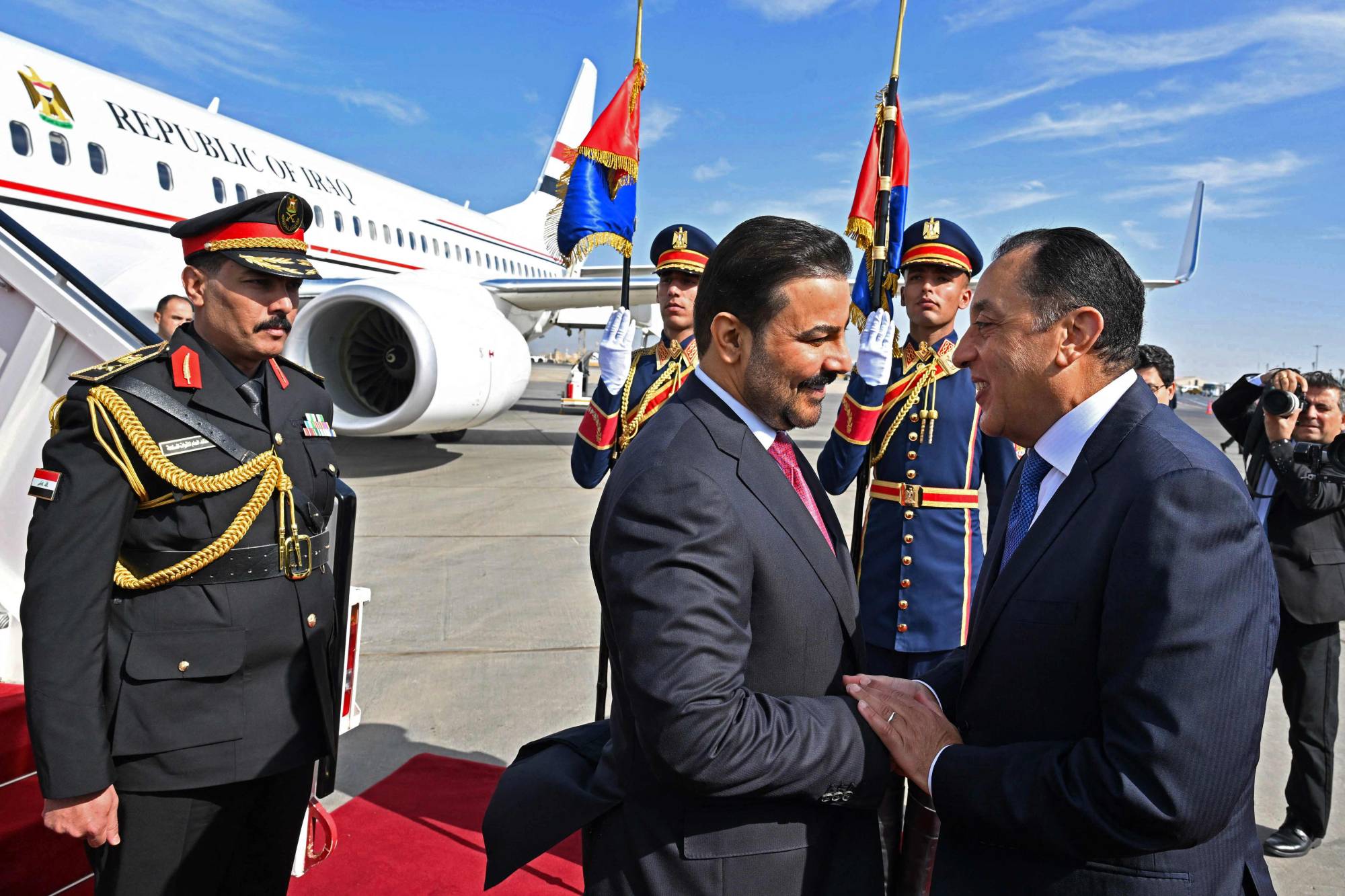
Egyptian Prime Minister Mostafa Madbouly received al-Zaidi at Cairo International Airport before he met with Egyptian President Abdel Fattah al-Sisi.

On Monday evening, al-Zaidi and Madbouly are co-chairing the fourth session of the Joint Higher Committee between the two countries at the government headquarters in the New Administrative Capital.

In a statement, the Egyptian Cabinet said the two sides will witness the signing of several documents across various fields "supporting the enhancement of bilateral cooperation between the two brotherly countries," in addition to attending a business forum to review trade and investment opportunities in both nations.

The visit comes "as both countries seek to open new horizons for joint cooperation, particularly in light of the promising opportunities abundant in Egypt and Iraq across various economic, commercial, and investment fields, with a view to deepening the partnership between the two countries,” it added.

A day earlier, Egyptian Foreign Minister Dr. Badr Abdelatty met his Iraqi counterpart Fuad Hussein on the sidelines of the Aswan Forum, saying he was looking forward to al-Zaidi's visit and the convening of the fourth session of the Joint Higher Committee.

He noted that the visit would give strong momentum to bilateral ties, bolster cooperation across various sectors, and serve the mutual interests of Egypt and Iraq.

The FMs stressed the importance of prioritizing political and diplomatic solutions to resolve crises, and maintaining coordination and consultation on issues of mutual concern to support efforts aimed at achieving regional security and stability.

Region in focus

Al-Zaidi’s first visit to Egypt centers on the regional developments and tensions across the Middle East. His media office said in a statement on Monday that al-Zaidi will discuss ways to confront various challenges in a manner that strengthens regional security and stability.

According to an Egyptian presidential statement, the PM expressed during his meeting with Sisi his appreciation for Egypt’s efforts aimed at easing regional tensions and preserving stability.

He underlined Iraq’s desire to intensify political consultation to prevent renewed regional escalation.

Egypt's Prime Minister Mostafa Madbouly (R) shakes hands with his Iraqi counterpart Ali al-Zaidi upon his arrival at the airport in Cairo on November 23, 2026. (AFP)

On bilateral cooperation, the two sides discussed ways to deepen joint collaboration in energy, investment, trade, and military cooperation.

Sisi reaffirmed Egypt’s steadfast position in support of the security and stability of all Arab countries, saying their security is an extension of Egyptian national security.

He highlighted Egypt’s persistent efforts to resolve ongoing regional crises.

Significance of the visit

Mohammed Hegazy, a member of the Egyptian Council for Foreign Affairs and former assistant foreign minister, said al-Zaidi's visit reflects growing Iraqi recognition of the importance of revitalizing relations with its Arab neighborhood.

Speaking to Asharq Al-Awsat, he added that Iraq, by virtue of its geographical and political standing, as well as its economic weight and resources, "cannot remain detached from the equations of security and stability in the region.”

“Cairo is a key Arab partner for Baghdad with extensive political and diplomatic experience and the ability to engage with various regional and international actors,” he went on to say.

Al-Zaidi’s first visit reflects "a desire to elevate the relationship from routine political coordination to a deeper, more sustainable partnership, and to move toward a policy grounded in national interests, balance, and strengthening the Arab presence in confronting current challenges,” he added.

He noted that Egypt and Iraq have a significant opportunity to expand cooperation, "but its success hinges on moving from agreements and memoranda of understanding to concrete projects with measurable results."

Hegazy believes this momentum should be built upon by identifying priority projects, while expanding opportunities for cooperation in electricity, electrical interconnection, the exchange of expertise in the oil and gas sector, and renewable energy projects.

Egyptian-Iraqi trade exchange reached roughly $1.1 billion in 2024, according to official Egyptian figures.

Hegazy said this remains well below available potential, and therefore the objective should not merely be increasing trade volume, but diversifying it and boosting investment.


Lebanon: Number of Detainees in Al-Qaa Explosives Case Rises to Six

Lebanese soldiers deployed in southern Lebanon. (AP file)
TT

Lebanon: Number of Detainees in Al-Qaa Explosives Case Rises to Six

Lebanese soldiers deployed in southern Lebanon. (AP file)

The number of detainees held in connection with the explosives shipment arriving from Syria, which the Lebanese Army seized in the Mashari al-Qaa area of the Bekaa Valley on Sunday, has risen to six Lebanese nationals.

Security agencies are tracking down two Syrians suspected of having been set to receive the cargo.

Government Commissioner to the Military Court Judge Claude Ghanem ordered the preliminary investigation transferred from the Military Police to the Army's Intelligence Directorate in order to expand the probe and identify the party for which the shipment was intended.

The number of detainees will likely rise as the investigation unfolds.

A judicial source told Asharq Al-Awsat that preliminary information indicates the two Syrians "were supposed to handle transporting the explosives to warehouses in the Bekaa," noting that their arrest is expected to help "uncover the identity of the recipient."

The source confirmed that Judge Ghanem "requested that samples of the seized TNT and C-4 be sent to laboratories for analysis, in an effort to determine their origin and compare them with samples from the Dahr al-Baidar shipment."

He pointed to "similarities between the materials seized in both shipments, with tests awaited to determine whether they are identical."

The Lebanese Army's announcement on Sunday regarding the seizure coincided with a statement by Syrian security forces reporting the confiscation of a cache of weapons in the Damascus countryside that they said was destined for smuggling into Lebanon.

The Lebanese Army had previously intercepted roughly 200 kilograms of explosives near the Syrian border in the Lebanese area of al-Qasr, while the person transporting them fled toward Syria.

A security source told Asharq Al-Awsat that repeated seizures along the eastern and northern borders "call for strengthening field measures and maintaining continuous coordination between Lebanon and Syria to close the loopholes threatening the security of both countries."

The security source stressed "the need to raise the readiness of security agencies to thwart smuggling operations before shipments reach their destinations."


Israel Defense Minister Says Police, Not Army, Should Handle Settler Violence

Palestinians inspect the damage after Israeli settlers set fire to their cars at the West Bank village of Kufr Malik, 22 November 2026. (EPA)
TT

Israel Defense Minister Says Police, Not Army, Should Handle Settler Violence

Palestinians inspect the damage after Israeli settlers set fire to their cars at the West Bank village of Kufr Malik, 22 November 2026. (EPA)

The defense minister in Israel's caretaker government on Monday said the police, not the military, should deal with violent settlers in the occupied West Bank, after Palestinian vehicles and properties were torched over the weekend.

It is not the first time Israel Katz, who serves in the right-wing caretaker government of Benjamin Netanyahu, has spoken about transferring civilian law enforcement over West Bank settlers to the police.

If implemented, the measure could constitute a step towards Israeli annexation of the Palestinian territory.

On Monday, Katz called the "ongoing violence by a handful of rioters... extremely serious in every respect."

The military "should not and cannot deal with civilian law enforcement over the Jewish population in Judea and Samaria" he added, using the biblical name for the West Bank, which Israel has occupied since 1967.

"Therefore, in accordance with my directive, the army has formulated a plan to transfer responsibility for civilian criminal enforcement in the territories to the Israel Police, which will be reinforced and prepared accordingly," Katz said.

"Only in this way will it be possible to normalize reality in Judea and Samaria and enable the settlements to flourish and prosper," he added.

Katz made a call to transfer law enforcement in August, during a siege of Palestinian homes in the northern West Bank, saying the police would "prepare and establish an appropriate force to handle civil matters".

His statement on Monday comes after Israeli authorities said they were investigating the torching of Palestinian vehicles and property in four West Bank villages over the weekend.

Social media posts showed vehicles in flames as well as slogans written on walls, including: "In blood and fire Judea has fallen, in blood and fire Judea will rise again".

At a conference on Monday, Israeli President Isaac Herzog said "violence by Jewish extremists against innocent people... is despicable and deserves strong condemnation," insisting that law enforcement was working "to scour this terrible moral stain".

Violence in the West Bank, occupied by Israel since 1967, has surged since Hamas's October 7, 2023 attack on Israel, which triggered the Gaza war.

More than 500,000 Israelis live in West Bank settlements, which are illegal under international law, in a territory home to around three million Palestinians.
