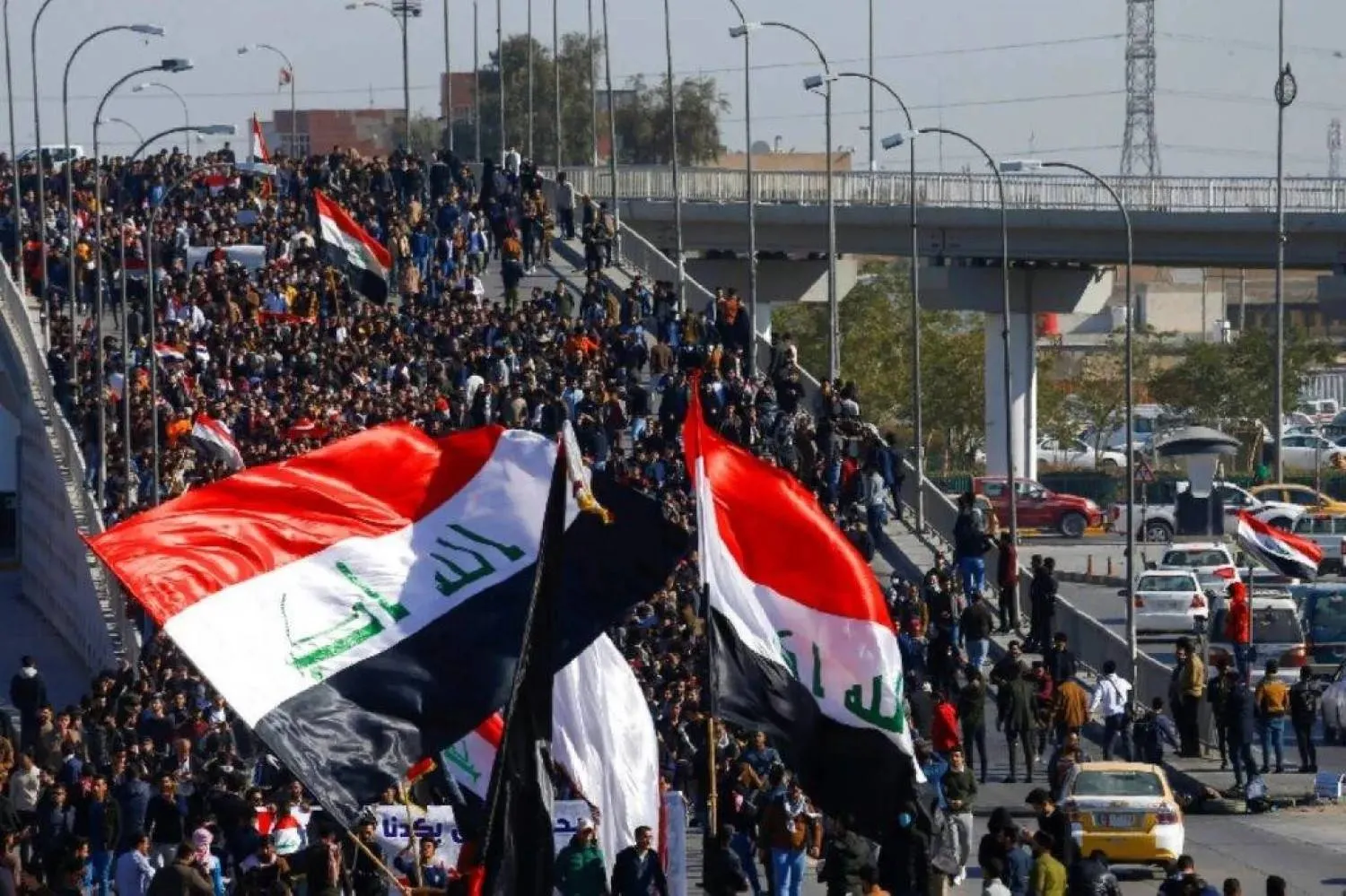

Public anger and criticism are mounting against Badr Organization chief Hadi al-Amiri after he acknowledged the involvement of what he called the “resistance” in events surrounding Iraq’s October 2019 protest movement.
The movement lasted nearly two years, leaving more than 600 demonstrators dead and over 20,000 wounded.
Many families of the victims said they planned to sue al-Amiri over his latest “admissions.”
“The resistance courageously stood against the Tishreen sedition and preserved the state and the political system,” al-Amiri said last Monday.
Most activists and observers saw the remarks as “an explicit admission that armed factions describing themselves as the ‘resistance’ were implicated in the bloodshed of demonstrators and protesters.”
Iraqi authorities formed numerous committees over the past several years to investigate the protests and the events surrounding them. But they announced no significant findings despite the high death and injury toll.
That reinforced a widespread belief that “armed factions feared by the authorities were involved in massacres of protesters.”
In September 2020, the office of Iraq’s top Shi’ite cleric, Ali al-Sistani, called on the authorities to “work with utmost seriousness to uncover everyone who committed criminal acts — including killing, wounding or otherwise — against demonstrators, security forces or innocent citizens.”
The authorities did not respond. Instead, they suggested a “third party” was behind the killings and other violence that accompanied the protest movement.
Hussein al-Gharabi, head of the National Home Party, which emerged from the Tishreen movement, said in a Facebook post: “Al-Amiri is publicly admitting that the third party in Tishreen was the resistance.”
He called al-Amiri’s statement “extremely dangerous” and said it contradicted the position of the religious authority, which called the Tishreen youth “the beloved” and described the blood of those killed as pure.
“Yet he comes forward and admits that the force that suppressed the ‘Tishreen sedition’ — as he unjustly and maliciously calls it — was the resistance’s weapons,” al-Gharabi said.
“Who gives him this advice and these hurtful words that divide the people?” he asked.
“How has he turned the resistance, which many Iraqis view through a patriotic lens, into a force that restrains the people’s aspirations and suppresses their legitimate demands — even burdening it with responsibility for the blood spilled during Tishreen?”
Sheikh Aws al-Khafaji, a former commander of the Abu al-Fadl al-Abbas faction, also lashed out at al-Amiri.
“God reveals the truth, even after a time,” al-Khafaji said in a television interview. “The blood shed in Tishreen carries a reckoning — the consequence of injustice. That reckoning has emerged in several stages and at many levels, including this moment when the leader of an Iraqi faction admits that he and his faction took part in killing hundreds of Iraqi youths.”
“I hope this declaration is used to submit a statement and a complaint to Iraq’s public prosecutor over his responsibility for this bloodshed,” he added, referring to al-Amiri.
Rights groups and political figures issued a stream of statements over the next two days rejecting al-Amiri’s remarks.
Al-Amiri and his organization are close allies of Iran and fought alongside it in its 1980-1988 war against Iraq.
The Nazil Akhudh Haqqi Democratic Movement, which emerged from the Tishreen movement, said: “At a time when state institutions are working to entrench the rule of law, combat corruption and address challenges, some political parties are issuing irresponsible statements describing Tishreen as a ‘sedition.’”
“Tishreen was and remains an honest expression of Iraqis’ concerns and their aspirations for reform and change,” it added. “Its young people shed their pure blood in defense of their freedom, while questions remain over the parties that targeted them.”
Ali al-Abadi, head of the Iraq Center for Human Rights, called on the Supreme Judicial Council and other relevant authorities to “address the Tishreen events and open a serious and transparent investigation that identifies those responsible for the violations in accordance with the law.”
“Al-Amiri’s statements require serious judicial scrutiny, away from political calculations,” he said.
Al-Abadi also urged international organizations, the United Nations and the International Criminal Court to follow the case “to ensure that those involved in violations do not escape accountability and justice.”
What ‘resistance’?
Writer and analyst Falah al-Mashaal said in a post on X that “the revolutionaries of the Tishreen uprising represent the conscious and courageous vanguard expressing the broad, national popular rejection of the quota-based system and the departure from the constitution, rights and justice.”
“Are these people to be killed in the name of the ‘resistance’ to preserve a system of thieves ... who violated the country, plundered its wealth and impoverished its people?” he asked.
“What kind of ‘resistance’ defends the most corrupt political system in history? Is it conceivable that revolutionaries should be killed for seeking to reclaim their country from the gangs of political parties and corrupt officials?”
Analyst and writer Yahya al-Kubaisi said on X that al-Amiri’s comments about those who killed Tishreen protesters were “not a slip of the tongue or a belated admission.”
Rather, he said, they were “a veiled threat that the militias will confront any future protest with the same machinery of death and will escape punishment, as usual.”
Former lawmaker Sajjad Salim said in a similar post: “Hadi al-Amiri has confirmed what everyone knows and what the resistance denies — and what led to us being inundated with lawsuits that pursue me today wherever there is a court in Iraq.”
“Al-Amiri confessed as though delivering the confession of a victor,” he added. “He confessed as thousands of young people from southern Iraq left the country after the resistance turned it into hell for them and their families.”
Complaint filed with the public prosecutor
Lawyer Hazem Mazen al-Badri filed a formal complaint with the public prosecutor in Wasit province on Wednesday, seeking legal proceedings and al-Amiri’s summons over his remarks about the “Tishreen sedition.”
According to the complaint, al-Badri cited a widely circulated video in which al-Amiri is heard saying: “The resistance courageously stood against the Tishreen sedition and preserved the state and the political system.”
Al-Badri said the remarks “raise serious questions requiring a judicial investigation to determine the nature of the tasks and actions carried out by the groups known as the ‘resistance.’”
The investigation should determine whether those actions were linked to attacks on protesters, their suppression, or the deaths and injuries recorded during the demonstrations, he said.
Al-Badri urged the judiciary to open a formal investigation, secure the original video recording and summon al-Amiri for questioning. He also called for al-Amiri’s testimony to be compared with previous investigations and the files of those killed and wounded.