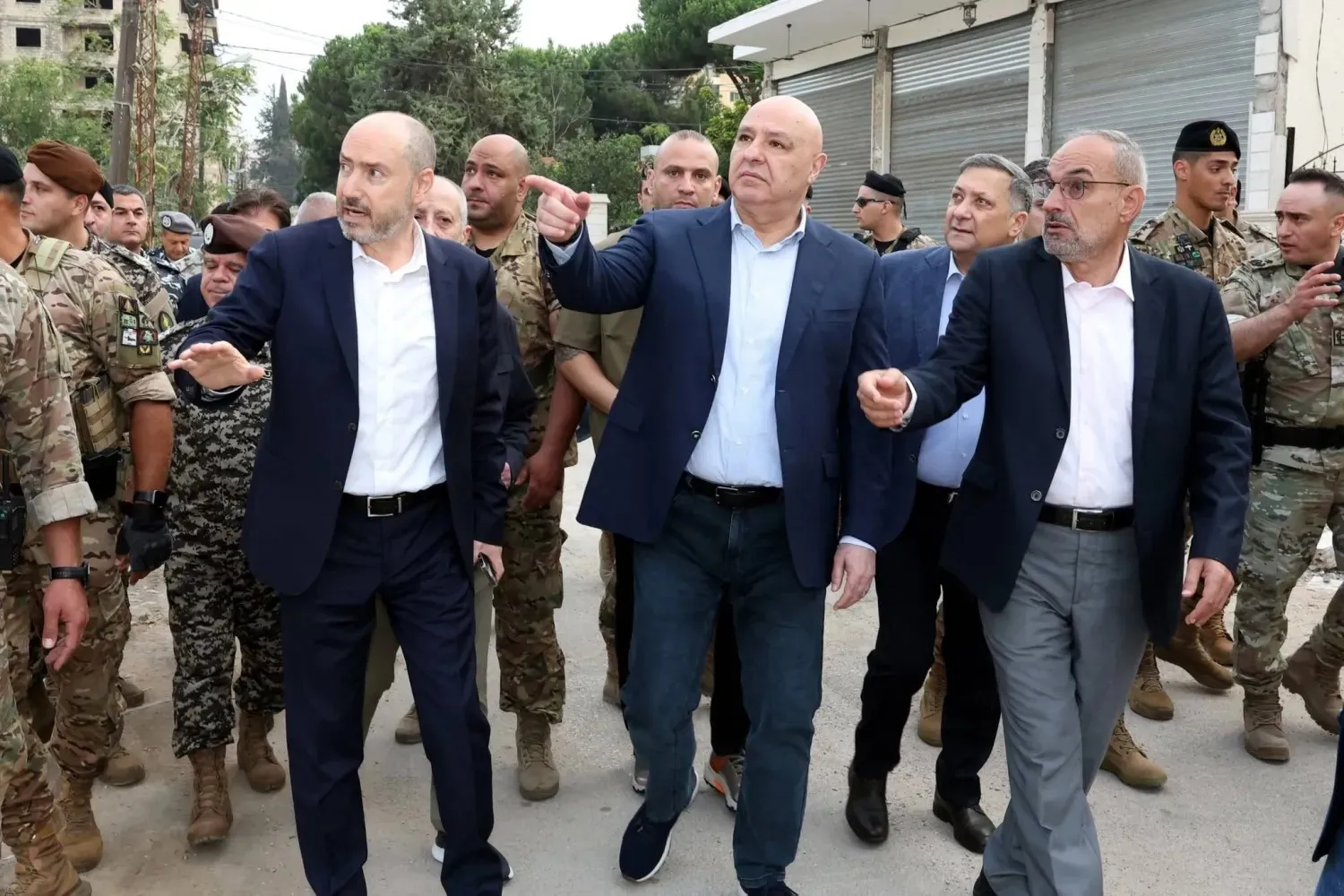
Aoun from Nabatieh: No New Negotiations with Israel at Present

Lebanese President Joseph Aoun tours the Nabatieh market - destroyed by Israel - during his visit to southern Lebanon. (Lebanese Presidency)
TT

Aoun from Nabatieh: No New Negotiations with Israel at Present

Lebanese President Joseph Aoun tours the Nabatieh market - destroyed by Israel - during his visit to southern Lebanon. (Lebanese Presidency)

Lebanese President Joseph Aoun visited the country's south on Saturday, in a surprise trip to Nabatieh, a city close to the strategic Ali al-Taher ridge captured from Hezbollah and blown up by Israel.

Official Lebanese media said he arrived in Nabatieh unannounced and accompanied by security officials.

The National News Agency (NNA) quoted Aoun as saying that there would be no new negotiations with Israel at present, stressing that the withdrawal of Israeli forces, the return of prisoners and displaced people, and reconstruction remain national principles that Lebanon is committed to upholding.

Aoun expressed solidarity with locals who greeted him, according to footage broadcast by Lebanese media.

He praised staff at Nabatieh Governmental Hospital, saying they were risking their lives to provide medical services in the area, which most people have fled.

He spoke a day after a senior US diplomatic official said a new round of US-brokered talks between Israel and Lebanon, initially scheduled for next week, had been pushed back to October.

Fighting between Israel and Hezbollah had eased off between late June and last week, thanks to a US-sponsored framework agreement between the two countries as well as a memorandum of understanding between the United States and Iran in the wider Middle East war.

But the Israeli army has in recent days stepped up attacks again, particularly in the Nabatieh region.

On Thursday it blew up underground fortifications on Ali al-Taher ridge after seizing the site, which lies a few kilometers from Nabatieh city.

The explosion was large enough to trigger a tremor detected by seismic monitoring agencies.

Israeli strikes in the area have killed at least 29 people in the last few days, including 12 members of the same family.

The Lebanese army, which has deployed in Nabatieh city, warned on Wednesday that Israel's actions threatened the implementation of the framework agreement.

The agreement involves the disarmament of Hezbollah, a gradual withdrawal of Israeli forces from Lebanon's south and the deployment of the Lebanese army to the region, starting in test areas known as "pilot zones.”


Lebanon's President: We Will Not Allow Anyone to Share Our Sovereignty

Lebanese President Joseph Aoun receives the second volume of a book on Lebanon and Lebanese neutrality (Lebanese Presidency)
TT

Lebanon's President: We Will Not Allow Anyone to Share Our Sovereignty

Lebanese President Joseph Aoun receives the second volume of a book on Lebanon and Lebanese neutrality (Lebanese Presidency)

Lebanese President Joseph Aoun vowed that no one would be allowed to share the state's sovereign authority, warning that Lebanon must not again pay the price for past mistakes.

His remarks came as five countries calling themselves the "Friends of Lebanon" renewed their support for Lebanese sovereignty and urged lawmakers and political parties to publicly affirm that the state alone has the right to decide on war and peace.

Lebanese authorities have pledged to bring all weapons under state control and reserve decisions on war and peace exclusively for the state. Hezbollah, however, rejects those decisions and insists on keeping its arms.

"Lebanon is an independent and sovereign state," Aoun said on Thursday. "We will not allow anyone to share our sovereignty, so that we do not once again pay the price for the mistakes of the past."

He urged those who seek foreign support against their fellow citizens to instead stand with their own people against outside powers.

Aoun called "positive neutrality" essential to shielding Lebanon from regional conflicts, saying the country had endured enough and could no longer bear the weight of rival blocs, foreign ambitions and attempts at domination.

He urged Lebanon's younger generation to recognize their country's value through education rooted in citizenship and openness to other cultures and civilizations, rather than isolation and dependence.

Protecting Lebanon from foreign ambitions and strengthening national unity were vital to safeguarding the country as rapid military and political developments plunged the region into uncertainty, he said.

International allies back Lebanon's decisions

Lebanon's pledges drew renewed international backing from the "Friends of Lebanon", who reaffirmed their support for the country's sovereignty and the state's exclusive control over weapons.

In a statement circulated by the US Embassy in Beirut, the embassies of Britain, the United States, Australia, Canada and Japan voiced strong support for the Lebanese government's efforts to ensure that only the state holds weapons and decides on war and peace.

"As friends of Lebanon, we reaffirm our strong support for the government of Lebanon in ensuring that weapons are held exclusively by the state and that the state alone has the authority to decide on matters of war and peace," the embassies said.

The five embassies also acknowledged steps taken by Lebanese authorities in the Dahr al-Baidar case, urging a swift, independent judicial process free from political interference to ensure full accountability.

They called on all members of parliament and political parties to make a clear, public commitment endorsing statements by the president and prime minister that the Lebanese state alone has the right to decide on war and peace.

The embassies reiterated their determination to see Lebanon fully restore effective sovereign authority across its entire territory.

Hezbollah defends seized explosives, attacks Israel talks

Hezbollah, meanwhile, defended a shipment of explosives seized by security forces last month in the Dahr al-Baidar area of eastern Lebanon.

The group's parliamentary bloc, Loyalty to the Resistance, called for an end to political accusations and media disputes, urging space for what it described as prudent national efforts to address the issue.

In a statement, the bloc condemned political positions it said denied the Lebanese people's "sacred right" to defend their country and resist the enemy, accusing those behind them of disregarding the constitution and established national legal principles.

The bloc also renewed its attack on the Lebanese government's approach to negotiations with Israel, demanding that authorities reverse course.

It accused Israel of continuing to destroy, burn and demolish villages and property in southern Lebanon while threatening to expand its attacks and occupy more Lebanese territory.

The bloc also pointed to mounting threats of an escalation in the war, including strikes and assassinations targeting Hezbollah and its leaders.

Yet Lebanese authorities remained indifferent, it said, accusing them of pursuing a "disastrous" policy of direct negotiations over the provisions of what it called an "ill-fated framework".

The bloc said the framework had brought Lebanon nothing but further calamities, devastation and destruction.


Jordan Says Security Officer Killed in Amman in Stabbing Attack

Jordan's capital, Amman (AFP)
TT

Jordan Says Security Officer Killed in Amman in Stabbing Attack

Jordan's capital, Amman (AFP)

Jordanian authorities said a security officer was stabbed to death in the country's capital Amman on Thursday, calling it a "terrorist attack".

"The Public Security Directorate mourned the martyrdom of Corporal Jawad Ali Khalaf Al-Salaytah, who was killed in a cowardly terrorist attack," the directorate said in a statement.

Another officer was injured in the incident, it added.

Authorities said the attack took place in front of the Sri Lankan embassy, where the victim was stabbed with a "sharp object".

The officer was rushed to hospital but later died from his injuries, the directorate said.

A nearby police patrol responded immediately and arrested the attacker, it added.

The second officer wounded in the incident sustained injuries to their face as he tried to intervene and is in a stable condition.

Security agencies were investigating, the directorate said.


Egypt, US Sign Strategic Objective Agreement to Expand Cooperation

Egypt and the US seek greater cooperation across multiple sectors (Egyptian Foreign Ministry). 
TT

Egypt, US Sign Strategic Objective Agreement to Expand Cooperation

Egypt and the US seek greater cooperation across multiple sectors (Egyptian Foreign Ministry). 

Egypt and the United States signed a Strategic Objective Framework Agreement on Enhancing Mutual Prosperity on Wednesday, aimed at expanding cooperation across several sectors, according to the Egyptian Foreign Ministry.

Egyptian Foreign Minister Badr Abdelatty attended the signing ceremony alongside the ministers of finance, supply and internal trade, and higher education and scientific research.

The agreement was signed by Egypt’s Deputy Foreign Minister for International Cooperation, Dr. Samar El-Ahdal, and US Chargé d’Affaires in Cairo Robert Silverman.

Foreign Ministry spokesman Ambassador Nader Zaki said the framework agreement aims to strengthen cooperation with the United States to achieve tangible economic growth in Egypt.

He explained that its objectives include expanding cooperation in key sectors and adopting US institutional and technological innovations to improve the efficiency of Egypt’s water, energy and infrastructure systems.

The agreement also seeks to modernize education, healthcare and governance, develop the skills of Egyptian professionals and create more jobs, particularly in areas of shared strategic interest such as water management, artificial intelligence and energy.

Another objective is to strengthen Egypt’s food security through science-based agriculture.

The signing comes amid repeated statements by both sides emphasizing the strategic nature of relations between Cairo and Washington and their longstanding ties.

Former US Ambassador David Satterfield identified three main reasons behind Washington’s strategic view of Egypt: preserving the Egyptian-Israeli peace treaty, ensuring access to and transit through the Suez Canal, and maintaining stability within Egypt itself.

Satterfield told Asharq Al-Awsat that the peace treaty “remains, even in light of the Abraham Accords, the cornerstone and fundamental pillar of stability and peace in the broader Middle East.”

He explained that the United States considers its engagement with and support for Egypt vital to preserving the treaty.

“Egypt’s geographical location gives it particular importance to the United States because of the Suez Canal,” he added.

A Congressional Research Service report updated on February 25, 2026, supports this assessment, linking Egypt’s importance to US national security to its geographical position, population and diplomatic influence.

The report notes that facilitating the passage of US naval vessels through the Suez Canal provides Washington with a significant advantage when it needs to deploy forces rapidly to the Gulf and Indian Ocean.

US interests, however, extend beyond the canal and the peace treaty.

Satterfield warned that instability in Egypt, whether driven by economic or political factors or both, “would threaten not only US interests but those of the broader Middle East.”

In his assessment, Egypt’s stability is therefore a strategic interest in its own right, rather than merely a desired outcome of bilateral cooperation.

Ben Fishman, a researcher at the Washington Institute for Near East Policy and former director for North Africa at the US National Security Council, agreed.

He told Asharq Al-Awsat that the United States maintains a longstanding strategic relationship and strong military partnership with Egypt, while the peace agreement with Israel “remains a pillar of regional stability.”

The two countries’ interests also converge in Gaza. Washington needs a regional partner to help negotiate and implement security arrangements, while Cairo requires US cooperation to support a resolution to a crisis affecting its borders and security.

The Congressional Research Service notes that Egypt played a key role, alongside other partners, in mediating the October 2025 Gaza ceasefire and hosted the Sharm el-Sheikh summit in support of the agreement.

Despite the importance of their relationship, Cairo and Washington do not agree on every issue.

Fishman explained that US and Egyptian interests converge in some conflicts and diverge in others, which is natural in a relationship based on mutual interests.

Satterfield echoed that assessment, stressing that such differences do not undermine the strategic nature of bilateral ties.

“Disagreements also exist between the United States and NATO countries, but they do not diminish the fact that both sides view the relationship as strategic,” he said. “That is the nature of international relations.”

In a related development, Abdelatty discussed the latest regional developments with Massad Boulos, senior adviser to the US president for Arab and African affairs, during a telephone call on Wednesday.

According to the Egyptian Foreign Ministry spokesman, the discussion addressed intensive efforts to promote de-escalation.

Abdelatty stressed “the importance of all parties showing the necessary flexibility to reduce tensions and allow a return to the political track, rather than moving toward a resumption of military operations, whose grave dangers to the region and the world President Sisi has warned against.”

The call also covered “the need to maintain full support for efforts to unify the Libyan government in a way that achieves the security and stability sought by the Libyan people.”

The two officials also discussed the situation in Sudan, emphasizing the importance of ending the ongoing war and launching a Sudanese-owned political process.