


Yemeni Leadership Moves to Overcome Shock of Losing West Coast

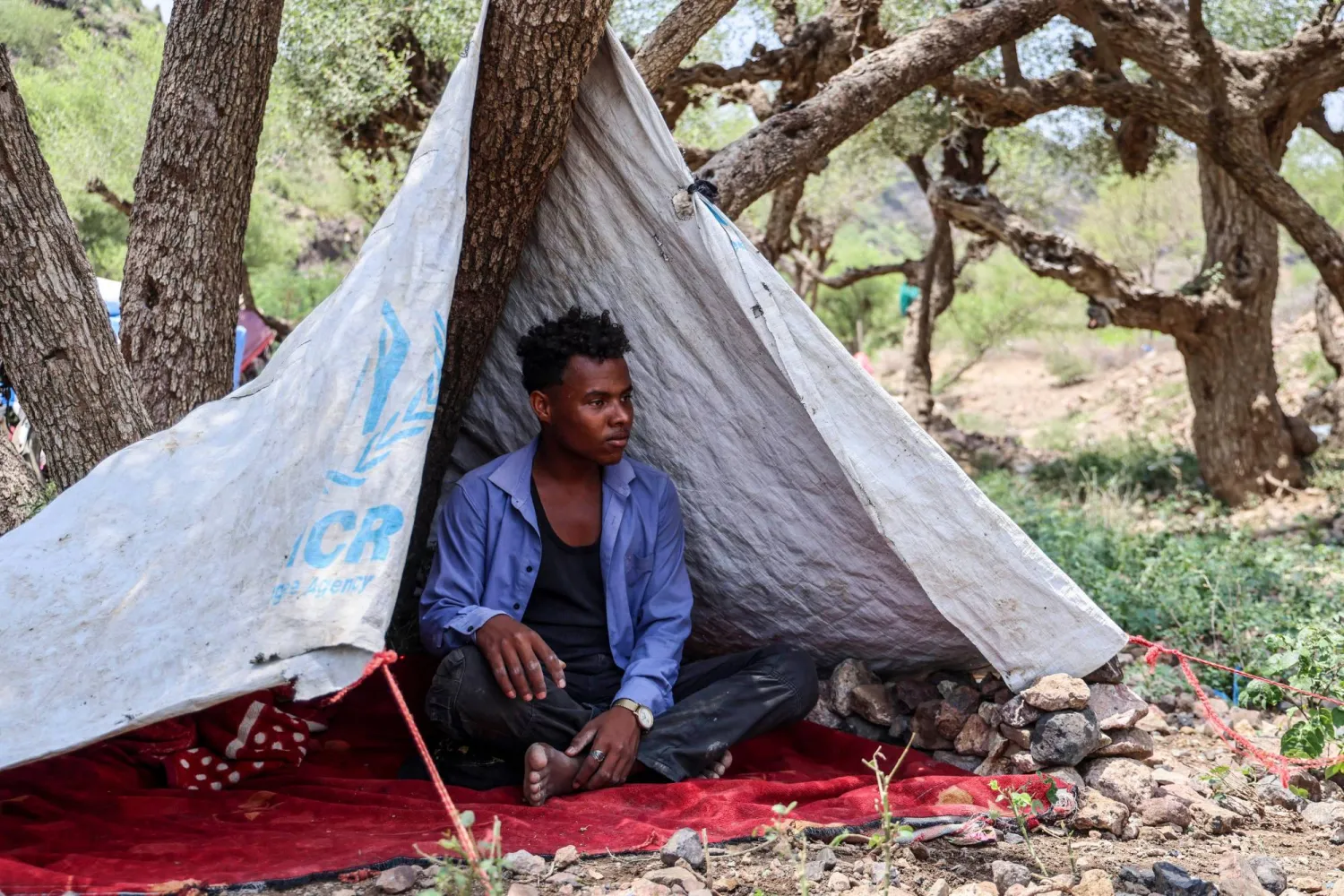
An internally displaced (IDP) Yemen, one of many who fled their homes due to renewed clashes between Yemen's government forces and the Houthi group, sits in his shelter in the al-Kadha area of the Taiz governorate, southwestern Yemen on September 6, 2026. (AFP)
TT

Yemeni Leadership Moves to Overcome Shock of Losing West Coast

An internally displaced (IDP) Yemen, one of many who fled their homes due to renewed clashes between Yemen's government forces and the Houthi group, sits in his shelter in the al-Kadha area of the Taiz governorate, southwestern Yemen on September 6, 2026. (AFP)

The Yemeni leadership is moving to deal with the loss suffered by government forces on the west coast as a painful field setback, but one that should not become a turning point in the conflict with the Houthi group.

The government and Presidential Leadership Council are, meanwhile, seeking to rearrange forces and regain the initiative, while containing the humanitarian consequences of displacement and maintaining the operation of state institutions.

PLC member and Governor of Marib Sultan Al-Aradah said the developments on the west coast are "painful and regrettable," but are part of wars that witness advances and retreats.

The developments will not deflect from the main goal, he added.

In remarks carried by state media, he said the forces that withdrew from the coast are rearranging their ranks and will return to the battle "in one way or another."

Field developments on the west coast had forced government troops to redeploy after losing positions and areas, amid a broad Houthi escalation. The developments led to new waves of displacement, while a number of military personnel relocated to Marib, where Al-Aradah said authorities had prepared a camp for them and made arrangements to secure their needs.

Al-Aradah's remarks reveal that the Yemeni leadership is attempting to shift the handling of the west coast loss from a state of field shock to restoring combat capability.

This approach aligns with what Prime Minister Shaya Al-Zandani put forward during a cabinet meeting in the interim capital Aden, when he stressed that the difficult developments over the past days should not be understood as an end to the confrontation.

He stressed that battles are not measured by the outcome of a single day or a change in a position, but rather by the state's ability to reorganize its efforts, mobilize its resources, support its forces, maintain the cohesion of its institutions, and regain the initiative.

It appears that the Yemeni leadership's priority in the coming phase centers on rearranging the forces that withdrew from the coast and reintegrating them into operations, alongside elevating government support for the armed and security forces.

The cabinet confirmed that it reviewed a report from the minister of defense regarding the military situation across various fronts, operational readiness levels, and requirements, while underlining the need to boost the forces' capacity to confront the escalation and regain the initiative.

In Marib, Al-Aradah said that the governorate's forces are focused on victory and supporting various fronts, noting that the ultimate goal in the fighting, in Marib and elsewhere, remains the liberation of the capital, Sanaa, from the Houthis.

The forces and commanders on the ground bear a historic responsibility to defend the state and national dignity, he said.

Yemen’s Armed Forces Say It Is Conducting Strikes Against Houthis in Sanaa

Yemen government soldiers ride in a pick-up truck near the Jabal Han front, west of the city of Taiz on October 3, 2026. (AFP)
TT

Yemen’s Armed Forces Say It Is Conducting Strikes Against Houthis in Sanaa

Yemen government soldiers ride in a pick-up truck near the Jabal Han front, west of the city of Taiz on October 3, 2026. (AFP)

Yemen's armed forces said early on Sunday it was conducting strikes against the Iran-aligned Houthis in the capital Sanaa and the group's stronghold Saada. 

A spokesperson for Yemen's armed forces, which ‌are aligned with ‌the legitimate government, ‌said ⁠forces were targeting "vital targets", without providing further details. 

The ‌conflict between the Iran-backed Houthis and forces aligned ‌with the government mostly ‌stopped after a 2022 truce, but fighting has broken out again in a spillover from the wider war between Iran ‌and the United States. 

Hostilities resumed this year after the ⁠Houthis ⁠escalated attacked in Yemen, making major territorial gains along the Red Sea coast. 

Earlier, government forces broke a new wave of Houthi attacks targeting the western front of the city of Taiz and forced the attackers to retreat.

This coincided with a broad escalation in air and artillery targeting operations that struck the group's positions, reinforcements, and supply lines across various fronts in the governorate.

The Iran-backed Houthi group has been exerting pressure for more than two weeks in an effort to encircle the city of Taiz from the south by seizing control of its countryside and isolating it from the liberated Yemeni regions toward Lahij and Aden.

It has also been trying to consolidate its gains in the West Coast and Bab al-Mandab regions by taking control of the highlands.

Armed Forces spokesperson Colonel Majid Al-Nuzaili said that the forces carried out 71 precise operations against Houthi gatherings, mobilizations, and reinforcements in the areas of Al-Aqrud, Samea, Al-Ahkoum, Al-Akboosh, Jabal Rasen, Jabal Jardad, Bani Omar, Bani Bakari, Al-Kaawish, and Al-Athawir.

He added that the operations resulted in the destruction of a number of hostile transport and support vehicles and the neutralization of militia elements, repelling their advance.


'National Day' Stirs Debate over Independence in Iraq

Members of the Iraqi security forces stand guard near the Victory Arch monument during preparations for Sovereignty Day celebrations, marking the withdrawal of US-led coalition forces from Iraq, in Baghdad, Iraq, October 2, 2026. (Reuters)
TT

'National Day' Stirs Debate over Independence in Iraq

Members of the Iraqi security forces stand guard near the Victory Arch monument during preparations for Sovereignty Day celebrations, marking the withdrawal of US-led coalition forces from Iraq, in Baghdad, Iraq, October 2, 2026. (Reuters)

Senior officials in Iraq celebrated the National Day on October 3, which marks the country's independence from the British mandate and its entry into the League of Nations in 1932. The day has sparked debate over conflicting occasions in the official calendar.

President Nizar Amidi said in a statement that “on this day in 1932, Iraq became an independent state and a member of the League of Nations,” noting that “Iraqis have remained committed to their homeland despite the wars, crises, challenges, and difficulties they have endured.”

Meanwhile, government spokesperson Haider Al-Aboudi stressed that “on this occasion, the government renews its pledge that the decision of Iraqis remains in their own hands, and that sovereignty is manifested in security and a dignified life.”

Judge Faiq Zidan, head of the Supreme Judicial Council, also stressed that “the judiciary will remain a guarantee for rights and a fortress for justice,” adding that “the accelerating developments at this stage and the increasing challenges facing Iraq make it capable of protecting its present and shaping its future with deeply rooted institutions and an independent judiciary.”

British King Charles III and Emperor Naruhito of Japan both sent congratulatory cables to the Iraqi government on National Day, which does not receive significant political or public attention due to legislative and political disputes.

King Charles expressed his aspiration for continued cooperation between the two countries in facing shared challenges, particularly regarding climate, environmental preservation, and working together to find effective and sustainable solutions to these challenges.

Debate over ‘National Day’

For years, cultural and political elites have been engaged in a debate over a date that could achieve consensus as the country's National Day.

The former Baath regime had designated July 17 to commemorate its 1968 coup against the rule of the late Prime Minister Abdul Karim Qasim, while leftist factions used to celebrate the fall of the monarchy on July 14, 1958.

After 2003, leaders of opposition parties to the regime of the late President Saddam Hussein attempted to designate the day of his regime's fall, April 9, as a national holiday. The suggestion was rejected by the American civil administrator, Paul Bremer, according to Nabil al-Musawi, a leader in the Iraqi National Congress led by Ahmad Chalabi.

Later, during the government of former Prime Minister Mustafa al-Kadhimi, it was agreed to designate October 3, 1932, as Iraq's National Day.

In a statement on Saturday, Kadhimi said that when his government chose October 3 as a national day to commemorate Iraq's accession to the League of Nations in 1932, he did not want it “to be just an occasion on the nation's calendar, but rather a day where Iraqis gather in love for their homeland and pride in their unifying national identity.”

Some Iraqi historians disagreed with the government, stating that October 3 should not be the National Day because, in their view, independence from the British mandate in 1932 was not complete.

Legal expert Ali al-Tamimi told Asharq Al-Awsat that October 3 is the only date that has a binding legal basis to serve as the country's National Day.

Al-Tamimi added that the legal philosophy behind this day is that it serves as international recognition of the completion of the components of the modern Iraqi state, including an independent government, fixed borders, financial resources, an independent judiciary, and international commitment, making Iraq the first Arab country to join the League of Nations.


Hospital Says 5 People Killed in Gaza

Palestinians walk amid war-damaged buildings in Gaza City, Wednesday, Sept. 23, 2026. (AP Photo/Jehad Alshrafi)
TT

Hospital Says 5 People Killed in Gaza

Palestinians walk amid war-damaged buildings in Gaza City, Wednesday, Sept. 23, 2026. (AP Photo/Jehad Alshrafi)

Israeli strikes overnight in Gaza killed five people, according to al-Shifa Hospital, where the casualties were taken. Four women were among the dead. A mother and daughter among them were Christians, a minority in Gaza, the hospital said,

A large fire burned at the site, where the strikes tore a gaping hole in the ground floor of a multistory building. The hospital said people were still reported missing beneath the debris.

Israel's military did not immediately comment, saying it was checking for information.

Israeli strikes have killed at least 1,439 Palestinians in Gaza since a ceasefire was reached with the Hamas militant group nearly a year ago, according to the territory’s Health Ministry. Its figures are seen as generally reliable by UN agencies and independent experts. It does not give a breakdown of civilians and militants.

Israel says it is targeting Hamas and other militants who pose a threat, and in response to ceasefire violations, including occasional attacks.
