


Guterres Backs Libya’s Endorsement of ‘4+4’ Agreement Despite High Council of State Objection

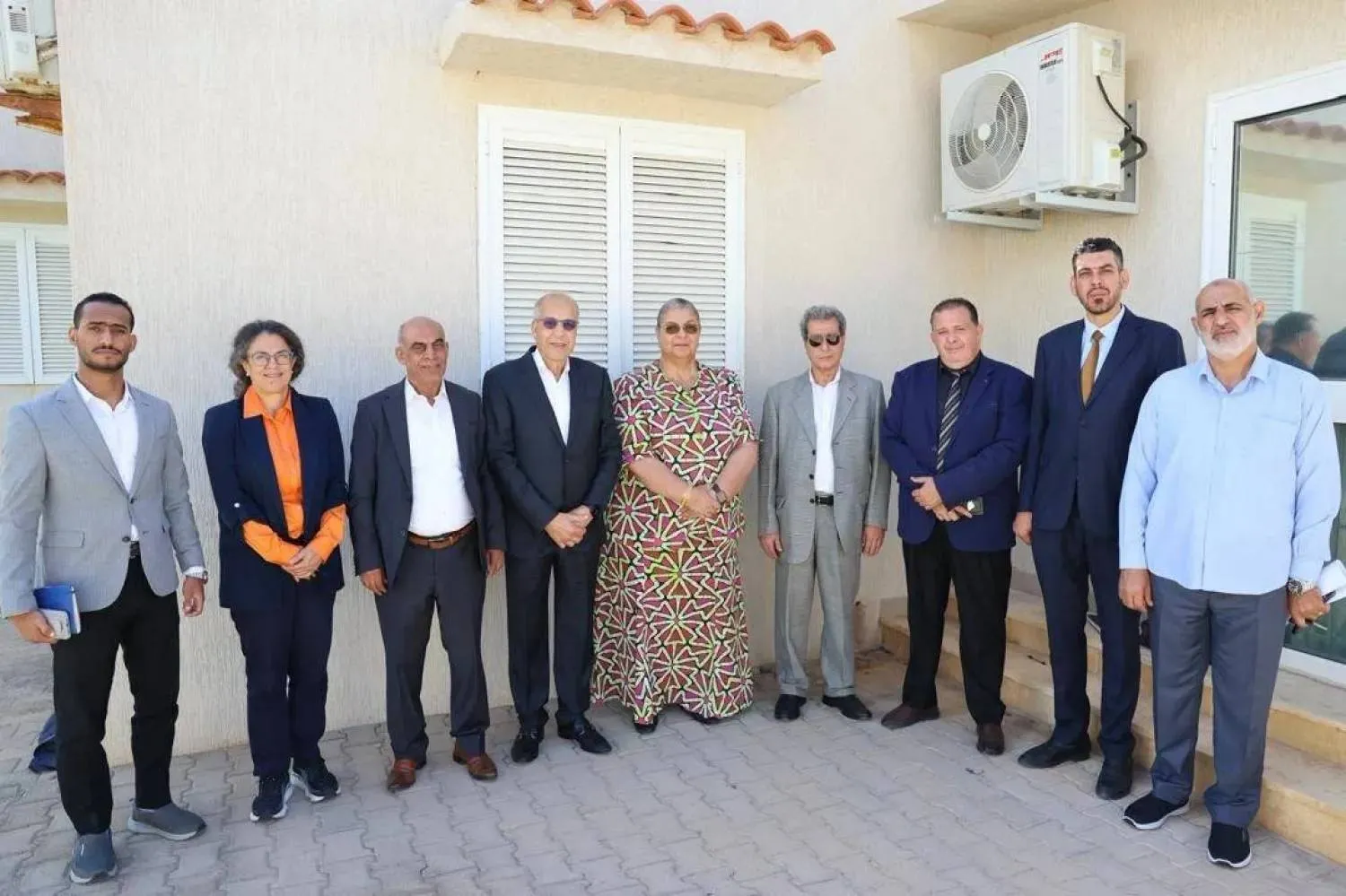
UN Special Representative of the Secretary-General for Libya, Hanna Tetteh and her deputy, Stephanie Koury meet members of the Political Dialogue and Reconciliation Team in Tripoli on Tuesday (UNSMIL) 
TT

Guterres Backs Libya’s Endorsement of ‘4+4’ Agreement Despite High Council of State Objection

UN Special Representative of the Secretary-General for Libya, Hanna Tetteh and her deputy, Stephanie Koury meet members of the Political Dialogue and Reconciliation Team in Tripoli on Tuesday (UNSMIL) 

UN Secretary-General Antonio Guterres on Wednesday welcomed the Libyan House of Representatives’ endorsement of the “4+4” Smaller Convening Agreement signed between Libyan conflict parties on August 30 to pave the way for long-awaited national election.

In a press briefing by the UN Support Mission in Libya (UNSMIL), spokesperson for the Secretary-General, Stephane Dujarric, said the House of Representatives' approval of the agreement represents “an important step to move things forward,” contributing to efforts to resolve the ongoing political deadlock in Libya.

Libya’s House of Representatives approved the agreement unanimously on Monday during a session in Benghazi chaired by Speaker Aguila Saleh.

In return, head of the High Council of State, Mohamed Takala sent a letter to Guterres objecting to the recent move by the UN mission in Tripoli concerning the political process and bodies related to elections.

He said the mission gathered a limited number of people who do not legitimately represent sovereign institutions.

Takala also said those people prepared a document about the structure of the political process and the formation of bodies involved in elections, a move he described as “an overstep of the UN’s facilitating role and an interference in Libya’s internal affairs and sovereignty.”

The head of the High Council of State urged building on the consensus achieved by the “6+6” committee instead of pursuing parallel processes that could deepen divisions.

Takala then asked Guterres to ensure the UN mission adheres to its mandate and respects Libya’s political agreement and state sovereignty.

He requested that the mission not legitimize bodies with limited representation and to reverse its recent action.

On August 30, the 4+4 Committee signed the final agreement during an official ceremony at the UNSMIL headquarters in Tripoli to restructure the board of Libya’s High National Elections Commission, address disputed issues related to the legal framework for presidential and parliamentary elections, and hold the votes under a single executive authority and unified national institutions within a maximum of 24 months.

Earlier this month, UNSMIL said it had formally referred the agreement to the House of Representatives and the High Council of State, giving the two bodies one month from the date of its signing to approve it.

Dr Saleh Al-Makhzoum, a law professor at the University of Tripoli accused some members of the High Council of State of objecting to the UN-sponsored agreement only to “buy time,” as happened during the Skhirat Agreement, signed in Morocco in 2015 to end Libya's civil war and political split.

“Those members ignore the changing motives of the international community towards the Libyan crisis,” he wrote on his Facebook account.

Al-Makhzoum warned that Libya is currently facing a “more complicated” situation due to the overlap of security, economy, oil and international race. He warned that disrupting the 4+4 agreement, or reigniting disputes through the 6+6 committee may narrow Libya’s options.

Meanwhile, the UN mission in Libya continues to intensify contacts with political forces, officials and youth from different regions, to broaden support for the 4+4 agreement.

In this regard, UN Deputy Special Representative for Political Affairs Stephanie Koury met on Tuesday a delegation of young people from Zawiya, Sorman, Sabratha, Ajileat and Tripoli to discuss the political process, including the Smaller Convening agreement and the outcomes of the Structured Dialogue.

Participants shared their views on youth inclusion and the challenges facing Libya’s path to national elections. The group welcomed the Smaller Convening agreement as a positive step, while expressing concern about the challenges of its implementation. They also stressed the need for broader inclusion, particularly of young people, in political and decision-making processes.

In another meeting, Koury and UN Special Representative of the Secretary-General for Libya, Hanna Tetteh discussed the latest political and economic developments with members of the Political Dialogue and Reconciliation Team.

The UN mission stated that the two sides exchanged views on recent economic and political developments, including the agreement reached during the “mini-meeting,” the outcomes of the structured dialogue, and the next steps in the political process facilitated by the UNSMIL.

The delegation shared its initiative aimed at overcoming the political stalemate and building broad-based support to advance the political process, emphasizing the importance of accelerating efforts to address the challenges facing the Libyan people.



Israeli Army Says One Soldier Killed, Three Wounded in South Lebanon

An Israeli army vehicle operates in East Zawtar, as seen from West Zawtar, southern Lebanon, October 1, 2026. REUTERS/Mohamed Azakir
TT

Israeli Army Says One Soldier Killed, Three Wounded in South Lebanon

An Israeli army vehicle operates in East Zawtar, as seen from West Zawtar, southern Lebanon, October 1, 2026. REUTERS/Mohamed Azakir

The Israeli army said Thursday that one soldier was killed and three others were slightly wounded in south Lebanon, where the military has occupied a band of territory since invading in March in response to Hezbollah attacks.

"Captain Eliav Haim Tzapalamus, aged 21, from Haifa, a combat officer in the 603rd Battalion, 7th Brigade, fell in combat in southern Lebanon," the army said.

Tzapalamus is the 17th Israeli soldier to be killed since a ceasefire was reached in June between Israel and Hezbollah.

Israel and Lebanon have agreed to a framework deal that involves the disarmament of Hezbollah, a gradual withdrawal of Israeli forces and the deployment of the Lebanese army to the region.

On Thursday, visiting EU foreign policy chief Kaja Kallas told AFP in Beirut that the bloc favored avoiding a security vacuum and extending a UN peacekeeping mandate in south Lebanon.

The EU's top diplomat also said that the bloc would soon be launching a training mission for the under-resourced Lebanese army.

Israeli airstrikes and ground operations in Lebanon have killed more than 4,300 since March, according to Lebanese official figures.


Yemeni Forces Consolidate West Coast Gains, Reinforce Bab al-Mandab Positions

 Yemeni government fighters sit in the back of a vehicle near Dhubab, Taiz Governorate, Yemen, in this still image taken from video released October 5, 2026.    Southern Giants Brigades/Handout via REUTERS
Yemeni government fighters sit in the back of a vehicle near Dhubab, Taiz Governorate, Yemen, in this still image taken from video released October 5, 2026. Southern Giants Brigades/Handout via REUTERS
TT

Yemeni Forces Consolidate West Coast Gains, Reinforce Bab al-Mandab Positions

 Yemeni government fighters sit in the back of a vehicle near Dhubab, Taiz Governorate, Yemen, in this still image taken from video released October 5, 2026.    Southern Giants Brigades/Handout via REUTERS
Yemeni government fighters sit in the back of a vehicle near Dhubab, Taiz Governorate, Yemen, in this still image taken from video released October 5, 2026. Southern Giants Brigades/Handout via REUTERS

Yemeni armed forces consolidated gains along the western coast and reinforced positions overlooking the Bab al-Mandab Strait as they pushed ahead in al-Wazi'iyah district in western Taiz province under Operation “Dawn of Yemen.” Fighting with the Houthis continued in the southern Taiz countryside and on fronts around the city.

The armed forces said they had neutralized more than 1,800 Houthi fighters in recent hours. Army figures put Houthi losses at nearly 10,000 killed or wounded over two weeks of air and ground strikes across multiple fronts.

Nation Shield forces, the Giants Brigades and the Joint Forces took full control of the Kahboub front, according to Yemeni military media. The advance strengthens government forces’ hold on heights overlooking Bab al-Mandab and boosts their ability to secure the strategic corridor as operations continue along the western coast.

Taiz province’s emergency committee suspended classes at public, community and private schools, institutes, colleges and universities in districts that have come under Houthi control. It also placed government employees there on temporary leave, citing exceptional security conditions.

The United Nations warned of a worsening humanitarian situation in Taiz as Houthi attacks spread, displacement rises and aid access faces growing restrictions. Major roads remain closed, adding to pressure on services and limited resources.

The eastern road into Taiz city remains closed, the United Nations said in a recent report. Road closures between Aden and Taiz have disrupted a major supply route from warehouses in Aden, hampering aid agencies’ ability to reach those affected and meet growing needs.


Iraq Rejects Syrian Request to Repatriate 4,000 Suspected ISIS Detainees

Members of the Iraqi border forces patrol along a concrete wall on the Iraqi-Syrian border, in the town of al-Baghuz in the Al-Qaim district of western Iraq, on January 21, 2026. (AFP)
TT

Iraq Rejects Syrian Request to Repatriate 4,000 Suspected ISIS Detainees

Members of the Iraqi border forces patrol along a concrete wall on the Iraqi-Syrian border, in the town of al-Baghuz in the Al-Qaim district of western Iraq, on January 21, 2026. (AFP)

Iraq has rejected Syria's request to repatriate thousands of suspected ISIS members transferred from Syrian detention centers to Iraqi custody earlier this year, a senior Iraqi security official said on Wednesday.

Iraqi National Security Advisor Qasim al-Aboudi said that a meeting had been held recently between Syria, Iraq and the United States to discuss the fate of the prisoners.

Al-Aboudi said Syria had requested that the 4,000 Syrian prisoners be handed over to be tried in Syria, but Iraq refused. Iraq has repatriated about 50 Syrian detainees who were determined not to be ISIS members, he told The Associated Press, while the Syrian prisoners remaining in Iraq include about 400 who are believed to be high-level members of the extremist group.

“Iraq is conducting investigations, and anyone proved to have committed crimes in Iraq will be tried under Iraqi law,” he said.

Some prisoners could later be transferred to their home countries to complete their sentences, he said.

Syria did not immediately respond to requests for comment.

More than 5,700 prisoners with alleged ISIS ties — including some 4,000 Syrians — were transferred from northeast Syria to Iraq after fighting broke out in January between Syrian government forces and the Kurdish-led Syrian Democratic Forces, which had long guarded the detention centers where they were held.

Some ISIS-linked prisoners managed to flee during the chaos of the clashes, and there were fears that a larger-scale escape would take place. While the extremist group lost control of the territory it once seized in Iraq and Syria years ago, its cells still periodically carry out attacks in both countries.

The discussions about the prisoners' fate come as the United States has ended a 12-year mission to fight ISIS in Iraq, with the last US troops withdrawing from the country last month.

Al-Aboudi said Iraq has asked for financial support from the US and other countries taking part in the global coalition against ISIS to help with the costs of housing the prisoners.

“Iraq asked for an allocation of $500 million. The coalition promised support, but Iraq is still waiting,” he said.

A US defense official and the office of Tom Barrack, the US envoy to Syria and Iraq, referred questions about the prisoners to Iraqi and Syrian authorities.

Many of the prisoners transferred to Iraq had been held in Syria for years without charges. Rights groups have raised concerns about detention conditions in both countries.