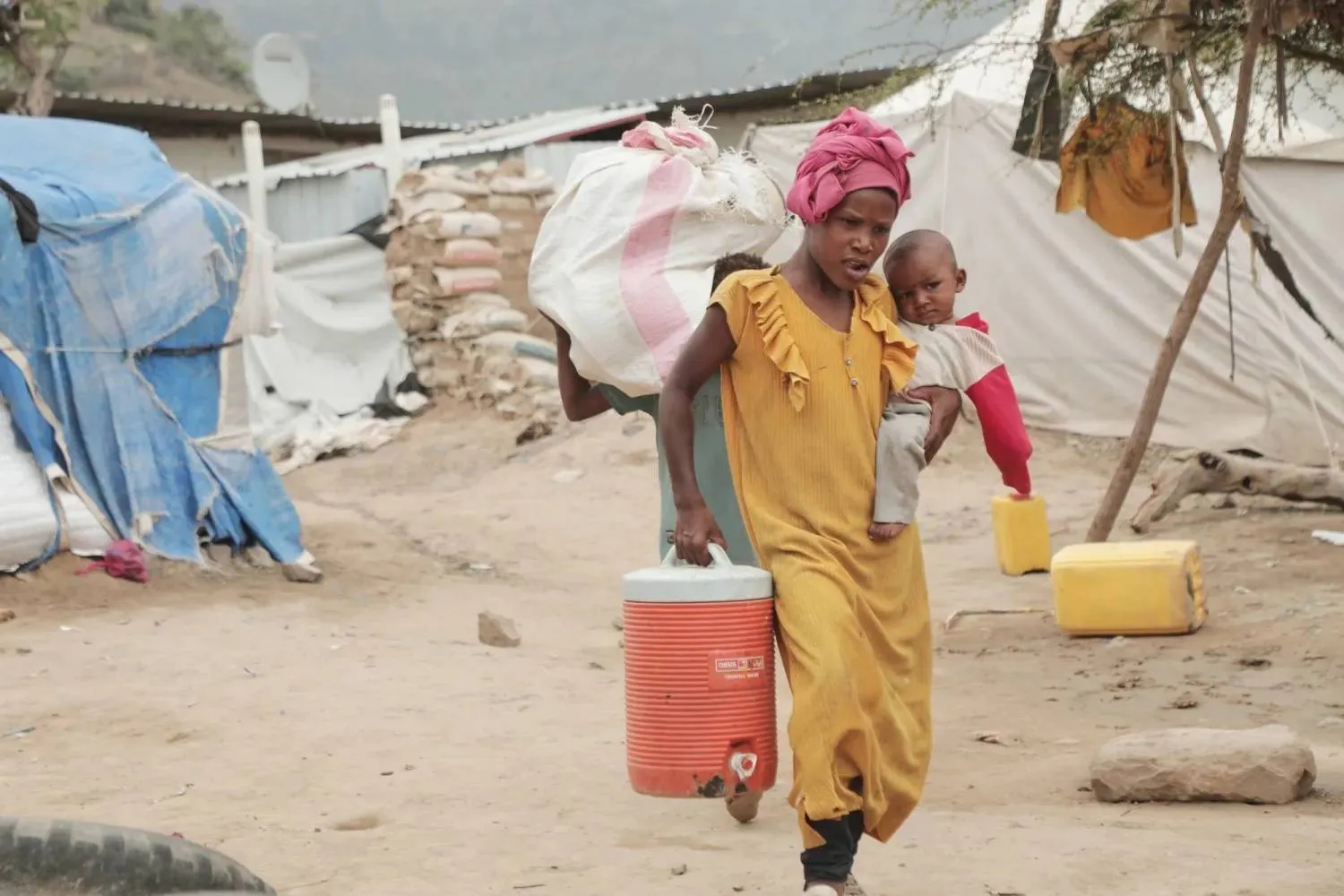
UN: Yemen Situation Rapidly Evolving as Restrictions Hamper Access to Western Coast

The United Nations said the latest events had displaced more than 100,000 people since the start of the month (AP)
TT

UN: Yemen Situation Rapidly Evolving as Restrictions Hamper Access to Western Coast

The United Nations said the latest events had displaced more than 100,000 people since the start of the month (AP)

More than 100,000 people have been displaced in Yemen since the beginning of September, most of them heading to the provinces of Taiz and Lahj, the United Nations said.

The pace of displacement has risen sharply since Sept. 3, Laurent Bukera, the UN resident and humanitarian coordinator for Yemen, told Asharq Al-Awsat.

Bukera said the United Nations was prepared to respond to further waves of displacement and an expected increase in humanitarian needs in Yemen as fighting continues along the western coast. More than 60,000 displaced people had received assistance through the Rapid Response Mechanism as of Sept. 15.

The movement of humanitarian workers has been affected in several areas along the western coast, he said, warning that insecurity, movement restrictions and communications outages continue to hamper access to some locations.

Bukera stressed the urgent need to ensure safe and sustained humanitarian access, provide safe passage for those fleeing the fighting, and secure the resources needed for a rapid response as needs continue to grow.

Displacement surges

The latest figures from the International Organization for Migration show that more than 100,000 people have been displaced since the start of September, Bukera said.

The situation remains fluid, with the number of internally displaced people expected to rise.

The United Nations and its humanitarian partners are supporting the most vulnerable people across Yemen, particularly those displaced, wherever security, access and available resources allow.

UNICEF said the fighting displaced more than 57,000 children in just two weeks and cut children off from essential services. It warned that the escalation was deepening a crisis in which 12.2 million children need humanitarian assistance.

Urgent needs, dwindling supplies

The most urgent needs include emergency shelter, household essentials, food, safe water, sanitation, emergency health care, protection and cash assistance, Bukera said.

Many of those displaced were already living in highly vulnerable conditions. Some have been forced to flee more than once.

Humanitarian response capacity is under severe pressure as supplies run low and funding remains scarce, Bukera said. Insecurity and movement restrictions are making it harder to reach people quickly.

Major gaps remain in shelter, water and sanitation, food security, health, nutrition, protection and cash assistance.

The Rapid Response Mechanism is working under a planning scenario designed to address any sharp increase in needs, Bukera said.

Aid workers and warehouses at risk

Asked about the change of control in Mokha, Bukera said the immediate priority was the safety and well-being of civilians, particularly those forced to flee or cut off from essential services and humanitarian aid by the recent fighting.

UN agencies are assessing needs and adapting their response to keep aid flowing, he said.

The safety of humanitarian workers and the security of offices, warehouses and other humanitarian assets remain a “matter of grave concern.”

Humanitarian workers, facilities and assets must be respected and protected at all times, Bukera said. Aid must also be allowed to move safely and without obstruction so life-saving relief can reach those in need.

Taiz and Lahj take in most of the displaced

Humanitarian partners are delivering immediate aid in affected areas and communities receiving displaced people, including Taiz and Lahj, which have taken in the largest numbers.

Registration is continuing as displacement and humanitarian needs rise.

More than 60,000 internally displaced people had received aid through the Rapid Response Mechanism by Sept. 15, in addition to other support for displaced families, Bukera said.

Access remains difficult in some locations because of insecurity, movement restrictions and communications outages.

The UN Office for the Coordination of Humanitarian Affairs remains in contact with the relevant authorities to facilitate aid deliveries and secure safe passage for civilians.

UN prepares for wider crisis

The United Nations is responding to the current crisis while preparing for further waves of displacement and mounting humanitarian needs, Bukera said.

Humanitarian partners are developing planning scenarios covering rapid-response assistance, multipurpose cash aid and multisector support, including food supplies, to meet the needs of large numbers of people.

Bukera called for civilians and civilian infrastructure, including displacement sites, roads, schools and hospitals to be protected at all times.

He renewed calls for safe passage for those fleeing the fighting and for the resources needed to keep pace with the escalating humanitarian needs.


First Algerian Troops Arrive in Niger Where Extremists Threaten Stability

Algeria, which shares a border with Niger, has traditionally regarded stability in ‌the Sahel-Sahara ‌as an important regional security ‌priority. (Getty Images)
TT

First Algerian Troops Arrive in Niger Where Extremists Threaten Stability

Algeria, which shares a border with Niger, has traditionally regarded stability in ‌the Sahel-Sahara ‌as an important regional security ‌priority. (Getty Images)

An Algerian army ‌convoy has arrived in Niger in Algeria's first foreign troop deployment since it sent forces to support Egypt during the 1973 Arab-Israeli war.

Niger, like other countries in West Africa's Sahel region, is battling insurgents linked to al-Qaeda and ISIS.

Algeria, which shares a border with Niger, has traditionally regarded stability in ‌the Sahel-Sahara ‌as an important regional security ‌priority.

⁠Energy is an ⁠important focus for Algeria in Niger, where Algerian state-run oil and gas firm Sonatrach has investments.

One major project, the Trans-Saharan Gas Pipeline with Niger and Nigeria, aims to deliver African gas to Europe ⁠and other international markets.

Reuters spoke ‌to 10 people ‌who said the first Algerian military convoy had ‌reached Arlit, a uranium mining town ‌in the country's northwest.

Algeria has said the decision to deploy troops was taken to protect the country's energy and economic interests, without disclosing ‌the size of the force or the timetable for their arrival.

Military ⁠officers ⁠have ruled Niger, which has uranium, oil and gold resources, since the July 2023 coup that ousted President Mohamed Bazoum, which Algeria initially opposed.


Houthis Suspected of Recruiting Children, Young Men Amid Surge in Disappearances in Sanaa

Human rights reports accuse the Houthis of recruiting more children. (Local media)
TT

Houthis Suspected of Recruiting Children, Young Men Amid Surge in Disappearances in Sanaa

Human rights reports accuse the Houthis of recruiting more children. (Local media)

Disappearances of children and young men have surged in Yemen's Houthi-held capital Sanaa and its outskirts in recent weeks, fueling accusations that the Houthis are luring them into military camps, training them for combat and sending them to battlefronts without their families' knowledge or consent.

The cases have also raised fears among families of possible extortion, as authorities face accusations of failing to investigate the disappearances or disclose the fate of those missing.

Local human rights sources told Asharq Al-Awsat that the unexplained disappearances have left residents increasingly alarmed, with children and young men vanishing from schools, streets and residential neighborhoods, sometimes without a trace.

Families have been left to search for their missing relatives on their own, turning to social media to appeal for information as Houthi-controlled security authorities ignore their reports, the sources said.

About 13 children and young men have disappeared from different parts of Sanaa since the start of October, the sources said. Most were aged between 15 and 23, and some were later found at Houthi military camps or on battlefronts after being lured into combat training without their families' knowledge or approval.

Hundreds of disappearances involving children and young men have been reported in Sanaa and other Houthi-controlled cities since the beginning of the year, the sources said. Some families remain in the dark about their missing relatives' whereabouts.

The sources accused Houthi security authorities of ignoring families' reports and appeals, compounding their distress and leaving those missing vulnerable to exploitation and recruitment.

The latest cases, reported over the past two days, involve Amjad Noman al-Sarouhi, 16, who vanished from the al-Ansi neighborhood in central Sanaa's Maeen district, and Mukhtar Abdullah Hassan al-Rifai, 22, who went missing near the Haziz market on the capital's outskirts.

Lured into military camps

Families' accounts have deepened fears that disappearances are being used to funnel children and young men into Houthi military camps, amid accusations that Houthi supervisors and recruitment brokers are exploiting their social and economic hardships to draw them into combat.

In one case, a family spent five days searching neighborhoods and hospitals for a minor who disappeared from Sanaa two months ago, only to learn from a Houthi supervisor that he was at a military camp north of the city.

A relative told Asharq Al-Awsat that the supervisor confirmed Houthi members had lured the boy into the camp and put him through combat training without his family's knowledge.

The relative described five days of fear and anguish as the family searched for the boy, worried he might have been harmed, before discovering he had been taken to a Houthi camp and subjected to military training without their consent.

For Mujeeb, a Sanaa resident and father of four, the disappearances have turned even routine outings into a source of fear.

"We live in constant fear for our children. We no longer feel at ease even when one of them steps out to run a simple errand," he said.

"We fear a Houthi member or supervisor could lure them away or exploit their needs and difficult living conditions, leaving us facing a situation we are powerless to change."

Mujeeb said families wanted their children kept safe and allowed to pursue their education and lead normal lives, free from recruitment and being sent to battlefronts.


Houthis Expand Taiz Offensive Southward into Lahj

A fighter loyal to Yemen's legitimate government fires a turret from the back of a pickup truck at a position along the frontlines against the Houthis around Mount al-Midan in Yemen's western Taiz province on October 26, 2026. (AFP)
TT

Houthis Expand Taiz Offensive Southward into Lahj

A fighter loyal to Yemen's legitimate government fires a turret from the back of a pickup truck at a position along the frontlines against the Houthis around Mount al-Midan in Yemen's western Taiz province on October 26, 2026. (AFP)

Yemen's Iran-backed Houthis launched a three-pronged offensive in northern Lahj province on Friday, seeking to push toward the Tur Al-Bahah district and gain fire control over strategic routes linking Lahj and Taiz.

The escalation came as Yemen's armed forces held their ground on the southern and western fronts around Taiz city and stepped up air and ground strikes against Houthi positions there, along the western coast and in the eastern provinces of Al-Jawf and Marib.

Government forces also raised concerns over reports that the Houthis had fired shells suspected of containing toxic substances, causing choking and fainting among civilians and fighters.

The armed forces said they had carried out 1,087 successful strikes under Operation Dawn of Yemen, deploying fighter jets, drones, artillery and rocket launchers. The military said the strikes had neutralized about 336 Houthi commanders and fighters and destroyed or disabled 112 military vehicles, pieces of equipment, supply assets and heavy weapons.

Local sources reported fierce fighting in Lahj's Al-Maqatirah district after the Houthis attacked from three directions in a bid to seize the district and open a route toward Tur Al-Bahah.

Al-Maqatirah's strategic importance lies in its commanding position over key roads and areas stretching across southern Taiz and northern Lahj.

The assault coincided with sporadic clashes along the Taiz-Lahj administrative boundary, particularly on the Al-Mudaribah front, amid reports of fresh Houthi reinforcements. Field sources said the group had also deployed additional forces to Al-Shamayatayn district in southern Taiz.

In Taiz, government troops clashed with Houthi fighters in Al-Shaqab, southeast of the city, as government drones struck Houthi positions and troop concentrations. Sporadic clashes also erupted on the city's western fronts before dawn.

Further west, government artillery struck a Houthi gathering at the Khalid bin Al-Walid area in Al-Dhabab. Field reports indicated casualties among fighters stationed there.

On the western coast, airstrikes hit Al-Amoud Al-Sughra in Mokha district before dawn, targeting Houthi positions and military movements along the coastline.

The air campaign also reached Al-Jawf and Marib, with two strikes targeting Huwayshan in Al-Jawf and another hitting Mahliyah district in Marib.

Toxic shells raise alarm

Yemen's armed forces said they were treating with utmost seriousness reports that Houthi fighters had used shells suspected of containing toxic substances on the Taiz fronts, amid accounts of civilians and Popular Resistance fighters suffering choking and fainting.

Colonel Majed Al-Nuzaili, the armed forces' official spokesperson, called for an urgent investigation to identify the suspected substances, document their effects and trace their origins and suppliers.

In a statement, Al-Nuzaili said the incidents formed part of a continuing Houthi escalation against Taiz residents, including sniper attacks, indiscriminate shelling of residential areas, a siege, road closures and restrictions on access to water, food, medicine and life-saving supplies.

The armed forces warned the Houthis against further attacks on civilians or the use of prohibited means of warfare.

They said protecting civilians and breaking the siege of Taiz remained core responsibilities of the state and its armed forces, pledging to take necessary measures in line with constitutional obligations and international humanitarian law.

The statement urged the United Nations and relevant international bodies to help deter violations, support an urgent investigation into the suspected toxic shells and press for roads to reopen to allow humanitarian aid and essential supplies to reach civilians unhindered.

The military also vowed that those behind attacks on civilians, including the commanders responsible, would face accountability and punishment.