Israel and Morocco Deepen Diplomatic Ties

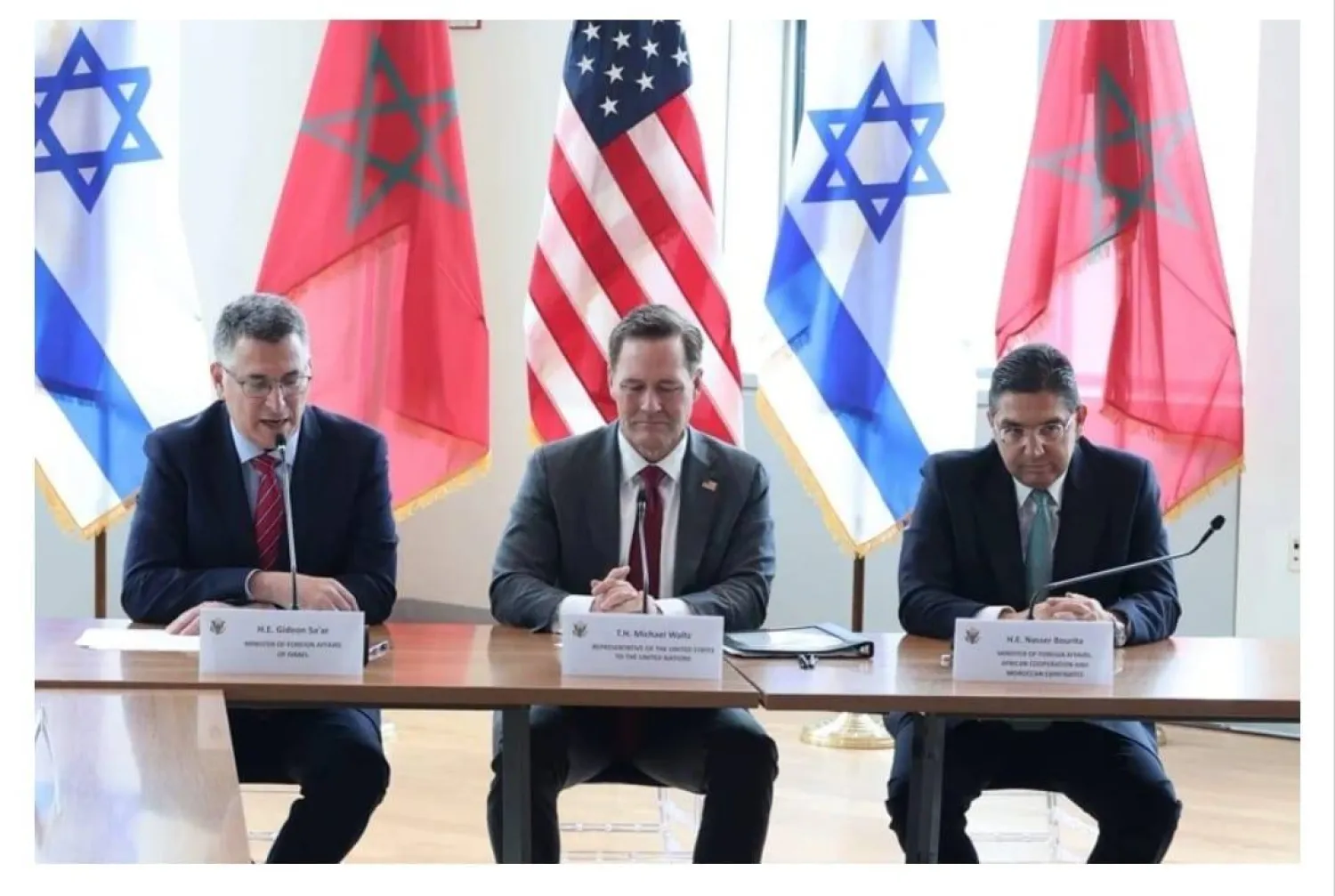
Meeting between the foreign ministers of Morocco and Israel held in New York under American sponsorship (Israeli Foreign Ministry)
TT

Israel and Morocco Deepen Diplomatic Ties

Meeting between the foreign ministers of Morocco and Israel held in New York under American sponsorship (Israeli Foreign Ministry)

Israel and Morocco have said they will open embassies and expand relations established under the US-brokered Abraham Accords.

Morocco was one of four Arab countries - along with the United Arab Emirates, Bahrain and Sudan - to move ⁠towards normalizing relations with Israel in 2020 under the accords.

Israel and Morocco announced the new move on Thursday in a joint statement with the United States, saying that integrating Israel into the broader Arab world “will lead to peace, stability and shared prosperity.”

Meeting between the foreign ministers of Morocco and Israel in New York (Israeli Foreign Ministry)

The Abraham Accords were a marquee foreign policy achievement of US President Donald Trump’s first term.

Thursday’s statement said a tripartite ⁠meeting was held in New York between Israeli Foreign Minister Gideon Saar, Moroccan counterpart Nasser Bourita and US ambassador to the United Nations Mike Waltz.

The officials affirmed commitment to ⁠a series of steps aimed at advancing ties between Israel and Morocco, including "elevating their respective diplomatic missions to the level of ⁠embassies, and appointing ambassadors," according to the statement.

They also agreed to expand flights between Israel and Morocco ⁠and work on finalizing agreements aimed at facilitating mutual investments and economic and trade ties.


French Lawyers Object to Handling of ISIS Detainees in Iraq

A suspected ISIS member arrives for questioning at Karkh Prison in Baghdad (AP) 
TT

French Lawyers Object to Handling of ISIS Detainees in Iraq

A suspected ISIS member arrives for questioning at Karkh Prison in Baghdad (AP) 

An Iraqi official said the cases of ISIS detainees transferred from Syria to Iraq earlier this year were being handled exclusively by the Counter-Terrorism Service and the Supreme Judicial Council because of the sensitivity of the issue.

The official told Asharq Al-Awsat that the cases remained “an Iraqi national security matter,” adding that they went beyond “formal defense requirements.”

“Their files are still being reviewed by senior authorities, and it may take some time before they are referred to trial,” the official added.

The comments came after a team of French lawyers accused Iraqi authorities of refusing them permits to follow the cases of French clients accused of belonging to ISIS after their transfer from northeastern Syria to Iraq.

The lawyers warned that their clients could face death sentences after trials they described as “lacking the minimum standards of justice.”

In a statement Thursday, the defense team said several French nationals they represented had been “unlawfully transferred from northeastern Syria to Iraq” and were due to appear before courts in Baghdad in the coming days.

The lawyers reported meeting some of the detainees in Iraq and witnessing what they described as inhumane and degrading treatment and violence.

They also informed French authorities of torture suffered by the detainees in Iraq and the arbitrary nature of the proceedings.

The lawyers said they had been denied access to their clients’ case files and could not speak to them without Iraqi authorities present.

They also alleged that court-appointed lawyers assigned to defend the detainees — some of whom had been able to meet them for only 10 minutes — insulted them in front of their guards.

‘They Were Children’

The lawyers noted that some of the detainees were young men who had been children when their parents forcibly took them to Syria and were now adults. They applied over the summer for new permits to travel to Iraq, but Iraqi authorities “rejected our requests at the last minute,” they added.

The lawyers recently renewed their request to meet their clients, “but we learned that their trials would be held without us.”

According to the defense team, French authorities merely confirmed the information, explaining that Iraq did not recognize the French lawyers’ right to represent the detainees in the country or intervene in local judicial proceedings concerning them.

“France knows very precisely the fate awaiting these French nationals,” the lawyers warned, noting that 11 French citizens transferred to Iraq in 2018 “under the same circumstances” were sentenced to death by Baghdad’s Central Criminal Court.

They argued that those trials “did not meet the minimum standards of a fair trial guaranteed by Article 6 of the European Convention on Human Rights.”

The defense team urged French authorities to “urgently return them to France” to prevent them from facing the death penalty and becoming victims of a “flagrant denial of justice,” noting that the request had been submitted “many months ago.”

Al-Hol and Prisons

Deputy Minister of Migration and Displacement Karim al-Nouri, meanwhile, told Asharq Al-Awsat that “a distinction must be made between two matters.”

The first concerns al-Hol camp in northeastern Syria’s Hasakah region, which he said held “more than 60,000 people from countries around the world, including more than 25,000 Iraqis, most of them children and women.”

Al-Nouri distinguished them from detainees in prisons held by the SDF.

“The camps were under the SDF (Syrian Democratic Forces) and then came under the control of official Syrian forces,” he explained.

Iraqis who returned from prisons were also different from those repatriated from Hasakah and al-Hol after security screening, he added.

“A distinction must be made between those who returned to Iraq, most of whom returned to their homes and have had no security violations recorded against them, and those who are currently in prisons,” al-Nouri said, adding that those in prison had different cases that fell outside the remit of the Migration and Displacement Ministry, with responsibility resting with the judiciary.

Iraqi Judicial Jurisdiction

Legal expert Ali al-Tamimi told Asharq Al-Awsat that Iraq’s refusal to allow French lawyers to represent their clients rested on “two aspects: the Iraqi Law of Lawyers and the law governing criminal jurisdiction,” both of which he said gave Iraq the right to refuse.

Under Iraq’s Law of Lawyers No. 173 of 1965, lawyers registered to practice must hold Iraqi citizenship, al-Tamimi explained, noting an exception for Palestinians residing in Iraq as refugees.

A foreign lawyer who is not a member of a bar association in an Arab country may only appear alongside an Iraqi lawyer, he added. This requires approval from both the head of the Iraqi Bar Association and the president of the Supreme Judicial Council for a specific case, after confirming that the foreign lawyer continues to practice law.

On jurisdiction, al-Tamimi said Iraq considered the detainees to have “committed crimes on its territory.”

He cited an Iraqi judicial source as saying they had “all held senior positions in ISIS,” with some involved in planning attacks in the Iraq-Syria region.

Al-Tamimi noted that Article 6 of Iraq’s Penal Code applies Iraqi law to crimes committed in the country, while Anti-Terrorism Law No. 13 of 2005 gives Iraqi courts jurisdiction over terrorism cases.

He continued that proceedings are governed “exclusively by Iraqi Code of Criminal Procedure No. 23 of 1971, which guarantees the right to a defense, but through an Iraqi-licensed lawyer.”

“If the defendant has no lawyer, the court appoints one.”

Asked whether international law required Iraq to allow foreign lawyers to represent the defendants, al-Tamimi said the Vienna Convention on Consular Relations gave France the right to consular visits and access, “not the right to impose its lawyers to plead cases.”

“National security considerations and the integrity of the proceedings prevent this,” he underlined.


US Sentences Ex-head of Syrian Prison to 60 Years on Torture Charges

File photo: Aleppo central prison. AAWSAT AR
TT

US Sentences Ex-head of Syrian Prison to 60 Years on Torture Charges

File photo: Aleppo central prison. AAWSAT AR

The former head of a notorious Syrian prison was sentenced by a US federal judge on Thursday to 60 years in prison for torture and immigration fraud, according to the Department of Justice (DOJ).
Samir Ousman Alsheikh, 74, who has been in the US since 2020, allegedly ran Damascus Central Prison -- known colloquially as Adra Prison -- from approximately 2005 to 2008, where detainees were subjected to horrific abuse in the "Punishment Wing”, AFP said.
A jury found Alsheikh guilty in March of "one count of conspiracy to commit torture, three counts of torture, one count of visa fraud, and one count of attempted naturalization fraud," according to the DOJ.
Three former prisoners testified during the trial about the abuse they suffered at the hands of Alsheikh, as well as the torture inflicted on other prisoners.
"The conviction in this case is a testament to the courage of his victims," Assistant US Attorney General A. Tysen Duva said in a statement.
In addition to the torture charges, Alsheikh was found guilty of immigration fraud after he lied about his past to gain entry to the United States in 2020.
"The message is clear: human rights violators who come to the United States will receive no safe harbor here," Duva added.
"We will find them, and they will be prosecuted and punished for their heinous crimes."
A coalition of the opposition toppled Bashar al-Assad's government in late 2024, and after the collapse, Syrians flocked to prisons searching for missing loved ones.


Hamas Silent on Killings: Ceasefire Restraint or Inability to Retaliate?

Palestinians carry the body of Nael Abu Obeid, commander of the Rafah Brigade, after he was killed in an Israeli strike in Khan Younis on Wednesday. (AP)
TT

Hamas Silent on Killings: Ceasefire Restraint or Inability to Retaliate?

Palestinians carry the body of Nael Abu Obeid, commander of the Rafah Brigade, after he was killed in an Israeli strike in Khan Younis on Wednesday. (AP)

After killing the most prominent members of the Qassam Brigades’ military council during the Gaza war, Israel has turned its focus to the Hamas armed wing’s second-tier commanders, who now oversee military operations in the enclave.

Over the past week, Israel killed Mohammed al-Yazouri and Nael Abu Obeid, commanders of the Khan Younis and Rafah brigades, in separate strikes on the Mawasi area of Khan Younis in southern Gaza. Both were among the Qassam Brigades’ most prominent commanders in the south.

Al-Yazouri took command of the Khan Younis Brigade shortly after commanders Izz al-Din al-Haddad and Mohammed Ouda were killed in separate strikes less than 10 days apart in May.

Hudhayfa Abu Muammar was killed alongside al-Yazouri. A Qassam Brigades engineer close to its senior commanders, Abu Muammar, was responsible for developing the group’s military capabilities.

Abu Obeid took command of the Rafah Brigade after Mohammed Shabana was killed in May 2025, when Israel struck a tunnel in Khan Younis where he was with Mohammed Sinwar, the Qassam Brigades’ commander-in-chief.

Sinwar had succeeded Mohammed Deif, who was killed in an Israeli strike on July 13, 2024, alongside Rafa Salama, the former commander of the Khan Younis Brigade.

Hamas and its armed wing have notably confined their responses to mourning the commanders, omitting the threats of retaliation common in their statements during and before the war.

Some observers say Hamas has been weakened and can no longer respond militarily. Others say it is merely seeking to avoid provoking a harsher Israeli response or giving Israel a pretext to resume the war.

Israeli media

Israeli media have portrayed Hamas as incapable of responding.

Israel’s Channel 12 said the group feared Israel’s reaction and did not intend to retaliate for the killings, adding that it had “come to realize that the Israeli military has the upper hand on the battlefield.”

Haaretz quoted a former senior Palestinian security official in Gaza as saying Hamas could no longer operate freely in response to the killing of its senior commanders.

Signs of this had emerged even before the October 2025 ceasefire, the official said. Rocket fire from Gaza toward Israel had become “almost nonexistent” during the final months of the war, and there had been no major military operations.

Yedioth Ahronoth quoted Israeli military Chief of Staff Eyal Zamir as telling a closed-door security meeting attended by Prime Minister Benjamin Netanyahu and Defense Minister Israel Katz that Hamas had been defeated and Israel had prevailed in the confrontation.

An official in the military intelligence directorate, however, warned that Hamas still posed a threat and was seeking to rebuild its capabilities and restore its rule.

Katz said Hamas faced a “difficult strategic reality,” adding that Israel would “continue working to achieve its security objectives and ensure that the threat of Oct. 7 is not repeated.”

“We have eliminated Hamas leaders inside and outside Gaza, and even in Iran,” Katz said. “We will not allow Iran or any other party to arm Hamas again.”

Hamas’ Priorities

Four Hamas sources — a political official abroad, another source in Gaza and two field operatives in the enclave — separately told Asharq Al-Awsat that the group and its armed wing had other priorities, chiefly denying Israel any pretext to exploit the situation and resume the war.

The political source abroad said there was “a clear decision not to respond to any assassination, because what Israel wants is a reaction that would lend credibility to its narrative that Gaza contains real weapons capable of affecting it and that these weapons must be removed by force.”

The Gaza-based source said Hamas did not want to drag the enclave’s residents back into war. Palestinian factions had therefore reached broad understandings on the need to avoid any action that could be described as “provocative” and might trigger an unpredictable Israeli response.

Both sources said Hamas remained committed to the ceasefire agreement reached last year and to understandings with the Board of Peace on the second phase.

The problem lay with Israel, they said, accusing it of continuing to violate the agreement and refusing to honor any deal.

They said Hamas, in coordination with the other factions, had decided to move forward with the agreement, including transferring governing authority to the National Committee for the Administration of Gaza and placing all weapons exclusively under its authority, rather than under the control of Israel or the United States.

Israel’s obstruction of the agreement was preventing that process from beginning, they said, adding that Israel was still blocking the committee from entering Gaza and assuming its duties.

The two field sources said Hamas and other factions retained what they described as “limited” capabilities, including small arms, explosive devices and anti-vehicle munitions that could be used to carry out attacks.

The political and military leaderships had decided, however, to preserve calm for as long as possible and prepare only for defensive, not offensive, operations.

One source said the decision reflected a desire to protect civilians, rather than fear of confronting Israel. It was also intended to prevent Israel from exploiting any attack to displace Palestinians, force them to move from one area to another and destroy more of the homes still standing in Gaza.

“The prevailing belief in Israel that Hamas has been defeated is merely a slogan with no value on the ground,” the source said.

“Hamas would rather spare Gaza’s residents the horrors of war than disprove that slogan through an attack whose outcome would have no significance at this time.”

Board of Peace Criticism

Separately, Israel’s i24NEWS quoted a Board of Peace official as criticizing Israel’s current strategy in Gaza: killing commanders while armed operatives remain and Hamas continues to govern.

The Board of Peace seeks to dismantle Hamas and eliminate it completely, while Israel is killing operatives without destroying the movement itself, the official said, according to the channel.

The official said Israel’s policy resembled the approach that prevailed before Oct. 7, 2023.

Dismantling Hamas, the official said, would require 14 days of calm, except for action needed to counter immediate threats; the Israeli government’s full cooperation with all preparations and logistical measures required for voluntary disarmament; and adherence to the Board of Peace’s deadline for halting attacks.

That would allow the parties to agree on a timetable for beginning to bring weapons under a single authority, as agreed in Cairo, the official said.

“If Hamas begins dismantling itself quickly and provides the coordinates of all the tunnels, that would be excellent,” the official added. “If it does not disarm, the Israeli military will receive international support to do so by force.”