



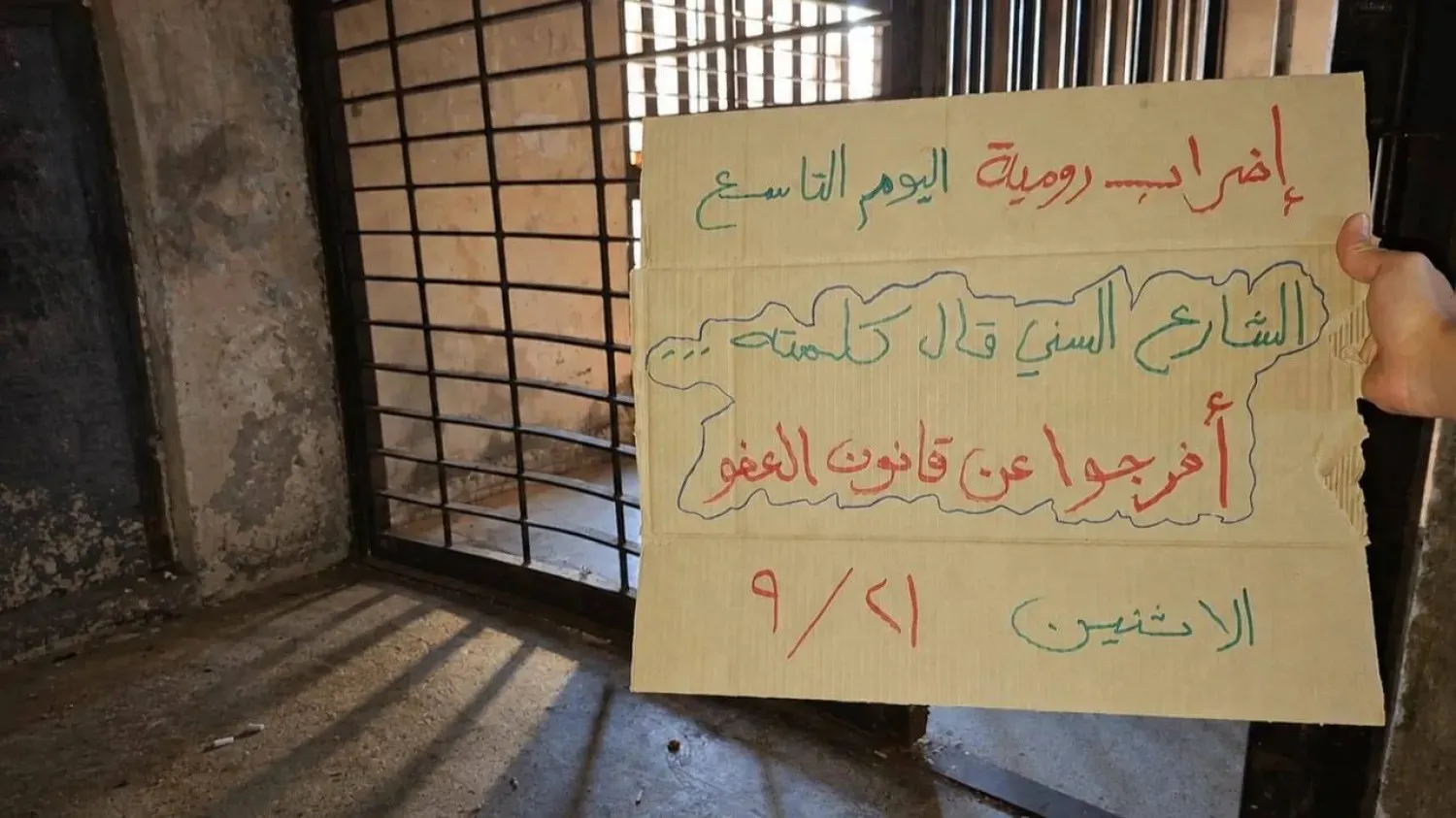

Inmates at Lebanon’s Roumieh Central Prison are on a hunger strike for a 10th day over an appeal to a general amnesty law, as warnings mounted that deteriorating conditions could trigger a broader humanitarian and social crisis.
Prisoners in Block B of Roumieh, Lebanon’s largest prison, have refused food, water and medication while awaiting a Constitutional Council ruling on the challenge to the law, which hundreds of inmates hope will secure their release.
The strike has coincided with protests outside prisons, including a demonstration Sunday that drew hundreds to Al-Nour Square in the northern city of Tripoli at the call of a committee representing prisoners’ families.
“The prisoners remain committed to the strike, but the situation is still under control and has not yet reached a highly dangerous stage,” a security source told Asharq Al-Awsat.
The main concern was for inmates with chronic illnesses, particularly those refusing medication, the source added. The prison doctor was examining strikers daily, prioritizing those with health conditions, while arrangements were in place to transfer any inmate whose condition deteriorated to hospital.
The source nevertheless warned that tensions could worsen if the Constitutional Council upheld the appeal and struck down the amnesty law, potentially prompting prisoners to escalate their protest.
Omar al-Atrash, spokesman for Lebanon’s prisoners, said the health of inmates had started to deteriorate “one after another,” adding that two prisoners were hospitalized Sunday.
Al-Atrash warned that the action could expand in the coming days into a general strike across Lebanon’s prisons.
He held Free Patriotic Movement leader Gebran Bassil and his political camp “morally and humanely responsible” because of its challenge to the amnesty law that was passed by parliament on Aug. 12.
Al-Atrash urged state institutions to implement the law, warning that further delays could lead to “a humanitarian catastrophe and an explosion inside the prisons” that could rapidly develop into a national and social crisis.
One Roumieh inmate told Asharq Al-Awsat that the strikers’ health was rapidly deteriorating and that prisoners with chronic illnesses were at particular risk.
The inmates “will not back down until the amnesty law is upheld and published in the Official Gazette,” he said.
A judicial source said prosecutors were monitoring the strikers’ health in coordination with Roumieh prison authorities.
Courts had already begun preparing cases to implement the amnesty should the Constitutional Council allow the law to stand, the source said, in an effort to avoid delays in releasing eligible prisoners.


