'A Challenge and Blank Ballots': What Is Happening in Hamas’s Leadership Election in Gaza?https://english.aawsat.com/arab-world/5322211-challenge-and-blank-ballots-what-happening-hamas%E2%80%99s-leadership-election-gaza
'A Challenge and Blank Ballots': What Is Happening in Hamas’s Leadership Election in Gaza?
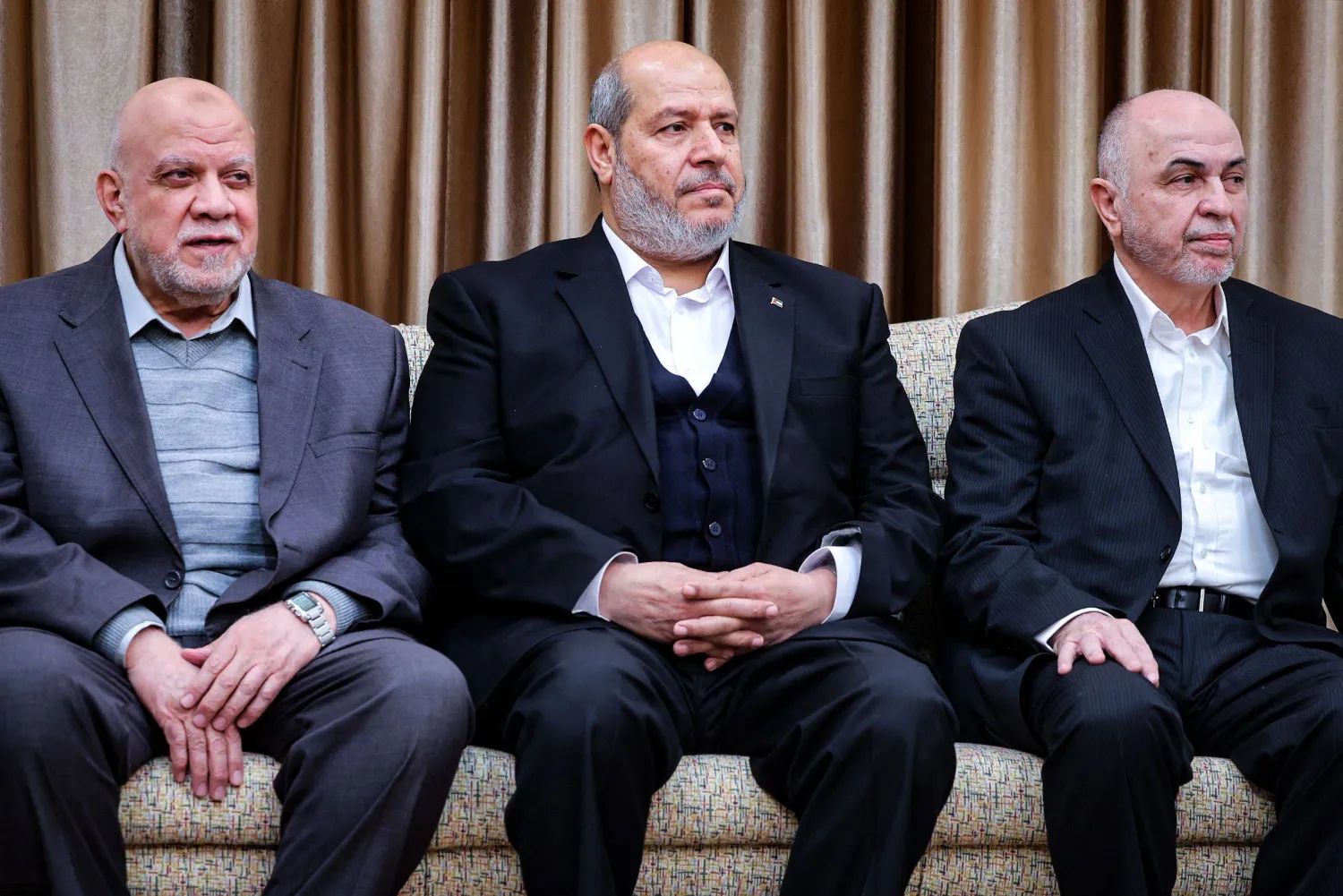
This handout picture released by the office of Iran's Supreme Leader Ayatollah Ali Khamenei on February 8, 2025, shows (L to R) member of the Hamas political bureau Nizar Awadallah, deputy chairman of the Hamas political bureau Khalil al-Hayya and the head of the political council of Hamas Mohammad Ismail Darwish, meeting with him in Tehran. (Photo by KHAMENEI.IR / AFP)
Four Hamas sources inside and outside the Gaza Strip told Asharq Al-Awsat in separate accounts that the runoff election to choose the head of the movement’s political bureau in Gaza had been suspended after the first round, held three weeks ago, failed to produce a result.
The sources agreed that the first round failed to produce a decisive result because eligible voters cast blank ballots, repeating a phenomenon that had occurred during the election to choose the overall head of the political bureau last May. That election went to a second round, which Khalil Al-Hayya won over Khaled Meshaal.
Three sources from inside and outside the Gaza Strip also said that the suspension of the runoff for the leadership of Hamas’s Gaza political bureau came after Nizar Awadallah, who is based outside Gaza and is running against Ali Al-Amoudi, who is based inside the Strip, challenged some of the procedures followed during the runoff. Both are members of the political bureau.
The fourth source, who is outside Gaza, said that “other disagreements” had also contributed to the temporary suspension of the election, which is expected to resume soon after “some arrangements” are made, without providing further details. The source described these as “normal disagreements, within the framework of the laws and regulations governing any electoral process within the movement.”
Some sources attributed part of the delay in reaching a decision to “the security situation and the circumstances facing the Strip, as well as the challenges of conducting elections in the aftermath of the Gaza war.” Another source said the election was being held while Israel was tracking substantial intelligence aimed at trying to locate participants in the election and others. These factors, the source said, had contributed to legal gaps that led to the current situation.
Why Have Blank Ballots Returned?
Regarding the renewed use of blank ballots, two sources inside the Gaza Strip said this was a normal outcome stemming from differences over the competing figures and the approach they might pursue, which some viewed as unsuitable for the current phase, as had also occurred in the general election.
None of the sources specified whether the head of Hamas’s political bureau, Khalil Al-Hayya, supports either of the two candidates, Ali Al-Amoudi or Nizar Awadallah.
Hamas is going through an exceptionally complex period, unlike any it has experienced since its establishment in 1987, following the October 7, 2023 attack it launched against Israeli sites and towns adjacent to the Gaza Strip, which prompted Israel to wage a prolonged war.
What Do We Know About Ali Al-Amoudi?
Sources told Asharq Al-Awsat in December that Al-Amoudi, a former prisoner and member of the political bureau who was responsible for the movement’s media division before the war, had become responsible for running the political bureau’s affairs in the Gaza Strip. He was appointed, along with a number of associates of the late Hamas leader Yahya Sinwar, to manage the movement in the Strip. Most of them are based in Khan Younis in southern Gaza.
Al-Amoudi, who was released in 2011 as part of the prisoner exchange deal involving Israeli soldier Gilad Shalit, has emerged over the past year as a central figure in the administration of the Gaza Strip. He was among Sinwar’s closest associates during their imprisonment in Israeli prisons and after their release. He frequently accompanied Sinwar at meetings, events and other engagements. He was appointed through an endorsement and consultation process to manage the Strip, while some sources at the time said the move had circumvented the movement’s internal regulations. This may help explain the holding of the internal election in Gaza.
In recent months, considerable controversy has arisen over Al-Amoudi’s decisions in Gaza, including changes he made and the dismissal of officials from their positions. This reportedly caused anger among local leaders in the Strip and prompted some members of the political bureau outside Gaza to intervene in an attempt to resolve the resulting disputes.
What Do We Know About Nizar Awadallah?
Nizar Awadallah is considered one of Hamas’s founding generation. He secretly led the movement’s political bureau during the period from late 2004 to early 2007. He also played a prominent role in several important stages in the movement’s modern history, including leading the negotiations over the Shalit prisoner exchange deal and taking an active and important part in negotiations during the most recent war. He also played a significant role in Palestinian reconciliation talks held in several capitals following Hamas’s takeover of the Gaza Strip in 2007.
Awadallah was very close to Sheikh Ahmed Yassin, the founder of Hamas, as well as Abdel Aziz Al-Rantisi and other early and historic leaders of the movement, of whom he was one.
Awadallah, a 68-year-old architect, rose to prominence. He lives in the Sheikh Radwan neighborhood of Gaza City, and his home has been struck several times during previous wars.
During the last internal elections, held in 2021, Awadallah competed against Yahya Sinwar for leadership of Hamas’s political bureau in the Gaza Strip. He lost to Sinwar after a second runoff was held.
Clarify the opening election sequenceFix Awadallah’s biography paragraph
Iraqi Court Gives 7 French Nationals Life Terms for Joining ISIShttps://english.aawsat.com/arab-world/5346898-iraqi-court-gives-7-french-nationals-life-terms-joining-isis
Iraqi Court Gives 7 French Nationals Life Terms for Joining ISIS
Iraqi fishermen paddle a fishing boat along the Tigris River south of Baghdad at sunset on November 25, 2026. (Photo by AHMAD AL-RUBAYE / AFP)
An Iraqi court on Sunday handed life terms to seven French nationals for belonging to ISIS, part of proceedings against 47 French extremists transferred to Iraq from Syrian detention last year.
Quentin Le Brun, who appeared in propaganda videos after joining ISIS in 2014, was one of the seven. Two other French militants were sentenced to 15 years in prison on similar charges, according to an AFP journalist at the court.
Appearing before the court in Baghdad earlier this month, Le Brun said he had worked as a translator and designer for ISIS publications.
Before Sunday, the Iraqi judiciary had already sentenced 23 French nationals to life, while three others have received 15-year sentences.
Israeli Military Kills Palestinian Man in the West Bankhttps://english.aawsat.com/arab-world/5346897-israeli-military-kills-palestinian-man-west-bank
Israeli Military Kills Palestinian Man in the West Bank
A relative mourns over the body of 60-year-old Hikmat al-Qutt at a hospital in the West Bank city of Nablus, 28 November 2026. EPA/ALAA BADARNEH
Israeli forces shot and killed a Palestinian man, Hikmat Mohammed Faraj, 62, in the village of Madama in the occupied West Bank on Saturday, the Palestinian Health Ministry said.
Israel’s military said that a soldier killed a man in an operation in the Madama area, south of Nablus.
The military said in a statement that soldiers entered a building from which stones had been thrown at them. It said a man tried to grab a soldier’s gun and “redirected the weapon” as the soldier fired, wounding another soldier nearby.
It said the Israeli forces then killed the man.
Five Army Chiefs Have Become Lebanese Presidents. Where Does Military Neutrality Stand?https://english.aawsat.com/arab-world/5346887-five-army-chiefs-have-become-lebanese-presidents-where-does-military-neutrality
Five Army Chiefs Have Become Lebanese Presidents. Where Does Military Neutrality Stand?
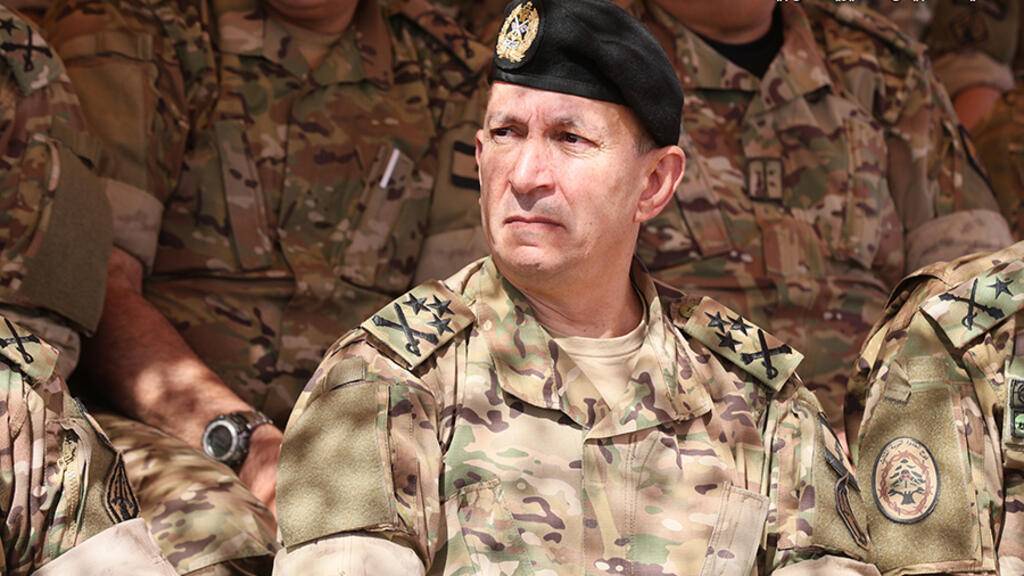
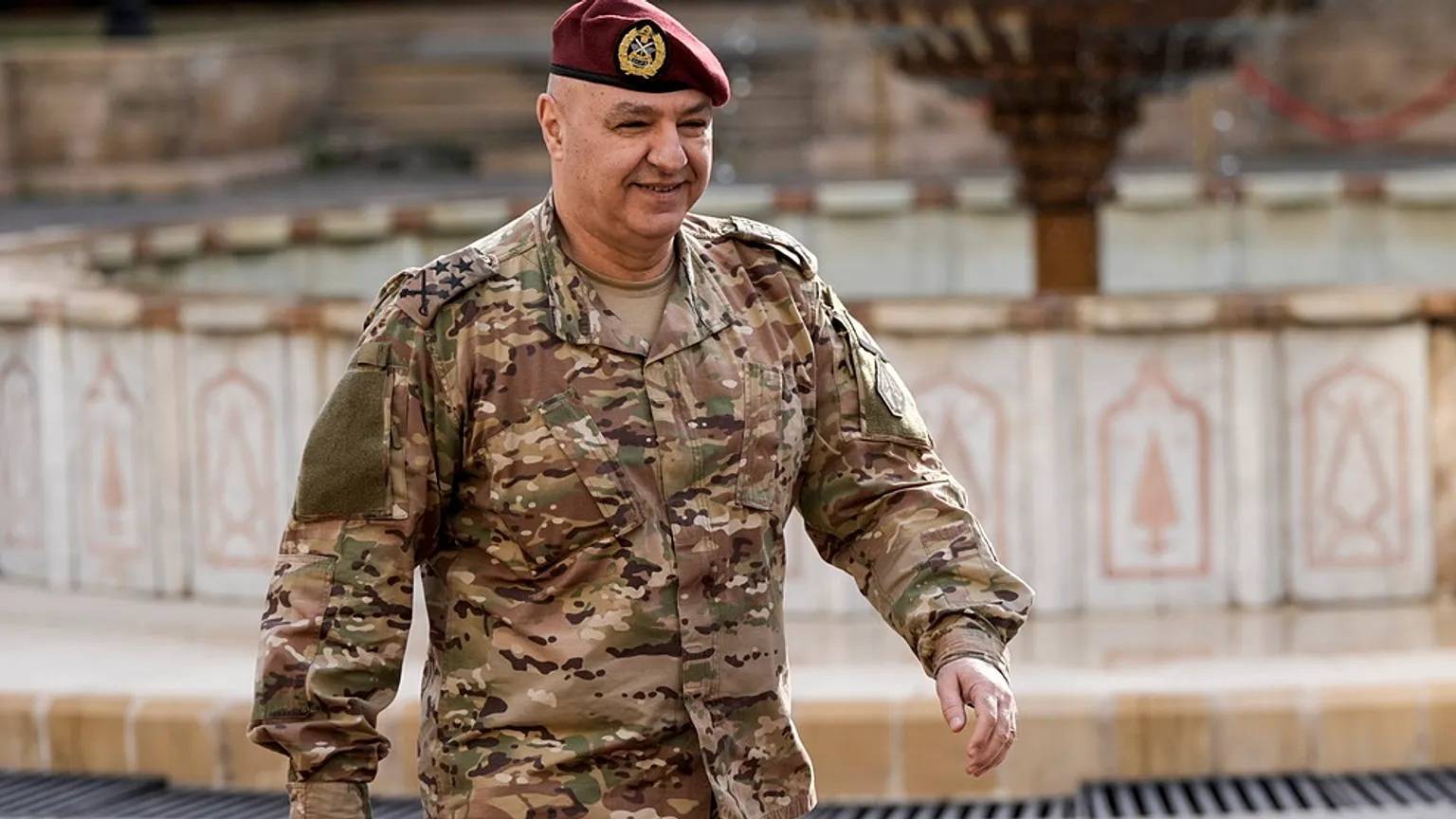
Lebanese President Joseph Aoun and army commander General Rodolphe Haykal (File photo – Lebanese Presidency)
Five army commanders have risen to Lebanon’s presidency since independence, emerging as consensus candidates often at times of deep political division and presidential deadlock. Their appeal lies in their perceived neutrality: standing equidistant from rival factions and above narrow partisan interests.
Yet that longstanding political consensus around the military came under unprecedented scrutiny in November following remarks by army commander General Rodolphe Haykal.
“The army’s policy is the national policy, and whoever does not agree with it is on the other side,” Haykal said, adding: “Anyone who speaks ill of their country’s army has no place in Lebanon and has no right to be in Lebanon.”
His remarks drew a backlash from Lebanese lawmakers, most notably MP Waddah Sadek.
“Are we now under military rule that determines who is patriotic and who is not? Is the Taif Agreement no longer in force? Has the government been stripped of its collective authority to determine the country’s policy?” Sadek asked.
MP Michel Douaihy, meanwhile, pointed to Article 65 of the Lebanese Constitution, which places the armed forces under the authority of the Council of Ministers as the constitutional executive authority.
“The Lebanese army is therefore subject to the Constitution. Lebanese citizens have the right, indeed the duty, to hold all institutions accountable and debate their roles, including the army and its decisions, without anyone claiming a monopoly on defining patriotism, labeling people or questioning their national allegiance,” he said.
Public criticism of the army is rare in Lebanon. But it has recently come to the fore amid demands that the military enforce political decisions on the state’s monopoly on arms and extend its authority across the country.
In his Order of the Day marking Independence Day last Sunday, Haykal reiterated the army’s “commitment to implementing the decisions of the political authorities and existing understandings, completing its deployment in the south, extending state authority and ensuring that weapons remain exclusively in its hands.”
Army commander General Rodolphe Haykal (Army website)
Five presidents since independence
For years, the army leadership remained largely immune to criticism, at least publicly, as political authorities and parties sought to shield the military from domestic disputes.
That approach paved the way for five presidents with military backgrounds to take office since independence: Fouad Chehab in 1958, Emile Lahoud in 1998, Michel Suleiman in 2008, Michel Aoun in 2016 and Joseph Aoun in 2025.
Michel Aoun was the only former army commander among them not to move directly from military command to the presidency, having gone on to lead a parliamentary bloc.
The consensus surrounding these figures stems not only from their personal attributes but also from the army’s place in Lebanon’s political landscape as an institution that commands broad national support and remains equidistant from rival political forces.
Army chiefs have often emerged as compromise candidates following popular unrest or security crises born of political turmoil.
That pattern has led critics to argue that army commanders become potential presidential candidates the moment they take up their military posts.
Military doctrine and neutrality
The Lebanese army is widely seen as the only institution that safeguards all Lebanese and embraces the country’s diversity.
That standing is rooted in the military doctrine adopted after the Taif Agreement, which sought to insulate the army from domestic political disputes after its fragmentation along political and sectarian lines during the civil war.
Retired Brigadier General and military pilot Bassam Yassin told Asharq Al-Awsat that following its reunification in 1990, the army “was rebuilt around a doctrine that identified Israel as the enemy and kept the military apart from political parties, partisan alignments and sectarian sensitivities.”
“The army was brought together around these two principles and the need to remain prepared to confront the Israeli enemy,” he said.
The military’s foremost priorities were “maintaining civil peace, deploying along and securing the borders, and preserving domestic security and stability,” Yassin said.
That meant steering clear of domestic and sectarian tensions.
The new doctrine explicitly identified Israel as Lebanon’s principal and sole enemy. It also abandoned the old notion that “Lebanon’s strength lies in its weakness” in favor of self-reliance and stronger defensive capabilities to protect the country’s territory and sovereignty.
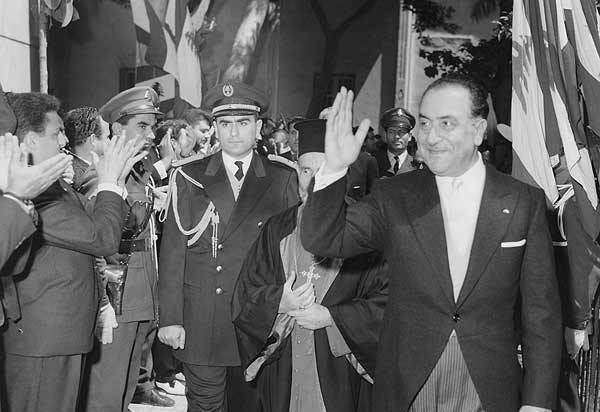
Former President Fouad Chehab in 1958 (army website)
Reunifying the army
The army’s reunification in 1990 followed the Taif Agreement, which ended the civil war and established a new national pact incorporating constitutional amendments.
Military units and brigades, previously divided along sectarian lines, were reintegrated into a structure that preserved balance and diversity, ensured broad representation and turned the army into an instrument of national integration.
Yassin said the process succeeded in establishing the balance and diversity needed to achieve that overarching national objective.
Reunification dismantled the sectarian and denominational makeup that had characterized some brigades during the war.
In 1991, the state implemented a decision to dissolve Lebanese and non-Lebanese militias, whose heavy and medium weapons were handed over to the army.
Thousands of militia members were also eligible for integration into the army and Internal Security Forces following military training and national rehabilitation programs.
Hezbollah’s arsenal, known as the weapons of the “resistance,” was exempted from the decision because the group was fighting the Israeli occupation in southern Lebanon.
The army’s policy was to support groups fighting Israel, secure their rear in liberated areas and avoid confrontation with them at home.
That arrangement endured under successive governments until 2025, when Prime Minister Nawaf Salam’s government became the first Lebanese administration since 1990 to criminalize armed activity and weapons possession outside state institutions through decisions to enforce the state’s monopoly on arms and pursue fighters and armed individuals.
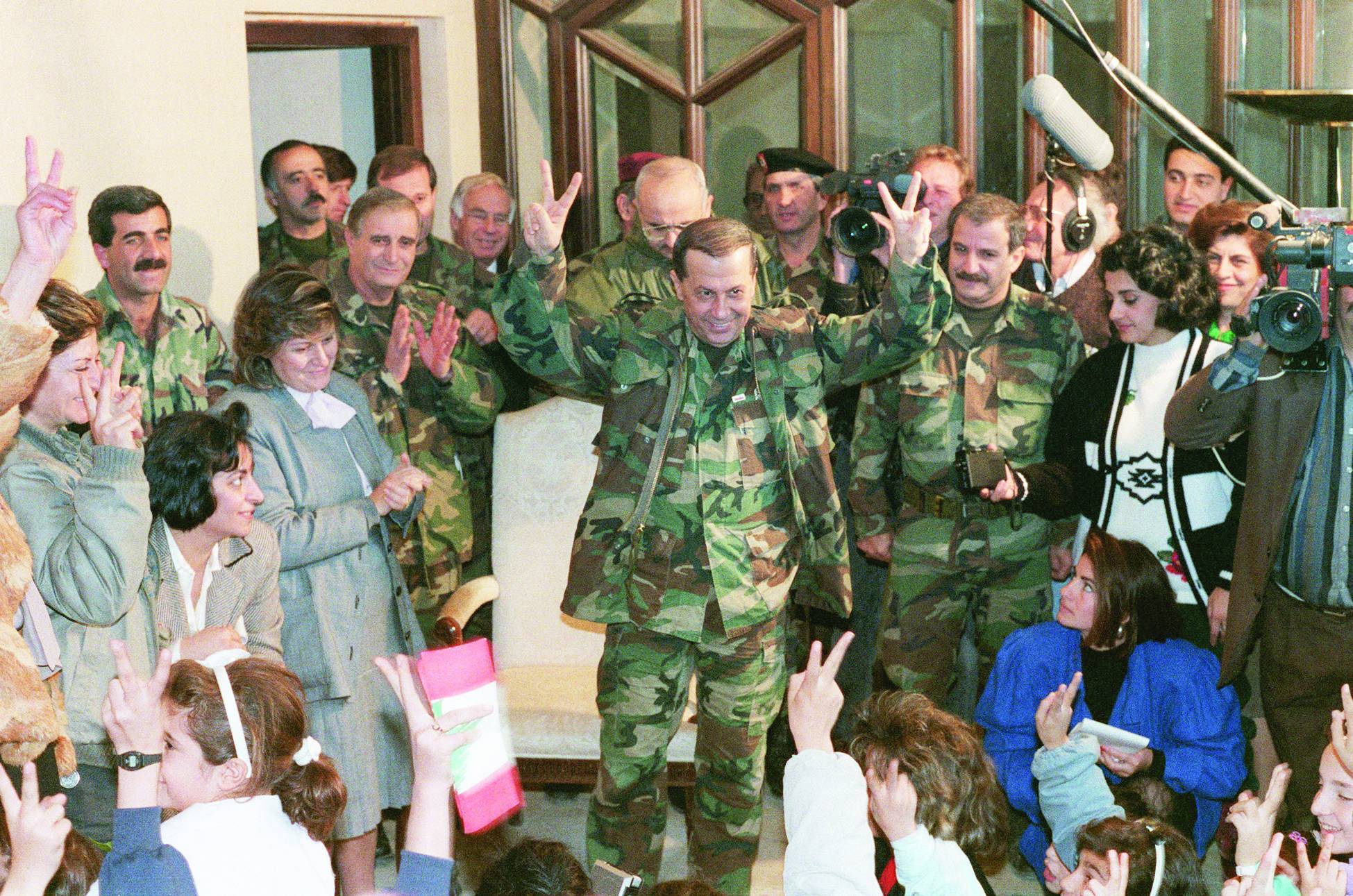
Gen. Michel Aoun at Baabda Palace in 1989. Getty
An army of the people, not the regime
Military doctrine is not the decisive factor behind the repeated rise of army commanders to the presidency.
Rather, it is their ability to navigate crises, preserve stability and safeguard democratic rights that makes them compelling candidates when political polarization prevents rival factions from agreeing on a figure who can command a two-thirds parliamentary majority.
“Usually, when political forces fail to elect a civilian figure backed by two-thirds of parliament because of unconstitutional obstruction, they agree on the army commander as a way out of the crisis,” political researcher and Dar al-Hiwar founder Bechara Khairallah told Asharq Al-Awsat.
Such circumstances often shape the choice, he said, given the military’s broad popular backing and near-universal acceptance among Lebanese.
“The army in Lebanon is the army of the people, not the army of the regime,” Khairallah said.
Unlike Syria under the Assad family, where the military’s mission was to protect the regime, Lebanon’s army safeguards national legitimacy beyond the government of the day, he explained.
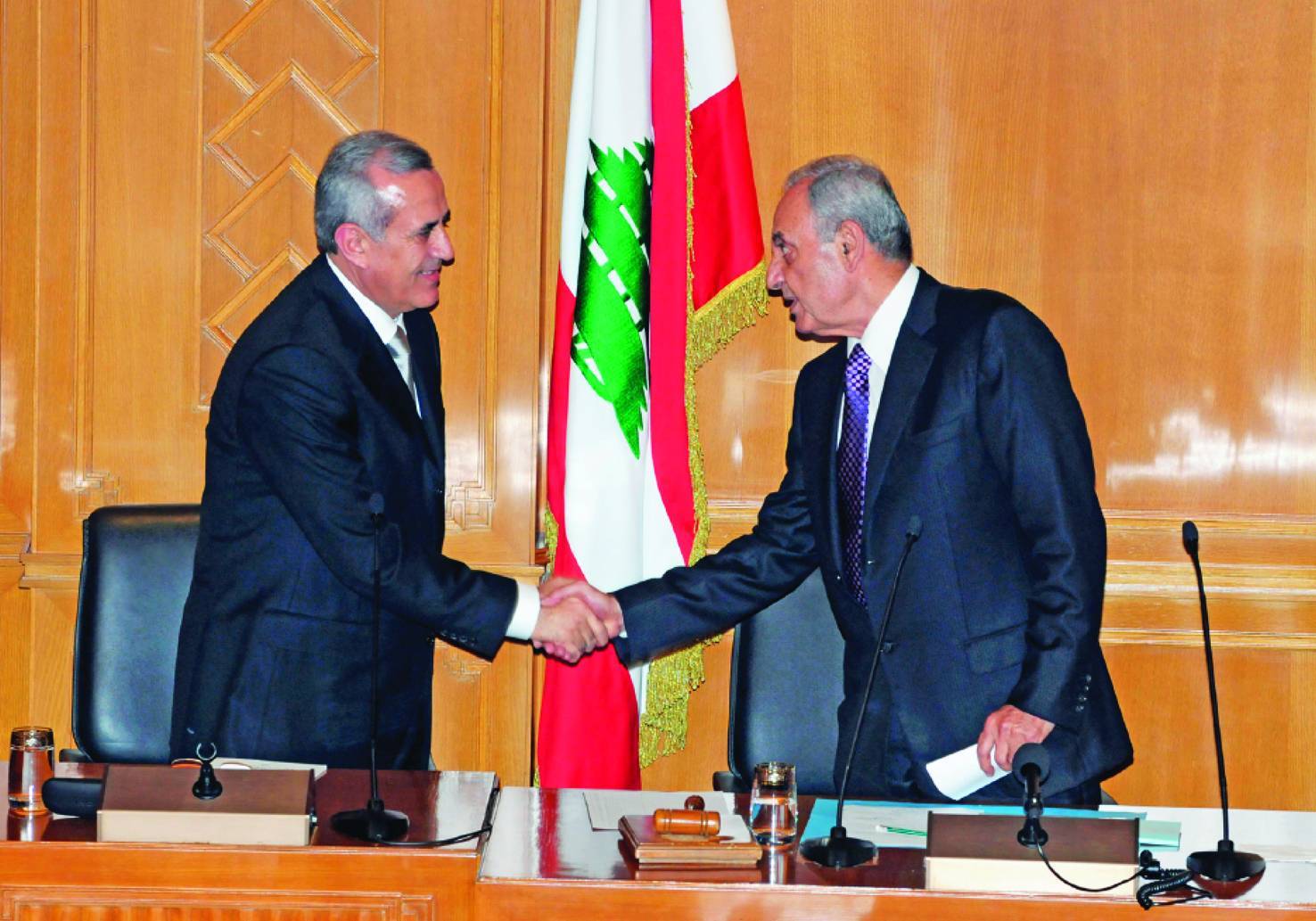
Speaker Nabih Berri congratulates Michel Suleiman upon his election
Khairallah recalled Michel Suleiman’s tenure as army commander in 2005, following the assassination of former Prime Minister Rafik Hariri, which split the country into the March 8 and March 14 camps.
Hundreds of thousands took to the streets of Beirut demanding Syria’s withdrawal in what became known as the March 14 Revolution, which culminated in the departure of Syrian troops in late April that year.
“At the time, the authorities were hostile to Hariri and inclined to suppress the protesters. But then-army commander Michel Suleiman made the historic decision to protect the demonstrations and the people’s right to take to the streets and express their views democratically, provided security was maintained and public and private property protected,” Khairallah said.
The army effectively broke with a political leadership inclined to use force against protesters, he added.
It protected both the March 8 demonstration thanking Assad’s Syria and the March 14 rally demanding the withdrawal of Syrian occupation forces, even as Suleiman’s conduct aligned more closely with Lebanon’s pro-sovereignty camp.
Political turmoil was followed by a security crisis in 2007, when the extremist Fatah al-Islam group attacked Lebanese military personnel, killing soldiers in the northern city of Tripoli.
Suleiman pressed political forces to secure the surrender of those responsible through contacts in Palestinian refugee camps, with military intervention looming if diplomatic efforts failed.
“Suleiman was the first general to challenge Hezbollah’s equation and stand up to the group,” Khairallah said.
Hezbollah’s then-Secretary-General Hassan Nasrallah had declared entry into the Nahr al-Bared refugee camp a red line. Suleiman, however, maintained that there could be no red lines in fighting terrorism and rooting it out.
“The approach Suleiman established during his tenure — protecting democracy while fighting terrorism without restrictions — earned him the respect of ambassadors from Arab and other countries friendly to Lebanon,” Khairallah said.
When political forces failed to elect Suleiman Franjieh, backed by Syria and its allies, or Nassib Lahoud or Boutros Harb, both backed by the March 14 camp, they settled on Suleiman.
He was elected president on May 25, 2008.
Former army commander and current President Joseph Aoun. AP file photo
Operation Juroud Dawn
Michel Aoun’s election in 2016 was the product of political deals that brought together unlikely allies: the Free Patriotic Movement, Lebanese Forces, Future Movement and Hezbollah.
Aoun had commanded the army during the civil war before leaving for France following his defeat by Syrian forces in October 1990.
The circumstances that brought Joseph Aoun to power, however, more closely resembled those behind Suleiman’s election.
They included the army’s battle against extremists in eastern Lebanon in 2017, known as Operation Juroud Dawn and led by Brigadier General Fadi Daoud, followed by its protection of protesters during the October 17, 2019 demonstrations, its safeguarding of public and private property, and its efforts to preserve stability and prevent internal confrontation.
Launched in the summer of 2017 against extremist groups, including ISIS and the al-Nusra Front, along Lebanon’s eastern border with Syria, Operation Juroud Dawn cleared Lebanese territory of extremist groups.
What propels army chiefs to the presidency?
Past experiences point to three factors that propel army commanders to the presidency: the military’s role and the stature of its commander, popular support for the army, and international confidence in its leadership.
“While in office, the army commander’s position overshadows civilian figures who might compete with him for the presidency,” Yassin said.
“Unlike civilian candidates, who often divide domestic political forces, the army commander generally enjoys nationwide consensus. That steers the choice toward a commander whose six or more years in office have been marked by neutrality and a constructive approach.”
The army commander’s strength, Yassin said, lies in the authority and prestige of his office and in leading a force whose personnel and officers outnumber those of any political party.
“When he performs his duties in the national interest, he commands broad public consensus and becomes popular at the grassroots level,” he said.
International backing is another factor, sometimes outweighing domestic considerations in determining who becomes president.
Yassin cited Emile Lahoud’s election under Syrian influence and Michel Suleiman’s election following the Doha Agreement.
“When someone has a successful track record, as an army commander might, foreign powers can engage with that person more easily. That is another advantage that strengthens army commanders’ presidential prospects,” he said.
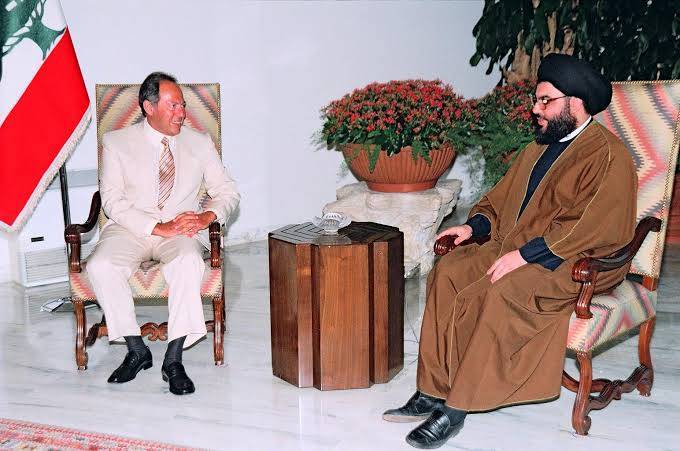
Former President Emile Lahoud meets with former Hezbollah leader Hassan Nasrallah at Baabda Palace in 2001 (File: Lebanese presidency)
International backing and domestic consensus
Security threats and domestic or regional wars create a demand for presidents with military and security experience, capable of preserving stability and preventing Lebanon from sliding into chaos.
The country’s presidential elections are also shaped by external power dynamics. Army commanders often emerge as acceptable, trusted choices for influential regional and international powers seeking to safeguard Lebanon’s stability.
Despite enjoying substantial international backing and support from most domestic political forces, except Hezbollah, President Joseph Aoun faces demands to accelerate the implementation of government decisions establishing the state’s monopoly on arms across Lebanese territory, given his position as commander-in-chief of the armed forces.
Khairallah believes the opportunity is now “more favorable than ever.”
He said Aoun’s presidency differs from those of his predecessors because most key security posts are held by figures considered close to him, to an extent that surpasses previous presidencies.
These range from the defense and interior ministers to the army leadership, State Security and other security posts.
Adding to that advantage, Khairallah said, is the absence of both the Assad regime and Hassan Nasrallah’s charisma.
From military command to political leadership
Success in military command does not necessarily translate into success in the presidency.
The two roles are fundamentally different. A president must navigate the complexities of Lebanese politics, whereas military leadership operates through hierarchy and discipline, allowing a commander ultimately to issue decisions as military orders.
“Some army commanders have the flexibility to adapt to political life, either through their personal abilities or the influence of the team around them,” Yassin said.
Their success, however, cannot be judged in absolute terms, he added, as assessments may reflect personal opinions or the criteria adopted by the country’s political forces.
“Broadly speaking, an objective assessment can be based on their ability to engage with other countries, preside over cabinet meetings, shape their public discourse and navigate competing interests in a way that steers people toward national objectives.”
لم تشترك بعد
انشئ حساباً خاصاً بك لتحصل على أخبار مخصصة لك ولتتمتع بخاصية حفظ المقالات وتتلقى نشراتنا البريدية المتنوعة